An international research team has developed a "gas-liquid-solid" process that can be used to produce MXenes—a family of two-dimensional materials—with unprecedented purity and controllability.
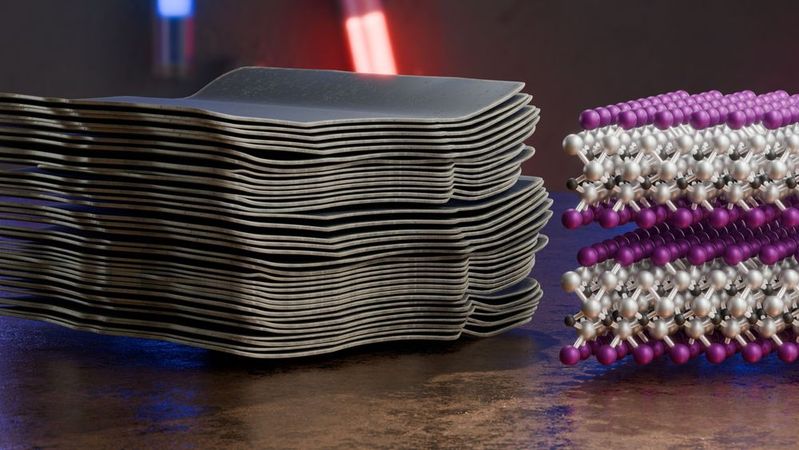
Combination of a model from a scanning electron microscope image (left) with a section of the underlying crystal structure of a studied MXene with precisely controlled surface terminations.
(Image: B. Schröder/HZDR)
Research Team Paves the Way for 2D Materials
MXenes were discovered in 2011 and are a rapidly growing class of inorganic two-dimensional materials. Each structural unit consists of layers of transition metals combined with carbon or nitrogen and is terminated by atoms bonded to the outermost surfaces. These surface terminations play a crucial role in determining the material properties. "They strongly influence how electrons move through the material, how stable it is and how it interacts with light, heat and chemical environments," explains Dr. Mahdi Ghorbani-Asl from the Institute of Ion Beam Physics and Materials Research at the HZDR.
Until now, most MXenes have been produced using chemical etching processes that lead to mixed and randomly distributed surface terminations with elements such as oxygen, fluorine or chlorine. "This atomic disorder limits performance because it traps and scatters electrons, much like potholes slow down traffic on a highway," describes Dr. Dongqi Li from TU Dresden, Germany. In the new gas-liquid-solid (GLS) process, solid starting materials, known as MAX phases, are used together with molten salts and iodine vapor to produce MXene films. Crucially, the molten salts and iodine interact to control which halogen atoms such as chlorine, bromine or iodine attach to the surface. The result is MXenes with highly uniform and well-ordered surface terminations and a greatly reduced level of impurities.
By combining theory with our experimental ability to precisely control surface terminations, we open a new pathway to MXenes with improved stability and tailored functional properties.
Dr. Mahdi Ghorbani-Asl
Using this approach, the international research team from TU Dresden, the Max Planck Institute of Microstructure Physics Halle, the Helmholtz-Zentrum Dresden-Rossendorf (HZDR) and other partner institutions in Europe succeeded in synthesizing MXenes from eight different MAX phases. In addition, the researchers used density functional theory (DFT) calculations to gain deeper insights into the influence of surface end groups on the stability and electronic properties of MXenes. "By combining theory and our experimental ability to precisely control surface terminations, we open a new route to MXenes with improved stability and tailored functional properties," summarizes Ghorbani-Asl.
Conductivity Due to Perfectly Organized Surfaces
To illustrate the potential of the new method, the team focused on one of the most frequently studied representatives of this class of compounds: the titanium carbide MXene Ti₃C₂. When produced using conventional chemical processes, Ti₃C₂ usually contains a mixture of chlorine and oxygen end groups, which impair its electrical properties. In contrast, Ti₃C₂Cl₂ produced using the GLS method contains only chlorine, which is incorporated into a highly ordered structure with no detectable impurities. "The results were impressive. The MXene variant, with only chlorine atoms covering the surface, showed a 160-fold increase in macroscopic conductivity and a 13-fold improvement in terahertz conductivity compared to the same material prepared using conventional methods. In addition, an almost four-fold increase in charge carrier mobility was observed, an important measure of how freely electrons can move through a material," summarizes Li. These performance improvements are directly attributable to the cleaner surface chemistry. As all chlorine atoms are arranged in an orderly fashion on the MXene surface, electrons encounter fewer obstacles and can flow more smoothly.
Customized 2D Materials for the Technologies of Tomorrow
The study shows that by adjusting the nature of the surface halogen, not only the electrical transport but also the absorption of electromagnetic waves by MXenes changes. This means that the materials can be developed for specific applications such as radar-absorbing coatings, electromagnetic shielding and next-generation wireless components. For example, MXenes with chlorine end groups show strong absorption in the frequency range of 14 to 18 GHz, while MXenes with bromine and iodine end groups absorb in other frequency ranges.
Date: 08.12.2025
Naturally, we always handle your personal data responsibly. Any personal data we receive from you is processed in accordance with applicable data protection legislation. For detailed information please see our privacy policy.
Consent to the use of data for promotional purposes
I hereby consent to Vogel Communications Group GmbH & Co. KG, Max-Planck-Str. 7-9, 97082 Würzburg including any affiliated companies according to §§ 15 et seq. AktG (hereafter: Vogel Communications Group) using my e-mail address to send editorial newsletters. A list of all affiliated companies can be found here
Newsletter content may include all products and services of any companies mentioned above, including for example specialist journals and books, events and fairs as well as event-related products and services, print and digital media offers and services such as additional (editorial) newsletters, raffles, lead campaigns, market research both online and offline, specialist webportals and e-learning offers. In case my personal telephone number has also been collected, it may be used for offers of aforementioned products, for services of the companies mentioned above, and market research purposes.
Additionally, my consent also includes the processing of my email address and telephone number for data matching for marketing purposes with select advertising partners such as LinkedIn, Google, and Meta. For this, Vogel Communications Group may transmit said data in hashed form to the advertising partners who then use said data to determine whether I am also a member of the mentioned advertising partner portals. Vogel Communications Group uses this feature for the purposes of re-targeting (up-selling, cross-selling, and customer loyalty), generating so-called look-alike audiences for acquisition of new customers, and as basis for exclusion for on-going advertising campaigns. Further information can be found in section “data matching for marketing purposes”.
In case I access protected data on Internet portals of Vogel Communications Group including any affiliated companies according to §§ 15 et seq. AktG, I need to provide further data in order to register for the access to such content. In return for this free access to editorial content, my data may be used in accordance with this consent for the purposes stated here. This does not apply to data matching for marketing purposes.
Right of revocation
I understand that I can revoke my consent at will. My revocation does not change the lawfulness of data processing that was conducted based on my consent leading up to my revocation. One option to declare my revocation is to use the contact form found at https://contact.vogel.de. In case I no longer wish to receive certain newsletters, I have subscribed to, I can also click on the unsubscribe link included at the end of a newsletter. Further information regarding my right of revocation and the implementation of it as well as the consequences of my revocation can be found in the data protection declaration, section editorial newsletter.
Future-Proof Authentication with Universal RFID Readers



:quality(80)/p7i.vogel.de/wcms/26/07/2607ca9a55754c81c6d65effc806c420/0134125580v1.jpeg "The new XB series from Mazak made its European debut at Euroblech 2026. Pictured is the new Optonics XB 130-32A press brake from the series. (Image:Mazak)")
:quality(80)/p7i.vogel.de/wcms/e0/85/e085a26186d214436f5e854dcbc2b8a4/6-nicokleiner-cmykv1.jpeg "As part of his technical thesis, Nico Kleiner developed a compact laser engraving machine for Norelem to use at trade shows. (Source: Norelem)")
:quality(80)/p7i.vogel.de/wcms/9e/23/9e23111e49d73012e9e3b7c69428ad5c/0134019347v1.jpeg "The Dominant VA45 high-helix tap from Bass, made of lead-free brass. The long chips, which result from the absence of lead, are clearly visible. (Image:Bass, Inc.)")
:quality(80)/p7i.vogel.de/wcms/1d/09/1d0999956ef87709b72ab1d0402ba207/csf-minis-gruppe-final-01-outputv1.jpeg "Since mid-2026, Harmonic Drive has been offering its CSF Mini gearheads in size 7 as well, in six variants designed for different installation scenarios. (Source: Harmonic Drive)")
:quality(80)/p7i.vogel.de/wcms/1f/7e/1f7eb8df75041d96602f297a5497d3ad/0134081637v1.jpeg "With Agile One SN, teams can develop, train, and validate humanoid robot capabilities for real-world applications, enabling them to bring their ideas from the lab to production more quickly. (Image:Agile Robots)")
:quality(80)/p7i.vogel.de/wcms/17/dd/17dd38fd7454673478427ec52780cd23/0134137180v1.jpeg "Humanoids: Between Hype and Everyday Industrial Life: Safety expert Jens Müller explains why technical maturity, safe motion sequences, and integration into existing processes are key to determining the practical utility of these robots. (Image:Jens Müller)")
:quality(80)/p7i.vogel.de/wcms/6e/bb/6ebb687f573be847aa611b413c6a33b1/0134094461v1.jpeg "From left: Sepp Hochreiter, founder of Nxai and AI researcher, and David Reger, founder and CEO of Neura Robotics, are excited about their collaboration on Physical AI. (Image:Neura)")
:quality(80)/p7i.vogel.de/wcms/89/01/890193a30c52ffd4811d18db82170952/0113143253v1.jpeg "In our China Market Insider, we regularly provide you with relevant information straight from China. (Image:© Eisenhans - stock.adobe.com)")
:quality(80)/p7i.vogel.de/wcms/70/ce/70cee969904bba9295b050329bae5ef5/optopatch-mosaic-2-1500x752-1v1.jpeg "High-tech patch: Bio-inspired technology simplifies measurements for cardiac diagnostics—without any electronics at all. (Source: NTNU)")
:quality(80)/p7i.vogel.de/wcms/c3/68/c368b4f6821557ec497c64bc17fe9f8d/adobestock-2051843806--kaliel-stock-adobe-com-ki-generiertv1.jpeg "To truly harness the full potential of virtual product development, teams and management must radically change their mindset. (Source: © kaliel – stock.adobe.com_AI-generated)")
:quality(80)/p7i.vogel.de/wcms/a3/c1/a3c19e028b66a6fd7c373ab94981631d/paprika-gripperv1.jpeg "For the final, additively manufactured gripper base, SoftGripping chose PA 2200, a material based on polyamide 12 (PA12). It offers balanced mechanical properties and high load-bearing capacity, making it ideal for robust gripper solutions with integrated pneumatics. (Source: SoftGripping GmbH)")
:quality(80)/p7i.vogel.de/wcms/51/b8/51b8e08d2105fdd9952aff385f154192/graphic-2-adma1v1.png "The new surface hardening process enhances the performance of corrosion-resistant alloys by improving their tribological and mechanical surface properties, while preserving the properties of the base material. (Source: Bodycote)")
:quality(80)/p7i.vogel.de/wcms/7d/52/7d5202d94b1125430ccefacc8ff66b2c/hf-20260505-113335-24485532-18a5-40d4-87a4-000ab161e0c1v1.png "It is no coincidence that the inaugural edition of the Watt Rally is wrapping up in Norway. The country is regarded worldwide as a true pioneer in the fields of electric mobility and charging infrastructure. (Source: Access Organization Group)")
:quality(80)/p7i.vogel.de/wcms/4b/9a/4b9a090d342310b04bd2dccb5bcac004/1791886894209v1.jpeg "Many Chinese automakers are looking to exports as a solution to their problems in the domestic market. (Image:Mario Hommen/sp-x)")
:quality(80)/p7i.vogel.de/wcms/79/bf/79bffc3fe1a6f2ef15695d0725c8f9ce/hyundai-staria-elektro-1026-05-wid-1024-bfc-offv1.jpeg "With the Staria, Hyundai now offers a comfortable electric van. (Source: Hyundai)")
:quality(80)/p7i.vogel.de/wcms/6c/95/6c956e609f79bfae3b6f83b6f18f837b/0134136245v1.jpeg "To secure its future, Audi is now planning to build a plant from the ground up in the U.S. U.S. President Donald Trump seems to welcome this. But the SPD, in particular, isn't too happy about it ... (Image:Audi)")
:quality(80)/p7i.vogel.de/wcms/f2/c0/f2c0bfc2c3c323220c2b1154cacda57a/0134132255v1.jpeg "Established semiconductor processes: While some foundries are reducing their manufacturing capacity, others are making targeted investments in specialized technologies. For developers in industrial electronics, the automotive industry, and medical technology, the long-term availability and cost of components are crucial. (Image:Dall-E / AI-generated)")
:quality(80)/p7i.vogel.de/wcms/71/c4/71c49858dd5195cbf540c4c37debab03/0134099748v1.jpeg "The Future of Space Travel: At Pretzl Connect 2026, ESA engineer Kate Underhill explained how sensor technology, software, and AI are transforming the development of future space transportation systems. (Image:mc/VCG)")
:quality(80)/p7i.vogel.de/wcms/20/b3/20b3ea557032591a4699c28076d349e3/0134117110v1.jpeg "Thermal simulation of a 3D IC visualizes the temperature distribution within the chip structure. Siemens and Nvidia aim to automate and accelerate such electrothermal analyses using AI-powered EDA workflows. (Image: Siemens EDA)")
:quality(80)/p7i.vogel.de/wcms/95/77/95778db428cbc81291ddd5718455d133/0134132383v1.jpeg "Weighing approximately 1.3 kg, the Tomahawk 6—Davisson combines an Ethernet switch ASIC with optical communication modules. Fuji has successfully evaluated the automated SMT assembly of the CPO package on an NXTR machine. (Image: Broadcom)")
:fill(fff,0)/images.vogel.de/vogelonline/companyimg/76800/76895/65.jpg "FAULHABER_120mm.jpg ()")
:fill(fff,0)/p7i.vogel.de/companies/68/a4/68a47beec75ce/logo-cmyk-de.jpeg "logo-cmyk-de (https://www.datatec.eu/)")
:quality(80):fill(efefef,0)/p7i.vogel.de/wcms/67/ae/67ae0b9ac31f8/elatec-wp-universal-reader.png "Elatec WP Universal Reader")
:quality(80)/p7i.vogel.de/wcms/dc/0b/dc0bb45fae3c250a7e75c1d9a1f5e041/thyssenkrupp-profile-aus-zm-beschichteten-bandstahlv1.jpeg "With ZM Ecoprotect Solar, thyssenkrupp Steel offers a variant developed for PV mounting systems. The coating is applied to the steel strip before forming, allowing profiles to be produced without the disadvantages of subsequent batch galvanizing. (Source: Thyssenkrupp Steel)")
:quality(80)/p7i.vogel.de/wcms/a7/8a/a78a582a42a96aaaff38bd6b8f97a015/vishal-lal-mit-kernuhrv1.jpeg "It's ticking: Researchers have stabilized the first atomic clock. (Source: PTB)")