How the right coating ensures flawless surfaces or how strip-galvanized ZM steel can serve as an alternative for corrosion protection, up to new materials that support designers in choosing the right material: These are the tips & tricks in the field of materials and surface treatment.
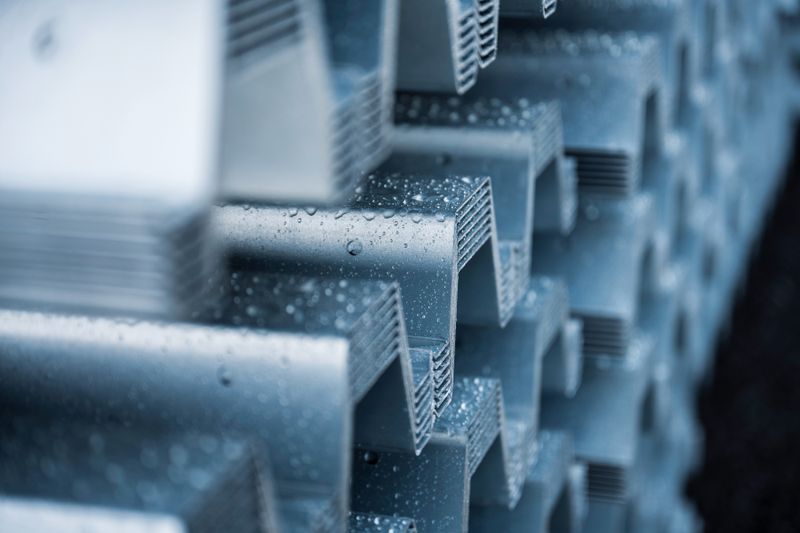
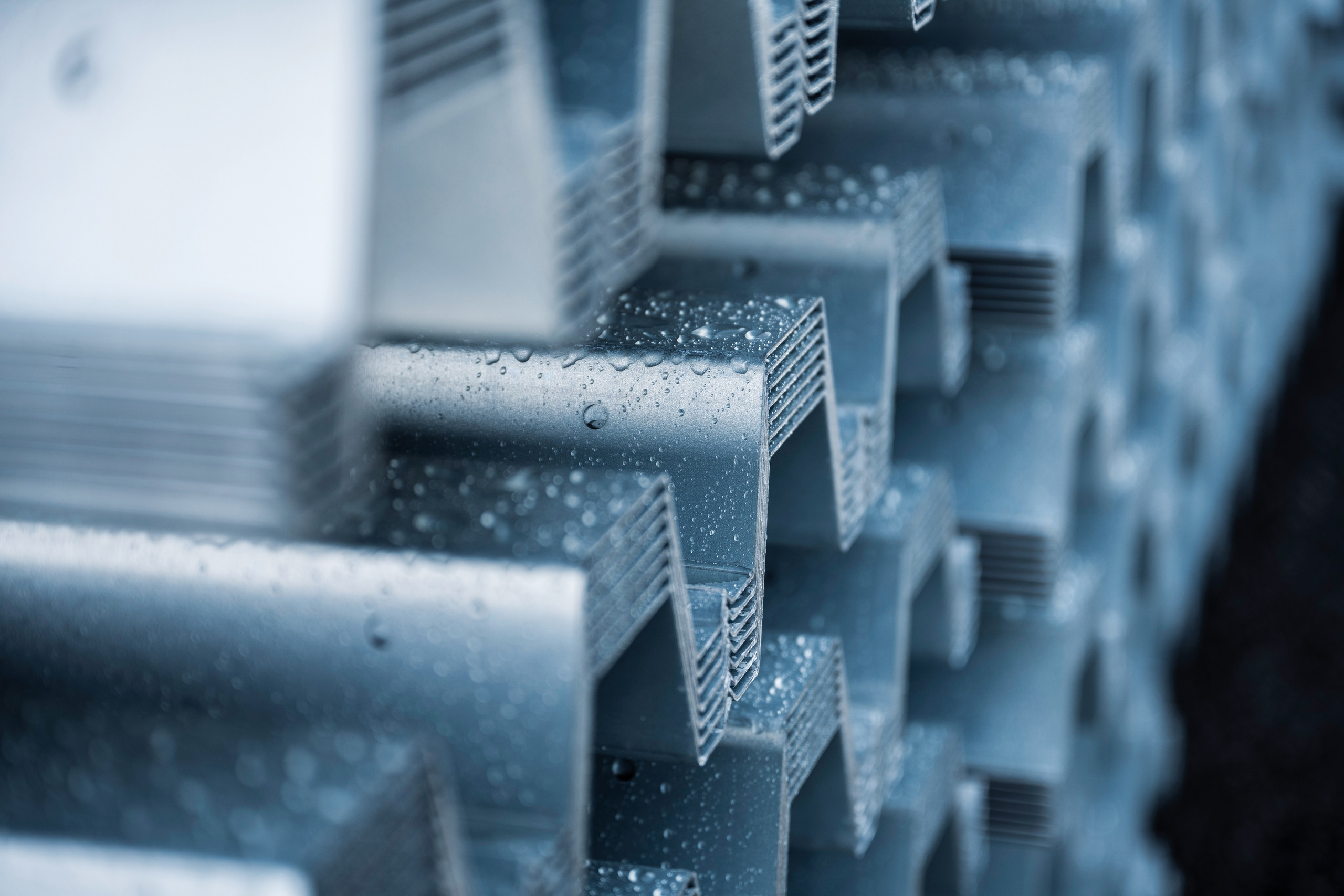
With ZM Ecoprotect Solar, thyssenkrupp Steel offers a variant developed for PV mounting systems. The coating is applied to the steel strip before forming, allowing profiles to be produced without the disadvantages of subsequent batch galvanizing.
(Source: Thyssenkrupp Steel)
Corrosion Protection: Strip-Galvanized ZM Steel as an Alternative to Batch Galvanizing
With ZM Ecoprotect Solar, thyssenkrupp Steel offers a variant developed for PV mounting systems. The coating is applied to the steel strip before forming, allowing profiles to be manufactured without the disadvantages of subsequent batch galvanizing.
(Source: Thyssenkrupp Steel)
In the design of substructures for open-field systems, Agri-PV systems, or solar carports, designers face a dual challenge: the components must be corrosion-resistant for decades while also being economically manufacturable. Particularly for profile constructions, it pays to look closely at alternatives to traditional hot-dip galvanizing. Hot-dip galvanized components offer proven corrosion protection but come with design and manufacturing challenges such as size limitations, required vent and drainage holes, and potential distortion of components due to the galvanizing process. A cost-effective alternative is zinc-magnesium-aluminum-coated steel strips. With ZM Ecoprotect Solar, Thyssenkrupp Steel offers a variant specifically designed for PV mounting systems. The coating is applied to the steel strip before forming, allowing profiles to be manufactured without the drawbacks of subsequent hot-dip galvanizing. At the same time, high formability enables efficient processing in the roll-forming process, while the hard surface reduces tool wear. Suitable materials are available according to DIN EN 10346 with coating weights ranging from ZM 310 to ZM 620. The ZM coating also offers advantages in corrosion protection. The combination of cathodic protective effect and stable top layer protects not only the surfaces but also cut edges, holes, and bend radii. A tip for designers: If corrosion protection is considered during the design phase, zinc-coated ZM steels can help reduce manufacturing effort while ensuring durable PV substructures.
Metal: Breakthrough for Extreme Heat—Tantal Alloy Withstands 2,400 °C
The tantalum alloy remains stable between 2,000 and 2,400 degrees and can still be deformed at room temperature.
A research team from Xi'an Jiaotong University has introduced a material that remains stable even where other metals have long since failed. The team at the "State Key Laboratory for Mechanical Behavior of Materials" has developed a tantalum alloy that remains resilient between 2,000 and 2,400 degrees (approx. 3,630°F to 4,350°F), while still being formable at room temperature. Tantalum only melts at around 3,000 degrees (approx. 5,430°F), making it one of the most promising candidates for such extreme conditions. However, existing tantalum alloys soften at high temperatures, losing their load-bearing capacity. This issue arises from a property shared by all metals: when the operating temperature reaches approximately 60% of the absolute melting point, atomic diffusion accelerates. At this point, mechanisms that strengthen the material at lower temperatures fail. The team in Xi'an solved the problem by adding a touch of boron. Using a specially developed oxidation reaction, the researchers evenly distributed hafnium oxide particles, approximately 50 nanometers in size, within the grain interior of the metal. According to the researchers, these particles act like tiny anchors, blocking the movement of dislocations and stabilizing grain boundaries. This prevents the material from creeping or deforming even near its stress limit. The boron attaches to the interfaces, preventing the oxide particles from coalescing at high temperatures. The Chinese researchers call their material a boron-stabilized, oxide dispersion-strengthened tantalum alloy, or "B-ODS" for short.
Smart Materials: Deformation Behavior in Shape Memory Alloys Deciphered
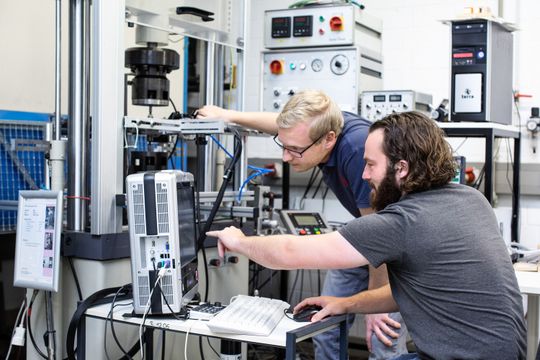
Researchers in the Metallic Materials Department at the University of Kassel have discovered a new deformation behavior in shape memory alloys.
(Source: Christine Buhl/Uni Kassel)
Researchers from the Metallic Materials department at the University of Kassel (Germany) have discovered a new deformation behavior in shape memory alloys. For the first time, the team was able to observe what happens at the atomic level within the material under load. Using specific cobalt-nickel-gallium crystals as an example, the Kassel team demonstrated the exact mechanism: when the pressure decreases, a previously unknown restructuring takes place, in which the crystal regions rearrange. The growth of a specific crystal variant causes the so-called twin boundaries in the material to shift. This atomic movement within the crystal structure produces acoustic signals, which the team was able to decode for the first time. The researchers illuminated the material using neutron diffraction, simultaneously listened to its deformation through acoustic emissions, and interpreted the processes in parallel within a model.
Surface: Flawlessly Shiny Plastic Surfaces
A new method for producing metallic effect pigments enables a flow-line-free metallic effect on plastic surfaces – and that without coating.
(Source: Fraunhofer IAP)
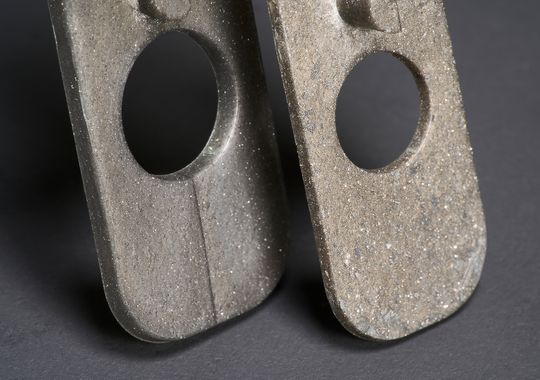
Metallic-looking plastic surfaces are trending—whether in automotive exteriors and interiors, toys, or household appliances. However, injection-molded products often have a drawback: they frequently show so-called flow lines—unsightly streaks and lines. A new method for producing metallic effect pigments, developed at the Technical University of Berlin and further optimized at the Fraunhofer Institute for Applied Polymer Research IAP, enables a flow-line-free metallic effect on plastic surfaces—without the need for coating. Scientist Nils Demski at TU Berlin (Germany) has developed tetrahedral particles. This geometry allows precise control of the degree of particle alignment in the plastic melt. Additionally, both the formation of flow lines and the brightness flop, the change in brightness depending on the viewing angle, can be influenced. However, producing these solid aluminum pigments with tetrahedral geometry is complex and associated with a high rejection rate. Therefore, Nils Demski and his team chose a new approach: the production of tetrahedral metallic pigment particles using UV imprint lithography. Their goal is to minimize pigment waste while achieving high automation through roll-to-roll processes. Instead of aluminum, the pigment particles are made of a UV-cured and then metalized thermoset that meets thermal and mechanical requirements to retain its shape and optical properties in injection molding. The new process significantly reduces material consumption and lowers the rejection rate compared to conventional production methods.
Date: 08.12.2025
Naturally, we always handle your personal data responsibly. Any personal data we receive from you is processed in accordance with applicable data protection legislation. For detailed information please see our privacy policy.
Consent to the use of data for promotional purposes
I hereby consent to Vogel Communications Group GmbH & Co. KG, Max-Planck-Str. 7-9, 97082 Würzburg including any affiliated companies according to §§ 15 et seq. AktG (hereafter: Vogel Communications Group) using my e-mail address to send editorial newsletters. A list of all affiliated companies can be found here
Newsletter content may include all products and services of any companies mentioned above, including for example specialist journals and books, events and fairs as well as event-related products and services, print and digital media offers and services such as additional (editorial) newsletters, raffles, lead campaigns, market research both online and offline, specialist webportals and e-learning offers. In case my personal telephone number has also been collected, it may be used for offers of aforementioned products, for services of the companies mentioned above, and market research purposes.
Additionally, my consent also includes the processing of my email address and telephone number for data matching for marketing purposes with select advertising partners such as LinkedIn, Google, and Meta. For this, Vogel Communications Group may transmit said data in hashed form to the advertising partners who then use said data to determine whether I am also a member of the mentioned advertising partner portals. Vogel Communications Group uses this feature for the purposes of re-targeting (up-selling, cross-selling, and customer loyalty), generating so-called look-alike audiences for acquisition of new customers, and as basis for exclusion for on-going advertising campaigns. Further information can be found in section “data matching for marketing purposes”.
In case I access protected data on Internet portals of Vogel Communications Group including any affiliated companies according to §§ 15 et seq. AktG, I need to provide further data in order to register for the access to such content. In return for this free access to editorial content, my data may be used in accordance with this consent for the purposes stated here. This does not apply to data matching for marketing purposes.
Right of revocation
I understand that I can revoke my consent at will. My revocation does not change the lawfulness of data processing that was conducted based on my consent leading up to my revocation. One option to declare my revocation is to use the contact form found at https://contact.vogel.de. In case I no longer wish to receive certain newsletters, I have subscribed to, I can also click on the unsubscribe link included at the end of a newsletter. Further information regarding my right of revocation and the implementation of it as well as the consequences of my revocation can be found in the data protection declaration, section editorial newsletter.
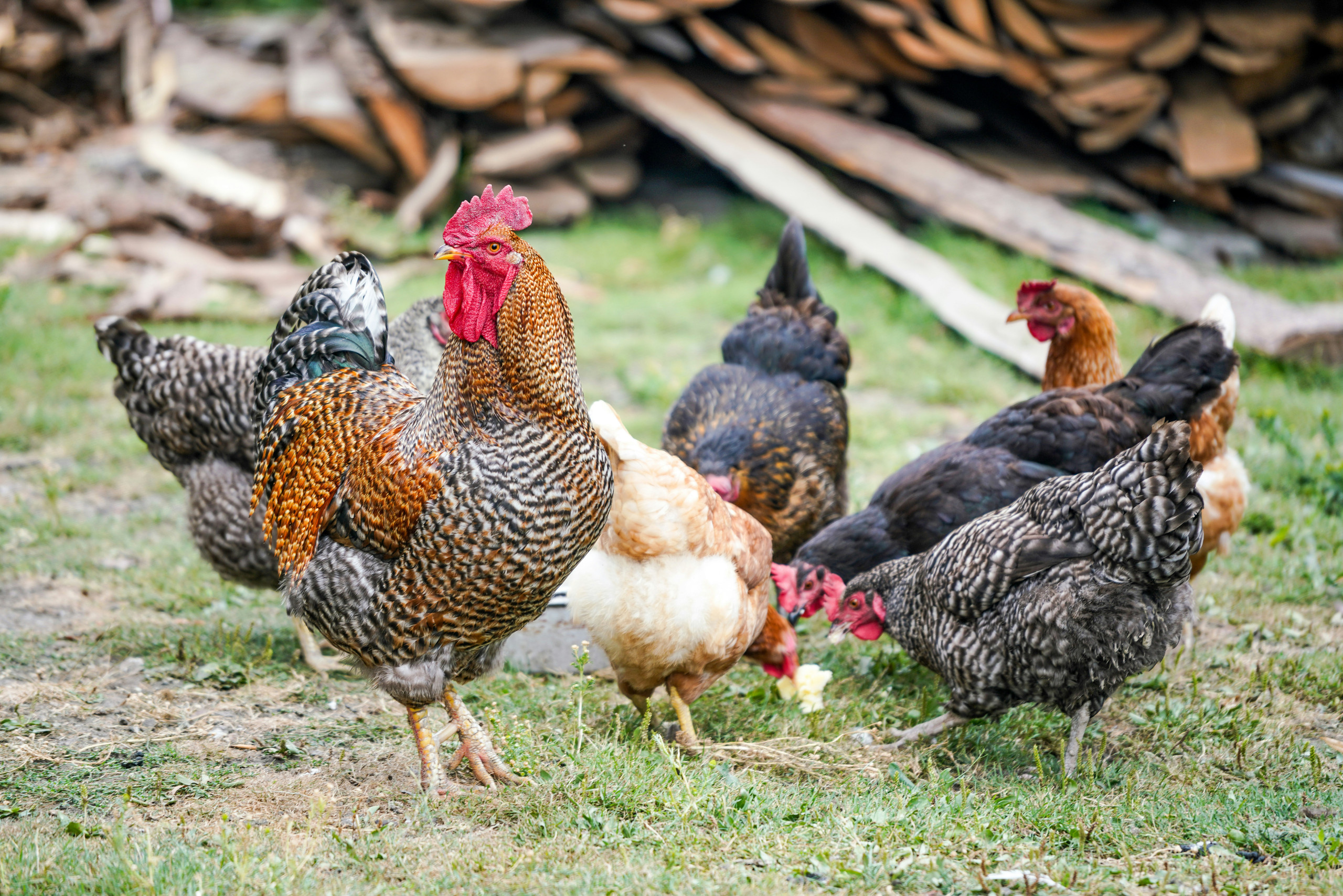
A cost-effective and multifunctional filler for paints and coatings could potentially be derived from chicken feathers: keratin. Researchers at the Fraunhofer Institute for Applied Polymer Research IAP in the Potsdam Science Park and the Fraunhofer Institute for Manufacturing Engineering and Automation IPA in Stuttgart (Germany) have achieved promising results with this protein. When keratin, ground into an ultra-fine powder, is mixed with water and sufficiently dispersed, it forms a milky liquid that decomposes very slowly by microorganisms. This makes keratin not only a cost-effective filler but also a potential base material for paints and coatings with enhanced resistance to microbial infestation. In laboratory tests, keratin combined with small additions of copper salts or particles also demonstrated UV protection. This means keratin particles could potentially perform functions similar to titanium dioxide, which is also antibacterial and protects against UV light but is considered potentially carcinogenic. Additionally, boron nitride can interact with keratin. When particles of both substances are embedded in a binder, ordered structures can form, resulting in mechanically stable and impact-resistant coatings. This could lead to keratin-based paints that protect against rust, such as powder coatings for fences, garden tools, or outdoor furniture. To use keratin in multifunctional additive coatings, chicken feathers must be cleaned and processed into fine powder. While chemical processes can readily produce large quantities of keratin powder, the keratin partially loses its functionality in the process. Mechanical or mechanochemical production methods yield better results but have other drawbacks: in the lab, researchers have only been able to produce a few grams of powder. To make mechanical production viable on an industrial scale, the researchers plan to collaborate with Zoz GmbH. This company, based in Wenden, Sauerland (Germany), develops and manufactures specialized equipment for mechanical process engineering and produces nanostructured high-performance materials using its proprietary systems.
Composite Material: Carbon and Ceramic Combined in High-Performance Hybrid Fiber
In the high-performance hybrid fiber Maxcarbon, conventional carbon fibers are transformed through a continuous surface reaction at 1,250 °C.
(Source: Institute for Textile Technology (ITA) of RWTH Aachen University)
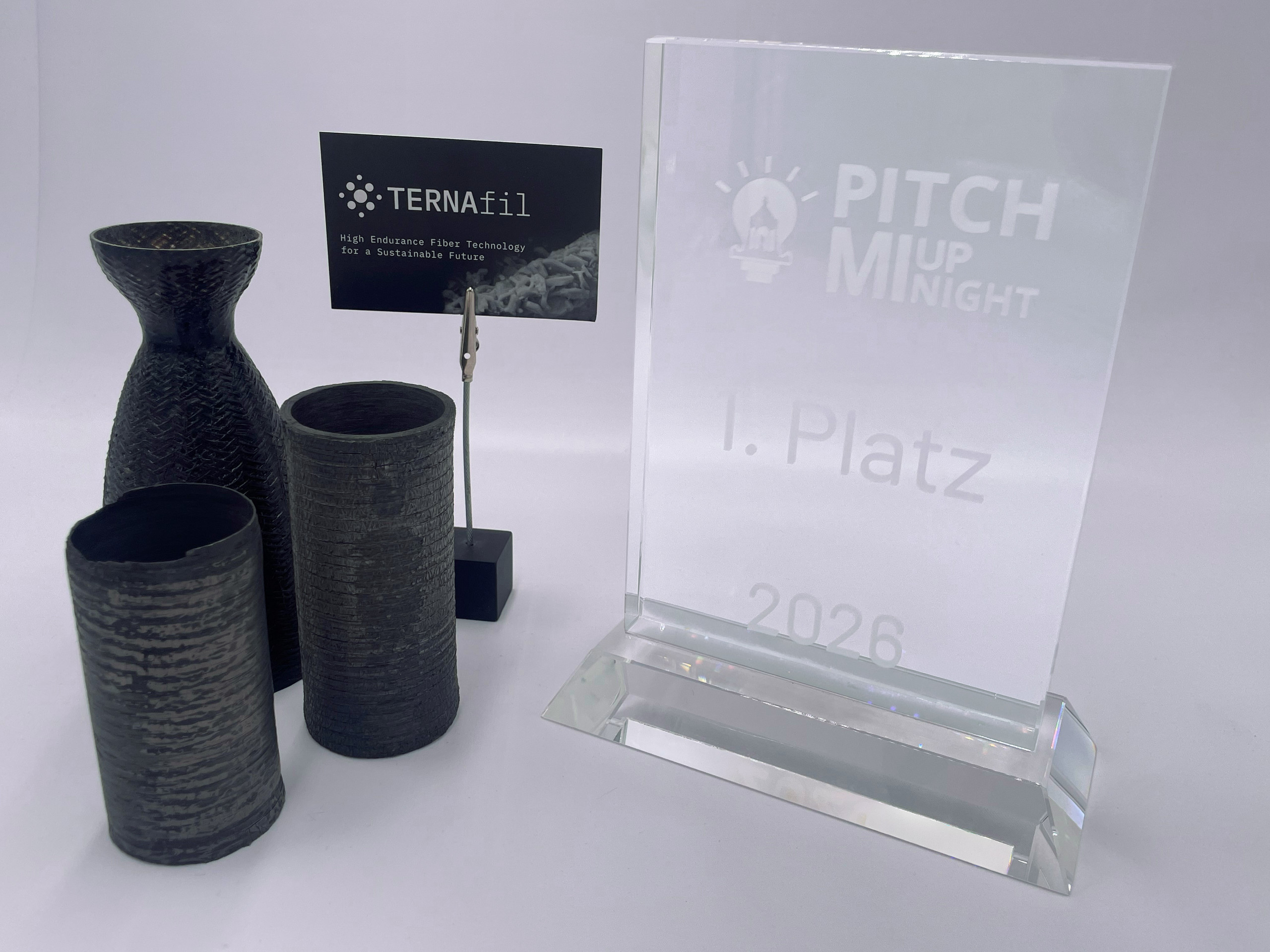
The RWTH spin-off Ternafil has developed a new high-performance hybrid fiber with its Maxcarbon technology, combining the mechanical performance of carbon with the temperature and corrosion resistance of ceramic materials. In the high-performance hybrid fiber Maxcarbon, conventional carbon fibers are transformed through a continuous surface reaction at 1,250 °C (approx. 2,280°F).. This process forms a MAX-phase hybrid structure that combines the mechanical strength of carbon with the thermal and chemical resistance of ceramics. The MAX phase is a family of layered ceramics that merges the stiffness and heat resistance of ceramics with the toughness, electrical conductivity, and machinability of metals—without the usual compromises. Most materials require trade-offs: ceramics are hard but brittle, metals are tough but heavy. MAX phases overcome this conflict. Silicon-based types, such as Ti₃SiC₂, are characterized by high mechanical performance and resistance to thermal shock, while aluminum-based types, such as Ti₂AlC, form self-healing oxide layers at high temperatures, making them especially resistant to oxidation and corrosion. Maxcarbon is a hybrid material in which the MAX phase is directly synthesized on the surfaces of carbon fibers. The fiber remains lightweight and flexible but gains chemical resistance, high-temperature stability, and electrical conductivity.
Fiber Composite: Plasma Accelerates the Manufacturing Process of Carbon Fibers
A research team at FH Aachen has developed a method that accelerates the manufacturing process of carbon fibers.
(Source: FH Aachen / Dr. Christoph Schopp)
Carbon is known as a material for bicycle frames, vehicle parts, or protective clothing. The carbon fibers, which serve as the base material for carbon, are usually produced from polyacrylonitrile (PAN). This process is divided into two phases: the stabilization of the fibers and the subsequent carbonization. A research team at FH Aachen (Germany) has developed a method to accelerate the manufacturing process of carbon fibers. In the stabilization phase, PAN fibers are currently passed millimeter by millimeter through a massive industrial furnace, approximately 30 meters long (approx. 98 feet). There, they are heated to around 300 degrees Celsius (approx. 570°F) for 60 minutes. A free-standing plasma makes the difference here. During the research, there were attempts to treat the surface of the PAN fibers with a plasma beam. The researchers managed to decouple the plasma from the electrode. The result was a plasma with a cylindrical expansion, detached from plasma-generating elements. The researchers were able to use this free-standing plasma as a tool in a novel apparatus. The PAN fibers can now pass through the plasma without direct contact, allowing the heat to radiate evenly onto the fibers. As a result, the fibers no longer burn and can be stabilized in a controlled manner. Using the new method, the PAN now passes through the furnace at a speed of one millimeter per second (approx. 0.04 in/s), resulting in a total dwell time of only seven minutes instead of the previous 60 minutes to achieve full stabilization. The energy consumption of the stabilization phase is reduced by 80 percent. The production line is also now only about four meters long (approx. 13 feet). The researchers can even further develop these results and transfer them into an additionally optimized, industrially viable setup. Soon, the more efficient production could enable the automotive and aviation industries to increase their use of carbon fiber-reinforced components—making cars and planes lighter and their usage more environmentally friendly.
Lightweight Construction: Sustainable Lightweight Construction with Magnesium and Shell Limestone
Researchers at the Hereon Institute of Materials and Process Design have stirred oyster shell powder into a magnesium-calcium alloy using a melting furnace.
(Source: Hereon/Rabea Osol)
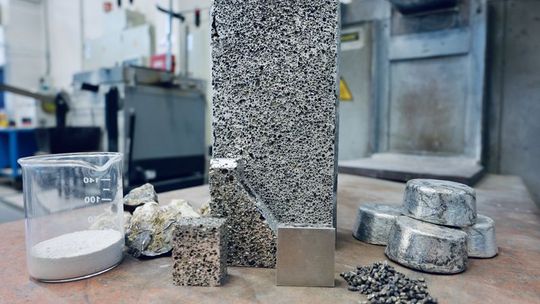
Oyster shells are generated in large quantities worldwide as a waste product of the food industry. Until now, they have mostly been disposed of in landfills or dumped into bodies of water. Researchers at the Hereon Institute for Materials and Process Design have now found a way to process the shells into magnesium foam as a sustainable resource. The team mixed powdered oyster shells into a magnesium-calcium alloy using a melting furnace. Since the shells are primarily composed of calcium carbonate (lime), the powder reacts at high temperatures to produce carbon dioxide (CO2). The gas forms bubbles that remain within the viscous melt, thus creating the foam. Once cooled and solidified, the result is a metal foam with a homogeneous pore structure, where the CO2 remains trapped. The unique features of the new material are its sustainable production, full recyclability, ultralight weight, and suitability for various applications. The porous structure makes the magnesium foam highly formable and allows it to absorb significant amounts of energy. This makes it particularly suitable for lightweight components designed to dampen vibrations or impacts, such as crumple zone parts in vehicles. The researchers also foresee future applications in shipbuilding, aviation, or protective equipment such as safety vests or pads, where low weight and high energy absorption capacity are critical.



:quality(80)/p7i.vogel.de/wcms/eb/2b/eb2bd1b8487afe577b37363cd02f16ff/0113143253v1.jpeg "In our China Market Insider, we regularly provide you with relevant information straight from China. (Image:© Eisenhans - stock.adobe.com)")
:quality(80)/p7i.vogel.de/wcms/dd/b8/ddb8edc98c49b384734ab2432b297eb5/adobestock-1913662309--irene-stock-adobe-com-ki-generiertv1.jpeg "Rotary joints are used in grippers and swivel mechanisms to allow assemblies to rotate or swivel smoothly relative to one another, even under very high loads (illustrative image). (Source: Irene - stock.adobe.com / KI-generiert)")
:quality(80)/p7i.vogel.de/wcms/d1/ef/d1ef6b6f7d4543f7999980bacccaf22b/0133499261v1.jpeg "As the growing imbalance in trade relations with China continues to widen, the EU Chamber of Commerce foresees a day when trade with China will have to be seriously reevaluated ... (Image: AI-generated)")
:quality(80)/p7i.vogel.de/wcms/fe/1f/fe1fa5ee713f94deaba963dc24c3abc5/0133299273v1.jpeg "The Flexistar enables highly flexible production of laser-welded tubes thanks to its tool-free clamping system. (Image:Because Technology, LLC)")
:quality(80)/p7i.vogel.de/wcms/60/ef/60ef4f07e4829b2c2929befc0f353c58/0133511729v1.jpeg "Humanoid robots can match human performance in certain tasks. (Image:Gemini / AI-generated)")
:quality(80)/p7i.vogel.de/wcms/2e/99/2e99726b522e4b35b690e25eb6a42643/0133463991v1.jpeg "Robotics: In AMR applications, connection technology must reliably transmit power, signals, and data despite vibration and shock loads—in very confined spaces and in a way that allows for regular maintenance. (Image:Hyperever)")
:quality(80)/p7i.vogel.de/wcms/d0/18/d01801e3d5dbd7bc9d0b4f60408b630c/0133468429v1.jpeg "Quality requirements for film packaging are on the rise. At the same time, many companies are turning to recyclable film materials, which, however, have their own challenges. Fraunhofer researchers have therefore developed a fast system that detects problems in real time. (Image:Fraunhofer IKTS)")
:quality(80)/p7i.vogel.de/wcms/b1/06/b106cf44923ce39565c3264982fd20eb/0133414574v1.jpeg "Robots Build Robots: At the new Ubtech factory, automated systems even handle parts of the material supply and logistics for the production of humanoid robots. (Image:Ubtech)")
:quality(80)/p7i.vogel.de/wcms/c0/52/c052f405eb55fc3d08c4837e77206fc0/adobestock-2021845957--aucartstudio-stock-adobe-com-ki-generiertv1.jpeg "An innovation from China to combat extreme summer heat: A novel coating lowers temperatures. (Source: © AucArtStudio – stock.adobe.com_AI-generated)")
:quality(80)/p7i.vogel.de/wcms/66/a7/66a7b78159caeacce57136529688799f/0133503398v1.jpeg "Sunlight Makes Stone! These stone blocks weren't made the traditional way. Instead, they were additively manufactured from sand using a laser. In the future, however, the laser is set to be replaced by concentrated sunlight—if the startup Addisol is successful... (Image:Addisol / F. Fiedler)")
:quality(80)/p7i.vogel.de/wcms/72/b9/72b995c2c8d812c5e2115cbef31e035a/0133462727v1.jpeg "Eggl manufactures center hoods that are precisely tailored to each cooking island—whether standard size or custom shape. They are made entirely of stainless steel and are individually customized in terms of size and filter arrangement. (Image:SPI)")
:quality(80)/p7i.vogel.de/wcms/13/5d/135dfae6229ceaf5c55467a43e8f7257/adobestock-1879961393--ardi-stock-adobe-com-ki-generiertv1.jpeg "Annoying chatterboxes or awkward silences in response to questions—a moderator should specifically prepare for difficult situations in order to navigate them effectively. (Image:ardi - stock.adobe.com_AI-generated)")
:quality(80)/p7i.vogel.de/wcms/aa/a2/aaa2c6dd2daa24b485cddbf9297590c0/0133467318v1.jpeg "Battery Monitoring: Battery monitoring using electrochemical impedance spectroscopy offers several advantages. (Image:TI)")
:quality(80)/p7i.vogel.de/wcms/39/b2/39b21bf03be1683831862239a369987c/0133469638v1.jpeg "Data from autonomous vehicles and robots operating autonomously is in high demand, and Ruqi wants to capitalize on this. (Image:Ruqi Mobility)")
:quality(80)/p7i.vogel.de/wcms/8a/bb/8abbb6217220595edc1549ac9b84f307/0133429906v1.jpeg "The IAA in Hanover showcased the ambitions of Chinese commercial vehicle manufacturers in Europe. (Image:Wehner - VCG)")
:quality(80)/p7i.vogel.de/wcms/0c/53/0c5313ef91c14b6df0d0996efc33c8ad/jpg03568-bearbeitetv1.jpeg "The category winners of the 2027 German Car of the Year award. (Source: GCOTY)")
:quality(80)/p7i.vogel.de/wcms/48/15/4815da27c45973ca629a99b375ac3aef/0133509585v1.jpeg "Ventuno Q RoadTest: Designed to help the Element14 community gain practical insights from real-world tests using the Ventuno Q. (Image:Farnell/Element14)")
:quality(80)/p7i.vogel.de/wcms/17/2b/172bd132f9febdfcbcedba292ad0504d/aufmacherv1.jpeg "Micro-Epsilon offers a wide range of IO-Link-compatible sensors. (Source: Micro-Epsilon Messtechnik GmbH & Co. KG)")
:quality(80)/p7i.vogel.de/wcms/ca/b4/cab46fd26d19d6a2febca032048200b6/0133471827v1.jpeg "Photonics SDK for C and Python: Computational operations are now abstracted as standard mathematical functions. (Image:Q.ANT)")
:quality(80)/p7i.vogel.de/wcms/92/b2/92b2ed5299cde450c0764f4f64468395/0133505895v1.jpeg "The \"Iris 100\" test system for high-precision volume production of microLEDs uses a spectrometer and a high-resolution camera. (Image:Teradyne)")

:quality(80)/p7i.vogel.de/wcms/94/7e/947e6c5ad061631259667942e694cd4a/adobestock-1952669980--c2-a9-20azan-20-e2-80-93-20stock-adobe-comv1.jpeg "Chinese researchers report a breakthrough in the field of materials science: They have developed a tantalum alloy that remains durable between 2,000 and 2,400 degrees (3,630°F to 4,350°F) and can still be deformed at room temperature. (Image: © Azan – stock.adobe.com)")
:quality(80)/p7i.vogel.de/wcms/23/b7/23b7c94b680b588e6a782720cc06900b/newsimage424308v1.jpeg "Left: Injection-molded test specimen with conventional platelet-shaped metallic effect pigments. Right: Injection-molded test specimen with novel tetrahedral pigment particles. (Image: Fraunhofer IAP)")
:quality(80)/p7i.vogel.de/wcms/a2/aa/a2aa1683d3149632ec8b99244de6010c/0131643886v1.jpeg "You can't see very much, but according to FH Aachen, this is a glimpse of an entirely new way of producing carbon fibers. Because at the university, they are relying on innovative plasma technology, as explained in the article ... (Image: FH Aachen / Chr. Schopp)")
:quality(80)/p7i.vogel.de/wcms/7d/f0/7df0df2c3fc0cd9cb7fd614412361aac/henkel-20ami-20pm-20anodis-uminium-bild-201-v1.jpeg "Henkel research in action: The development of Bonderite M-AD 2000A demonstrates how targeted additives can make anodizing processes more energy-efficient, sustainable, and economical. (Source: Henkel)")