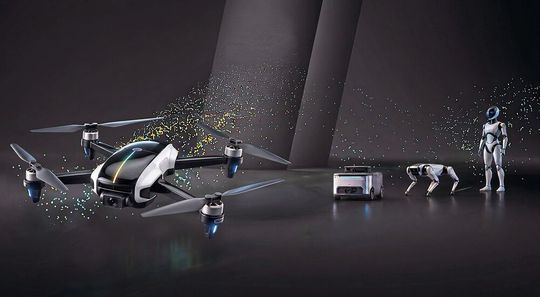
The open-source SDK and reference designs enable faster development of robotic systems. The SDK offers AI capabilities, connectivity, motor control, safety features, and power management.
NXP introduces a unified robotics platform for the rapid deployment of trustworthy physical AI.
(Image: NXP Semiconductors)
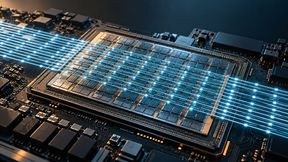
NXP Semiconductors’ new robotics platform is based on the NXP Neural-Axis Architecture, a distributed architecture that securely connects sensors, real-time control, AI processing, and communication in robotic systems. The platform combines NXP security technologies and functional safety solutions into a unified hardware and software ecosystem.
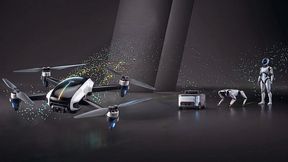
Using the unified, validated development approach, developers can quickly scale from individual functions to complete, trustworthy physical AI systems. The process begins, for example, with the evaluation of a motor control subsystem that has already been tested and validated using the SDK. Using the unified robotics SDK, reference designs, and platform architecture, functions for AI-based perception, flight control, and navigation can then be easily integrated. This enables developers to build a fully autonomous drone more quickly.
Pre-Integrated Software and Validated Interoperability of the Subsystems
Robotic subsystems must work together seamlessly across all designs. As a result, their integration and validation can typically take developers several months. NXP’s unified robotics platform reduces this effort to just a few days or weeks through pre-integrated software and validated interoperability of the subsystems. This is made possible by a secure hardware architecture built on NXP’s diverse product portfolio. As a result, developers can focus more on differentiating their solutions and bringing new ideas to life.
“Autonomous robots are increasingly being used not only in controlled environments, but also in places where people live and work. This makes trust in these systems a crucial prerequisite for their acceptance,” explains Jerome Legros, Vice President and General Manager of Robotics at NXP Semiconductors. “To build this trust, developers need an architecture that addresses cybersecurity, functional safety, real-time control, and reliability throughout the entire lifecycle from the very beginning. NXP’s robotics platform combines these essential requirements into a scalable architecture and helps developers create the next generation of trustworthy physical AI systems.”
Faster Prototyping and Time to Market
“When it comes to developing drones, speed is of the essence. The market is evolving rapidly, customer requirements are changing quickly, and new autonomous features are constantly being added,” says James McClearen, CTO at blueflite. “NXP’s unified robotics platform provides a ready-to-use foundation that shortens development cycles. This allows us to evaluate new ideas, create prototypes faster, and bring innovative solutions to market more efficiently.”
“In high-performance robotics, particularly in drone systems, computing power alone is not enough,” explains Srdjan Kovačević, CEO and co-founder of Orqa. “Efficient communication between computing units, predictable system behavior, and extremely low latencies are crucial. Through our close collaboration with NXP, we can address these challenges at the architectural level, thereby laying a stronger foundation for the next generation of robotic systems. This is more important today than ever, as the demands placed on advanced unmanned systems under real-world operating conditions continue to rise.”
NXP's robotics platform supports industry-standard robotics frameworks and provides a common hardware and software foundation for robotics development. The modular open-source SDK provides drivers, middleware integration, reference applications, configuration tools, and reusable software components. This also includes the integration of established open-source technologies such as PX4, Zephyr, and ROS 2.
The platform's reference designs incorporate secure data processing, deterministic real-time control, and system architectures designed for functional safety, all based on NXP's diverse hardware portfolio. This enables developers to create robots that operate safely and reliably under real-world conditions.
Date: 08.12.2025
Naturally, we always handle your personal data responsibly. Any personal data we receive from you is processed in accordance with applicable data protection legislation. For detailed information please see our privacy policy.
Consent to the use of data for promotional purposes
I hereby consent to Vogel Communications Group GmbH & Co. KG, Max-Planck-Str. 7-9, 97082 Würzburg including any affiliated companies according to §§ 15 et seq. AktG (hereafter: Vogel Communications Group) using my e-mail address to send editorial newsletters. A list of all affiliated companies can be found here
Newsletter content may include all products and services of any companies mentioned above, including for example specialist journals and books, events and fairs as well as event-related products and services, print and digital media offers and services such as additional (editorial) newsletters, raffles, lead campaigns, market research both online and offline, specialist webportals and e-learning offers. In case my personal telephone number has also been collected, it may be used for offers of aforementioned products, for services of the companies mentioned above, and market research purposes.
Additionally, my consent also includes the processing of my email address and telephone number for data matching for marketing purposes with select advertising partners such as LinkedIn, Google, and Meta. For this, Vogel Communications Group may transmit said data in hashed form to the advertising partners who then use said data to determine whether I am also a member of the mentioned advertising partner portals. Vogel Communications Group uses this feature for the purposes of re-targeting (up-selling, cross-selling, and customer loyalty), generating so-called look-alike audiences for acquisition of new customers, and as basis for exclusion for on-going advertising campaigns. Further information can be found in section “data matching for marketing purposes”.
In case I access protected data on Internet portals of Vogel Communications Group including any affiliated companies according to §§ 15 et seq. AktG, I need to provide further data in order to register for the access to such content. In return for this free access to editorial content, my data may be used in accordance with this consent for the purposes stated here. This does not apply to data matching for marketing purposes.
Right of revocation
I understand that I can revoke my consent at will. My revocation does not change the lawfulness of data processing that was conducted based on my consent leading up to my revocation. One option to declare my revocation is to use the contact form found at https://contact.vogel.de. In case I no longer wish to receive certain newsletters, I have subscribed to, I can also click on the unsubscribe link included at the end of a newsletter. Further information regarding my right of revocation and the implementation of it as well as the consequences of my revocation can be found in the data protection declaration, section editorial newsletter.
From Design to Initial Drone Functionality in 30 Minutes
The platform’s reference designs, prepared for prototype development, combine NXP’s secure solutions with built-in support for functional safety. The first reference designs for the unified robotics platform support drone applications. These include NavQ95 for autonomous data processing and flight control based on the i.MX 95 application processor, and Tropic VMU/FMU, a flight management unit based on the i.MX RT1064 crossover MCU.
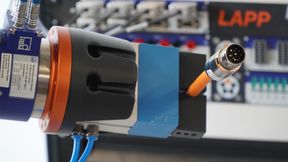
The 100Base-T1 Sensor Node enables intelligent sensor networking based on the MCX N947 MCU, while the AM32-compatible electronic speed controller for motor control is based on the MCX A13 MCU.
Each reference design includes functional safety and security features for the respective main processor, which can be enabled independently of the robotics-specific functions. Using the Robotics SDK and the reference designs, developers can implement basic drone functionality within 30 minutes without having to integrate the individual components themselves first.
In the future, the platform will support additional autonomous systems that require environmental perception, navigation, motor control, connectivity, and secure real-time operation. Plans include reference designs for service robots, autonomous mobile robots (AMRs), and other autonomous systems. NXP’s unified robotics platform is available now. It includes reference designs for drones as well as the associated SDK. Additional features and components to support other autonomous systems are expected to be available in the second half of 2027.