Neura Robotics and the Technical University of Munich (Germany) have opened the Robogym, one of the most advanced training and research centers for physical AI in Europe today. Initially, about 100 robots will train here in 48 training cells. At the opening, Neura also unveiled the 4NE1 Gen 4, the new generation of its humanoid robot.
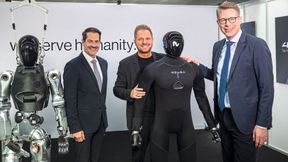
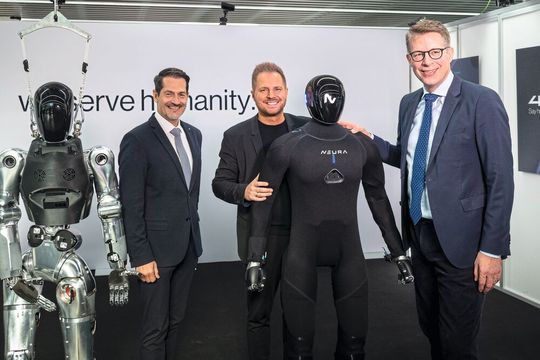
TUM President Thomas Hofmann, Neura CEO David Reger, and Markus Blume (from left to right) at the opening of the TUM Robogym.
(Image: Andreas Heddergott / Technical University of Munich)
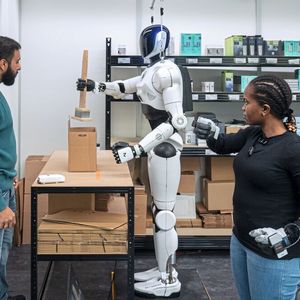
With the TUM Robogym, the Munich Institute of Robotics and Machine Intelligence (Mirmi) at the Technical University of Munich (TUM) and Neura Robotics, one of the most advanced training and research centers for physical artificial intelligence in Europe. Initially, approximately 100 humanoid and service robots will practice specific skills and procedures in 48 training cells. The large volume of training data is intended to enable the safe and reliable deployment of robots. In addition to robot training cells, the training center at LabCampus boasts enormous computing power for AI model training and computer simulation. Together, these generate large amounts of data that are used for the further development of intelligent robots. The current focus is on industrial applications and intralogistics. At the opening, Neura Robotics also unveiled the 4NE1 humanoid robot. This latest generation of robots will also be available at the TUM Robogym in the future.
David Reger, CEO of Neura Robotics, explains: “Our companies possess knowledge that has been built up over generations. People know how to process materials, assemble components, and master complex processes. This knowledge is one of our greatest strengths in the age of Physical AI. Together with TUM, we’re creating a powerhouse of physical capabilities that will give rise to new possibilities. Small and medium-sized businesses, in particular, should be able to help shape this future. With today’s launch of the 4NE1 Gen 4 humanoid, we’re demonstrating which robots are ready for this: designed for mass production, engineered for productive work, and powered by Neuron AI, our proprietary foundation model that learns from experience in the Neura Gyms. Developed, built, and trained in Germany, for the world.”
Collecting Large Amounts of Data in Training and Simulation Environments
Unlike generative AI such as ChatGPT, which can draw on very large amounts of data from the Internet, physical artificial intelligence requires training data from “real” physical interactions. Such data is currently scarce. The new training center features robot training cells where robots learn, among other things, to fold boxes, assemble components, and operate tools. At the TUM Robogym, robot skills can be developed and tested in a realistic environment.
The data generated at the TUM Robogym is fed into a curated data lake in the cloud, where it is available for training physical AI models. As a central scientific resource, the data lake enables scalable research into generalizable robotic capabilities, safe human-robot interaction, and AI models for robotics.
A Place where Companies Teach Robots How to Do their Jobs
Since September, partners have been practicing specific workflows at the TUM RoboGym. Companies from more than ten industries are participating, including automotive, pharmaceuticals, medical technology, packaging, logistics, agriculture, and healthcare. Demand is high: Capacity in Munich is already in high demand.
The tasks range from handling cardboard boxes to filling bottles and loading and unloading wooden components. Companies can test applications, identify training needs, and evaluate the suitability of different robotic systems before expanding their use within their own operations.
Various form factors are available for this purpose: humanoid robots, mobile assistance robots such as MiPA, and cognitive robotic arms. The key factor is the capability required for a given task. To this end, the center provides a shared development environment for researchers, established companies, and startups.
Developing Products from Prototypes
The core objective of the project is to translate scientific findings into practical applications: “Close, ongoing, and flexible collaboration with the robotics industry is important and essential for research in the field of physical AI. This is the only way to systematically and rapidly develop research prototypes into marketable products,” says Prof. Achim Lilienthal of TUM Mirmi, the scientific coordinator of the TUM Robogym, who describes it as a groundbreaking pilot project for science. TUM President Prof. Thomas F. Hofmann emphasizes: “The TUM Robogym is unique in Germany and Europe. Through our collaboration with Neura Robotics, we are also sending a clear signal in support of Germany as an industrial hub during these geopolitically uncertain times.” Prof. Lorenzo Masia, Executive Director of TUM Mirmi and Head of the TUM Robogym: “TUM Mirmi and Neura Robotics are two partners who, together, can achieve great things. Building on our world-leading scientific expertise, we are now able—together with a strong industry partner—to develop concrete applications for the market. Our long-term goal is a dynamic and thriving robotics industry that will serve as a new engine for the German economy.”
Date: 08.12.2025
Naturally, we always handle your personal data responsibly. Any personal data we receive from you is processed in accordance with applicable data protection legislation. For detailed information please see our privacy policy.
Consent to the use of data for promotional purposes
I hereby consent to Vogel Communications Group GmbH & Co. KG, Max-Planck-Str. 7-9, 97082 Würzburg including any affiliated companies according to §§ 15 et seq. AktG (hereafter: Vogel Communications Group) using my e-mail address to send editorial newsletters. A list of all affiliated companies can be found here
Newsletter content may include all products and services of any companies mentioned above, including for example specialist journals and books, events and fairs as well as event-related products and services, print and digital media offers and services such as additional (editorial) newsletters, raffles, lead campaigns, market research both online and offline, specialist webportals and e-learning offers. In case my personal telephone number has also been collected, it may be used for offers of aforementioned products, for services of the companies mentioned above, and market research purposes.
Additionally, my consent also includes the processing of my email address and telephone number for data matching for marketing purposes with select advertising partners such as LinkedIn, Google, and Meta. For this, Vogel Communications Group may transmit said data in hashed form to the advertising partners who then use said data to determine whether I am also a member of the mentioned advertising partner portals. Vogel Communications Group uses this feature for the purposes of re-targeting (up-selling, cross-selling, and customer loyalty), generating so-called look-alike audiences for acquisition of new customers, and as basis for exclusion for on-going advertising campaigns. Further information can be found in section “data matching for marketing purposes”.
In case I access protected data on Internet portals of Vogel Communications Group including any affiliated companies according to §§ 15 et seq. AktG, I need to provide further data in order to register for the access to such content. In return for this free access to editorial content, my data may be used in accordance with this consent for the purposes stated here. This does not apply to data matching for marketing purposes.
Right of revocation
I understand that I can revoke my consent at will. My revocation does not change the lawfulness of data processing that was conducted based on my consent leading up to my revocation. One option to declare my revocation is to use the contact form found at https://contact.vogel.de. In case I no longer wish to receive certain newsletters, I have subscribed to, I can also click on the unsubscribe link included at the end of a newsletter. Further information regarding my right of revocation and the implementation of it as well as the consequences of my revocation can be found in the data protection declaration, section editorial newsletter.
4NE1 Gen 4: New Hardware for Adaptive Robotics
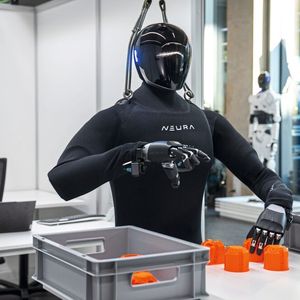
With the 4NE1 Gen 4, Neura has unveiled the new generation of its humanoid robot, which was already in use at the TUM Robogym during the opening: sleeker, lighter, and powered by Neuron AI.
New design, lighter body: The 4NE1 Gen 4 has a sleeker body, a textile and sensor-equipped outer skin, and is 20 percent lighter than the previous generation. The fabric makes the robot seem even more approachable: It is built to work alongside people and is designed to look that way. In addition, the material offers potential for further easy customization.
More Precise Manipulation:Advanced hands enable even more precise grips. Added to this are Smart Limbs: Reflexes are built directly into the limbs, allowing each limb to react independently. As a result, the 4NE1 Gen 4 responds immediately to its surroundings and moves more fluidly and in a more human-like manner.
The 4NE1 Gen 4 runs on Neuron AI, Neura’s Perception-Language-Action model for Physical AI. It translates what the robot perceives directly into movement. In addition to visual data, the model also incorporates touch, force, sound, and the robot’s status. This makes all the difference, especially for industrial tasks—such as when a robot needs to determine whether a latch is engaged. Neuron AI is trained using real robot data from the Neura Gyms, human demonstrations, and simulations. Through the Neuraverse, the skills a robot learns are also made available to other connected robots. This allows the 4NE1 Gen 4 to benefit from everything learned across the growing network of Neura Gyms.
The 4NE1 Gen 4 is being prepared for mass production. In conjunction with the opening of the TUM Robogym in Munich, it was showcased at the NVIDIA GTC conference in Berlin and is already in use at the Neura Gyms. At these training facilities, companies can practice tasks with the new generation of robots, making them among the first to work with the 4NE1 Gen 4.