Unimicron is winding down its German PCB manufacturing operations and investing in new capacity in Asia. These two developments are not mutually exclusive, but how does this fit in with the AI boom, and what does it mean for German electronics assemblers?
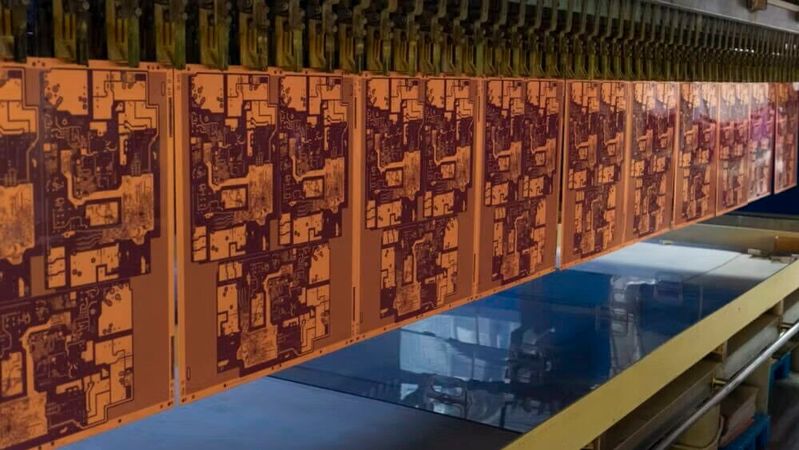
Printed Circuit Board Manufacturing: At Unimicron Germany’s electroplating facility in Geldern, printed circuit boards and their through-holes are coated with copper. While the company is expanding its capacity in Asia, production in Germany is scheduled to be discontinued in the first half of 2027.
(Image: Unimicron Germany)
On October 27, 2026, the Taiwanese printed circuit board manufacturer Unimicron passed two resolutions that, at first glance, seem incompatible: Its German subsidiary in Geldern will be wound up, we reported on this, and at the same time, the group approved additional orders for manufacturing equipment totaling 50.9 billion New Taiwan dollars. Based on current exchange rates, this amounts to approximately 1.4 billion euros ($1.596 billion). Unimicron plans to use the equipment to outfit new factories and further develop its manufacturing processes. The orders will be placed depending on demand and market developments.
So while printed circuit board production is being phased out in Germany, the parent company is expanding its capacity in Asia—particularly for high-performance IC substrates and AI applications. This does not necessarily have to be a contradiction. Even though both cases involve printed circuit board manufacturing, the markets differ significantly.
Geldern Serves Other Markets
In Geldern, North Rhine-Westphalia, Unimicron primarily manufactures printed circuit boards for the automotive industry, industrial electronics, and renewable energy. Its product range includes, among other things, HDI, high-frequency, thick-copper, and semiflex printed circuit boards. These are certainly not products from a manufacturing facility that is no longer technologically up to par. As recently as 2022, the company had invested around twelve million euros in modernizing the site.
Economically, however, this did not pay off. Unimicron cites ongoing losses and a challenging market environment as the reasons for the closure. Despite several years of financial support from the parent company, no viable solution could be found for Geldern. Production is scheduled to be discontinued during the first half of 2027. Approximately 240 employees are affected.
In Asia, however, the situation is different. There, Unimicron is benefiting from strong demand for AI accelerators, servers, and networking technology. High-quality IC substrates—such as those based on ABF—are in particularly high demand, as they are required for high-performance processors and their packaging. As computing power grows, so do the technical requirements. The substrates are getting larger, require more layers, and feature finer interconnect structures. At the same time, they must support high data rates and facilitate heat dissipation. Unimicron is among the manufacturers that have already mastered these technologies and therefore intend to expand their production capacity.
In addition, key customers as well as suppliers of materials and equipment for semiconductor and substrate manufacturing are based in Asia. Existing manufacturing infrastructure and proximity to these supply chains facilitate expansion. However, this does not mean that production in Geldern will be relocated to Asia. There is no indication of this. Rather, two distinct business units face different economic prospects.
Wait Up to 30 Months—But for What?
Even for Unimicron, this expansion is not without its challenges. As Chairman S. C. Chien explained to Nikkei Asia in late October 2026, delivery times for about 20 percent of the required manufacturing equipment have doubled. For certain machines, manufacturers now have to wait up to 30 months.
This figure has already made headlines, though not always accurately. For example, Tom's Hardware interpreted the up to 30-month lead time for manufacturing equipment as an equally long wait for printed circuit board orders. However, this is not mentioned in the original Nikkei Asia report.
Date: 08.12.2025
Naturally, we always handle your personal data responsibly. Any personal data we receive from you is processed in accordance with applicable data protection legislation. For detailed information please see our privacy policy.
Consent to the use of data for promotional purposes
I hereby consent to Vogel Communications Group GmbH & Co. KG, Max-Planck-Str. 7-9, 97082 Würzburg including any affiliated companies according to §§ 15 et seq. AktG (hereafter: Vogel Communications Group) using my e-mail address to send editorial newsletters. A list of all affiliated companies can be found here
Newsletter content may include all products and services of any companies mentioned above, including for example specialist journals and books, events and fairs as well as event-related products and services, print and digital media offers and services such as additional (editorial) newsletters, raffles, lead campaigns, market research both online and offline, specialist webportals and e-learning offers. In case my personal telephone number has also been collected, it may be used for offers of aforementioned products, for services of the companies mentioned above, and market research purposes.
Additionally, my consent also includes the processing of my email address and telephone number for data matching for marketing purposes with select advertising partners such as LinkedIn, Google, and Meta. For this, Vogel Communications Group may transmit said data in hashed form to the advertising partners who then use said data to determine whether I am also a member of the mentioned advertising partner portals. Vogel Communications Group uses this feature for the purposes of re-targeting (up-selling, cross-selling, and customer loyalty), generating so-called look-alike audiences for acquisition of new customers, and as basis for exclusion for on-going advertising campaigns. Further information can be found in section “data matching for marketing purposes”.
In case I access protected data on Internet portals of Vogel Communications Group including any affiliated companies according to §§ 15 et seq. AktG, I need to provide further data in order to register for the access to such content. In return for this free access to editorial content, my data may be used in accordance with this consent for the purposes stated here. This does not apply to data matching for marketing purposes.
Right of revocation
I understand that I can revoke my consent at will. My revocation does not change the lawfulness of data processing that was conducted based on my consent leading up to my revocation. One option to declare my revocation is to use the contact form found at https://contact.vogel.de. In case I no longer wish to receive certain newsletters, I have subscribed to, I can also click on the unsubscribe link included at the end of a newsletter. Further information regarding my right of revocation and the implementation of it as well as the consequences of my revocation can be found in the data protection declaration, section editorial newsletter.
There is, however, no question that the supply of printed circuit boards is also difficult in some cases. The manufacturer Kinwong Electronic, for example, stated that it can currently offer new customers delivery no earlier than the end of 2028. The Taiwanese CCL manufacturer Elite Materials also has a clear view of its order backlog all the way through 2030. However, this does not mean that all printed circuit boards are in short supply, nor does it mean that orders will generally not be delivered for several years.
One should treat the reported price increases with similar caution. A Taiwanese PC manufacturer told Nikkei that its costs for copper-clad laminates (CCL) had increased at least twelvefold since July. It is not known which material grades and purchasing terms form the basis of this comparison. A general twelvefold increase in CCL prices is therefore not substantiated.
When AI-Generated Materials Replace Standard Manufacturing
However, the challenges are not limited to particularly complex printed circuit boards and IC substrates. One reason for this is that manufacturers of base materials are increasingly focusing their production capacities on higher-grade products. In the case of glass fiber fabrics, for example, this applies to low-Dk and low-Df materials required for high-frequency applications and AI servers. Because production capacities are being retooled for these purposes, E-glass—which is used in conventional printed circuit boards—may also become scarcer.
The Professional Association for Electronics Design and Manufacturing (FED) has been warning about this trend for months. Even with standard FR-4, rising prices, longer lead times, and the first allocation programs are becoming apparent. Manufacturers are in some cases distributing available material quantities based on previous years’ purchase volumes. Those who need more on short notice may run into difficulties. This does not mean that the entire printed circuit board market is facing a supply crisis. The problems are concentrated on specific material grades and manufacturing capacities. However, because some of these same supply chains also serve traditional electronics manufacturing, the effects are not limited to AI applications.
What Does this Mean for German Electronics Manufacturers?
With the closure of the facility in Geldern, German EMS service providers and electronics developers are losing a domestic supplier of custom—and in some cases, technically sophisticated—printed circuit boards. As part of the winding-down process, Unimicron intends to fulfill existing orders and delivery obligations and coordinate with customers. Those who have previously had their products manufactured in Geldern will nevertheless need to look for alternatives. Especially for HDI, high-frequency, or thick-copper printed circuit boards, switching manufacturers isn’t always as simple as placing a new order. Depending on the application, materials, processes, and, if necessary, the new supplier must be qualified.
In addition, material availability is becoming more important. The FED therefore recommends reviewing PCB specifications in collaboration with manufacturers. This includes, for example, panel layout, where better utilization of manufacturing formats can save material. X-outs can also be useful: If individual PCBs within a panel are defective, not all PCBs need to be discarded provided they are appropriately marked. Modern assembly systems can generally account for such defect markings. For EMS service providers, this primarily means coordinating with their PCB suppliers at an early stage regarding available materials, possible alternatives, and future requirements.