The path to safe autonomous systems—which should also be as affordable as possible—is much more challenging than originally thought. To bring all stakeholders together, the company TTTech Auto—which, following its acquisition by NXP Semiconductors, now operates under the name “TrustMotion”—launched the “The Autonomous” initiative in 2017. At that time, the focus was clearly on autonomous driving, but now the initiative encompasses autonomous systems of all kinds.
From vehicles to the moon: At the Autonomous Main Event in Vienna this fall, the founding of a new association was announced, named “The Autonomous – Global Platform for Safe Autonomous Systems and Robotics.”
(Image: Alfred Vollmer)
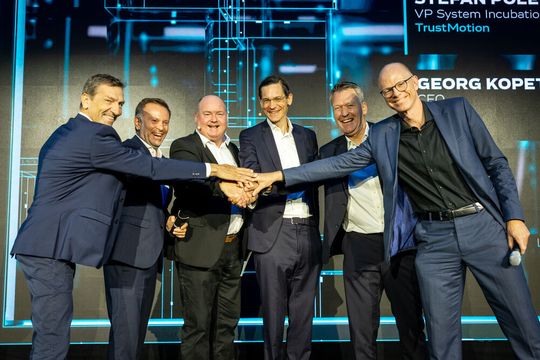
At the Autonomous Main Event in Vienna this fall, the founding of a new association was therefore announced, operating under the name “The Autonomous – Global Platform for Safe Autonomous Systems and Robotics” (Figure 1). This independent and open multi-stakeholder organization aims to advance safe, secure, and robust autonomous systems through cross-industry collaboration. The credo of Ricky Hudi, Chairman of The Autonomous, plays a central role in this effort: Safety is a must—“Safety is non-negotiable,” as Hudi put it.
Founded by NXP, TrustMotion, Infineon, Qualcomm, and TTTECH, the association builds on the success of the Autonomous Initiative, which has brought together many stakeholders from industry, academia, politics, regulation, and research since its inception. “The future of autonomous systems depends on industry-wide collaboration,” explained Ricky Hudi, chairman of the Autonomous Association in Vienna. “By bringing together leading organizations from across the entire ecosystem, we are creating a neutral platform to accelerate innovation and lay the trustworthy foundations necessary for the widespread scaling of autonomous systems.” This platform is designed to promote collaboration in the automotive, robotics, and industrial automation sectors, as well as other application areas of autonomous systems.
Figure 1: The founding of the new association “The Autonomous – Global Platform for Safe Autonomous Systems and Robotics” was officially announced in Vienna (from left to right): Dr. Stefan Poledna (TrustMotion), Eric Mazzoleni (Qualcomm), Ricky Hudi (The Autonomous), Georg Kopetz (TTTech), Lars Reger (NXP), and Peter Schäfer (Infineon).
(Image: Christian Steinbrenner)
Putting Physical AI into Practice
It was clear to all 600-plus attendees of the Autonomous Main Event that artificial intelligence (AI) will play a crucial role in autonomous systems, but “what really matters is putting Physical AI into practice,” explained Philipp von Schierstaedt, EVP & CSO of Consumer, Computing, and Communication at Infineon, in his presentation “The Future of Physical AI Is Based on Chips.”
He pointed out that the complexity of use cases in robotics is greater than in the automotive industry. While it is possible to draw on insights from automotive applications, the variety of use cases in robotics is much greater. For example, a car is controlled in two dimensions—by accelerating and braking, as well as by steering left and right. Robots, on the other hand, also sense and act in the vertical plane, and thus operate in a three-dimensional environment. While a vehicle’s autonomy is confined to the relatively narrow context of “driving,” (humanoid) robots, by their very nature, must perform or process many hundreds of different tasks, making their working environment considerably more complex than that of a vehicle. However, the fail-operational concepts and architectures developed in the automotive world also provide valuable services in robotics. It is therefore only a matter of time before the automotive industry receives valuable feedback from robotics. If the forecasts cited by Philipp von Schierstaedt prove accurate, the automotive sector should soon benefit from these insights from robotics: By 2030, 1.5 million humanoid robots are expected to be in use worldwide; by 2035, that number is projected to reach 11.6 million; and by 2050, a whopping 300 million.
Trust is the Foundation
“Practical deployment must be based on trust,” and to achieve this, autonomous systems require safety (functional safety) and security (cybersecurity), which must be deeply embedded across all hardware and software levels, von Schierstaedt noted. In this context, the ecosystem’s resilience acts as a gateway to scaling—and “for that, we need collaborative learning, virtualization, and supply chain resilience from the chip all the way to AI and the OEM level.”
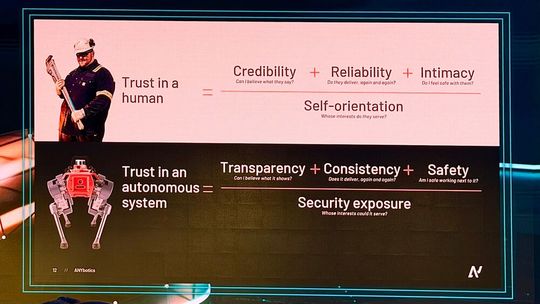
“There is no market for physical AI without trust in the autonomous systems that surround us,” says Lars Reger, EVP & CTO of NXP, summing up the situation. “Trust begins with the right system architectures that combine safety, security, AI, and deterministic guardrails. With the Autonomous Association, we’re bringing industries together to create the safe and intelligent foundation necessary for the widespread scaling of autonomous systems.” In his keynote address, “How Robots Earn Their Place,” Péter Fankhauser, Co-Founder & CEO of ANYbotics, distilled trust in a human being into a mathematical formula, and then immediately presented the corresponding equivalent required for trust in an autonomous robot (Figure 2).
Figure 2: How does trust in a person differ from trust in an autonomous system? The company ANYbotics provided a mathematically grounded answer in Vienna.
(Image: Alfred Vollmer)
Autonomous Robots on the Moon
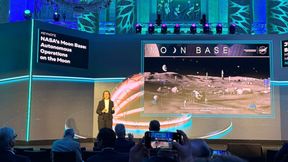
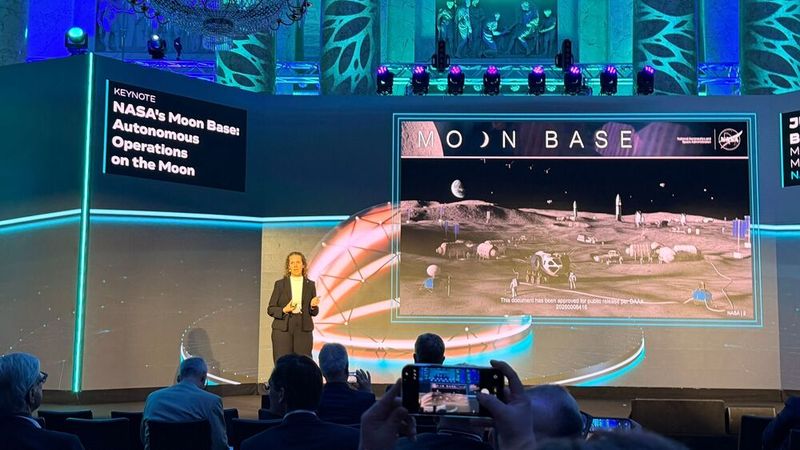
Julia Badger, Moon Base’s Surface Mobility Deputy Lead at NASA, gave a rather unusual presentation. She said that about 900 commands sent from Earth must be executed every day to keep the ISS operational. However, the ISS is only about 400 km (249 miles) from Earth, while the Moon is, on average, 380,000 km (236,000 miles) farther away. Remote control—an option that works well for cars and is just barely feasible for the ISS in certain exceptional cases—is therefore completely out of the question for operating autonomous systems on the Moon due to the long latency times, which effectively constitute control dead times.
Date: 08.12.2025
Naturally, we always handle your personal data responsibly. Any personal data we receive from you is processed in accordance with applicable data protection legislation. For detailed information please see our privacy policy.
Consent to the use of data for promotional purposes
I hereby consent to Vogel Communications Group GmbH & Co. KG, Max-Planck-Str. 7-9, 97082 Würzburg including any affiliated companies according to §§ 15 et seq. AktG (hereafter: Vogel Communications Group) using my e-mail address to send editorial newsletters. A list of all affiliated companies can be found here
Newsletter content may include all products and services of any companies mentioned above, including for example specialist journals and books, events and fairs as well as event-related products and services, print and digital media offers and services such as additional (editorial) newsletters, raffles, lead campaigns, market research both online and offline, specialist webportals and e-learning offers. In case my personal telephone number has also been collected, it may be used for offers of aforementioned products, for services of the companies mentioned above, and market research purposes.
Additionally, my consent also includes the processing of my email address and telephone number for data matching for marketing purposes with select advertising partners such as LinkedIn, Google, and Meta. For this, Vogel Communications Group may transmit said data in hashed form to the advertising partners who then use said data to determine whether I am also a member of the mentioned advertising partner portals. Vogel Communications Group uses this feature for the purposes of re-targeting (up-selling, cross-selling, and customer loyalty), generating so-called look-alike audiences for acquisition of new customers, and as basis for exclusion for on-going advertising campaigns. Further information can be found in section “data matching for marketing purposes”.
In case I access protected data on Internet portals of Vogel Communications Group including any affiliated companies according to §§ 15 et seq. AktG, I need to provide further data in order to register for the access to such content. In return for this free access to editorial content, my data may be used in accordance with this consent for the purposes stated here. This does not apply to data matching for marketing purposes.
Right of revocation
I understand that I can revoke my consent at will. My revocation does not change the lawfulness of data processing that was conducted based on my consent leading up to my revocation. One option to declare my revocation is to use the contact form found at https://contact.vogel.de. In case I no longer wish to receive certain newsletters, I have subscribed to, I can also click on the unsubscribe link included at the end of a newsletter. Further information regarding my right of revocation and the implementation of it as well as the consequences of my revocation can be found in the data protection declaration, section editorial newsletter.
On the Moon, therefore, full Level 5 functionality is required when Lunar Train Vehicles (LTVs) take on the “vital task of moving cargo from the landing zones to the actual mission sites.” The goal, therefore, is to transition in terms of autonomy from “humans in the loop” to “humans on the loop.” In addition to a robust design for critical components that operates in a fail-operational mode, she also emphasizes the importance of maintenance and inspection in terms of system design.
The Autonomous Systems Management (ASM) software is designed to ensure autonomous operation on-site—for example, on the Moon. This requires not only a distributed hierarchical architecture but also clear definitions of the interfaces and interdependencies.
For NASA, the top priority in closing the remaining technology gaps for the lunar mission is autonomous mobility on the lunar surface—including navigation. In second place is the unloading of the payload, along with its handling and processing by machines on the Moon. Only in third and fourth place do the systems for survival during the long night and shadow phases on the Moon, as well as resistance to the fine but sharp-edged lunar dust, rank. This clearly demonstrates just how important autonomous mobility activities are to NASA.