Miracle II is the second phase of the Miracle project funded by the Werner Siemens Foundation. The name stands for Minimally Invasive Robot Assisted Computer-guided LaserosteotomE, i.e. a modular laser robot for minimally invasive bone removal that is planned and accompanied in virtual reality. The robotics elements of this system were developed by Prof. Dr. Georg Rauter and his team at the University of Basel, based on Beckhoff control technology and in particular on TwinCAT 3 Target for Simulink.
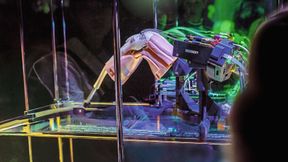
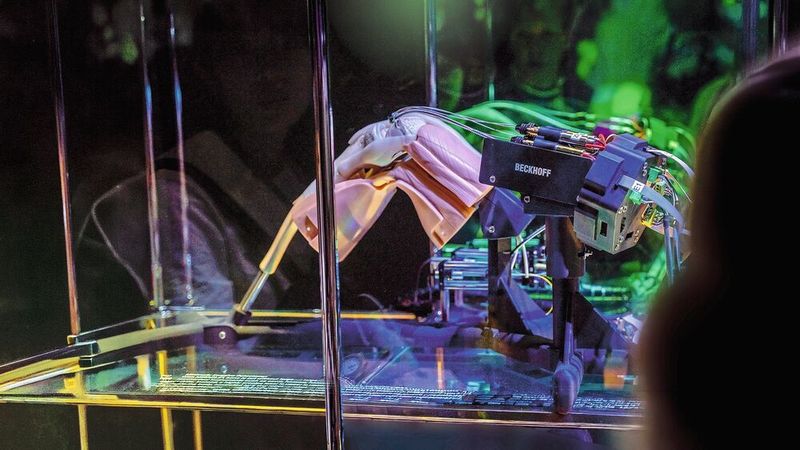
The surgical robot developed at the University of Basel as part of the Miracle II project was also a highlight at Expo 2025 in Osaka, Japan.
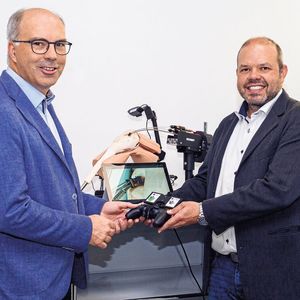
(Image: University Hospital Basel: Kai-Marie Schimanski, Carl-Victor Krüger and Aidan Alberola)
Miracle II is based at the Department of Biomedical Engineering (DBE) of the Faculty of Medicine at the University of Basel. “There, researchers from the fields of computer science, engineering, robotics, laser physics, surgery and other disciplines are brought together to take bone surgery into the space age,” says Prof. Dr. Georg Rauter, head of the Biromed Lab (Bio-Inspired Robots for Medicine Laboratory) at the DBE. The corresponding miniature robot is to carry out functional cuts with previously unattainable precision for individually adapted implants manufactured directly at the point of care.
PC-Based Control as the Technological Basis
As part of his research, roboticist Prof. Dr. Georg Rauter has been working with Beckhoff’s PC-based control technology since 2008. He describes the starting point as follows: “At the time, we needed communication with several hundred components distributed across a large space. In addition, measurement cards were predominantly based on the PCI bus or PCI Express bus. To avoid the increasing difficulties regarding the number of interfaces and signal line lengths, we looked for a bus-based system and came across EtherCAT as a suitable solution—and thus also Beckhoff as a suitable control supplier.”
As a doctoral candidate, he began his activities with the development of a rowing simulator at ETH Zurich, based on a cable robot. The focus was on the synchronized control of two cable-based parallel robots, each with five drive strands. The aim of this rowing simulator was to autonomously teach people movements via an intelligent algorithm by providing personalized multimodal feedback on movement execution. Prof. Dr. Georg Rauter explains: “The intention was to investigate motor learning in complex movements in healthy individuals. However, since rowing can generate large forces, e.g. when immersing the oar, which the simulator must also be able to reproduce, safety was a key element of the simulator. Initially, the safety functionality was implemented with a separate safety controller. With TwinCAT 3, we now use the system-integrated safety technology TwinSAFE, which, for example, also enables seamless integration into the HMI. Another advantage of TwinCAT 3 is that we were able to keep the familiar workflow. This means we can continue to use a graphical programming environment as well as programming with MATLAB and Simulink. I really like the workflow with TwinCAT 3 Target for Simulink, which delivers a C++ project that can be integrated directly into TwinCAT and, after compilation, provides the appropriate machine code.” In addition, the TwinCAT workflow also benefits master’s students and new employees: “Every year there is a block course on this—twice in Basel and, due to its great popularity, now also once in Innsbruck. In addition, there are corresponding workshops held in connection with conferences that we organize. In principle, these courses are also open to industry participants who are particularly interested in implementing MATLAB and Simulink in TwinCAT 3.”
Implementation in Surgical Robotics
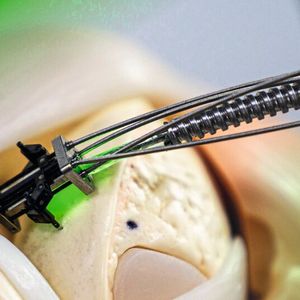
Prof. Dr. Georg Rauter applied his robotics know-how and experience with PC-based control to surgical robotics within the Miracle II project. The aim is classic orthopedic applications in which, during a minimally invasive procedure, the laser is introduced into the body together with an endoscope through a small opening and then precisely processes the bone or modifies its geometry and thus its stability. Building on this research, work is also moving in the direction of regenerative cartilage medicine. Serving as a platform for this is the miniature robot presented, among other venues, at the 2025 World Expo in Osaka, Japan, which can be used to illustrate interdisciplinary collaboration through a specific application in the knee—laser osteotomy or regenerative cartilage medicine.
Prof. Dr. Georg Rauter explains: “Parallel robotics combined with a laser—that is our core focus here in Basel and is also unique at miniaturized dimensions. Currently, surgical robotics uses large devices placed on the floor with correspondingly large kinematic chains that have to be laboriously stabilized to ensure sufficient precision. Our miniature robot, by contrast, is supported locally on the tissue and also introduces the laser there, which itself exerts no interaction forces. This allows the system to be positioned very precisely without having to compensate for disturbing forces. The required torques are introduced from the outside via flexible spindles. Overall, with a cross-section of 7.5 × 7.5 mm (approx. 0.3 × 0.3 inches), this design results in a very small footprint.”
Date: 08.12.2025
Naturally, we always handle your personal data responsibly. Any personal data we receive from you is processed in accordance with applicable data protection legislation. For detailed information please see our privacy policy.
Consent to the use of data for promotional purposes
I hereby consent to Vogel Communications Group GmbH & Co. KG, Max-Planck-Str. 7-9, 97082 Würzburg including any affiliated companies according to §§ 15 et seq. AktG (hereafter: Vogel Communications Group) using my e-mail address to send editorial newsletters. A list of all affiliated companies can be found here
Newsletter content may include all products and services of any companies mentioned above, including for example specialist journals and books, events and fairs as well as event-related products and services, print and digital media offers and services such as additional (editorial) newsletters, raffles, lead campaigns, market research both online and offline, specialist webportals and e-learning offers. In case my personal telephone number has also been collected, it may be used for offers of aforementioned products, for services of the companies mentioned above, and market research purposes.
Additionally, my consent also includes the processing of my email address and telephone number for data matching for marketing purposes with select advertising partners such as LinkedIn, Google, and Meta. For this, Vogel Communications Group may transmit said data in hashed form to the advertising partners who then use said data to determine whether I am also a member of the mentioned advertising partner portals. Vogel Communications Group uses this feature for the purposes of re-targeting (up-selling, cross-selling, and customer loyalty), generating so-called look-alike audiences for acquisition of new customers, and as basis for exclusion for on-going advertising campaigns. Further information can be found in section “data matching for marketing purposes”.
In case I access protected data on Internet portals of Vogel Communications Group including any affiliated companies according to §§ 15 et seq. AktG, I need to provide further data in order to register for the access to such content. In return for this free access to editorial content, my data may be used in accordance with this consent for the purposes stated here. This does not apply to data matching for marketing purposes.
Right of revocation
I understand that I can revoke my consent at will. My revocation does not change the lawfulness of data processing that was conducted based on my consent leading up to my revocation. One option to declare my revocation is to use the contact form found at https://contact.vogel.de. In case I no longer wish to receive certain newsletters, I have subscribed to, I can also click on the unsubscribe link included at the end of a newsletter. Further information regarding my right of revocation and the implementation of it as well as the consequences of my revocation can be found in the data protection declaration, section editorial newsletter.
High-Performance Control Technology in Demand
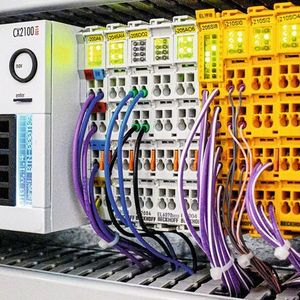
The drive trains that must be operated in parallel require high-performance control technology for synchronization, as provided by TwinCAT, the embedded PC CX2043, and the EtherCAT and TwinSAFE terminals from Beckhoff. This enables the planar system to reliably utilize its three planar degrees of freedom: forward/backward motion, lateral movements, and rotation. For this purpose, a total of four EtherCAT- and FSoE-capable small servo motors are used, including redundancy, which bring the robot to the desired position via flexible spiral lead screws. Prof. Dr. Georg Rauter describes the special control-engineering aspect as follows: “Due to the redundant drive, the controller does not have to solve a linear system of equations, but rather a real-time optimization problem in order to arrive iteratively—and several times every millisecond—at the best possible result.”
The high functionality of TwinCAT is used very broadly, according to Prof. Dr. Georg Rauter: “A good example is TwinCAT HMI, where I particularly like the data exchange across different logics—from C++ to the PLC or hardware and all the way to safety. In addition, our kinematics can be conveniently integrated into TwinCAT, and you can easily communicate with third-party components via ADS, for example with machine-learning-based vision components. This openness and flexibility are offered by TwinCAT and EtherCAT not least because of their widespread adoption. Therefore, for all requirements there are also components available with the appropriate interfaces.”
Benefits Through Close Collaboration
According to Prof. Dr. Georg Rauter, research at the University of Basel also benefits from the close cooperation with Beckhoff Switzerland. Important aspects in this regard are the very short response times to specific inquiries as well as the possibility of testing hardware at short notice. For example, they were able to test the application potential of the intelligent transport system XPlanar for a year. In addition, their own development suggestions regarding control technology are listened to openly and reviewed.
“Ten years ago, the safe and reliable communication and automation technology from Beckhoff, which we originally used on the rowing simulator at ETH, enabled a technology transfer: in the form of the world’s first cable robot for free, body-weight-supported 3D gait rehabilitation over ground, ‘The FLOAT,’ developed together with Reha-Stim Medtec AG, Schlieren, Switzerland, and the University of Zurich’s Paraplegic Center at Balgrist. We are now looking forward to achieving this step of commercialization—thanks to robust automation technology—in surgical robotics as well, as soon as possible.”