The semiconductor industry is picking up the pace: How linear axes, mechatronic solutions, and subsystems are shortening the time from the lab to mass production and boosting the performance of machines and systems.
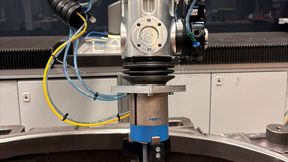
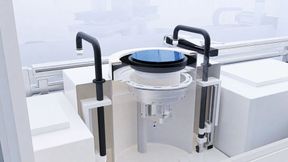
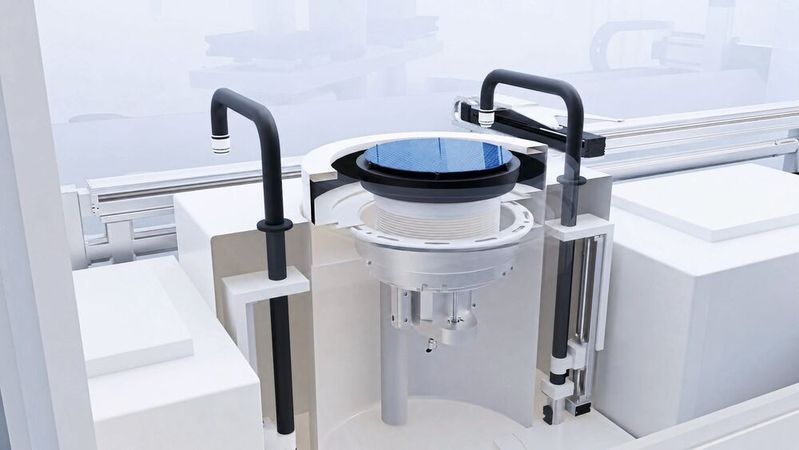
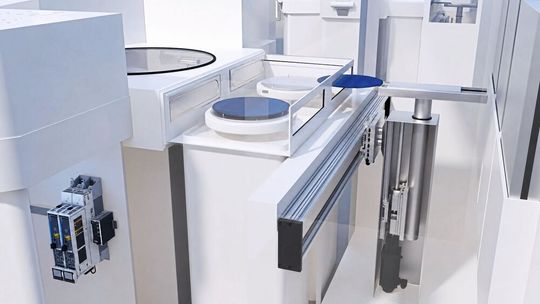
Figure 1: Subsystem developed through co-development: wafer handling system for wet etching.
(Image: Bosch Rexroth)
Demand for increasingly powerful chips, memory, and electronic components is on the rise. According to a McKinsey analysis, the global semiconductor market is projected to grow from $775 billion to as much as $1.6 trillion between 2024 and 2030 under a base-case scenario. To keep pace with this rapid development, machine manufacturers and OSAT (Outsourced Semiconductor Assembly and Test) suppliers must develop their equipment even faster, accelerate prototyping, and shorten the time to series production. Time to market is becoming a key competitive factor.
How Linear Technology and Mechatronics Contribute
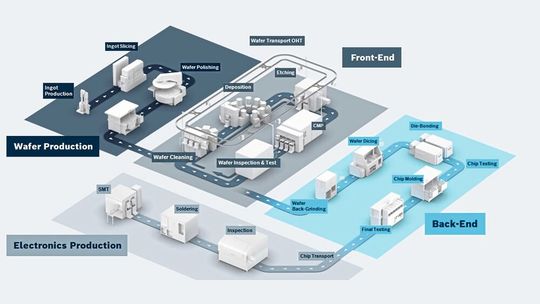
Anyone looking to industrialize machine and plant designs more quickly needs modular, compact, and adaptable automation solutions. Their quality, performance, and efficiency also depend on the linear technology and mechatronics used, with each phase of the value stream presenting its own challenges. For example, the front end requires an optimal combination of precision and reliability, while the back end demands maximum throughput and highly dynamic movements.
Figure 4: Increased throughput, yield, and scalability: With its broad portfolio of linear technology and mechatronics solutions, Bosch Rexroth covers the entire value stream of semiconductor and electronics manufacturing.
(Image: Bosch Rexroth)
To accelerate go-to-market under the respective conditions with a high degree of standardization, Bosch Rexroth relies on three pillars: a globally available portfolio of compact, cleanroom-certified linear technology components; mechatronic assemblies based on standard components; and ready-to-install, tested subsystems that can be brought to series production in the shortest possible time. These three approaches, which vary in their level of integration, offer equipment manufacturers a high degree of flexibility and have proven themselves in practice. Over the past 25 years, Bosch Rexroth has commissioned more than 150,000 assemblies in the industry.
How Linear Modules Streamline Engineering
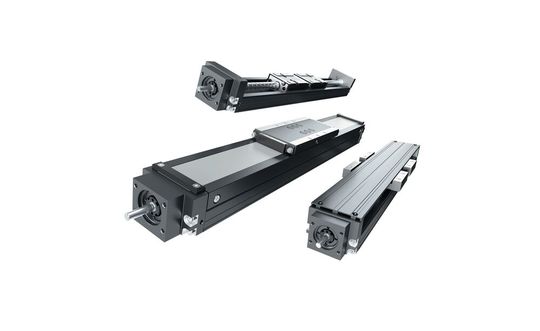
The first step toward shorter development times involves industry-specific assemblies, such as electromechanical cylinders or linear modules. For example, the PSK precision series—with a steel main body and integrated guide rails—ensures exceptionally high precision and rigidity in the vertical axes of wafer and pin lifts. Larger-scale movements, such as those encountered in wafer handling, can be optimally achieved using Compact modules, which combine high dynamics and power density.
Figure 3: Designed for semiconductor and electronics manufacturing: The linear modules in the PSK precision series reduce cycle times and the time required for engineering and assembly.
(Image: Bosch Rexroth)
In addition to directly driven linear modules for precision and high-speed applications, equipment manufacturers frequently use linear motor axes and linear actuators, as well as mechatronic handling systems that include drive technology. Profile rail guides with integrated measurement systems and high-precision ball screws have also proven their worth. For the interlinking of systems and processes, equipment manufacturers will also find cleanroom-compatible assembly, transfer, and material-handling systems in the Rexroth portfolio, ranging all the way to flexible 7-axis cobots from Kassow Robots.
Certified Quality for All Payload Classes
Rexroth's broad portfolio of linear technology covers the entire spectrum of the semiconductor and electronics value chain. In addition to linear guides and precision lead screws, equipment manufacturers will find a selection of linear axes and components that have been tested by Fraunhofer IPA in accordance with ISO 14644-1 and certified for cleanroom classes up to ISO 3. For special environmental conditions such as cleanrooms, vacuum environments, or contact with corrosive substances, standard variants with special coatings or made from special materials are available. Examples include the NRTVG guide carriage, which is made entirely of metal, and special lubricants such as the cleanroom grease Castrol Tribol GR 215.
Mechatronic Subsystems as Game-Changers
The most comprehensive way to reduce the effort required for development, design, and validation is through co-development of ready-to-install subsystems (subassemblies). Joint solution development with Bosch Rexroth based on standard components—including precise motion control—makes sense when system complexity increases and the customer wants to focus more on the actual manufacturing process. As part of such a go-to-market partnership, Rexroth experts combine technically coordinated standard products from linear technology, drive technology, and control technology into ready-to-install subsystems.
Real-World Examples: Wafer Handling
Such pre-engineered subsystems can be quickly adapted to specific process requirements and integrated into the new machine with minimal effort. Typical front-end examples include wafer lifts for cleaning, etching, deposition, or chemical-mechanical polishing (CMP), as well as multi-axis loading and unloading systems.
Date: 08.12.2025
Naturally, we always handle your personal data responsibly. Any personal data we receive from you is processed in accordance with applicable data protection legislation. For detailed information please see our privacy policy.
Consent to the use of data for promotional purposes
I hereby consent to Vogel Communications Group GmbH & Co. KG, Max-Planck-Str. 7-9, 97082 Würzburg including any affiliated companies according to §§ 15 et seq. AktG (hereafter: Vogel Communications Group) using my e-mail address to send editorial newsletters. A list of all affiliated companies can be found here
Newsletter content may include all products and services of any companies mentioned above, including for example specialist journals and books, events and fairs as well as event-related products and services, print and digital media offers and services such as additional (editorial) newsletters, raffles, lead campaigns, market research both online and offline, specialist webportals and e-learning offers. In case my personal telephone number has also been collected, it may be used for offers of aforementioned products, for services of the companies mentioned above, and market research purposes.
Additionally, my consent also includes the processing of my email address and telephone number for data matching for marketing purposes with select advertising partners such as LinkedIn, Google, and Meta. For this, Vogel Communications Group may transmit said data in hashed form to the advertising partners who then use said data to determine whether I am also a member of the mentioned advertising partner portals. Vogel Communications Group uses this feature for the purposes of re-targeting (up-selling, cross-selling, and customer loyalty), generating so-called look-alike audiences for acquisition of new customers, and as basis for exclusion for on-going advertising campaigns. Further information can be found in section “data matching for marketing purposes”.
In case I access protected data on Internet portals of Vogel Communications Group including any affiliated companies according to §§ 15 et seq. AktG, I need to provide further data in order to register for the access to such content. In return for this free access to editorial content, my data may be used in accordance with this consent for the purposes stated here. This does not apply to data matching for marketing purposes.
Right of revocation
I understand that I can revoke my consent at will. My revocation does not change the lawfulness of data processing that was conducted based on my consent leading up to my revocation. One option to declare my revocation is to use the contact form found at https://contact.vogel.de. In case I no longer wish to receive certain newsletters, I have subscribed to, I can also click on the unsubscribe link included at the end of a newsletter. Further information regarding my right of revocation and the implementation of it as well as the consequences of my revocation can be found in the data protection declaration, section editorial newsletter.
Figure 2: Wafer-handling system for loading the etching chamber. Development based on standard components such as the Rexroth Compact Module (center) shortens the time to the first prototype and, subsequently, to production readiness.
(Image: Bosch Rexroth)
Thanks to the flexible combination of linear axes, mechatronic modules, servomotors, and other components of the open automation platform ctrlX AUTOMATION, Bosch Rexroth can quickly develop high-performance subassemblies that meet the highest standards for uniformity, precision, and reliability. For example, processes such as spraying, dipping, or dosing must be carried out with positional accuracy in the micrometer range.
In addition, the installation space for mechatronics is often limited, which is why—in wet etching, for example—the vertical movement of the spray arms is achieved using compact linear modules from the PSK precision series. Many other development challenges were also solved using Rexroth standard components, including vibration issues, resistance to corrosive chemicals, and integration into wet lab handling systems and robotic transfer modules.
Co-development is often twice as fast
The time savings achievable through co-development range from rapid concept evaluation to the development of initial solution approaches and the creation of functional prototypes. In most cases, the Semicon experts at Bosch Rexroth can present an initial solution proposal or proof-of-concept within just 48 hours and produce a customer-specific prototype in less than three months—regardless of whether the project involves a new application or machine optimization in terms of installation space, precision, or cycle time.
Based on practical experience, the time from the initial idea to production readiness can often be cut in half. A key factor in this is support for rollouts, which are often global in scope. To meet the high demands for availability, quality, and reproducibility, Bosch Rexroth operates an international network of development, application, and manufacturing sites tailored to the needs of the semiconductor and electronics industries. This enables jointly developed concepts to be rapidly validated and scaled “copy exact” as standardized, reproducible machine designs.
Conclusion: Three Approaches Based on the Level of Integration
Collaborating with a full-service provider and an industry-experienced development partner for motion control tasks saves time and enables equipment manufacturers to reduce the workload on their own development teams, focus more intently on the process, and confidently position themselves in the race for the fastest time-to-market in semiconductor and electronics manufacturing. At Bosch Rexroth, they’ll find the right level of support for every degree of integration: from precision linear technology components for in-house development work, to accelerated engineering with linear modules and standardized mechatronics solutions, to efficient co-development based on proven subassemblies that achieve maximum throughput and yield. (mc)
*Jan Kazmaier is Senior Sales Manager for the Semiconductor and Electronics Industry at Bosch Rexroth AG