









Additive Manufacturing Integrating Pneumatics into Additively Manufactured Grippers
Related Vendors


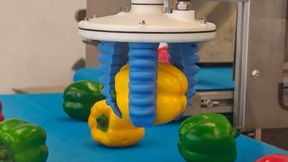
In the food and packaging industries, grippers must handle products of various shapes quickly and gently. To address this, SoftGripping GmbH has used additive manufacturing to produce a gripper base with integrated air channels. Selective laser sintering enables a compact design with fewer individual parts.
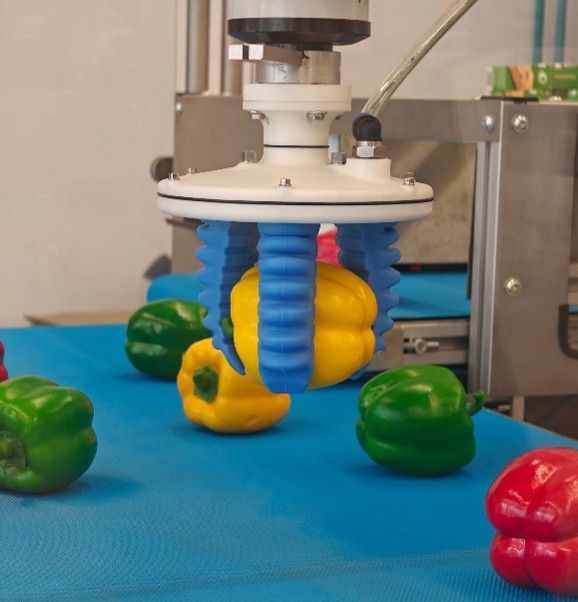
Vegetables and poultry parts are not always the same size or shape. Grippers must compensate for such variations while reliably picking up products without damaging them. SoftGripping, based in Hanover, develops pneumatic gripping systems with flexible silicone fingers for such applications. A key challenge lay not only in the fingers themselves but also in the gripper base: It had to accommodate the fingers and direct compressed air precisely to them—ideally without additional hoses, connectors, or seals.Conventional machining could not produce the desired air flow path as a single, continuous component. The base would have had to consist of several parts that would then need to be joined and sealed. Every additional interface increases design and assembly complexity and can be a potential leak point. To achieve a compact, hygienically designed gripper solution, SoftGripping therefore sought a manufacturing process capable of producing complex internal geometries.
Sign in or register and read on
Please log in or register and read this article. To be able to read this article in full, you must be registered. Free registration gives you access to exclusive specialist information.
Already registered? Log in here

