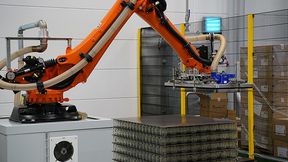
Chinese machine builders are often still viewed as newcomers in German industry, with some skepticism. Ironically, it is in the aerospace industry—one of the most demanding sectors of all—that the Shanghai-based company TOPNC has already made a name for itself. Now, the manufacturer of high-end CNC machine tools aims to conquer the German market as well—and has opened a branch right next to an Airbus plant to that end.
In the aerospace industry—one of the most demanding sectors of all—the Shanghai-based company TOPNC has already made a name for itself.
(Image: TOPNC)
Anyone looking into TOPNC’s product lineup will initially see what they’re familiar with from established gantry machine manufacturers: large, five-axis machining centers for aerospace and structural components. The difference lies in the details—or, more precisely, in the crossbeam. “We are the only company in the world that builds a gantry machine with a combined carbon and honeycomb core crossbeam,” says Thomas Haurenherm, Head of Sales at TOPNC in Germany. Instead of the 4.8-metric-ton Z/Y-axis structure typical of other manufacturers, TOPNC’s design weighs just 1.8 metric tons—while offering significantly higher rigidity. This results in lower mass, reduced energy consumption, greater dynamics, less heat input, and less complex machine foundations.
From a "Hidden Champion" in China to a Publicly Traded Company in Hong Kong
Shanghai Top Numerical Control Technology—the company’s official name—was founded in 2007 by Wang Yuhan, a professor at Shanghai Jiao Tong University. In China, TOPNC has secured a market share of approximately 80 percent in the field of high-precision five-axis machining centers for the aerospace industry—its customers include suppliers for the Chinese C919 wide-body aircraft as well as for components of the Long March family of launch vehicles, such as large-format tank structures with diameters of up to five meters. This year, the company went public on the Hong Kong Stock Exchange—a move that, according to company representatives, is explicitly intended to advance its internationalization. “We are already successfully positioned in the high-end five-axis segment in China and have gained extensive experience in the aerospace and general industrial sectors. Now we want to go global,” said Jane Gao, Director of Commercial & International Business.
TOPNC openly acknowledges that the path to Western markets is not automatically paved with open doors. In the aviation sector, for example, major Tier 1 suppliers initially turned them down. According to the company, they gained access not through price, but by offering solutions to specific technical problems.
Service Rather Than a Purely Price-Based Strategy
(Image: TOPNC)
For German buyers, the decisive factor is likely to be not so much the gantry technology as the issue of service and spare parts supply—which, based on experience, is the biggest hurdle with Chinese suppliers. TOPNC has responded to this: Its European headquarters is located in Nordenham—deliberately situated in the immediate vicinity of an Airbus plant. In Germany, Austria, and Switzerland, there are now about ten service technicians on staff, along with a spare parts warehouse and showrooms in northern and southern Germany. “A professional partnership with our customers is important to us. It’s not about selling a machine and then running off,” says Haurenherm. The company also aims to stand out when it comes to language: The hotline is operated in German, not in English or Chinese—a detail that, in practice, can make all the difference in building trust.
After launching in the DACH region, TOPNC plans to expand into the United Kingdom, Scandinavia, France, and Italy. The stated goal: to be among the top five providers of large-scale portal machines worldwide within five years.
A Mid-Sized Company Despite a Market Worth Billions
One aspect that comes up time and again in conversation is the company culture. Despite its IPO and growing international business, TOPNC describes itself as owner-managed and quick to make decisions. “I spoke with the boss for an hour yesterday, and we resolved all the issues. No ten meetings, no endless discussions,” says Gao. For German SMEs, which are accustomed to direct contact with decision-makers, this could be a surprisingly familiar working model—closer to the structure of a German family-owned business than to the image of anonymous Chinese conglomerates that still prevails in some parts of the industry.
Date: 08.12.2025
Naturally, we always handle your personal data responsibly. Any personal data we receive from you is processed in accordance with applicable data protection legislation. For detailed information please see our privacy policy.
Consent to the use of data for promotional purposes
I hereby consent to Vogel Communications Group GmbH & Co. KG, Max-Planck-Str. 7-9, 97082 Würzburg including any affiliated companies according to §§ 15 et seq. AktG (hereafter: Vogel Communications Group) using my e-mail address to send editorial newsletters. A list of all affiliated companies can be found here
Newsletter content may include all products and services of any companies mentioned above, including for example specialist journals and books, events and fairs as well as event-related products and services, print and digital media offers and services such as additional (editorial) newsletters, raffles, lead campaigns, market research both online and offline, specialist webportals and e-learning offers. In case my personal telephone number has also been collected, it may be used for offers of aforementioned products, for services of the companies mentioned above, and market research purposes.
Additionally, my consent also includes the processing of my email address and telephone number for data matching for marketing purposes with select advertising partners such as LinkedIn, Google, and Meta. For this, Vogel Communications Group may transmit said data in hashed form to the advertising partners who then use said data to determine whether I am also a member of the mentioned advertising partner portals. Vogel Communications Group uses this feature for the purposes of re-targeting (up-selling, cross-selling, and customer loyalty), generating so-called look-alike audiences for acquisition of new customers, and as basis for exclusion for on-going advertising campaigns. Further information can be found in section “data matching for marketing purposes”.
In case I access protected data on Internet portals of Vogel Communications Group including any affiliated companies according to §§ 15 et seq. AktG, I need to provide further data in order to register for the access to such content. In return for this free access to editorial content, my data may be used in accordance with this consent for the purposes stated here. This does not apply to data matching for marketing purposes.
Right of revocation
I understand that I can revoke my consent at will. My revocation does not change the lawfulness of data processing that was conducted based on my consent leading up to my revocation. One option to declare my revocation is to use the contact form found at https://contact.vogel.de. In case I no longer wish to receive certain newsletters, I have subscribed to, I can also click on the unsubscribe link included at the end of a newsletter. Further information regarding my right of revocation and the implementation of it as well as the consequences of my revocation can be found in the data protection declaration, section editorial newsletter.
TOPFAB: The Small, AI-Powered Spin-Off
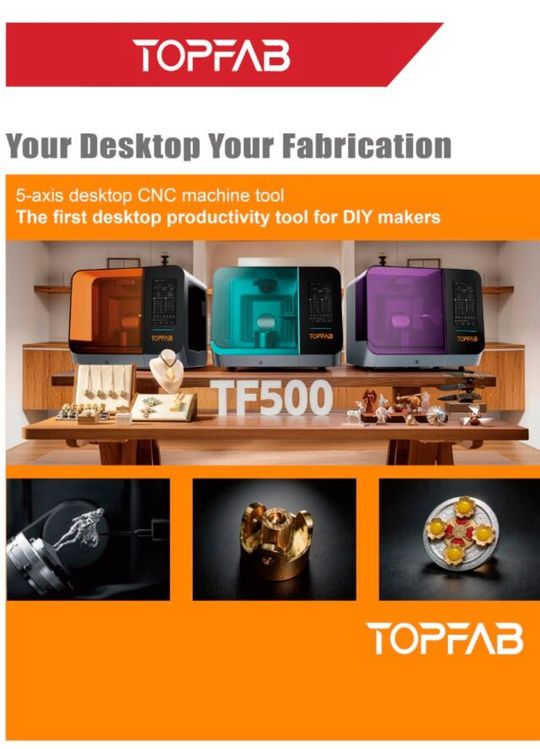
While the portal machines are designed for large aerospace components, the subsidiary TOPFAB targets the other end of the market: compact five-axis milling machines for prototyping, training, and small-batch production. The centerpiece is a desktop machine weighing about 75 kilograms, featuring an integrated camera for automatic material recognition and calibration, a measurement system, and six tool stations. It can be operated either via traditional G-code or through an AI-powered prompt system: Users take a photo of the raw part, enter a description, and the software generates the machining strategy based on that information—which can also be accessed from a tablet or smartphone.
According to TOPNC, the target groups are primarily educational institutions and CAD/CAM training programs, but also sectors such as the watch industry and dental technology, where small, high-precision components are in demand in small quantities.