What is a “bottleneck” for data center operators is a gold mine for suppliers. The lists of newly minted millionaires and billionaires in Asia are growing rapidly. Among the new entrants are founders of companies like Envicool in Shenzhen, which provide cooling solutions for AI chips.
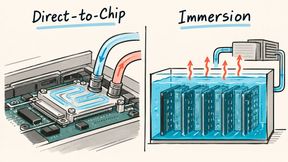
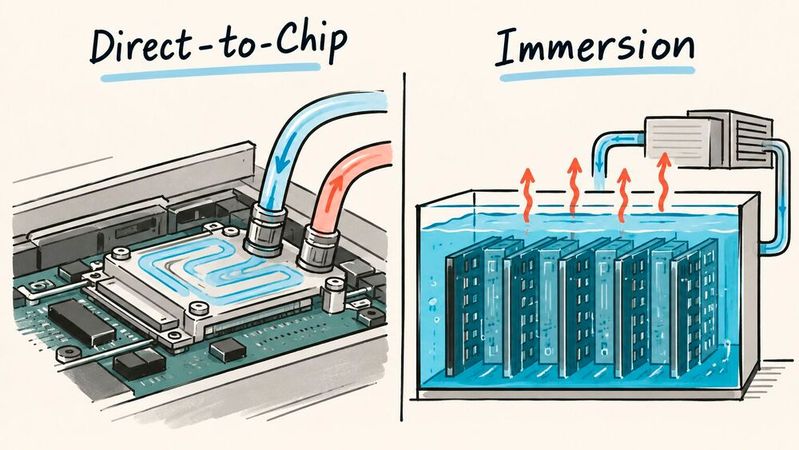
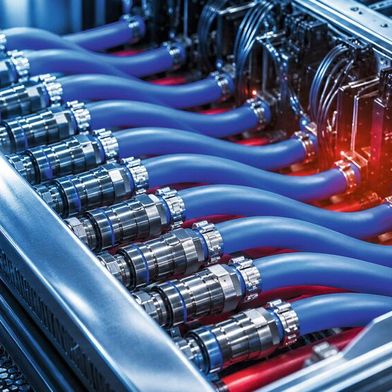
Illustration: In direct-to-chip cooling, a heat sink absorbs heat directly from the processor. In immersion cooling, on the other hand, the electronic components are completely submerged in an electrically insulating coolant.
(Image: Dall-E / AI-generated)
A single Nvidia Blackwell B200 processor consumes more than 1,000 watts, according to a February 2026 report in the Hong Kong newspaper South China Morning Post. Dozens of them, packed tightly into a single server rack, generate a great deal of waste heat. Air cooling quickly reaches its limits in such situations.
At “Data Center World Asia,” held September 29–30 in Singapore, the leading manufacturers of cooling systems for AI data centers showcased their latest products. The event provided a great opportunity to see which companies are on the rise in the industry and which technical trends in cooling are currently gaining momentum.
Chinese cooling specialists such as Envicool, Midea, Shenling, Sugon Data Energy, and Goaland were in attendance at the Marina Bay Sands Hotel, as were industry suppliers, including Sanhua, Kehua Data, and Lansi Technology. Among their international competitors, Vertiv and Delta Electronics were present. Potential customers included Chinese technology companies such as Alibaba and Tencent, as well as Google, Intel, and Nvidia.
It Won't Work without Cooling
The U.S. government in Washington may be waging a chip and technology war against China to hinder its economic rise, but American hyperscalers cannot build their data centers without Chinese suppliers. This is particularly evident when it comes to cooling.
According to media reports, Envicool, a Chinese precision cooling and temperature management specialist based in Shenzhen that supplies cooling systems for data centers, also welcomed a delegation from Google Taiwan to its headquarters earlier this year. Neither company was willing to comment publicly on the meeting afterward.
The two main technological approaches that China’s cooling experts are currently pursuing are “direct-to-chip” cooling and immersion cooling. Envicool, whose stock price rose 255 percent last year before falling slightly at times this year, focuses on the most widely used direct-to-chip cooling. The Shenzhen-based up-and-comer showcased its latest-generation “Cooling Distribution Units” (CDUs). According to a report by the Reuters news agency earlier this year, Envicool has reportedly already built a version of this critical component of cooling systems—which controls the distribution of coolant to specific server racks—that meets the specifications for Google’s servers.
Envicool is expanding its production facilities in the southern Chinese province of Guangdong, in Thailand, and in the United States. The Chinese manufacturer is thus becoming a strong competitor to Taiwanese companies such as Foxconn, Auras, and Delta Asia in this market.
Cooling Considered from the Very Beginning
Midea Building Technologies, a division of the Chinese Midea Group, unveiled an architectural concept in Singapore that integrates power supply, energy storage, and cooling right from the planning stage of a data center. Midea’s offerings range from individual components to complete systems that handle multiple cooling tasks.
A particularly large number of innovations are in the field of cooling system infrastructure, such as the cooling plate on the chip, which supplies and distributes the coolant. At the event in Singapore, Midea showcased its “Magnetic CDU,” which is said to enable particularly effective distribution of coolant within the cooling plates for chips. This solution combines a cooling source with magnetic bearing technology and fluid distribution into a single unit. Compared to a separate chiller and a passive CDU, the manufacturer promises that this saves up to 70 percent of the installation space. For data center planners, this is a concrete way to reduce the space required for cooling technology.
Sanhua Intelligent Controls, a Chinese manufacturer of heating, air conditioning, and thermal management components based in Shenzhen, southern China, was represented with a booth at the event; the company is currently expanding its presence in the liquid cooling market. “We are actively expanding our business with liquid-cooled servers and continuing to foster relevant partnerships,” explained a spokesperson for Sanhua Intelligent Controls on an investor platform. In particular, he highlighted the thermal management components for liquid cooling that his company produces.
Date: 08.12.2025
Naturally, we always handle your personal data responsibly. Any personal data we receive from you is processed in accordance with applicable data protection legislation. For detailed information please see our privacy policy.
Consent to the use of data for promotional purposes
I hereby consent to Vogel Communications Group GmbH & Co. KG, Max-Planck-Str. 7-9, 97082 Würzburg including any affiliated companies according to §§ 15 et seq. AktG (hereafter: Vogel Communications Group) using my e-mail address to send editorial newsletters. A list of all affiliated companies can be found here
Newsletter content may include all products and services of any companies mentioned above, including for example specialist journals and books, events and fairs as well as event-related products and services, print and digital media offers and services such as additional (editorial) newsletters, raffles, lead campaigns, market research both online and offline, specialist webportals and e-learning offers. In case my personal telephone number has also been collected, it may be used for offers of aforementioned products, for services of the companies mentioned above, and market research purposes.
Additionally, my consent also includes the processing of my email address and telephone number for data matching for marketing purposes with select advertising partners such as LinkedIn, Google, and Meta. For this, Vogel Communications Group may transmit said data in hashed form to the advertising partners who then use said data to determine whether I am also a member of the mentioned advertising partner portals. Vogel Communications Group uses this feature for the purposes of re-targeting (up-selling, cross-selling, and customer loyalty), generating so-called look-alike audiences for acquisition of new customers, and as basis for exclusion for on-going advertising campaigns. Further information can be found in section “data matching for marketing purposes”.
In case I access protected data on Internet portals of Vogel Communications Group including any affiliated companies according to §§ 15 et seq. AktG, I need to provide further data in order to register for the access to such content. In return for this free access to editorial content, my data may be used in accordance with this consent for the purposes stated here. This does not apply to data matching for marketing purposes.
Right of revocation
I understand that I can revoke my consent at will. My revocation does not change the lawfulness of data processing that was conducted based on my consent leading up to my revocation. One option to declare my revocation is to use the contact form found at https://contact.vogel.de. In case I no longer wish to receive certain newsletters, I have subscribed to, I can also click on the unsubscribe link included at the end of a newsletter. Further information regarding my right of revocation and the implementation of it as well as the consequences of my revocation can be found in the data protection declaration, section editorial newsletter.
Power system manufacturer Kehua Data and electronics manufacturer Lansi Technology also announced plans this year to expand their cooling technology production. Both are examples of suppliers that grew large in other industries but have now recognized the business opportunity presented by data centers and are making a major push into the market. Kehua Data is a Chinese manufacturer of power supply systems and cloud infrastructure services that is currently expanding rapidly in the field of data center cooling.
Lansi Technology, or “Lansi Keji”—also known outside China as “Lens Technology”—is a manufacturer of precision components for consumer electronics founded by entrepreneur Zhou Qunfei. When Lens Technology became an Apple supplier, it made Zhou Qunfei a billionaire. It’s unimaginable that she would let an opportunity like data center cooling slip away.
No One Can Hold a Candle to Liquid Cooling
The big race between air and liquid cooling appears to be largely decided worldwide. According to a Bank of America forecast from September of this year, liquid cooling could be used in 70 percent of new AI data center installations by 2030. At the time of the report, the figure was around 30 percent. For Chinese suppliers, therefore, the key issue right now is choosing the fastest-growing technological path in an already rapidly growing market.
In direct-to-chip cooling, coolant flows through closed loops in plates attached to the processors. With immersion cooling, server components are submerged in a liquid bath. The choice of technology also depends on whether an existing data center is being retrofitted and what power density it must handle. For retrofits, cooling plates offer an economic advantage. Due to its technical maturity and comparatively low retrofitting costs, this method is likely to retain the largest share of the Chinese market for the time being, according to the Chinese industry portal Huajing Qiaobao Wang.
In addition to Envicool, Shenling Environmental Systems from Foshan is also among the up-and-coming suppliers of CDUs. These systems are used, among other things, in the modernization of data centers operated by Chinese telecommunications providers. Immersion cooling, as was clearly evident in Singapore, is, by contrast, the fastest-growing cooling technology. Sugon Data Energy, based in Beijing, develops complete systems and components for this purpose, which are used in supercomputers and AI computing facilities.
The components transfer their heat directly to an electrically insulating fluid. This is said to allow high-performance data centers to be cooled in a very small space while keeping noise levels low. Goaland, based in Guangzhou (Gaolon Gufen), offers both methods and also builds complete liquid cooling systems in a containerized design. The extent to which liquid-cooling systems can gain a foothold in the market also depends on costs. Observers in Beijing and Shenzhen expect that as costs decline, market share could grow in the long term.
When it comes to international competition among cooling specialists, Chinese suppliers benefit from their large domestic market. Numerous data center projects enable higher volume and lower costs. Government efficiency mandates for AI computing power and local subsidies for particularly energy-efficient systems further bolster demand. As a result, Chinese companies are becoming increasingly strong competitors to major providers such as Vertiv in the U.S. and Delta Electronics in Taiwan.