Traditional air cooling is increasingly reaching its limits with AI and HPC systems. Direct-to-chip, liquid, and two-phase cooling, as well as intelligent control methods, are set to dominate the next performance class.
Thermal management in the data center: Air cooling is no longer sufficient for AI applications, but liquid cooling is not universally applicable.
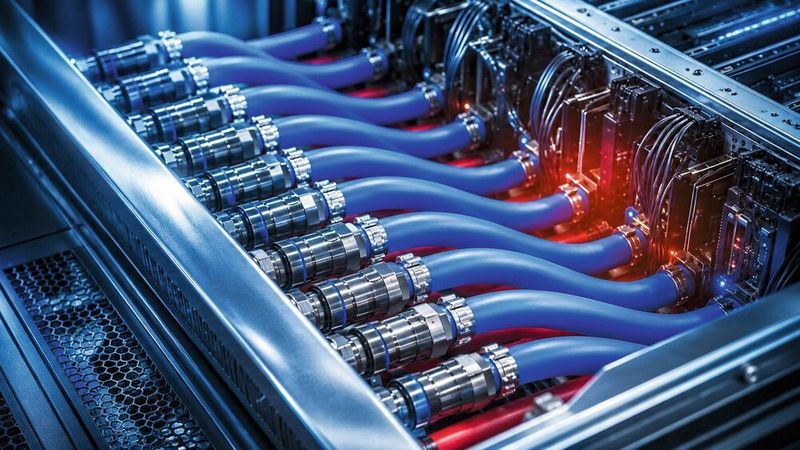
(Image: Dall-E / AI-generated)
The thermal architecture of data centers is changing. Not only do artificial intelligence applications generate increasingly higher heat loads, but communication is also becoming a thermal issue. At 112-Gbit/s PAM4, optical I/O modules typically consume 15 to 25 W according to interconnect specialist Molex, while modules for 224-Gbit/s PAM4 consume up to 40 W each. In a 32-port switch, optical modules alone generate a power dissipation of more than 1 kW.
Air Cooling Reaches Its Limits
Forced air cooling remains practical for many servers and especially for less densely packed areas. Molex considers a rack power of around 10 kW as a manageable scale for directed air cooling. Modern data centers are therefore increasingly combining air and liquid cooling.
As power density increases, so does the effort required for managing airflow, heat sinks, and fans. Optical transceivers are particularly critical: their design is largely dictated by existing slots and backward compatibility. More power loss therefore means more heat on an almost unchanged surface area.
The Potential of Drop-Down Heat Sinks
An interim solution is drop-down heat sinks. In this design, the heat sink does not contact the transceiver during insertion. Only in the last 10% of the insertion process is it lowered onto a defined contact surface. This allows the use of TIMs (Thermal Interface Materials) without them being damaged during the insertion process.
Molex reports an improvement in heat dissipation of up to 9 °C (16.2 °F) at 35 W compared to an optimized zipper-fin heat sink. This can be used either for lower fan speeds or for more powerful modules.
Direct-to-Chip Cooling Becomes the Standard for AI and HPC
At even higher power densities, heat dissipation moves directly to the heat source. In direct-to-chip cooling, a cold plate is placed directly on the CPU or GPU. Liquid transports the heat through a circuit to the coolant distribution unit and then to the heat sink.
Molex cites a rack power range of 25 to 50 kW as the threshold at which direct-to-chip cooling becomes relevant. However, this is not a fixed limit. The determining factors are heat flux density, chip power, coolant temperature, and system architecture. Other sources see direct-to-chip cooling and other liquid cooling concepts as applicable for AI racks in the range of about 50 to 100 kW and above. In practice, significantly higher rack power levels are already relevant today.
The key advantage of liquid cooling is its significantly higher heat transport capability compared to air. At the same time, the higher coolant temperatures can be used for heating, for example, buildings.
However, the development does not stop at CPUs and GPUs. In high-speed systems with 224 Gbit/s, cooling of optical I/O modules is also becoming increasingly relevant. A single cold plate per transceiver, however, would hardly be practical: with 32 ports, up to 32 supply and return lines would be required.
A solution, therefore, is a shared cold plate for multiple modules, which, however, presents mechanical challenges. The modules do not have exactly the same height; cages, connectors, and cooling surfaces also have tolerances. As a result, a rigid cold plate would thermally contact some modules well and others insufficiently.
Molex relies on a cold plate with floating pedestals. Spring-mounted cooling contacts compensate for mechanical tolerances, provide the necessary contact pressure, and thermally connect multiple QSFP-DD modules simultaneously. With a 1×6 QSFP-DD configuration, six modules can thus be cooled via a shared cold plate.
Two-Phase Liquid Cooling for Extreme Heat Flux Densities
As power density continues to increase, two-phase liquid cooling comes into play. The cooling medium evaporates at the heat source and transports the heat via its enthalpy of vaporization. This allows high heat flux densities to be achieved with relatively small temperature differences.
Date: 08.12.2025
Naturally, we always handle your personal data responsibly. Any personal data we receive from you is processed in accordance with applicable data protection legislation. For detailed information please see our privacy policy.
Consent to the use of data for promotional purposes
I hereby consent to Vogel Communications Group GmbH & Co. KG, Max-Planck-Str. 7-9, 97082 Würzburg including any affiliated companies according to §§ 15 et seq. AktG (hereafter: Vogel Communications Group) using my e-mail address to send editorial newsletters. A list of all affiliated companies can be found here
Newsletter content may include all products and services of any companies mentioned above, including for example specialist journals and books, events and fairs as well as event-related products and services, print and digital media offers and services such as additional (editorial) newsletters, raffles, lead campaigns, market research both online and offline, specialist webportals and e-learning offers. In case my personal telephone number has also been collected, it may be used for offers of aforementioned products, for services of the companies mentioned above, and market research purposes.
Additionally, my consent also includes the processing of my email address and telephone number for data matching for marketing purposes with select advertising partners such as LinkedIn, Google, and Meta. For this, Vogel Communications Group may transmit said data in hashed form to the advertising partners who then use said data to determine whether I am also a member of the mentioned advertising partner portals. Vogel Communications Group uses this feature for the purposes of re-targeting (up-selling, cross-selling, and customer loyalty), generating so-called look-alike audiences for acquisition of new customers, and as basis for exclusion for on-going advertising campaigns. Further information can be found in section “data matching for marketing purposes”.
In case I access protected data on Internet portals of Vogel Communications Group including any affiliated companies according to §§ 15 et seq. AktG, I need to provide further data in order to register for the access to such content. In return for this free access to editorial content, my data may be used in accordance with this consent for the purposes stated here. This does not apply to data matching for marketing purposes.
Right of revocation
I understand that I can revoke my consent at will. My revocation does not change the lawfulness of data processing that was conducted based on my consent leading up to my revocation. One option to declare my revocation is to use the contact form found at https://contact.vogel.de. In case I no longer wish to receive certain newsletters, I have subscribed to, I can also click on the unsubscribe link included at the end of a newsletter. Further information regarding my right of revocation and the implementation of it as well as the consequences of my revocation can be found in the data protection declaration, section editorial newsletter.
The European EuroHPC project TEXTAROSSA is investigating two-phase liquid cooling for future exascale systems. The EU project DYMAN combines two-phase cooling with dynamic control of cooling performance and processor workload.
Thermal Design Must Consider the Entire Heat Path
With increasing power density, especially for optical components, it is no longer sufficient to only consider a module's case temperature. Specifying a case temperature of, for example, 70 °C does not necessarily reflect the most critical internal component. Lasers, TIAs, and DSPs may have different thermal margins.
A more precise approach is a thermal analysis of the actually critical components. For this, temperature measurements, simulations, and system tests must be correlated.
This starts at the module level, where hotspots are identified, and extends to the simulation of the entire chassis. Components such as GPUs, SSDs, add-in cards, and I/O modules mutually influence the airflow and thus the temperature distribution.
European research projects such as DYMAN and ECO-Qube are therefore pursuing integrated thermal management, where IT load, cooling circuit, and energy consumption are optimized together.
Immersion Cooling Remains an Option for Highest Power Densities
With immersion cooling, the entire electronics are submerged in an electrically non-conductive liquid. The liquid absorbs the heat directly from the components and transfers it via a heat exchanger.
This solution is suitable for very high heat loads in the range of more than 50 kW per rack. The choice between direct-to-chip, rear-door heat exchanger, and immersion depends on rack power, hardware, infrastructure, and cost-effectiveness. Direct-to-chip cooling currently appears in the literature as the most established liquid cooling solution for AI and HPC applications.
Immersion cooling also has a significant drawback in high-speed communication: the dielectric properties of the cooling liquid change the electromagnetic boundary conditions. For connectors and high-speed components designed for air, this results in altered impedance and signal integrity. Accordingly, components qualified for data rates of 112- and 224-Gbit/s are required.
Hybrid Solutions: Combinations Instead of the Ultimate Cooling System
The development does not aim at completely replacing air cooling. Instead, a hybrid thermal architecture is emerging: air cooling handles less heat-critical components, direct-to-chip cools CPUs and GPUs, cold plates increasingly reach memory, power supply, and I/O, while immersion cooling remains an option for specialized high-performance applications.
The key will be thermal integration. Cooling, mechanics, power supply, and signal transmission can no longer be optimized independently at the upcoming performance levels. Power and cooling must therefore be designed in an integrated manner. The next generation of data centers will not simply be cooled more intensively but thermally re-engineered.



:quality(80)/p7i.vogel.de/wcms/ed/78/ed786ed6b280ff6c692908f01f715e3d/0113143253v1.jpeg "In our China Market Insider, we regularly provide you with relevant information straight from China. (Image:© Eisenhans - stock.adobe.com)")
:quality(80)/p7i.vogel.de/wcms/68/a5/68a5ce0896756c1dcf48dbeceefafbd3/0132300990v1.jpeg "Christoph Geigges is President and CEO of Walter AG. Headquartered in Tübingen (Germany), the company is one of the world’s leading suppliers of precision tools for metalworking. Under Geigges’ leadership, this long-established company is increasingly transforming itself from a tool manufacturer into an engineering partner that supports the entire manufacturing process. (Image: Walter AG)")
:quality(80)/p7i.vogel.de/wcms/3e/7c/3e7c26f44c68545fc7318597b6b65903/0133649650v1.jpeg "The flexible Heller circular storage system can store and process pallets measuring both 630 millimeters by 630 millimeters and 800 millimeters by 800 millimeters—even in mixed-mode operation. This makes the entire production line particularly flexible. (Image:Brighter)")
:quality(80)/p7i.vogel.de/wcms/16/29/162983885950ec1df27ab441bfe88613/0133132549v1.jpeg "Bernd Hermeler is the CEO of Cemecon AG. He studied mechanical engineering at RWTH Aachen University (Germany)—the very university from which the company emerged as a spin-off 40 years ago. Today, Hermeler is responsible for the global strategy of the coating specialist, which, with branches in Europe, the U.S., China, Japan, and India, is considered the global technology leader in the coating of cutting tools. (Image: Cemecon AG)")
:quality(80)/p7i.vogel.de/wcms/4b/7c/4b7c11f510878f154012d04c18a7c3cc/0133798118v1.jpeg "RobCo Becomes a Unicorn: The Munich-based robotics company has reached a valuation of more than one billion U.S. dollars and is driving the next generation of autonomous industrial robotics with Alfie. (Image:RobCo)")
:quality(80)/p7i.vogel.de/wcms/c8/a9/c8a96d5841d508c9e9c609c64168cbaa/0133758997v1.jpeg "Hospital Robotics: Neura Robotics' autonomous healthcare platform is designed to independently transport empty hospital beds between wards and floors. (Image:Neura Robotics)")
:quality(80)/p7i.vogel.de/wcms/88/dc/88dc38a1a0b5e016192ab83b0850fbd0/0133514708v1.jpeg "Scalable data sovereignty is the foundation for the transition from computationally intensive AI processing and growing data streams to sustainable, energy-efficient storage systems. (Image:Gemini / AI-generated)")
:quality(80)/p7i.vogel.de/wcms/1c/ef/1cef66e13c5cc02c5731fefcc99c00d2/0133697754v1.jpeg "Embodied AI in Industry: FMC³ Robotics combines AI-based perception and adaptation with traditional robot control to prepare robots for use in industrial manufacturing. (Image:FMC³/processed by AI)")
:quality(80)/p7i.vogel.de/wcms/a7/8a/a78a582a42a96aaaff38bd6b8f97a015/vishal-lal-mit-kernuhrv1.jpeg "It's ticking: Researchers have stabilized the first atomic clock. (Source: PTB)")
:quality(80)/p7i.vogel.de/wcms/36/f9/36f96a206fc408c9a632ce849de1f7fa/newsimage428299v1.jpeg "Polystyrene is used in protective packaging for televisions and electronic devices, in decorative moldings and baseboards for interior home construction, and even in Petri dishes. (Source: Hereon/Marcel Schwickerath)")
:quality(80)/p7i.vogel.de/wcms/90/30/90300137452b00d22f95113eff065ac3/fliehkraftkupplungen-und-bremsen-montage-centrifugal-clutches-and-brakes-assembly-1v1.jpeg "Installation: Centrifugal clutches should always be precisely matched to the machine. (Source: Amsbeck Machine Technology)")
:quality(80)/p7i.vogel.de/wcms/93/84/9384230e840a99a2015fdd3e0af11e2b/newsimage428236v1.jpeg "The crutch replicates the natural, biomechanical movement pattern of the human body. (Source: Leon Kast)")
:quality(80)/p7i.vogel.de/wcms/50/23/5023ffaefac8f9a47286b368143b88eb/0133801078v1.jpeg "Life isn't exactly a walk in the park for Porsche right now. And now Porsche management is saying that next year will be even worse. Read here to find out why that's supposed to be the case... (Image: Porsche)")
:quality(80)/p7i.vogel.de/wcms/2f/ab/2fabf62cdd2f57cb279e00931c91c869/0133794991v1.jpeg "The Atto 2 SUV is one of BYD's most popular plug-in hybrids. (Image:BYD)")
:quality(80)/p7i.vogel.de/wcms/e9/6e/e96e34d467ca1017f2a689275ae07302/0133815122v1.jpeg "Porsche CEO Leiters has shared new information about the company's model plans. (Image:Porsche)")
:quality(80)/p7i.vogel.de/wcms/0a/50/0a50938be0b598b36efc4e5457ed56dd/forvia-siege-zen-massage-16-9-06v1.jpeg "Seat with massage function by Forvia. (Source: Forvia)")
:quality(80)/p7i.vogel.de/wcms/4d/eb/4debf44ac7c0349544c70033bb9a182c/0133750488v1.jpeg "AI-enabled hardware: is a prerequisite for successful AI projects. (Image:Tung Lam)")
:quality(80)/p7i.vogel.de/wcms/36/f0/36f0472d20227013871aa790f4d48ac6/0133726018v1.jpeg "Ion beams can ablate, coat, or smooth surfaces down to the atomic level. Such processes are used, among other things, in optical chips, precision optics, and superconducting materials. (Image:AI-generated)")
:quality(80)/p7i.vogel.de/wcms/1f/47/1f47da6ee12c38a745eb478a04157a65/0133726100v1.jpeg "The schematic diagram shows the structure of a 3D NAND memory device with memory cells stacked on top of one another and vertical connections for high storage density. (Image:Dall-E / AI-generated)")
:quality(80)/p7i.vogel.de/wcms/b6/06/b6060e0b986e103e442b3971b6c0724c/0133731535v1.jpeg "Rendering of the planned Terafab facility in Texas (presumably generated using AI). Elon Musk does not seem to be making progress with his plans to operate his own semiconductor manufacturing facility. The SpaceX CEO has confirmed that he is currently in talks with TSMC regarding a stake in the Terafab project. (Image:SpaceX)")
:fill(fff,0)/images.vogel.de/vogelonline/companyimg/76800/76895/65.jpg "FAULHABER_120mm.jpg ()")
:quality(80)/p7i.vogel.de/wcms/35/e2/35e29bb4a9f8326c2c1fb2d772547828/adobestock-2094390289--c2-a9-20moneymoney-20-e2-80-93-20stock-adobe-com-ki-generiertv1.jpeg "A central question in the concept of the underwater data center was how to cool the server cabinets in sealed chambers on the seabed. (Symbol image) (Source: © moneymoney – stock.adobe.com / AI-generated)")
:quality(80)/p7i.vogel.de/wcms/7d/17/7d174cbff42173176bae8b12dcec0c18/0132966756v1.jpeg "Thermal management: Custom and mechanically perfectly adapted heat sink solutions for the application provide users with efficient thermal management for many applications. (Image:© Fischer Elektronik)")
:quality(80)/p7i.vogel.de/wcms/d6/a5/d6a598893f7f79a0d8625f51e16d305f/0127360662v1.jpeg "Thermal management: Thermally conductive and electrically insulating interface materials (TIM) offer an effective, straightforward, and cost-efficient solution. (Image: ©Tatyana Evdokimova – stock.adobe.com / AI-generated)")