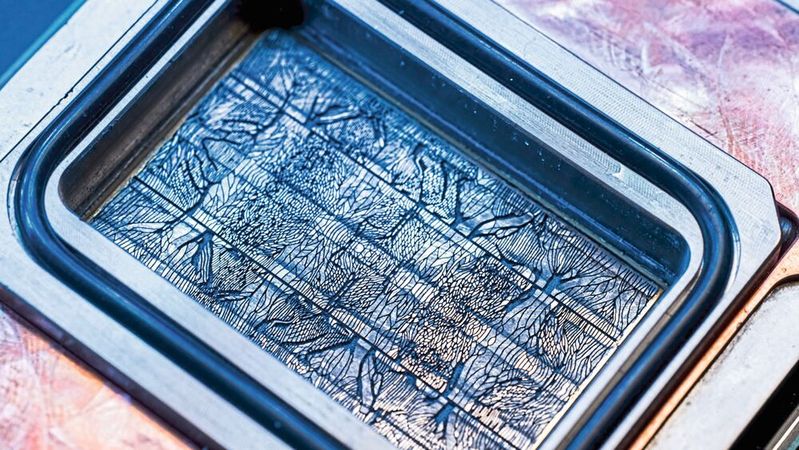
Microsoft showcases cooling channels etched directly into the back of the chip. The microfluidics direct the coolant to hotspots, significantly reducing temperature peaks. The company is evaluating integration into future proprietary chips and describes it as a realistic path toward data centers.
Microfluidics in the chip: Channels are etched into the silicon, allowing coolant to flow directly onto the chip and dissipate heat more efficiently.
(Image: Dan DeLong for Microsoft)
AI servers are running hot. With each GPU generation, TDP and power density increase, and traditional cold plates are foreseeably reaching their limits. In Microsoft's lab setup, coolant circulates through finely structured channels in the silicon. Measurements showed up to three times higher heat dissipation compared to cold plates. Part of the experiments included a Teams-related workload. The channel geometry was developed with support from Corintis, which optimizes topologies for local hotspots using AI. Microsoft also reports a 65 percent reduction in maximum temperature increase in the GPU silicon.
Microfluidics would enable designs with higher power density, offering more customer-relevant functions and better performance in smaller spaces. "Those who continue to rely heavily on traditional cold plate technology will not progress," said Sashi Majety of Microsoft.
Status Quo With Cold Plates: Future Vs. Today
Today, direct-to-chip liquid cooling with cold plates and single-phase water or water-glycol circuits dominates in hyperscaler and increasingly in colocation environments. Two-phase systems without water, such as Zutacore, rely on boiling dielectrics and address significantly higher chip loads. Immersion cooling submerges entire servers in a dielectric and offers strong thermal scalability but requires different service models and infrastructure.
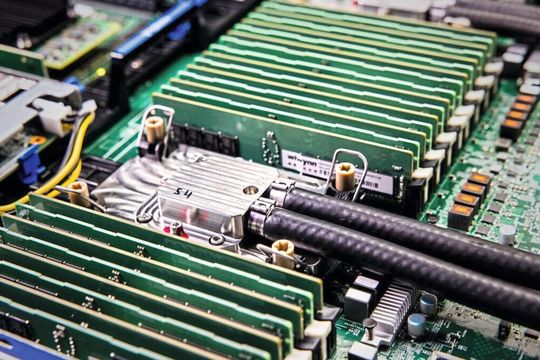
This microfluidic chip developed by Microsoft is covered and equipped with tubes to ensure safe coolant flow.
(Image: Dan DeLong for Microsoft)
At the packaging level, foundries are already showcasing silicon-integrated coolers. TSMC, for example, is testing fusion-bonded silicon "lids" with microchannels (IMC-Si), which allow for warm water and dissipate kilowatts of power per component. Microsoft's approach follows a similar direction but focuses on the operator's perspective: cooling closer to the heat source, lower thermal resistances (fewer TIM layers, no traditional heat spreader), and thus higher inlet temperatures for the coolant.
Challenges: Manufacturing, Service, Reliability
The idea is not new, but the step of a hyperscaler with concrete metrics is. The real challenge lies in industrialization: microchannels in the die or a silicon lid require stable etching and bonding processes, strict particle control, and reliable fluid connections at the package level. Field serviceability needs filtration, leak detection, corrosion and material compatibility, as well as monitoring for erosion and clogging. All of this must operate reliably for years—in racks with increasing power density.
The metrics are also shifting. PUE alone falls short when cooling moves into the IT device. Operators are focusing more on TUE/ITUE, the potential increase in supply temperatures, and usable waste heat. Microfluidics directly on silicon can provide leverage here, as higher inlet temperatures facilitate more economical cooling and heat recovery.
Similar Research is Being Conducted in Japan
A concept recently discussed in Elektronikpraxis from Japan (University of Tokyo) follows the same basic idea: microchannels in or on silicon. However, this approach employs a two-phase regime: water evaporates in an embedded 3D capillary structure directly at the hotspots. This promises very high local heat transfer but is currently based on lab setups and academic prototypes.
Microsoft, on the other hand, demonstrates a single-phase system with back-etched channels, optimized distribution, and a clearly targeted data center context. The comparisons mentioned there explicitly refer to today's common cold plates, whereas the Japanese study evaluates its effects against "conventional methods" and with laboratory-specific parameters.
Date: 08.12.2025
Naturally, we always handle your personal data responsibly. Any personal data we receive from you is processed in accordance with applicable data protection legislation. For detailed information please see our privacy policy.
Consent to the use of data for promotional purposes
I hereby consent to Vogel Communications Group GmbH & Co. KG, Max-Planck-Str. 7-9, 97082 Würzburg including any affiliated companies according to §§ 15 et seq. AktG (hereafter: Vogel Communications Group) using my e-mail address to send editorial newsletters. A list of all affiliated companies can be found here
Newsletter content may include all products and services of any companies mentioned above, including for example specialist journals and books, events and fairs as well as event-related products and services, print and digital media offers and services such as additional (editorial) newsletters, raffles, lead campaigns, market research both online and offline, specialist webportals and e-learning offers. In case my personal telephone number has also been collected, it may be used for offers of aforementioned products, for services of the companies mentioned above, and market research purposes.
Additionally, my consent also includes the processing of my email address and telephone number for data matching for marketing purposes with select advertising partners such as LinkedIn, Google, and Meta. For this, Vogel Communications Group may transmit said data in hashed form to the advertising partners who then use said data to determine whether I am also a member of the mentioned advertising partner portals. Vogel Communications Group uses this feature for the purposes of re-targeting (up-selling, cross-selling, and customer loyalty), generating so-called look-alike audiences for acquisition of new customers, and as basis for exclusion for on-going advertising campaigns. Further information can be found in section “data matching for marketing purposes”.
In case I access protected data on Internet portals of Vogel Communications Group including any affiliated companies according to §§ 15 et seq. AktG, I need to provide further data in order to register for the access to such content. In return for this free access to editorial content, my data may be used in accordance with this consent for the purposes stated here. This does not apply to data matching for marketing purposes.
Right of revocation
I understand that I can revoke my consent at will. My revocation does not change the lawfulness of data processing that was conducted based on my consent leading up to my revocation. One option to declare my revocation is to use the contact form found at https://contact.vogel.de. In case I no longer wish to receive certain newsletters, I have subscribed to, I can also click on the unsubscribe link included at the end of a newsletter. Further information regarding my right of revocation and the implementation of it as well as the consequences of my revocation can be found in the data protection declaration, section editorial newsletter.
Both approaches bring cooling closer to the source; the two-phase variant targets maximum power density, while the single-phase focuses on integration, serviceability, and supply temperatures. In practice, what matters is whether packaging, tightness, and maintenance can be managed over the years. Here, Microsoft provides the more pragmatic path, while the Japanese solution demonstrates the theoretical potential.
What Matters for Operators
In the short term, D2C with cold plates remains the standard, as retrofitting and operation are proven, and the supply chain is established. Two-phase solutions and immersion expand the options when individual chips or entire racks exceed the limits of single-phase systems. Microfluidics within or on the die provides additional flexibility: it relieves hotspots, allows for tighter power budgets, and can increase rack density without requiring extreme chilled water systems. The price for this is higher integration and service complexity, as well as the need to closely align packaging and facility design.
Outlook: Cooling Medium, Service Concept, And Timeline
Microsoft positions microfluidics as a candidate for future custom chips and aims to work with manufacturing partners to establish a pathway toward data centers. Open questions remain: In the target state, are the channels etched into the active die, or is it a bonded silicon lid? Which cooling medium is planned—deionized water or a dielectric—and with what additives and lifespan? What does the service concept look like for filters, sensors, and leak detection at the package level?
Microsoft does not provide a timeline. However, it is clear that increasing chip loads are forcing cooling even closer to the source. Those looking to expand power density and waste heat utilization need solutions beyond traditional cold plates: microfluidics now visibly belongs on this list. (mc)
Secure and Compliant Authentication in Laboratories



:quality(80)/p7i.vogel.de/wcms/4c/af/4cafbff8a06028a7250e03626a7e6afb/0132939283v1.jpeg "Behind the acronym Clasco is a project based on laser processing techniques, aiming to enable the reliable and application-specific post-processing of even complex metal parts produced by 3D printers. TU Dresden took the lead... (Image:German Materials Society)")
:quality(80)/p7i.vogel.de/wcms/cf/fc/cffc25779317b5b1e42cba9cfcd52bbc/0132927530v1.jpeg "The analysts were wrong again, as Japan was able to increase its export volume far more than predicted. Here are some numbers and facts about Nippon's economic situation... (Image:AI-generated)")
:quality(80)/p7i.vogel.de/wcms/6f/12/6f122ac26fd08f621f7b14f421fc435c/0132930817v1.jpeg "The Federal Statistical Office has taken a closer look at the first half of 2026 in terms of trade. Among other findings, it revealed that China is once again Germany's top trading partner... (Image:AI-generated)")
:quality(80)/p7i.vogel.de/wcms/3c/26/3c2635fb73f283b2d0e6ede46a2c2f9f/0113143253v1.jpeg "In our China Market Insider, we regularly provide you with relevant information directly from China. (Image:© Eisenhans - stock.adobe.com)")
:quality(80)/p7i.vogel.de/wcms/28/6e/286efb691c0622c9e32e99c59080ee87/0132970673v1.jpeg "In China, more precisely in Beijing, two Chinese robots have made headlines. One surpassed the previous record in the 100-meter sprint (symbolic image). And the other excelled with its expertise as a goal scorer ... (Image:AI-generated)")
:quality(80)/p7i.vogel.de/wcms/4b/93/4b9320e9d7f460ba574b08011f5ceb99/0132971049v1.jpeg "Bosch is getting serious about humanoids in Bühl. In the Black Forest, humanoid robots will, so to speak, see the light of day starting next year. Bosch's partner is a British start-up, and Schaeffler is already on board as a user ... (Image: AI-generated)")
:quality(80)/p7i.vogel.de/wcms/05/e7/05e7017a2699ef15b513bfd2e18431fb/digitaler-planungszwilling-bildv1.png "The author explains here why the digital twin only becomes a planning tool when it follows a clear decision-making question. (Source: T&O Group/AI-generated)")
:quality(80)/p7i.vogel.de/wcms/07/b3/07b368b6d067acdbb49c1e88b0cd8e9d/0131022521v1.jpeg "The seven-axis collaborative robot from Yamaha Motor is equipped with Harting connectors. (Image:Yamaha Motor)")
:quality(80)/p7i.vogel.de/wcms/95/7b/957b5deb968697d4fc72dbc82799b13e/0132976937v1.jpeg "In the telescopic PV pool cover from Skyvolution, energy chains from Igus safely guide the solar cables through the moving roof elements, even in the tightest installation spaces. (Image:Igus)")
:quality(80)/p7i.vogel.de/wcms/7d/17/7d174cbff42173176bae8b12dcec0c18/0132966756v1.jpeg "Thermal management: Custom and mechanically perfectly adapted heat sink solutions for the application provide users with efficient thermal management for many applications. (Image:© Fischer Elektronik)")
:quality(80)/p7i.vogel.de/wcms/96/41/96417cd62028ff69af2cd74ab6d91901/adobestock-2023215848--numan-stock-adobe-com-ki-generiertv1.jpeg "What must function smoothly in everyday laboratory routines presents special challenges for designers: centrifuges require compact drives that generate high centrifugal forces without emitting harmful waste heat. (Source: © Numan – stock.adobe.com / AI-generated)")
:quality(80)/p7i.vogel.de/wcms/c8/a1/c8a170f594765cecbdafbc139b96d91a/0132860586v1.jpeg "V-shaped grooves, known as riblets, are directly incorporated into the paint. They reduce overall drag by 50 percent, resulting in significant fuel savings. (Image:Trumpf)")
:quality(80)/p7i.vogel.de/wcms/84/e6/84e6ae788373e311da6c1a135ddd34ec/semi-79v1.jpeg "Einride integrates the Tesla Semi into its network. (Source: Tesla)")
:quality(80)/p7i.vogel.de/wcms/ad/16/ad16f6d961e9c53a7ab524ae6713a1d0/0132971036v1.jpeg "Retractable door handles are a hit with Tesla models. But in China, there are warnings about functional defects. As a result, around three million Teslas of various types have to go to the workshop. Unfortunately, this is not the only flaw that Beijing is criticizing at the moment ... (Image: Tesla)")
:quality(80)/p7i.vogel.de/wcms/2a/d8/2ad86e6759700a0a8fb878c8220fef2d/xpeng-g6-sprawitz-23bv1.jpeg "The Xpeng G6 in the \"Performance\" variant. (Source: Sven Prawitz/Vogel Communications Group)")
:quality(80)/p7i.vogel.de/wcms/b5/11/b51110efc282473cb667c4e4708d47a0/geely-research-institutev1.jpeg "Part of the Geely Research Institute in Hangzhou Bay, south of Shanghai. (Image:Geely)")
:quality(80)/p7i.vogel.de/wcms/61/54/6154ff60caffd4552fcdeb45e4dc72b2/0132962188v1.jpeg "Using optical coherence tomography (OCT), high-resolution cross-sectional images of the retina and cornea with a resolution of a few micrometers can be created. However, the demands on the necessary computing power of industrial PCs are high. (Image:freely licensed)")
:quality(80)/p7i.vogel.de/wcms/d6/61/d661801f679db7b71de6cbf76c38de64/0132929603v1.jpeg "Thermal management in the data center: Air cooling is no longer sufficient for AI applications, but liquid cooling is not universally applicable. (Image:Dall-E / AI-generated)")
:quality(80)/p7i.vogel.de/wcms/dc/17/dc178c6f831bb1d99ecca0a342f6bcee/0132945424v1.jpeg "The BrainBoard 1500 brings the AI accelerator AKD1500 to a development board. (Image:Brainchip)")
:quality(80)/p7i.vogel.de/wcms/b7/e2/b7e2324dedc6c9c96d5f265f06aa409e/0132928076v1.jpeg "Compact and standardized: CubeSats enable cost-effective space missions and increasingly serve as a platform for testing new technologies – from sensors and communication to innovative energy supply systems. (Image:City Labs, Inc.)")
:quality(80):fill(efefef,0)/p7i.vogel.de/wcms/67/ac/67acb931a438c/elatec-wp-gmp.png "Elatec WP GMP")
:quality(80)/p7i.vogel.de/wcms/d6/61/d661801f679db7b71de6cbf76c38de64/0132929603v1.jpeg "Thermal management in the data center: Air cooling is no longer sufficient for AI applications, but liquid cooling is not universally applicable. (Image:Dall-E / AI-generated)")
:quality(80)/p7i.vogel.de/wcms/63/76/637650b27d87a8be792940d423ef2921/0126980518v1.jpeg "In data centers used for generative AI applications, high-performance chips are utilized. The resulting waste heat must be efficiently dissipated. (Image:freely licensed)")