A clear trend is emerging at SID Display Week 2026: OLEDs need to become brighter and more durable. However, the industry giants are taking different approaches to achieve this goal. While Samsung Display is focusing on new fluorescent materials with PSF, LG Display is pushing ahead with multi-layer tandem architecture for vehicles and IT.
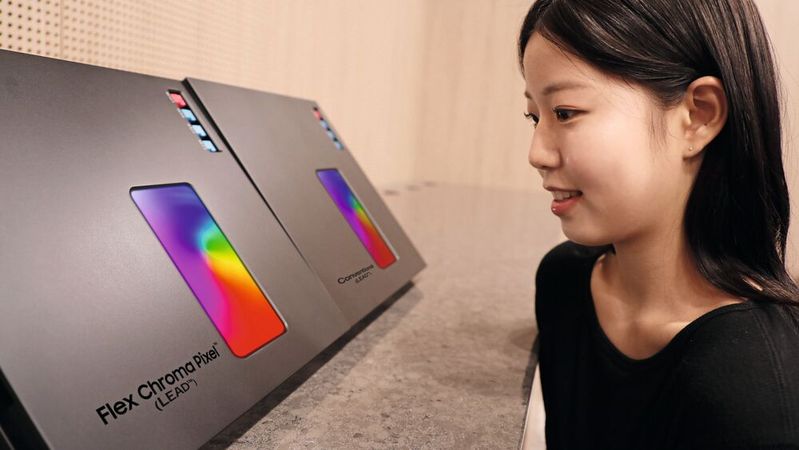
Visible difference at peak brightness: The comparison at the SID 2026 shows Samsung's new Flex Chroma Pixel OLED in direct comparison. Thanks to the new PSF emitter materials, the color saturation (96% BT.2020) is maintained even at extreme luminance levels without the colors washing out.
(Image: Samsung Display)
The current generation of displays offers technical advantages for hardware developers, system integrators and the thermal management of end devices. At SID Display Week 2026 in Los Angeles, the industry is intensively addressing two classic weak points of OLED technology: the loss of color saturation at extreme brightness levels (color washout) and the degradation of organic layers under permanent thermal stress (burn-in). It is interesting to note that the major panel manufacturers are taking completely different approaches to solving these problems.
SF And LEAD for Mobile Devices
Samsung Display is focusing on innovations at the material and optical level with its new Flex Chroma Pixe. panel, which is specially designed for smartphones and wearables. The centrepiece is the first use of PSF (Phosphorescent Sensitized Fluorescence) as an emitter material.
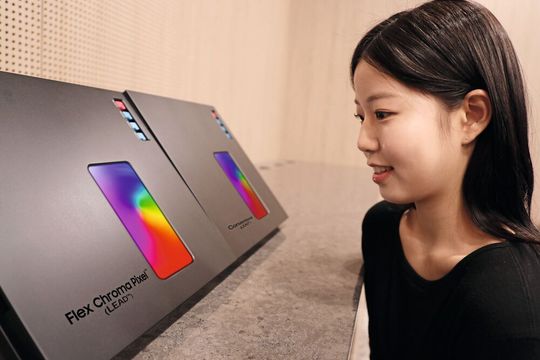
Visible difference at peak brightness: The comparison at the SID 2026 shows Samsung's new Flex Chroma Pixel OLED in direct comparison. Thanks to the new PSF emitter materials, the color saturation (96% BT.2020) is maintained even at extreme luminance levels without the colors washing out.
(Image: Samsung Display)
PSF uses phosphorescent materials as so-called sensitizers to capture the internally generated triplet excitons and transfer their energy highly efficiently to a fluorescent emitter. The metrological result: the display achieves 3,000 nits in High Brightness Mode (HBM) and covers 96% of the huge BT.2020 color space. This is 1.7 times the current DCI-P3 standard. At the trade fair, Samsung used direct image comparisons to demonstrate the impact of this extended color space and the prevention of typical color washout at high luminance in practice
PSF is combined with Samsung's LEAD architecture (Low Energy Advanced Display), which works without classic circular polarizers. As polarizers often swallow up more than 50 percent of the light yield, eliminating them increases light extraction. The display achieves 3,000 nits in High Brightness Mode (HBM) and covers 96% of the BT.2020 color space. This is 1.7 times the current DCI-P3 standard.
Samsung also demonstrated progress in sensor integration. Smartphone panels integrate organic photodiodes (OPDs) with a density of 500 ppi directly into the pixel grid across the entire surface. This turns the entire display into a biometric scanner that can also record vital parameters such as heart rate and blood pressure.
Tandem OLEDs of the 3rd Generation for Automotive
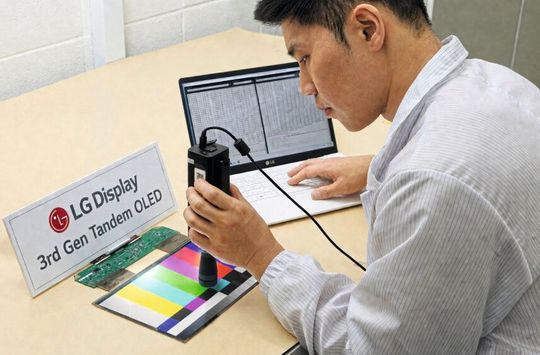
LG Display presents the 3rd generation of its Tandem OLED technology.
(Image: LG Display)
LG Display is taking a completely different approach. Instead of relying primarily on new emitter molecules, LG is scaling up the architecture. The company presented the 3rd generation of its tandem OLED technology at the trade fair. The primary target market: automotive and software-defined vehicles (SDVs).
In a tandem OLED, several organic, light-emitting layers are stacked on top of each other. The load of light generation is thus distributed over two layers. The 3rd generation brings massive leaps in service life: LG speaks of over 15,000 hours of operation at room temperature without degradation. This is more than double that of the previous generation.
On a physical level, LG Display has also improved the charge carrier balance in the panel. In organic semiconductors, the mobility of the positive holes (defect electrons) is usually higher than that of the electrons, which leads to edge recombination, heat generation and material degradation. By using a new material doping in the transport layers, LG was able to synchronize the speed of movement of holes and electrons.
The recombination to excitons now takes place exactly in the middle of the emitter layers. The result of this improved internal quantum efficiency: the automotive panel achieves a brightness of 1,200 nits, reduces power consumption by 18% and significantly reduces thermal stress in the component. For developers of automotive displays, the tandem structure solves the biggest OLED problem in cars: low durability under the influence of extreme temperatures and direct sunlight.
Date: 08.12.2025
Naturally, we always handle your personal data responsibly. Any personal data we receive from you is processed in accordance with applicable data protection legislation. For detailed information please see our privacy policy.
Consent to the use of data for promotional purposes
I hereby consent to Vogel Communications Group GmbH & Co. KG, Max-Planck-Str. 7-9, 97082 Würzburg including any affiliated companies according to §§ 15 et seq. AktG (hereafter: Vogel Communications Group) using my e-mail address to send editorial newsletters. A list of all affiliated companies can be found here
Newsletter content may include all products and services of any companies mentioned above, including for example specialist journals and books, events and fairs as well as event-related products and services, print and digital media offers and services such as additional (editorial) newsletters, raffles, lead campaigns, market research both online and offline, specialist webportals and e-learning offers. In case my personal telephone number has also been collected, it may be used for offers of aforementioned products, for services of the companies mentioned above, and market research purposes.
Additionally, my consent also includes the processing of my email address and telephone number for data matching for marketing purposes with select advertising partners such as LinkedIn, Google, and Meta. For this, Vogel Communications Group may transmit said data in hashed form to the advertising partners who then use said data to determine whether I am also a member of the mentioned advertising partner portals. Vogel Communications Group uses this feature for the purposes of re-targeting (up-selling, cross-selling, and customer loyalty), generating so-called look-alike audiences for acquisition of new customers, and as basis for exclusion for on-going advertising campaigns. Further information can be found in section “data matching for marketing purposes”.
In case I access protected data on Internet portals of Vogel Communications Group including any affiliated companies according to §§ 15 et seq. AktG, I need to provide further data in order to register for the access to such content. In return for this free access to editorial content, my data may be used in accordance with this consent for the purposes stated here. This does not apply to data matching for marketing purposes.
Right of revocation
I understand that I can revoke my consent at will. My revocation does not change the lawfulness of data processing that was conducted based on my consent leading up to my revocation. One option to declare my revocation is to use the contact form found at https://contact.vogel.de. In case I no longer wish to receive certain newsletters, I have subscribed to, I can also click on the unsubscribe link included at the end of a newsletter. Further information regarding my right of revocation and the implementation of it as well as the consequences of my revocation can be found in the data protection declaration, section editorial newsletter.
LG will start mass production of these panels for the automotive market at the end of 2026 and demonstrated the potential directly on a 57-inch wide pillar-to-pillar (P2P) concept display.
Two Solutions, One Goal
SID 2026 shows that although OLED technology is mature, it is still a long way from being fully developed. For system developers in the mobile sector (smartphones, smartwatches), the sensitization of fluorescent emitters (PSF) and polarization-free design will be the key to greater efficiency. In the automotive and IT sector (laptops, monitors), where long-life static displays and extreme operating temperatures predominate, the robust, multi-layer tandem architecture is becoming the industry standard. (heh)



:quality(80)/p7i.vogel.de/wcms/26/07/2607ca9a55754c81c6d65effc806c420/0134125580v1.jpeg "The new XB series from Mazak made its European debut at Euroblech 2026. Pictured is the new Optonics XB 130-32A press brake from the series. (Image:Mazak)")
:quality(80)/p7i.vogel.de/wcms/e0/85/e085a26186d214436f5e854dcbc2b8a4/6-nicokleiner-cmykv1.jpeg "As part of his technical thesis, Nico Kleiner developed a compact laser engraving machine for Norelem to use at trade shows. (Source: Norelem)")
:quality(80)/p7i.vogel.de/wcms/9e/23/9e23111e49d73012e9e3b7c69428ad5c/0134019347v1.jpeg "The Dominant VA45 high-helix tap from Bass, made of lead-free brass. The long chips, which result from the absence of lead, are clearly visible. (Image:Bass, Inc.)")
:quality(80)/p7i.vogel.de/wcms/1d/09/1d0999956ef87709b72ab1d0402ba207/csf-minis-gruppe-final-01-outputv1.jpeg "Since mid-2026, Harmonic Drive has been offering its CSF Mini gearheads in size 7 as well, in six variants designed for different installation scenarios. (Source: Harmonic Drive)")
:quality(80)/p7i.vogel.de/wcms/1f/7e/1f7eb8df75041d96602f297a5497d3ad/0134081637v1.jpeg "With Agile One SN, teams can develop, train, and validate humanoid robot capabilities for real-world applications, enabling them to bring their ideas from the lab to production more quickly. (Image:Agile Robots)")
:quality(80)/p7i.vogel.de/wcms/17/dd/17dd38fd7454673478427ec52780cd23/0134137180v1.jpeg "Humanoids: Between Hype and Everyday Industrial Life: Safety expert Jens Müller explains why technical maturity, safe motion sequences, and integration into existing processes are key to determining the practical utility of these robots. (Image:Jens Müller)")
:quality(80)/p7i.vogel.de/wcms/6e/bb/6ebb687f573be847aa611b413c6a33b1/0134094461v1.jpeg "From left: Sepp Hochreiter, founder of Nxai and AI researcher, and David Reger, founder and CEO of Neura Robotics, are excited about their collaboration on Physical AI. (Image:Neura)")
:quality(80)/p7i.vogel.de/wcms/89/01/890193a30c52ffd4811d18db82170952/0113143253v1.jpeg "In our China Market Insider, we regularly provide you with relevant information straight from China. (Image:© Eisenhans - stock.adobe.com)")
:quality(80)/p7i.vogel.de/wcms/70/ce/70cee969904bba9295b050329bae5ef5/optopatch-mosaic-2-1500x752-1v1.jpeg "High-tech patch: Bio-inspired technology simplifies measurements for cardiac diagnostics—without any electronics at all. (Source: NTNU)")
:quality(80)/p7i.vogel.de/wcms/c3/68/c368b4f6821557ec497c64bc17fe9f8d/adobestock-2051843806--kaliel-stock-adobe-com-ki-generiertv1.jpeg "To truly harness the full potential of virtual product development, teams and management must radically change their mindset. (Source: © kaliel – stock.adobe.com_AI-generated)")
:quality(80)/p7i.vogel.de/wcms/a3/c1/a3c19e028b66a6fd7c373ab94981631d/paprika-gripperv1.jpeg "For the final, additively manufactured gripper base, SoftGripping chose PA 2200, a material based on polyamide 12 (PA12). It offers balanced mechanical properties and high load-bearing capacity, making it ideal for robust gripper solutions with integrated pneumatics. (Source: SoftGripping GmbH)")
:quality(80)/p7i.vogel.de/wcms/51/b8/51b8e08d2105fdd9952aff385f154192/graphic-2-adma1v1.png "The new surface hardening process enhances the performance of corrosion-resistant alloys by improving their tribological and mechanical surface properties, while preserving the properties of the base material. (Source: Bodycote)")
:quality(80)/p7i.vogel.de/wcms/7d/52/7d5202d94b1125430ccefacc8ff66b2c/hf-20260505-113335-24485532-18a5-40d4-87a4-000ab161e0c1v1.png "It is no coincidence that the inaugural edition of the Watt Rally is wrapping up in Norway. The country is regarded worldwide as a true pioneer in the fields of electric mobility and charging infrastructure. (Source: Access Organization Group)")
:quality(80)/p7i.vogel.de/wcms/4b/9a/4b9a090d342310b04bd2dccb5bcac004/1791886894209v1.jpeg "Many Chinese automakers are looking to exports as a solution to their problems in the domestic market. (Image:Mario Hommen/sp-x)")
:quality(80)/p7i.vogel.de/wcms/79/bf/79bffc3fe1a6f2ef15695d0725c8f9ce/hyundai-staria-elektro-1026-05-wid-1024-bfc-offv1.jpeg "With the Staria, Hyundai now offers a comfortable electric van. (Source: Hyundai)")
:quality(80)/p7i.vogel.de/wcms/6c/95/6c956e609f79bfae3b6f83b6f18f837b/0134136245v1.jpeg "To secure its future, Audi is now planning to build a plant from the ground up in the U.S. U.S. President Donald Trump seems to welcome this. But the SPD, in particular, isn't too happy about it ... (Image:Audi)")
:quality(80)/p7i.vogel.de/wcms/f2/c0/f2c0bfc2c3c323220c2b1154cacda57a/0134132255v1.jpeg "Established semiconductor processes: While some foundries are reducing their manufacturing capacity, others are making targeted investments in specialized technologies. For developers in industrial electronics, the automotive industry, and medical technology, the long-term availability and cost of components are crucial. (Image:Dall-E / AI-generated)")
:quality(80)/p7i.vogel.de/wcms/71/c4/71c49858dd5195cbf540c4c37debab03/0134099748v1.jpeg "The Future of Space Travel: At Pretzl Connect 2026, ESA engineer Kate Underhill explained how sensor technology, software, and AI are transforming the development of future space transportation systems. (Image:mc/VCG)")
:quality(80)/p7i.vogel.de/wcms/20/b3/20b3ea557032591a4699c28076d349e3/0134117110v1.jpeg "Thermal simulation of a 3D IC visualizes the temperature distribution within the chip structure. Siemens and Nvidia aim to automate and accelerate such electrothermal analyses using AI-powered EDA workflows. (Image: Siemens EDA)")
:quality(80)/p7i.vogel.de/wcms/95/77/95778db428cbc81291ddd5718455d133/0134132383v1.jpeg "Weighing approximately 1.3 kg, the Tomahawk 6—Davisson combines an Ethernet switch ASIC with optical communication modules. Fuji has successfully evaluated the automated SMT assembly of the CPO package on an NXTR machine. (Image: Broadcom)")
:fill(fff,0)/images.vogel.de/vogelonline/companyimg/76800/76895/65.jpg "FAULHABER_120mm.jpg ()")
:fill(fff,0)/p7i.vogel.de/companies/68/a4/68a47beec75ce/logo-cmyk-de.jpeg "logo-cmyk-de (https://www.datatec.eu/)")
:fill(fff,0)/p7i.vogel.de/companies/69/de/69de1b7403b0d/simtos-logo.jpeg "simtos-logo (SIMTOS)")
:quality(80):fill(efefef,0)/p7i.vogel.de/wcms/67/ad/67adf92d254d2/elatec-wp-smart-factory.png "Elatec WP Smart Factory")
:quality(80)/p7i.vogel.de/wcms/94/df/94df56799ab9815ea485aff909fa04f5/0128372219v1.jpeg "In the new Q3, Audi uses OLED panels in the taillights. The 216 isolated segments can be controlled individually. (Image:Audi)")
:quality(80)/p7i.vogel.de/wcms/78/66/7866a25d3734c5caed45c3ea0f516dff/0132071151v1.jpeg "Under the name \"Rollable Flex,\" Samsung Display has already presented prototypes of a rollable OLED display. (Image:Samsung Display)")