Smart BuildingBattery-Free Indoor Sensors Are Becoming Economically Interesting
From
Susanne Braun
| Translated by AI
5 min Reading Time
Indoor multi-sensors for smart buildings quickly cost between 55 and 165 USD, which can quickly become expensive for large-scale applications. Ligna Energy from Sweden has developed QWEN, a battery-free sensor platform that costs around 10 USD for quantities of 10,000 to 50,000 units.
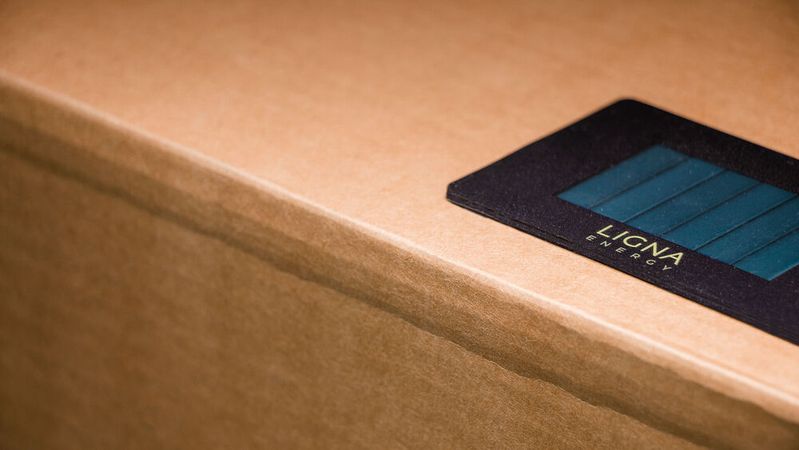
QWEN in smart card format: The battery-free sensor platform combines a supercapacitor and printed indoor solar cell to make smart building sensor technology more economical without changing batteries.
(Image: Ligna Energy)
In times when energy guzzlers in particular are unnecessarily inefficient and cost-intensive, smart building applications are seen as one of the most realistic ways to achieve efficient and transparent building operation, for example in order to achieve sustainability goals. Reducing energy consumption through needs-based control using sensors and the associated reduction in costs can be a significant lever. Sensors for temperature, air quality, presence or light can be used to automatically activate heating, air conditioning and lighting only where they are actually needed. In office buildings with changing occupancy rates in particular, energy can be saved noticeably in this way.
A positive side effect is the condition monitoring of building technology, as networked sensors detect anomalies in ventilation, elevators or air conditioning systems at an early stage. Maintenance requirements can therefore be identified earlier. Failures can be announced and potentially prevented. Also on the plus side: smart buildings can increase comfort, for example through better air quality or dynamically adapted working environments. However, investing in large numbers of indoor multi-sensors can quickly run into money—for some companies, the smart building venture then becomes a showstopper.
When the Price is Hot
"End users told us that sensors are too expensive to use on a large scale," explains John Söderström, Marketing Director at Ligna Energy. "An indoor sensor can cost between 55 and 165 USD—just for the hardware. For a large-scale application, we need to come up with 10–15 USD per sensor." Ligna Energy, a Swedish provider of sustainable energy storage systems, has developed QWEN—a battery-free sensor platform for temperature and humidity.
Instead of a battery, QWEN uses a supercapacitor in combination with a low-power PV cell from Epishine, a manufacturer of printed solar cells. "We have tried to minimize the number of components," says Söderström in an interview at Embedded World 2026. The aim is to reduce both material costs (bill of materials) and housing costs by making the design thinner. A thin housing is cheaper to produce than a thick one.
Surprise in the Field Test
The first generation of QWEN was completed a year ago—shortly before Embedded World 2025—and has since been tested at various locations in Sweden. "None of them have had any downtime in a year," says Söderström. "And that surprised us ourselves." Sweden is relatively dark in winter and the offices are closed for several weeks in summer. "All these different phases of everyday office life—zero downtime."
Parallel to the internal test, a customer evaluated QWEN with a different system—different components, different protocol. "And now they have presented their data for a year, also with zero downtime." This customer is now planning to install between 10,000 and 50,000 sensors. "Their experience with indoor sensors of this size shows that the costs would be around 10 USD or less."
Energy Budget Calculation is Crucial
However, the battery-less approach requires a deeper understanding of the use case. "If you have a battery, as an engineer you add capacity to have a buffer—a safe space in case the environment is not as you thought it would be," explains Söderström. "If you don't have a battery, but a light cell and a supercapacitor, you have to understand how much light is available." How does the light vary over the course of a year—both daylight and artificial lighting? Is there any shading?
"You have to understand the environment you're going into," says Söderström. This also applies to batteries—manufacturers often state a battery life of five years, but in reality it is one to two years because the optimum environment is not given. With energy harvesting, however, you also have to use low-power components and minimize quiescent currents and leakage currents. "There are other things that draw energy from the architecture that you need to understand even more than if you have the safe capacity of a large battery."
Date: 08.12.2025
Naturally, we always handle your personal data responsibly. Any personal data we receive from you is processed in accordance with applicable data protection legislation. For detailed information please see our privacy policy.
Consent to the use of data for promotional purposes
I hereby consent to Vogel Communications Group GmbH & Co. KG, Max-Planck-Str. 7-9, 97082 Würzburg including any affiliated companies according to §§ 15 et seq. AktG (hereafter: Vogel Communications Group) using my e-mail address to send editorial newsletters. A list of all affiliated companies can be found here
Newsletter content may include all products and services of any companies mentioned above, including for example specialist journals and books, events and fairs as well as event-related products and services, print and digital media offers and services such as additional (editorial) newsletters, raffles, lead campaigns, market research both online and offline, specialist webportals and e-learning offers. In case my personal telephone number has also been collected, it may be used for offers of aforementioned products, for services of the companies mentioned above, and market research purposes.
Additionally, my consent also includes the processing of my email address and telephone number for data matching for marketing purposes with select advertising partners such as LinkedIn, Google, and Meta. For this, Vogel Communications Group may transmit said data in hashed form to the advertising partners who then use said data to determine whether I am also a member of the mentioned advertising partner portals. Vogel Communications Group uses this feature for the purposes of re-targeting (up-selling, cross-selling, and customer loyalty), generating so-called look-alike audiences for acquisition of new customers, and as basis for exclusion for on-going advertising campaigns. Further information can be found in section “data matching for marketing purposes”.
In case I access protected data on Internet portals of Vogel Communications Group including any affiliated companies according to §§ 15 et seq. AktG, I need to provide further data in order to register for the access to such content. In return for this free access to editorial content, my data may be used in accordance with this consent for the purposes stated here. This does not apply to data matching for marketing purposes.
Right of revocation
I understand that I can revoke my consent at will. My revocation does not change the lawfulness of data processing that was conducted based on my consent leading up to my revocation. One option to declare my revocation is to use the contact form found at https://contact.vogel.de. In case I no longer wish to receive certain newsletters, I have subscribed to, I can also click on the unsubscribe link included at the end of a newsletter. Further information regarding my right of revocation and the implementation of it as well as the consequences of my revocation can be found in the data protection declaration, section editorial newsletter.
QWEN is designed in such a way that it can bridge four to five days of darkness—such as a long weekend without lighting in the office. "But you have to understand the limitations of such a system," emphasizes Söderström. For safety reasons, some wireless protocols require a manual restart if a sensor is to go online again after a complete loss of power. "This is one of the challenges that engineers need to understand if they want to remove the battery completely."
Not Suitable for All Applications
Söderström emphasizes that battery-free sensors are not suitable for all applications. "It doesn't have many fancy features. You have to understand the disadvantages of not having a big battery." However, for simple data points such as temperature and humidity, which are widely used, there is a real benefit, he says. "In my estimation, we shouldn't have batteries for these types of sensors. There is no real need for continuous measurements every second. You can have potential downtime with these types of sensors."
However, batteries are necessary for other sensors. "I don't want to badmouth batteries. But for large-scale applications like this, you shouldn't have a lot of batteries that need to be replaced." The life cycle costs, lithium and other hazardous materials are problematic, he said. "If you just look at the IoT sensors already in use and how many batteries are in them—and then look five years ahead—it's a bit scary."
Ligna Energy sees the real market interest primarily in the area of transportation and asset tracking. "Moving objects or simply tracking something—logistics is an area where you track something." QWEN itself is stationary—for temperature and humidity at a fixed point. "But we have several projects in this application area. However, where we are furthest along in terms of actual signed contracts is more in the transportation sector."
QWEN is conceived as a reference design. "Of course, we are not the ones who are going to produce thousands of them. We are using it as a reference and something that someone else can adopt," says Söderström. (sb)



:quality(80)/p7i.vogel.de/wcms/17/b8/17b8af0cb725e0e1d3e8d72458bab260/siemens-meet-at-the-machinev1.jpeg "“Meet at the Machine” is Siemens’ new initiative, which aims to bring together machine builders, software, and automation technologies to accelerate innovation in the machine tool industry and help manufacturers become productive more quickly. (Source: Siemens)")
:quality(80)/p7i.vogel.de/wcms/8e/7e/8e7e0cda4c68699bcc48283a38739769/0133316747v1.jpeg "A little-known hidden champion! When people think of laser cutting, the first thing that comes to mind is the power of the laser beam—and it is impressive to see the sparks flying. But Air Liquide—an exhibitor at Euroblech, by the way—wants to make it clear that the process gas is also key to success. (Image:AI-generated)")
:quality(80)/p7i.vogel.de/wcms/20/fa/20fa35e0af203c3464f7e7fdbb57a685/0133281172v1.jpeg "Since 2003, Etzinger AG has been developing and manufacturing high-quality coffee grinders, pepper mills, and grinding mechanisms for professional and home use. (Image:Etzinger)")
:quality(80)/p7i.vogel.de/wcms/69/91/6991413943488b4a2f6fde9dcd88c5b0/0133256686v1.jpeg "The CMA-patented pendulum mount can compensate for radial tolerances of up to one millimeter. (Image:Schwiening)")
:quality(80)/p7i.vogel.de/wcms/38/79/38799bfbbccd938b64c67068cfa68780/0133329362v1.jpeg "What exactly enables machines to act on their own? (Image:Shutterstock)")
:quality(80)/p7i.vogel.de/wcms/1b/9f/1b9fc9f113fc66212e2c0e17a3edaf9f/org-blobs-user-response-file-output-f317796f-57b7-483f-9403-5d9ac8a816f5-plugin-output-call-kdigtepb7be7us8xvbota0mh-1672x940v1.png "According to Barclays data, Europe leads the global trade in actuator components. With a 34 percent share, the region ranks ahead of China, which has a 26.3 percent share. (Source: Statista | CC BY-ND 4.0, AI-generated)")
:quality(80)/p7i.vogel.de/wcms/f5/4c/f54c9fc59ccb0604ab9219188469a45f/image1v1.jpeg "Christopher Savoia, Global Head of the UR+ Ecosystem at Universal Robots, presents the new SP7 Smart Panel on a UR17g-1300 robot during the unveiling of Gen 7—UR’s 7th-generation robot platform—at IMTS in Chicago on September 14, 2026. (Image:Image: Teradyne Robotics)")
:quality(80)/p7i.vogel.de/wcms/bd/4e/bd4ef09ab0f84932ea76ca0330ffe789/0133329802v1.jpeg "The robotics boom and its consequences: According to a study, a significant portion of value creation occurs in the electronics industry. (Image:Fraunhofer IPA)")
:quality(80)/p7i.vogel.de/wcms/87/87/87870cf2b30aaef7b8a06212a4ef2c14/0133403885v1.jpeg "A digital twin and a real component demonstrate how closely simulation and manufacturing are converging. Stampack Xpress 2026.1 virtually models forming behavior and supports the validation of process and tool design. (Image:Stampack)")
:quality(80)/p7i.vogel.de/wcms/59/2a/592a7f2d0964e9e6846cae331f5daa3a/0133266065v1.jpeg "Perforated metal sheets are particularly well-suited for balcony railings, as they combine stability, privacy, and design versatility. (Image:Ripo Factory)")
:quality(80)/p7i.vogel.de/wcms/45/64/45642ff0fe0a6bec251b77739131d83b/abb-ferrari-hypersail-16-9-three-quarter-front-viewv1.jpeg "The Ferrari Hypersail is a 100-foot monohull wing-in-plane yacht powered entirely by renewable energy. (Source: ABB / Ferrari Hypersail)")
:quality(80)/p7i.vogel.de/wcms/3e/0e/3e0e3ea22e48410ceada53b02ffccb59/0133358454v1.jpeg "BYD top executive Stella Li plans to offer megawatt flash charging for commercial vehicles as well. (Image:VDA/IAA Transportation 2026)")
:quality(80)/p7i.vogel.de/wcms/e2/7d/e27de60472809cc58ac0d321066c9679/l1051833v1.jpeg "Geely has acquired a stake of just over 26 percent in Renault do Brasil. Geely models for the South American market are now also being produced at the Ayrton Senna plant in São José dos Pinhais. (Image:Renault)")
:quality(80)/p7i.vogel.de/wcms/1e/c1/1ec1495eb283200f4b7cb55de0c4dff7/20260917-110436643v1.jpeg "Ceremonial launch of Mercedes-Benz GLA production in Rastatt; among those in attendance was plant manager Marco Zwick (second from the right). (Source: Thomas Günnel – Automotive Industry)")
:quality(80)/p7i.vogel.de/wcms/76/f3/76f310eed0caebc79ff91195c29de08d/visual-siwa-treatment-optimizerv1.jpeg "A Mireo train from Siemens Mobility was used in the “Automated Train” project for a fully automated delivery and return trip on the open rail network. (Source: Siemens Mobility)")
:quality(80)/p7i.vogel.de/wcms/4c/53/4c534208d09a9b1ce597938715e7fc19/0133288763v1.jpeg "Logic Folding: In its latest Kirin 9050 Pro, Huawei uses hybrid bonding to distribute the computing units across two silicon layers in order to increase the effective transistor density without resorting to finer manufacturing processes. (Image:Huawei)")
:quality(80)/p7i.vogel.de/wcms/56/d1/56d131e0b5bd05ef47411e92ad740cb4/0133351029v1.jpeg "Researchers at DTU have developed a nanolaser in a semiconductor membrane. The structure concentrates charge carriers and the light field into a small area (shaded in blue). If data is transmitted on microchips using light instead of electrical signals, transmission speeds can be increased and energy losses reduced. (Image:Yi Yu, DTU)")
:quality(80)/p7i.vogel.de/wcms/5e/55/5e55101ddc6338f755fcf3244db1367f/0133331863v1.jpeg "For data center projects, it is becoming increasingly important to also obtain the consent of the affected community. (Image:Dall-E / AI-generated)")
:quality(80)/p7i.vogel.de/wcms/8d/f9/8df95d3f58408673986b3d643e6b63ba/0133252773v1.jpeg "TXC targets high-speed optical links in AI data centers with 312.5 MHz oscillators, among other solutions. As data rates increase, requirements for jitter and frequency stability become more demanding as well. (Bild: TXC)")
:quality(80):fill(efefef,0)/p7i.vogel.de/wcms/66/d0/66d08fb5ceae0/dossier-battery-technology.png "Dossier Battery Technology")
:quality(80)/p7i.vogel.de/wcms/02/50/02507ce2e6225bb6816c8805bd98da71/0129407664v1.jpeg "Thanks to a new type of sensor, hydrogen can also be reliably detected in humid environments. (Image:freely licensed)")
:quality(80)/p7i.vogel.de/wcms/f0/35/f035afad8613734aaefe4d6778d21309/0129554823v1.jpeg "The Aquis Touch S multi-channel measuring, control and recording device ensures that the quality parameters of the cooling media are correct. (Image:Jumo)")