Automated production initially presented Sysbohr with challenges in thread production. Stable automation in unmanned production was only achieved with a change to the process.
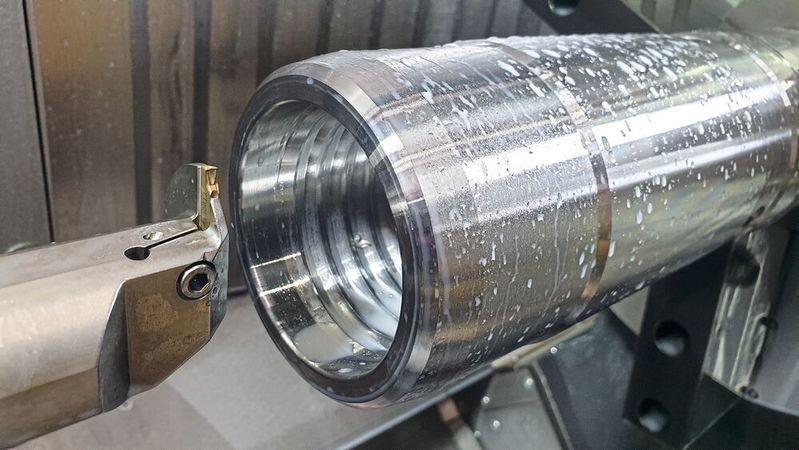
A TDXU 3E-0.3 multifunctional indexable insert from Ingersoll can be used at Sysbohr for threads in all sizes, replacing several special threaded inserts from another manufacturer.
(Image: Ingersoll)
Since it was founded in 2004 as a design office, the Fulda-based (Germany) company has developed well. The establishment of in-house production in Hünfeld was not intended to replace contract manufacturers, but to increase production capacity. External manufacturers, some of whom have been supplying Sysbohr for over 20 years, will continue to do so. With production in Hünfeld, the manufacturer can react more flexibly and has its delivery times better under control.
"If a customer requires an additional flushing hole on their drilling tool, for example, this is redesigned in Fulda and manufactured by us according to the requirements," says Production Manager Sebastian Reith, describing one of the company's great strengths: "Tailor-made special designs can be implemented individually and quickly here. Sysbohr supports projects from design to the finished system and optimally adapts drilling systems to the prevailing ground conditions and the requirements of the construction site. Tools and accessories are sold worldwide.
The portfolio of mainly in-house products includes drill bits, drill pipes, flushing heads and drive units. Typical quantities for special tools are in the single-digit range, but batch sizes of up to 200 units are also achieved for drill bits for the wholesale trade. The majority of customers come from the construction industry, where the tools are mainly used for securing excavations and tunnels. In some applications, the drill bit remains in the borehole and is considered lost. In most cases, however, the drill bit and drill rods are provided with threads instead of an easily detachable bayonet catch.
Production Rapidly Expanded
Production in Hünfeld , Germany, started with a machine from DMG Mori and was expanded very quickly in order to achieve the desired production capacity. In the meantime, six turn-mill centers from this machine manufacturer fill the hall. A turret lathe from Okuma, which has a larger spindle opening, was purchased especially for processing large tubes. All the machines are equipped with robots. Despite the relatively low quantities, automation is worthwhile due to the long running times:
We can completely finish our products on the machines, i.e. ideally, raw part in, finished part out. With ten components, that can add up to five hours of running time. That's a late shift.
Sebastian Reith, Production Manager, Sysbohr GmbH
The workflow is such that the ten employees produce individual parts in the morning and run in one part per machine towards the evening. Robots then take care of the rest in the unmanned late and night shifts.
However, what sounds like cost-effective production initially presented Sysbohr with major problems in the production of trapezoidal threads, which are required for almost all components. The required process reliability was lacking because, especially with thin material thicknesses, vibrations occurred again and again, which left clear chatter marks on the internal threads and produced poor surface qualities. In some cases, automatic production stopped after just a few parts or it ran through completely despite a damaged cutting insert and produced rejects.
We never knew what to expect when we arrived at work in the morning. The pallet may or may not have been processed.
Sebastian Reith, Production Manager, Sysbohr GmbH
The Problems Only Came With Automation
The pavers tried out many things, experimenting with different infeeds and speeds. However, the repeat accuracy in the automated process always left a lot to be desired. Although Ingersoll was represented as a tool supplier in Hünfeld right from the start, the problematic inserts came from another manufacturer. Sysbohr had taken over the process, including the threaded inserts in a special design, from a supplier who never had any difficulties with it. One crucial difference, however, is that the contract manufacturer always has an operator at each machine who can intervene immediately in the event of irregularities before a problem arises. This applies to vibrations as well as chip jams, which also occurred frequently at Sysbohr.
Ingersoll was to provide a solution. Daniel Rudolph, technical consultant at the tool manufacturer, analyzed the problem: "The special threaded insert used to turn the internal thread caused vibrations that built up during the process due to its engagement width and relatively long clamping. Instead of the heavily pressing solid profile plate, we used a grooving tool that exerts less pressure."
Date: 08.12.2025
Naturally, we always handle your personal data responsibly. Any personal data we receive from you is processed in accordance with applicable data protection legislation. For detailed information please see our privacy policy.
Consent to the use of data for promotional purposes
I hereby consent to Vogel Communications Group GmbH & Co. KG, Max-Planck-Str. 7-9, 97082 Würzburg including any affiliated companies according to §§ 15 et seq. AktG (hereafter: Vogel Communications Group) using my e-mail address to send editorial newsletters. A list of all affiliated companies can be found here
Newsletter content may include all products and services of any companies mentioned above, including for example specialist journals and books, events and fairs as well as event-related products and services, print and digital media offers and services such as additional (editorial) newsletters, raffles, lead campaigns, market research both online and offline, specialist webportals and e-learning offers. In case my personal telephone number has also been collected, it may be used for offers of aforementioned products, for services of the companies mentioned above, and market research purposes.
Additionally, my consent also includes the processing of my email address and telephone number for data matching for marketing purposes with select advertising partners such as LinkedIn, Google, and Meta. For this, Vogel Communications Group may transmit said data in hashed form to the advertising partners who then use said data to determine whether I am also a member of the mentioned advertising partner portals. Vogel Communications Group uses this feature for the purposes of re-targeting (up-selling, cross-selling, and customer loyalty), generating so-called look-alike audiences for acquisition of new customers, and as basis for exclusion for on-going advertising campaigns. Further information can be found in section “data matching for marketing purposes”.
In case I access protected data on Internet portals of Vogel Communications Group including any affiliated companies according to §§ 15 et seq. AktG, I need to provide further data in order to register for the access to such content. In return for this free access to editorial content, my data may be used in accordance with this consent for the purposes stated here. This does not apply to data matching for marketing purposes.
Right of revocation
I understand that I can revoke my consent at will. My revocation does not change the lawfulness of data processing that was conducted based on my consent leading up to my revocation. One option to declare my revocation is to use the contact form found at https://contact.vogel.de. In case I no longer wish to receive certain newsletters, I have subscribed to, I can also click on the unsubscribe link included at the end of a newsletter. Further information regarding my right of revocation and the implementation of it as well as the consequences of my revocation can be found in the data protection declaration, section editorial newsletter.
As Sysbohr had already had good experience with the Ingersoll cutting insert, it was tried out without further ado. However, because thread cutting is fundamentally different from grooving, existing process sequences could not simply be adopted. The machining speed initially achieved proved to be far too slow. Simply changing the tool was therefore not enough.
"Process reliability was only achieved by completely converting the process," reports Daniel Rudolph.
We not only changed the insert, but also looked at and assessed the entire process, from the cycle to the cutting insert. The machining process was changed and we now do thread cutting rather than thread turning.
Daniel Rudolph, Technical Consultant, Ingersoll
The transition to a 40 millimeter tool shank proved to be very efficient, as application engineer Christopher Hees explains: "Ingersoll chose a larger boring bar in order to achieve a better length-to-diameter ratio. This meant that significantly more infeed could be used and higher cutting speeds were possible. Compared to the first machining tests using the grooving process, machining could be carried out with fewer cuts in half the time. We switched to this precision sintered TDXU 3E-0.3 indexable insert in order to maintain accuracy in the process. In terms of accuracy of fit, the threads now always come off the machine in the same quality."
The multifunctional grooving insert is suitable for radial, axial and internal grooving. With its soft cut, it is suitable for medium to high feed rates. It also produces small chips that can no longer get caught on the tool changer or in the chuck, which contributes to process reliability in unmanned production. In contrast to the previously used solid profile inserts, it is a standard tool that Ingersoll can deliver the very next day if required. Delivery times of three to four weeks were required for the custom-made threaded inserts.
One Cutting Plate For Everything
The pavers have gained a further advantage: The plate to be used is always identical and replaces several special solutions that were previously required for different threads. Sysbohr requires the full-surface threads for all component diameters between 50 and 600 millimetres with different pitches. The universal machining was also made possible by optimizing the programming. In close consultation with Ingersoll and Sysbohr, DMG Mori adapted an existing thread cycle on the machine to the special requirements.
A normal metric thread form, as is usually used for thread production, was out of the question for Sysbohr due to the often harsh operating conditions of its products. "We can't use such pointed threads because you always have to reckon with sand and dirt on construction sites. Nevertheless, an excavator must be able to reliably screw the parts in and out," explains Reith. This also makes it clear why good round thread surfaces are more important for production than the last micrometer of precision.
The user is very satisfied with the results achieved. The machining time has remained practically identical, while the tool life has improved slightly with the Ingersoll tool. Above all, however, it is now also possible to work reliably in the unmanned late and night shifts. This has created the desired production capacity and increased quality at the same time.



:quality(80)/p7i.vogel.de/wcms/17/b8/17b8af0cb725e0e1d3e8d72458bab260/siemens-meet-at-the-machinev1.jpeg "“Meet at the Machine” is Siemens’ new initiative, which aims to bring together machine builders, software, and automation technologies to accelerate innovation in the machine tool industry and help manufacturers become productive more quickly. (Source: Siemens)")
:quality(80)/p7i.vogel.de/wcms/8e/7e/8e7e0cda4c68699bcc48283a38739769/0133316747v1.jpeg "A little-known hidden champion! When people think of laser cutting, the first thing that comes to mind is the power of the laser beam—and it is impressive to see the sparks flying. But Air Liquide—an exhibitor at Euroblech, by the way—wants to make it clear that the process gas is also key to success. (Image:AI-generated)")
:quality(80)/p7i.vogel.de/wcms/20/fa/20fa35e0af203c3464f7e7fdbb57a685/0133281172v1.jpeg "Since 2003, Etzinger AG has been developing and manufacturing high-quality coffee grinders, pepper mills, and grinding mechanisms for professional and home use. (Image:Etzinger)")
:quality(80)/p7i.vogel.de/wcms/69/91/6991413943488b4a2f6fde9dcd88c5b0/0133256686v1.jpeg "The CMA-patented pendulum mount can compensate for radial tolerances of up to one millimeter. (Image:Schwiening)")
:quality(80)/p7i.vogel.de/wcms/38/79/38799bfbbccd938b64c67068cfa68780/0133329362v1.jpeg "What exactly enables machines to act on their own? (Image:Shutterstock)")
:quality(80)/p7i.vogel.de/wcms/1b/9f/1b9fc9f113fc66212e2c0e17a3edaf9f/org-blobs-user-response-file-output-f317796f-57b7-483f-9403-5d9ac8a816f5-plugin-output-call-kdigtepb7be7us8xvbota0mh-1672x940v1.png "According to Barclays data, Europe leads the global trade in actuator components. With a 34 percent share, the region ranks ahead of China, which has a 26.3 percent share. (Source: Statista | CC BY-ND 4.0, AI-generated)")
:quality(80)/p7i.vogel.de/wcms/f5/4c/f54c9fc59ccb0604ab9219188469a45f/image1v1.jpeg "Christopher Savoia, Global Head of the UR+ Ecosystem at Universal Robots, presents the new SP7 Smart Panel on a UR17g-1300 robot during the unveiling of Gen 7—UR’s 7th-generation robot platform—at IMTS in Chicago on September 14, 2026. (Image:Image: Teradyne Robotics)")
:quality(80)/p7i.vogel.de/wcms/bd/4e/bd4ef09ab0f84932ea76ca0330ffe789/0133329802v1.jpeg "The robotics boom and its consequences: According to a study, a significant portion of value creation occurs in the electronics industry. (Image:Fraunhofer IPA)")
:quality(80)/p7i.vogel.de/wcms/87/87/87870cf2b30aaef7b8a06212a4ef2c14/0133403885v1.jpeg "A digital twin and a real component demonstrate how closely simulation and manufacturing are converging. Stampack Xpress 2026.1 virtually models forming behavior and supports the validation of process and tool design. (Image:Stampack)")
:quality(80)/p7i.vogel.de/wcms/59/2a/592a7f2d0964e9e6846cae331f5daa3a/0133266065v1.jpeg "Perforated metal sheets are particularly well-suited for balcony railings, as they combine stability, privacy, and design versatility. (Image:Ripo Factory)")
:quality(80)/p7i.vogel.de/wcms/45/64/45642ff0fe0a6bec251b77739131d83b/abb-ferrari-hypersail-16-9-three-quarter-front-viewv1.jpeg "The Ferrari Hypersail is a 100-foot monohull wing-in-plane yacht powered entirely by renewable energy. (Source: ABB / Ferrari Hypersail)")
:quality(80)/p7i.vogel.de/wcms/3e/0e/3e0e3ea22e48410ceada53b02ffccb59/0133358454v1.jpeg "BYD top executive Stella Li plans to offer megawatt flash charging for commercial vehicles as well. (Image:VDA/IAA Transportation 2026)")
:quality(80)/p7i.vogel.de/wcms/e2/7d/e27de60472809cc58ac0d321066c9679/l1051833v1.jpeg "Geely has acquired a stake of just over 26 percent in Renault do Brasil. Geely models for the South American market are now also being produced at the Ayrton Senna plant in São José dos Pinhais. (Image:Renault)")
:quality(80)/p7i.vogel.de/wcms/1e/c1/1ec1495eb283200f4b7cb55de0c4dff7/20260917-110436643v1.jpeg "Ceremonial launch of Mercedes-Benz GLA production in Rastatt; among those in attendance was plant manager Marco Zwick (second from the right). (Source: Thomas Günnel – Automotive Industry)")
:quality(80)/p7i.vogel.de/wcms/76/f3/76f310eed0caebc79ff91195c29de08d/visual-siwa-treatment-optimizerv1.jpeg "A Mireo train from Siemens Mobility was used in the “Automated Train” project for a fully automated delivery and return trip on the open rail network. (Source: Siemens Mobility)")
:quality(80)/p7i.vogel.de/wcms/09/dc/09dcc37616c3a9d5d7a289c97a352a89/0133428369v1.jpeg "(Image:Gemini / AI-generated)")
:quality(80)/p7i.vogel.de/wcms/4c/53/4c534208d09a9b1ce597938715e7fc19/0133288763v1.jpeg "Logic Folding: In its latest Kirin 9050 Pro, Huawei uses hybrid bonding to distribute the computing units across two silicon layers in order to increase the effective transistor density without resorting to finer manufacturing processes. (Image:Huawei)")
:quality(80)/p7i.vogel.de/wcms/56/d1/56d131e0b5bd05ef47411e92ad740cb4/0133351029v1.jpeg "Researchers at DTU have developed a nanolaser in a semiconductor membrane. The structure concentrates charge carriers and the light field into a small area (shaded in blue). If data is transmitted on microchips using light instead of electrical signals, transmission speeds can be increased and energy losses reduced. (Image:Yi Yu, DTU)")
:quality(80)/p7i.vogel.de/wcms/5e/55/5e55101ddc6338f755fcf3244db1367f/0133331863v1.jpeg "For data center projects, it is becoming increasingly important to also obtain the consent of the affected community. (Image:Dall-E / AI-generated)")
:fill(fff,0)/p7i.vogel.de/companies/69/88/69882c428938e/tmts2026-ticec-banner-en-2000px.png "tmts2026-ticec-banner-en-2000px (https://www.tmts.tw/en)")
:fill(fff,0)/p7i.vogel.de/companies/69/de/69de1b7403b0d/simtos-logo.jpeg "simtos-logo (SIMTOS)")
:quality(80)/p7i.vogel.de/wcms/74/fa/74fa35679e7ec5e53355629aa363d22a/0130959027v1.jpeg "Sysbohr produces drill pipes with lengths of up to 3 meters and diameters ranging from 50 to 600 millimeters. On the right, production manager Sebastian Reith.(Image: Ingersoll)")
:quality(80)/p7i.vogel.de/wcms/c7/26/c7269def274a73065df49b491b4bd694/0130959040v1.jpeg "The TDXU 3E-0.3 multifunctional grooving insert is suitable for radial, axial and internal grooving. With its soft cut, it is suitable for medium to high feed rates and produces small chips.(Image: Ingersoll)")
:quality(80)/p7i.vogel.de/wcms/21/53/2153d08d4beaa848e1e89628f4eb593a/0130959024v1.jpeg "According to the motto \"raw part in, finished part out\", Sysbohr relies heavily on automation. Only the robots work in the late and night shifts.(Image: Ingersoll)")
:quality(80)/p7i.vogel.de/wcms/0b/c8/0bc8d4527af31ae355f391944db32eb0/0130959009v1.jpeg "According to the motto \"raw part in, finished part out\", Sysbohr relies heavily on automation. Only the robots work in the late and night shifts.(Image: Ingersoll)")
:quality(80)/p7i.vogel.de/wcms/b0/41/b041264d931df4347bc760fff1c7cb7b/0129439236v1.jpeg "The circular milling system proves to be a problem solver in the numerous standard variants, as well as in special shapes for some other milling processes. (Image:Horn/Sauermann)")
:quality(80)/p7i.vogel.de/wcms/0c/58/0c587c8221ae96052b5dcc0f40eb3dcd/0128880879v1.jpeg "A chip surfer with a solid carbide head is used for finishing in the third operation. (Image:Ingersoll)")