From
Henrik Bork
Henrik Bork | Translated by AI
6 min Reading Time
Will BYD founder Wang Chuanfu's rail vision become reality after all? For more than a decade, the self-made billionaire from Shenzhen has been working on the SkyRail monorail system, with which he wants to revolutionize local transport.
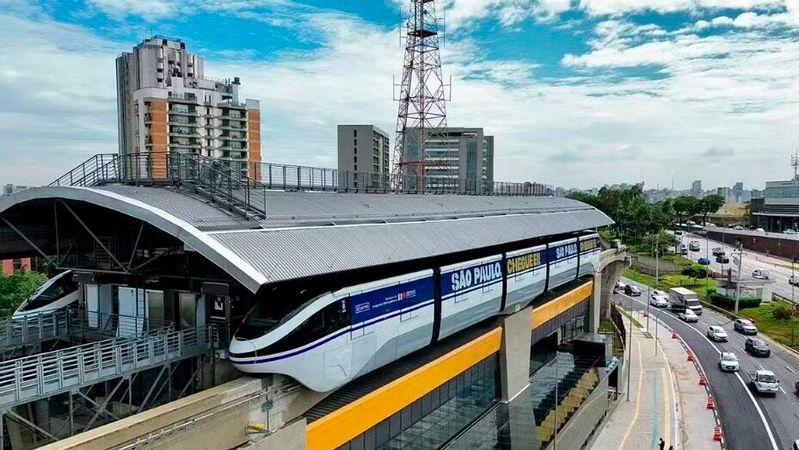
On March 31, BYD put the first major Sky Rail line outside of China into operation with Line 17 on the outskirts of the metropolis of Sao Paulo.
(Image: BYD)
In Brazil, the first major Sky Rail line has been put into operation after a long period of preparatory work. On March 31, it went into operation as line 17, the so-called "Gold Line", on the outskirts of the metropolis of Sao Paulo, according to press releases from BYD. This is a monorail on stilts, i.e. an "elevated" monorail. It is also referred to as a saddle type. The train connects Congonhas Airport with the Morumbi district, running along a 6.7-kilometre route via five stations (approx. 4.2-mile route). It is battery-powered and completely autonomous - without a driver. It is BYD's first rail transportation project outside China to be completed.
Additional Offer to Subway Trains
Such above-ground trains are lighter and therefore cheaper to build than subway trains. Passengers can enjoy the view on the way. However, BYD is expressly not positioning this local transport solution as a replacement for subway networks, but rather for routes with medium to low capacity utilization. In other words, for smaller and medium-sized cities or, as here in Sao Paulo, for the suburbs and connecting the airport to the city center.
The company had taken over the project from predecessors in 2020 and had to adapt the trains to the existing track structure. The SkyRail trains run on batteries specially developed by BYD. They offer space for 616 passengers in five carriages. In the event of a power failure, the trains can continue to run for around three kilometers with the help of emergency batteries so that passengers can at least make it to the next station.
Japan as a Role Model
The vision for BYD's SkyRail was created during a heavy cloudburst in Beijing. It must have been around 2012, although the sources are not entirely clear. Heavy rain is rare in Beijing, whose climate is more influenced by the nearby Gobi Desert and the steppes of Mongolia than its relative proximity to the sea on the other side would suggest. As is often the case in the Chinese capital, road traffic came to a complete standstill during the heavy rain. BYD founder Wang Chuanfu was stuck in a traffic jam for more than four hours before he made it from the center of Beijing to the airport by car. The following week, he flew to Tokyo and was amazed at how smoothly the traffic flowed there. The Japanese capital has more cars and fewer roads than Beijing, but the majority of commuters use public transport on weekdays. "I believe China must move towards a city on rails," Wang said afterwards in interviews with Chinese media.
This is how the SkyRail project came about. BYD invested a total of around 640 million euros (approx. USD 747 million). The company's 1,000 engineers have been working on developing the technology for several years now. As with electric cars, the company is also benefiting here from the vertical integration of its supply chains. BYD is active in all parts of the e-mobility value chain, from energy generation and storage in batteries to applications such as electric cars and, according to the company founder's grand vision, soon also in public transportation.
China as a Starting Point
The system would only cost a fifth of a metro per kilometer and could be built in a third of the time, Wang calculated at the time. Similar comparisons can now also be read in press reports about the line in Brazil. BYD started at home in China. There are 273 independent cities with large populations, each a potential customer. In September 2017, the first line went into operation in Yinchuan in northwest China. Around 40,000 passengers rode on the opening day. Visitors to the BYD campus in Shenzhen are also taken around silently on a train developed in-house. Smaller projects in other Chinese cities and many negotiations with potential customers followed.
Setback: Chinese Government Halts Rail Infrastructure Projects
Then came a setback. In 2021, Beijing suspended approvals for new urban rail infrastructure projects in order to curb spiraling municipal debt. New minimum thresholds for economic output and population excluded many of the medium-sized cities that SkyRail is tailored to for the time being.
Date: 08.12.2025
Naturally, we always handle your personal data responsibly. Any personal data we receive from you is processed in accordance with applicable data protection legislation. For detailed information please see our privacy policy.
Consent to the use of data for promotional purposes
I hereby consent to Vogel Communications Group GmbH & Co. KG, Max-Planck-Str. 7-9, 97082 Würzburg including any affiliated companies according to §§ 15 et seq. AktG (hereafter: Vogel Communications Group) using my e-mail address to send editorial newsletters. A list of all affiliated companies can be found here
Newsletter content may include all products and services of any companies mentioned above, including for example specialist journals and books, events and fairs as well as event-related products and services, print and digital media offers and services such as additional (editorial) newsletters, raffles, lead campaigns, market research both online and offline, specialist webportals and e-learning offers. In case my personal telephone number has also been collected, it may be used for offers of aforementioned products, for services of the companies mentioned above, and market research purposes.
Additionally, my consent also includes the processing of my email address and telephone number for data matching for marketing purposes with select advertising partners such as LinkedIn, Google, and Meta. For this, Vogel Communications Group may transmit said data in hashed form to the advertising partners who then use said data to determine whether I am also a member of the mentioned advertising partner portals. Vogel Communications Group uses this feature for the purposes of re-targeting (up-selling, cross-selling, and customer loyalty), generating so-called look-alike audiences for acquisition of new customers, and as basis for exclusion for on-going advertising campaigns. Further information can be found in section “data matching for marketing purposes”.
In case I access protected data on Internet portals of Vogel Communications Group including any affiliated companies according to §§ 15 et seq. AktG, I need to provide further data in order to register for the access to such content. In return for this free access to editorial content, my data may be used in accordance with this consent for the purposes stated here. This does not apply to data matching for marketing purposes.
Right of revocation
I understand that I can revoke my consent at will. My revocation does not change the lawfulness of data processing that was conducted based on my consent leading up to my revocation. One option to declare my revocation is to use the contact form found at https://contact.vogel.de. In case I no longer wish to receive certain newsletters, I have subscribed to, I can also click on the unsubscribe link included at the end of a newsletter. Further information regarding my right of revocation and the implementation of it as well as the consequences of my revocation can be found in the data protection declaration, section editorial newsletter.
The city of Bengbu in Anhui province had almost completed a 5.7-kilometre test track, but was then not allowed to put it into operation because it did not meet the new, stricter criteria. In Anyang and Guilin, half-finished stations and trains stand around unused, as videos on Douyin, the Chinese version of TikTok, show.
"We have enough data to prove that we are right," Wang said in an interview in 2021, when the authorities began to put SkyRail projects on hold. Despite the difficulties, he believes that the public will one day overcome their doubts and accept the system as a viable solution.
Not everything went according to plan in Brazil either. A monorail contract with the city of Salvador was terminated in 2023 due to rising costs. Then there were unfavorable press reports and political setbacks. Reports claimed that there had been violations of labor law at the BYD plant in Camaçari, Brazil. Suddenly, many critical questions also arose with regard to SkyRail. The bitter experience that BYD has now had to make has little to do with its technology. Exporting trains and tracks is a fundamentally different business to selling cars.
Skyrail Is Not a Stromer
An electric vehicle often goes directly to an end customer. If the technology and the price are right, there is relatively little standing in the way of success. BYD, which once entered into the construction of electric cars just as crosswise as it later entered into the construction of monorails, is now the largest electric car manufacturer in the world, even ahead of Tesla.
A mass transit system, on the other hand, requires close coordination with governments and local politics. It needs long-term funding and local approval procedures, which politicians like to use to further their careers, rather detached from the transport or environmental benefits of rail. This is the case in Brazil, in China and it is not fundamentally different in Germany either.
Cultural differences, civil protests, elections - all of these can delay a project for years or cause it to fail altogether. In Brazil, too, it took a very long time before the red ribbon could finally be cut.
The fact that line 17 is now running in São Paulo is anything but a matter of course. At the opening ceremony, the governor of the state of São Paulo even announced an extension of 4.6 kilometers (approx. 2.9 mi) and three additional stations. "This is BYD's first rail transportation project abroad and an important example of how the company is using innovative technology to support local transportation development," Li Tie, General Manager of BYD Brazil, was quoted as saying by the Chinese technology portal IT Zhijia at the opening ceremony.
Has BYD Speculated?
Whether SkyRail will actually become a global business with the dimensions in which Wang Chuanfu usually thinks remains to be seen. What is certain is that he is holding on to this vision just as tenaciously as to all the others before. Anyone who doubts this should remember the time when BYD was primarily a manufacturer of batteries for cell phones and started building electric cars without any experience. "What this is, is a fucking miracle," Charlie Munger, the late business partner of Warren Buffett and an early BYD investor, once said at an investor meeting.
Until now, critics have been saying that the monorail development has been BYD's only strategic mistake to date. The BYD founder still sees things differently, at least in his public statements. Wang Chuanfu believes that with the investment of five billion yuan, he can open up a market with an estimated total value of many trillions of yuan. You can wait a little while.
The offer of being able to build local public transport routes much more cheaply and quickly than subway lines is tempting. The value of offering commuters plagued by traffic jams an alternative to the car is undisputed. It will be interesting to observe the operation of this new line 17 in Sao Paulo over the next few years. (se)



:quality(80)/p7i.vogel.de/wcms/21/b6/21b61c2ac1df28254fb0dad1574fb2d7/0132853015v1.jpeg "The rose-gold, TiAlSiN-based coating material InoxaCon contributes significantly to the stability and service life of HPTec's new RQR-350 milling tool. It enables safe and efficient automated processes in the manufacturing of surgical instruments. (Image:Cemecon)")
:quality(80)/p7i.vogel.de/wcms/d2/73/d273374d6347651e4e6200cf6061ea4e/0132860560v1.jpeg "Even in July, the flag of the Chinese economy did not flutter particularly briskly in the air. Read here what’s happening and why production in China is apparently declining ... (Image:AI-generated)")
:quality(80)/p7i.vogel.de/wcms/18/47/1847f131e3afda201d1dbb98ad0ecb04/0132826776v1.jpeg "Image 1: Difender armored steels from Dillinger stand out with top scores in ballistic testing and cold bending. Defense companies therefore readily choose them. They can be found, for example, in the armored vehicles Fuchs and GTK Boxer of the German Armed Forces. (Image: Dillinger)")
:quality(80)/p7i.vogel.de/wcms/1e/7d/1e7d651782e0e97b3efc25abf2b52350/img-3485v1.jpeg "The Siemens Energy employees attach balancing weights at the precisely calculated and adjusted angular position to achieve the best possible result. (Source: Schenck Rotec)")
:quality(80)/p7i.vogel.de/wcms/a7/38/a73840cb81da9dc3c503f4c04bf66b96/0132892768v1.jpeg "Unitree's IPO symbolizes the high expectations for humanoid robots and embodied AI. (Image:Dall-E / AI-generated)")
:quality(80)/p7i.vogel.de/wcms/1c/a5/1ca5e3ef5d834c3a42de8909c872e3c6/0132876444v1.jpeg "The autonomous transport system Active Shuttle marketed by Bosch Rexroth has been sold to Neura Robotics. (Image:Bosch Rexroth)")
:quality(80)/p7i.vogel.de/wcms/30/1a/301a1aa59e093d848b69e9ff7006b83e/image1v1.jpeg "Wireless switching devices offer advantages in numerous industrial applications – wherever wired communication reaches its limits (Image: Steute) (Image:)")
:quality(80)/p7i.vogel.de/wcms/a2/85/a285b12508af812e28b17be3482a736c/0132488872v1.jpeg "NIS2 is no longer an abstract requirement in the distant future for many industrial companies. (Image:AI-generated)")
:quality(80)/p7i.vogel.de/wcms/41/fc/41fc456ff1ff8f30807924663e8df127/img-0942v1.jpeg "In industrial additive manufacturing, the production strategy must influence the design from the very beginning. (Source: Materialise)")
:quality(80)/p7i.vogel.de/wcms/44/fe/44fe86a16c26c09bb363b3671bf0b930/0132847771v1.jpeg "CoreTechnologie (CT) points out that the 3D printing software 4D_Additive has been equipped with additional application possibilities. Here you can learn more about what the new version 1.8 can do – such as generating complex lattice structures or optimizing faulty data ... (Image:CT)")
:quality(80)/p7i.vogel.de/wcms/b4/f2/b4f2c272247f79c5e87334a6839f20cb/0132549860v1.jpeg "Morefire analysis: Many mechanical engineering websites focus on technical specs instead of customer benefits. Translating features into clear benefits increases visibility, inquiries, and competitiveness. (Image: ©peopleimages.com - stock.adobe.com)")
:quality(80)/p7i.vogel.de/wcms/b4/9a/b49aaad0500e06e253f7d75ecb77338a/adobestock-4840668--dani-kreienb-hl-stock-adobe-comv1.jpeg "Metal processing in 2026 will be more digital, automated, and data-driven – but not automatically easier. (Image:© Dani Kreienbühl - stock.adobe.com)")
:quality(80)/p7i.vogel.de/wcms/5b/88/5b88d94e6a43f2b857462cd1921f7386/0132281427v1.jpeg "The eTurbo solves a well-known turbocharger problem: by combining an exhaust gas turbocharger and a permanently excited synchronous motor into a highly integrated core assembly, the compressor achieves sufficient speed even when the exhaust energy is actually not yet sufficient. (Image: BorgWarner)")
:quality(80)/p7i.vogel.de/wcms/75/fe/75feffb63bc6275786606d78a8d797c4/0132901853v1.jpeg "Steyr Motors reports similar business results as last year. Here you can learn more about the details of the Austrian company's situation ... (Image:E-Steyr)")
:quality(80)/p7i.vogel.de/wcms/57/d2/57d2b75d884c18866b46e776126fb46b/org-blobs-user-response-file-output-dac07b02-0e97-4452-9a3a-26528da583b3-file-1787126178766-jpgv1.jpeg "The memory manufacturer CXMT has had an extremely successful IPO. Among the investors are several car manufacturers. (Image:KI-generiert)")
:quality(80)/p7i.vogel.de/wcms/d0/68/d0681c9d26012538a22ff5c103429612/0132875205v1.jpeg "Electric vehicles: Structure of the zone architecture in a modern vehicle. (Image:TI)")
:quality(80)/p7i.vogel.de/wcms/22/82/22826566c11220ed61efac5982fb94a2/0132896083v1.jpeg "Electrodes made from paper and copper paste deliver comparable signal quality to the established gold standard. They perform significantly better in all environmental impact analyses. (Image:Screentec)")
:quality(80)/p7i.vogel.de/wcms/c4/9f/c49f5b8173f678f7ef071355b1fbbd7c/yamu-jay-ai-generated-9088888v1.jpeg "As part of a strategic partnership, Siemens and Reinhausen are advancing the future of energy supply solutions for AI data centers. (Symbol image) (Source: pixabay / AI-generated)")
:quality(80)/p7i.vogel.de/wcms/28/20/28204a4592a69a8682bfbf9a8f7e1dc2/0132846993v1.jpeg "The health status of a lithium-ion battery changes with increasing aging. AI models can utilize characteristic changes in the charge and voltage curves to estimate the state of health. (Image:freely licensed)")
:quality(80)/p7i.vogel.de/wcms/90/dc/90dc332e30a3e4bd3ff77646ed0633b7/0132833369v1.jpeg "Through a compromised repository of the widely used open-source tool LiteLLM, attackers were able to capture several terabytes of data and login credentials. Security company CloudSEK concludes, after analyzing the data, that the attack conducted in March of this year affected more than 2,000 companies, including major players like Microsoft, Nvidia, AWS, and Deutsche Bahn. (Image:freely licensed)")
:quality(80)/p7i.vogel.de/wcms/8f/55/8f5540f2332f53727c075ca33edcc7ec/0132570086v1.jpeg "Two lines, 45,000 passengers per direction per hour: That is what the monorail in Cairo, now partially in operation, is expected to achieve. (Image:ALSTOM SA 2025 | Innovia)")
:quality(80)/p7i.vogel.de/wcms/e9/60/e960f8c34a847b11fc576c54d9d46ea6/0129325747v1.jpeg "Robobuses, like WeRide here, are well on the way to becoming an integral part of local public transport. (Image:WeRide)")