From workflow management software for 3D printers, which can be used to create grid structures for 3D-printed parts, to a ceramic 3D printing system for the production of geometrically complex ceramic components, to the first PTFE-free resin—the innovations in additive manufacturing.
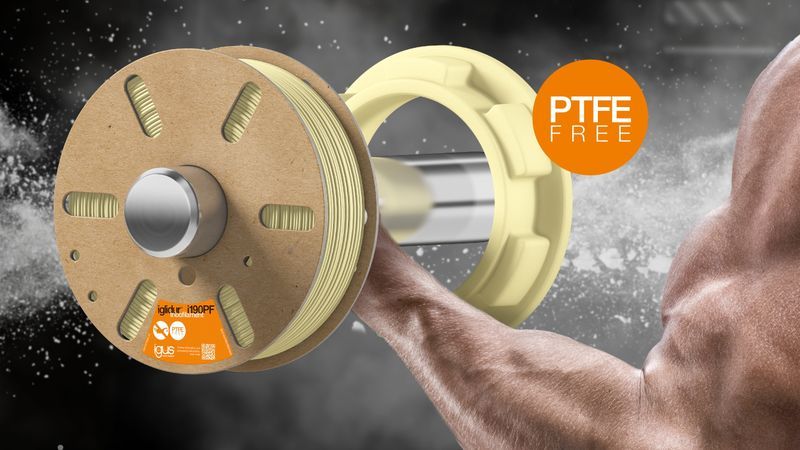
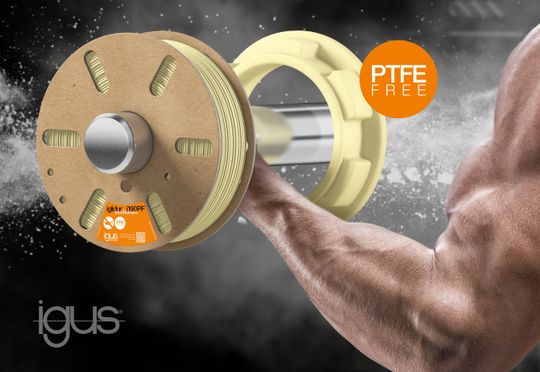
With Iglidur i190PF, Igus has developed a highly stable filament for the 3D printing of wear-resistant and PTFE-free special parts.
(Image: Igus)
Create Grid Structures Easily
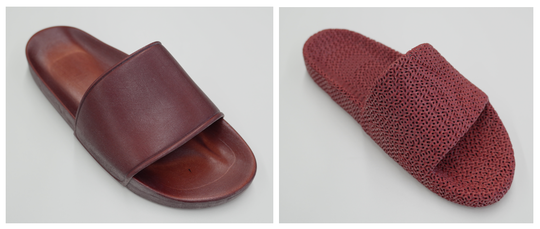
With the new grid structure function, users can create 3D prints with a soft or padded effect - ideal for realistic models of shoes and other soft objects.
(Image: Mimaki)
Mimaki has launched a new version of its workflow management software for 3D printers, Mimaki 3D Print Prep Pro v2.0 (3DP3v2). The updated software version automatically optimizes 3D data for 3D printing. 3DP3v2 is equipped with a conversion function that can be used to create lattice structures for 3D printed parts. With four grid patterns and adjustable density values, the weight of the printed object is already significantly reduced. Depending on the material used, a padded or soft effect can also be achieved. This function is particularly useful when printing realistic 3D models of soft objects such as shoes, sofas or beds that require multidirectional flexibility. While 3DP3 was originally a cloud-only software, 3DP3v2 can now also be used offline with Mimaki 3D printers. The software will be available from June 2026.
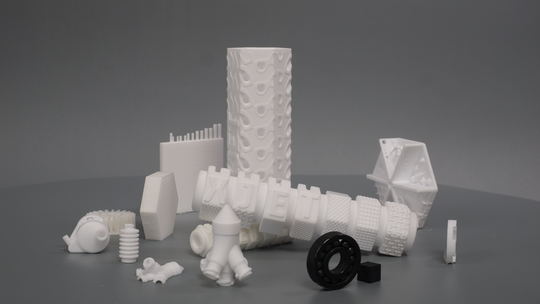
The XJet Nano Particle Jetting solution offers a wide selection of ceramic materials
(Image: XJet)
Ter Hoek has introduced the XJet Carmel 1400C ceramic 3D printing system from XJet. Ter Hoek, known since the 1990s for excellence in precision metal fabrication using advanced EDM, PECM and ultra-precision CNC milling technologies, is now extending its expertise to engineering ceramics. The ceramic 3D printing system enables the Dutch precision manufacturing specialist to produce geometrically complex ceramic components with exceptional accuracy and outstanding surface quality. This opens up new opportunities for regional customers in the aerospace, semiconductor, medical and other innovative industries where geometric innovation and material performance are key. A key benefit of the collaboration between XJet and Ter Hoek is the comprehensive support throughout the entire product lifecycle. XJet's Carmel-1400C system is designed to handle both rapid prototyping and production scale manufacturing, matching Ter Hoek's proven service model from engineering consulting to production enablement.
AI-Supported Manufacturing Platform Accelerates the 3D Printing Process
ProDesk combines all functions in an interactive dashboard with real-time updates on current orders, providing the most important information at a glance immediately after logging in.
(Image: Protolabs)
With ProDesk, Protolabs has developed an all-in-one platform. The newly launched online environment enables real-time AI-powered offerings including Design for Manufacturability (DfM), seamless cross-team collaboration and a range of other tools that support prototyping and production projects, increasing the speed of innovation for product development and procurement teams. ProDesk provides AI-powered DFM analysis for injection molding, CNC machining and 3D printing services to provide instant feedback on parts before they go into production. The configurable platform also includes the ability to provide real-time quotes for services such as material options, post-processing and surface treatments. Lead times can also be set, allowing users to customize quotes based on required lead time and budget. ProDesk supports the entire product development process and offers additional benefits: In the platform, users can select components in the production catalog that have already been approved for production. This makes it much easier to manage, organize and reorder parts at a later date.
3D Printed Parts With Injection Molding Quality
With Iglidur i190PF, Igus has developed a highly stable filament for the 3D printing of wear-resistant and PTFE-free special parts.
(Image: Igus)
Igus has further expanded its filament portfolio with Iglidur i190PF. In addition to a PTFE-free resin and SLS material, Iglidur i190PF is now the first PTFE-free filament from Igus. It is based on the tribofilament Iglidur i190 and has the same tribological properties as the injection molding material Iglidur W300PF. It is also characterized by its high flexural strength of 80 MPa and its lubrication- and maintenance-free operation. The new filament also scores with its high mechanical strength and exceptional abrasion resistance, which significantly outperforms standard plastics such as ABS or nylon. The printed components can be used at temperatures of up to 194 °F and offer a long service life in lubrication-free operation. Iglidur i190PF is also suitable for the construction of sliding components for multi-material parts, as it bonds very well with highly rigid materials. The filament can be easily processed on all commercially available closed 3D printers with a heatable printing plate. With Iglidur i190PF, designers can now produce PTFE-free wear parts in 3D printing without having to accept differences in material performance compared to the well-known and proven Iglidur i190 filament.
Functional, Robust, Deep Black: The SLA Material Accura Xtreme Black
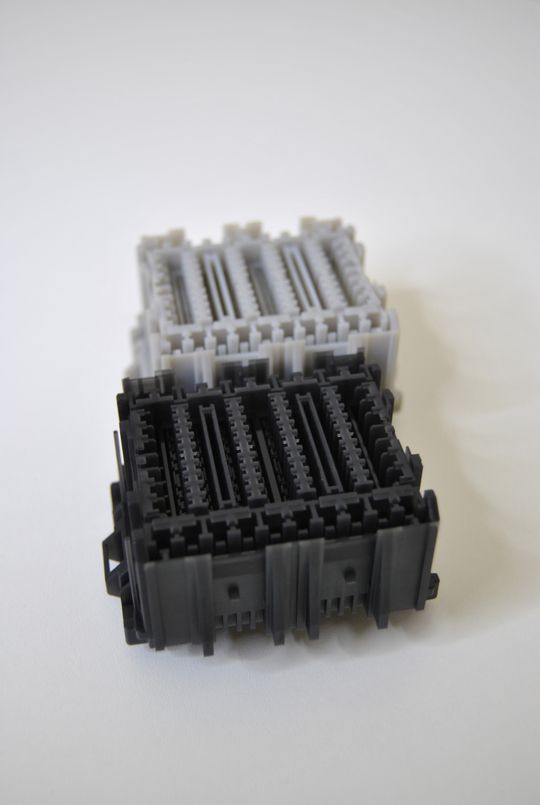
Accura Xtreme Black and Xtreme Grey in comparison.
(Image: Speedpart)
The requirements for 3D-printed components are developing rapidly: the shape, level of detail and material properties must be as close as possible to production components in order to enable realistic tests and functional prototypes. With Accura Xtreme Black, Speedpart has added a new SLA resin to its portfolio that meets precisely these requirements: robust, true to detail and deep black. Especially suitable for form, fit and function applications, it impresses with its high durability of demanding assemblies such as robust housings. In combination with the precise SLA technology, functional prototypes can be realized that can withstand even the highest demands. Accura Xtreme Black, developed by 3D Systems, impresses with its precise shape and detail reproduction as well as robust mechanical properties. With layer thicknesses from 0.05 mm (0.002 inches), fine details can be reproduced, while wall thicknesses from 0.25 mm (0.01 inches) and tolerances of ±0.03 mm (±0.001 inches) ensure reliable implementation of complex geometries. Even the basic finish produces a smooth and visually appealing surface. Blasting can be used to refine the component surface to a uniformly matt, anthracite-colored finish. For applications with particularly high visual requirements, a fine-finish process is also available, which specifically smoothes the visible areas and achieves a high-quality appearance.
Date: 08.12.2025
Naturally, we always handle your personal data responsibly. Any personal data we receive from you is processed in accordance with applicable data protection legislation. For detailed information please see our privacy policy.
Consent to the use of data for promotional purposes
I hereby consent to Vogel Communications Group GmbH & Co. KG, Max-Planck-Str. 7-9, 97082 Würzburg including any affiliated companies according to §§ 15 et seq. AktG (hereafter: Vogel Communications Group) using my e-mail address to send editorial newsletters. A list of all affiliated companies can be found here
Newsletter content may include all products and services of any companies mentioned above, including for example specialist journals and books, events and fairs as well as event-related products and services, print and digital media offers and services such as additional (editorial) newsletters, raffles, lead campaigns, market research both online and offline, specialist webportals and e-learning offers. In case my personal telephone number has also been collected, it may be used for offers of aforementioned products, for services of the companies mentioned above, and market research purposes.
Additionally, my consent also includes the processing of my email address and telephone number for data matching for marketing purposes with select advertising partners such as LinkedIn, Google, and Meta. For this, Vogel Communications Group may transmit said data in hashed form to the advertising partners who then use said data to determine whether I am also a member of the mentioned advertising partner portals. Vogel Communications Group uses this feature for the purposes of re-targeting (up-selling, cross-selling, and customer loyalty), generating so-called look-alike audiences for acquisition of new customers, and as basis for exclusion for on-going advertising campaigns. Further information can be found in section “data matching for marketing purposes”.
In case I access protected data on Internet portals of Vogel Communications Group including any affiliated companies according to §§ 15 et seq. AktG, I need to provide further data in order to register for the access to such content. In return for this free access to editorial content, my data may be used in accordance with this consent for the purposes stated here. This does not apply to data matching for marketing purposes.
Right of revocation
I understand that I can revoke my consent at will. My revocation does not change the lawfulness of data processing that was conducted based on my consent leading up to my revocation. One option to declare my revocation is to use the contact form found at https://contact.vogel.de. In case I no longer wish to receive certain newsletters, I have subscribed to, I can also click on the unsubscribe link included at the end of a newsletter. Further information regarding my right of revocation and the implementation of it as well as the consequences of my revocation can be found in the data protection declaration, section editorial newsletter.
Additive Manufacturing of Flexible Partial Dentures
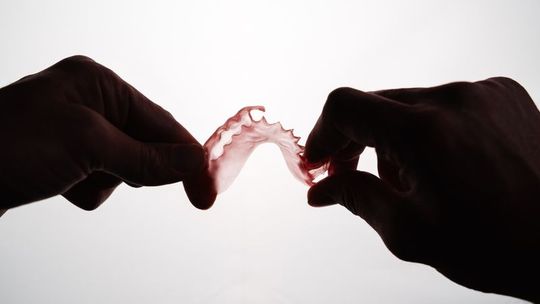
The FDA-approved FP3D resin enables dental laboratories to produce flexible partial dentures reliably, economically and quickly.
(Image: Carbon)
With FP3D, Carbon has developed a resin for flexible, removable partial dentures together with Keystone Industries. It is the first dental resin to integrate Carbon's proven double-curing chemistry. FP3D offers exceptional durability, translucency, dimensional accuracy and flexibility—while providing natural aesthetics, an improved fit for patients and significant cost advantages over traditional manufacturing methods. The development is based on direct feedback from dental laboratories looking for a printable alternative to time-consuming traditional methods. The result is an FDA-approved Class II medical device. Compared to traditional manufacturing methods, FP3D offers a simplified workflow that can help reduce time and effort. With a flexural modulus of 800 MPa, FP3D offers a comfortable fit without compromising structural integrity. The high translucency and improved polishability allow for a lifelike appearance and easy post-processing. Available in multiple color options including Original Pink, Light Red Pink and Dark Adriatic to meet a variety of aesthetic requirements.



:quality(80)/p7i.vogel.de/wcms/17/b8/17b8af0cb725e0e1d3e8d72458bab260/siemens-meet-at-the-machinev1.jpeg "“Meet at the Machine” is Siemens’ new initiative, which aims to bring together machine builders, software, and automation technologies to accelerate innovation in the machine tool industry and help manufacturers become productive more quickly. (Source: Siemens)")
:quality(80)/p7i.vogel.de/wcms/8e/7e/8e7e0cda4c68699bcc48283a38739769/0133316747v1.jpeg "A little-known hidden champion! When people think of laser cutting, the first thing that comes to mind is the power of the laser beam—and it is impressive to see the sparks flying. But Air Liquide—an exhibitor at Euroblech, by the way—wants to make it clear that the process gas is also key to success. (Image:AI-generated)")
:quality(80)/p7i.vogel.de/wcms/20/fa/20fa35e0af203c3464f7e7fdbb57a685/0133281172v1.jpeg "Since 2003, Etzinger AG has been developing and manufacturing high-quality coffee grinders, pepper mills, and grinding mechanisms for professional and home use. (Image:Etzinger)")
:quality(80)/p7i.vogel.de/wcms/69/91/6991413943488b4a2f6fde9dcd88c5b0/0133256686v1.jpeg "The CMA-patented pendulum mount can compensate for radial tolerances of up to one millimeter. (Image:Schwiening)")
:quality(80)/p7i.vogel.de/wcms/38/79/38799bfbbccd938b64c67068cfa68780/0133329362v1.jpeg "What exactly enables machines to act on their own? (Image:Shutterstock)")
:quality(80)/p7i.vogel.de/wcms/1b/9f/1b9fc9f113fc66212e2c0e17a3edaf9f/org-blobs-user-response-file-output-f317796f-57b7-483f-9403-5d9ac8a816f5-plugin-output-call-kdigtepb7be7us8xvbota0mh-1672x940v1.png "According to Barclays data, Europe leads the global trade in actuator components. With a 34 percent share, the region ranks ahead of China, which has a 26.3 percent share. (Source: Statista | CC BY-ND 4.0, AI-generated)")
:quality(80)/p7i.vogel.de/wcms/f5/4c/f54c9fc59ccb0604ab9219188469a45f/image1v1.jpeg "Christopher Savoia, Global Head of the UR+ Ecosystem at Universal Robots, presents the new SP7 Smart Panel on a UR17g-1300 robot during the unveiling of Gen 7—UR’s 7th-generation robot platform—at IMTS in Chicago on September 14, 2026. (Image:Image: Teradyne Robotics)")
:quality(80)/p7i.vogel.de/wcms/bd/4e/bd4ef09ab0f84932ea76ca0330ffe789/0133329802v1.jpeg "The robotics boom and its consequences: According to a study, a significant portion of value creation occurs in the electronics industry. (Image:Fraunhofer IPA)")
:quality(80)/p7i.vogel.de/wcms/87/87/87870cf2b30aaef7b8a06212a4ef2c14/0133403885v1.jpeg "A digital twin and a real component demonstrate how closely simulation and manufacturing are converging. Stampack Xpress 2026.1 virtually models forming behavior and supports the validation of process and tool design. (Image:Stampack)")
:quality(80)/p7i.vogel.de/wcms/59/2a/592a7f2d0964e9e6846cae331f5daa3a/0133266065v1.jpeg "Perforated metal sheets are particularly well-suited for balcony railings, as they combine stability, privacy, and design versatility. (Image:Ripo Factory)")
:quality(80)/p7i.vogel.de/wcms/45/64/45642ff0fe0a6bec251b77739131d83b/abb-ferrari-hypersail-16-9-three-quarter-front-viewv1.jpeg "The Ferrari Hypersail is a 100-foot monohull wing-in-plane yacht powered entirely by renewable energy. (Source: ABB / Ferrari Hypersail)")
:quality(80)/p7i.vogel.de/wcms/3e/0e/3e0e3ea22e48410ceada53b02ffccb59/0133358454v1.jpeg "BYD top executive Stella Li plans to offer megawatt flash charging for commercial vehicles as well. (Image:VDA/IAA Transportation 2026)")
:quality(80)/p7i.vogel.de/wcms/e2/7d/e27de60472809cc58ac0d321066c9679/l1051833v1.jpeg "Geely has acquired a stake of just over 26 percent in Renault do Brasil. Geely models for the South American market are now also being produced at the Ayrton Senna plant in São José dos Pinhais. (Image:Renault)")
:quality(80)/p7i.vogel.de/wcms/1e/c1/1ec1495eb283200f4b7cb55de0c4dff7/20260917-110436643v1.jpeg "Ceremonial launch of Mercedes-Benz GLA production in Rastatt; among those in attendance was plant manager Marco Zwick (second from the right). (Source: Thomas Günnel – Automotive Industry)")
:quality(80)/p7i.vogel.de/wcms/76/f3/76f310eed0caebc79ff91195c29de08d/visual-siwa-treatment-optimizerv1.jpeg "A Mireo train from Siemens Mobility was used in the “Automated Train” project for a fully automated delivery and return trip on the open rail network. (Source: Siemens Mobility)")
:quality(80)/p7i.vogel.de/wcms/4c/53/4c534208d09a9b1ce597938715e7fc19/0133288763v1.jpeg "Logic Folding: In its latest Kirin 9050 Pro, Huawei uses hybrid bonding to distribute the computing units across two silicon layers in order to increase the effective transistor density without resorting to finer manufacturing processes. (Image:Huawei)")
:quality(80)/p7i.vogel.de/wcms/56/d1/56d131e0b5bd05ef47411e92ad740cb4/0133351029v1.jpeg "Researchers at DTU have developed a nanolaser in a semiconductor membrane. The structure concentrates charge carriers and the light field into a small area (shaded in blue). If data is transmitted on microchips using light instead of electrical signals, transmission speeds can be increased and energy losses reduced. (Image:Yi Yu, DTU)")
:quality(80)/p7i.vogel.de/wcms/5e/55/5e55101ddc6338f755fcf3244db1367f/0133331863v1.jpeg "For data center projects, it is becoming increasingly important to also obtain the consent of the affected community. (Image:Dall-E / AI-generated)")
:quality(80)/p7i.vogel.de/wcms/8d/f9/8df95d3f58408673986b3d643e6b63ba/0133252773v1.jpeg "TXC targets high-speed optical links in AI data centers with 312.5 MHz oscillators, among other solutions. As data rates increase, requirements for jitter and frequency stability become more demanding as well. (Bild: TXC)")
:fill(fff,0)/images.vogel.de/vogelonline/companyimg/76800/76895/65.jpg "FAULHABER_120mm.jpg ()")
:fill(fff,0)/p7i.vogel.de/companies/69/de/69de1b7403b0d/simtos-logo.jpeg "simtos-logo (SIMTOS)")

:quality(80):fill(efefef,0)/p7i.vogel.de/wcms/67/af/67af6d7f2d755/skz-whitepaper-mission-additive-manufacturing-coverbild.png "SKZ Whitepaper_Mission Additive Manufacturing_Coverbild")
:quality(80)/p7i.vogel.de/wcms/67/30/6730b015b3dd6f925877edd795eda319/0130247463v1.jpeg "The comparison between the SLA printable plastics Accura Xtreme Grey (above) and the robust newcomer Accura Xtreme Black now used at Speedpart, which represents an inexpensive and deep black alternative to mechanically processed plastic prototypes ... (Image:Speedpart)")
:quality(80)/p7i.vogel.de/wcms/6b/5c/6b5cf02ffa718f295c1b0194dce14c1e/0126983566v1.jpeg "Customized plastic hand splint manufactured using a 3D printer. (Image: ©mari1408 - stock.adobe.com)")