3D printing established itself early on in medicine and healthcare. Today, personalized, additively manufactured parts, medications, or delivery aids based on individual data improve patient treatment. But which materials and processes are particularly suitable for this?
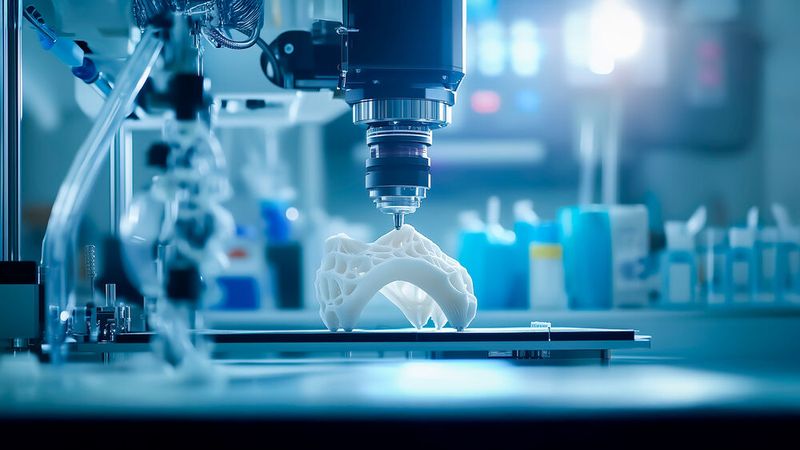
Printing a complex medical model in the laboratory.
Additive manufacturing is also widespread, beyond medicine, in related services such as pharmacies, therapists, or developers and manufacturers of medical devices. For these users, the economic advantages of 3D printing also play a role. The production of medical products via on-demand manufacturing eliminates the need for inventory. Patients no longer have to wait as long for aids, and design adjustments can be quickly implemented after an initial test. Compared to conventional manufacturing methods, 3D printing is also more environmentally friendly and reduces material waste.
3D Printing in Healthcare
Traditionally, the production of medical aids involves a lot of manual labor. Raw materials are shaped through grinding, carving, and machining until an end product as individual as possible is created. Additive processes make the process simpler, less labor-intensive, and therefore usually faster and cheaper. Designs for such 3D products are typically created using computer-aided design software (CAD). However, it is also possible to produce models based on 3D scans created in digital magnetic resonance imaging (MRI). To implement their ideas, many users utilize a production platform like Xometry, which connects them to the appropriate manufacturer for their desired product from a vast company network. In some cases, medical facilities also have their own printers, allowing them to produce directly on-site.
The success of 3D printing in the medical and healthcare sectors is based on its ability to create individualized and patient-specific designs. The possibilities of additive manufacturing are almost unlimited. It is therefore used for specialized and patient-specific surgical tools, procedural guides, and even facial reconstruction. Based on feedback from surgeons, quick and precise design adjustments can be made to such products.
Personalized Parts Reduce Surgery Times
3D-printed implants can be produced using many different printing methods and a wide variety of materials. Nowadays, items such as spinal and orthopedic implants, prostheses, shafts and parts, dental crowns, bridges, and other orthodontic tools are being printed. Additionally, delivery devices like inhalers, patches and implants, hearing aids, and detailed anatomical models are tailored to the personal needs of patients. Such personalized parts can reduce surgery times and prevent complications that could arise from manually modifying standard-sized implants.
3D-Printed Prosthetics Fit Perfectly to the Patient's Body
Printed prosthetics are among the most impressive solutions 3D printing has brought to healthcare. For amputees, personalization has created new freedoms: additively manufactured parts fit perfectly to the patient's body and offer greater comfort and functionality. Traditional prosthetics and their components are expensive and require frequent, labor-intensive manual adjustments. A 3D-printed prosthesis, on the other hand, is often more cost-effective. It is also quickly deliverable and requires fewer adjustments because it is custom-made. This is especially beneficial for children, as they quickly outgrow their prosthetics.
Anatomical Replicas Increase the Success Rate of Procedures
In addition to prosthetics, anatomical replicas can be created for education, training, and surgical planning. Such 3D prints closely resemble real organs, as they are based on actual imaging data from the patient. This allows doctors to practice major surgeries in advance. Complex procedures are simulated on the models, enabling medical staff to train in a realistic setting. The result is fewer complications and a higher success rate for procedures. Xometry, for instance, facilitates full-color printing using PolyJet 3D printing technology to create lifelike replicas with realistic textures and colors.
Printing of Organs And Tissue
Bioprinting is used to create scaffolds that resemble human tissue. This is a first step toward the production of printed organs and tissues. Such machine-manufactured organs have the potential to save millions of lives. Sick individuals would no longer need to wait on long lists for a donor organ. Research in this area is progressing intensively, but for now, it remains a vision of the future.
Medical devices and tools tailored specifically to a patient are already being printed. The method is also used for individualized medication dosages and formulations, reducing the risk of side effects. For example, the U.S. Food and Drug Administration (FDA) approved the epilepsy drug Spritam, which is manufactured using 3D printing. The technology allows for a porous surface on the tablets, making the improved preparation more easily dissolvable than other pills.
The Right 3D Technologies
So far, different technologies are used in healthcare—each with its advantages and disadvantages. The most commonly used 3D techniques in the healthcare industry are:
Date: 08.12.2025
Naturally, we always handle your personal data responsibly. Any personal data we receive from you is processed in accordance with applicable data protection legislation. For detailed information please see our privacy policy.
Consent to the use of data for promotional purposes
I hereby consent to Vogel Communications Group GmbH & Co. KG, Max-Planck-Str. 7-9, 97082 Würzburg including any affiliated companies according to §§ 15 et seq. AktG (hereafter: Vogel Communications Group) using my e-mail address to send editorial newsletters. A list of all affiliated companies can be found here
Newsletter content may include all products and services of any companies mentioned above, including for example specialist journals and books, events and fairs as well as event-related products and services, print and digital media offers and services such as additional (editorial) newsletters, raffles, lead campaigns, market research both online and offline, specialist webportals and e-learning offers. In case my personal telephone number has also been collected, it may be used for offers of aforementioned products, for services of the companies mentioned above, and market research purposes.
Additionally, my consent also includes the processing of my email address and telephone number for data matching for marketing purposes with select advertising partners such as LinkedIn, Google, and Meta. For this, Vogel Communications Group may transmit said data in hashed form to the advertising partners who then use said data to determine whether I am also a member of the mentioned advertising partner portals. Vogel Communications Group uses this feature for the purposes of re-targeting (up-selling, cross-selling, and customer loyalty), generating so-called look-alike audiences for acquisition of new customers, and as basis for exclusion for on-going advertising campaigns. Further information can be found in section “data matching for marketing purposes”.
In case I access protected data on Internet portals of Vogel Communications Group including any affiliated companies according to §§ 15 et seq. AktG, I need to provide further data in order to register for the access to such content. In return for this free access to editorial content, my data may be used in accordance with this consent for the purposes stated here. This does not apply to data matching for marketing purposes.
Right of revocation
I understand that I can revoke my consent at will. My revocation does not change the lawfulness of data processing that was conducted based on my consent leading up to my revocation. One option to declare my revocation is to use the contact form found at https://contact.vogel.de. In case I no longer wish to receive certain newsletters, I have subscribed to, I can also click on the unsubscribe link included at the end of a newsletter. Further information regarding my right of revocation and the implementation of it as well as the consequences of my revocation can be found in the data protection declaration, section editorial newsletter.
Stereolithography (SLA)
Printers cure liquid resin with lasers here. On Xometry, the process is used for manufacturing high-resolution and precise products with smooth surfaces. It is suitable for producing prototypes and anatomical models but requires some post-processing.
Selective Laser Sintering (SLS)
The technology is primarily used for complex mechanical and custom parts. High-performance lasers fuse powdered material into a finished product. Nylon and other polyamides (PA) are commonly used in this process. SLS nylon prints can be sterilized because the material is highly heat-resistant. The large and complex printers are mainly used in industry. However, through a production platform, the technology can also be accessed by smaller users who do not have their own printer.
Fused Deposition Modeling (FDM)
An FDM printer melts a thermoplastic filament and extrudes it strategically onto a build platform. It builds layer by layer until the final product is completed. This process is cost-efficient and ideal for simple prototypes and parts. However, the lower resolution means it is not the first choice for complex products and likely requires post-processing.
Direct Metal Laser Sintering (DMLS)/Selective Laser Melting (SLM)
Both printer types use lasers to melt metal powder to create strong and biocompatible parts, such as custom implants. They are very expensive to purchase and operate, making them almost exclusively intended for industrial environments.
Disadvantages of 3D printing in healthcare
Despite all its undeniable advantages, there are also weaknesses. For example, the selection of materials suitable for 3D printing in the medical field is still narrower compared to traditional manufacturing methods. Additionally, there are sometimes issues in achieving consistent quality of the printed parts.
There are various materials for 3D printing in the healthcare sector, all of which must meet strict safety, quality, and efficiency standards. They need to be stable, durable, sterilizable, corrosion-resistant, and lightweight. Not all 3D printer-compatible materials are safe for medical use. Below is a list of the most commonly used 3D printing materials in medicine and healthcare that can meet the necessary requirements:
Nylon PA-12
PC-ISO
ABS M30i
Titanium
Cobalt-chrome
Stainless steel
Thermoplastic polyurethane (TPU)
Polylactic acid (PLA)
Polyetheretherketone (PEEK)
Polyetherketoneketone (PEKK)
Polymethyl methacrylate (PMMA)
Bio-ceramic
Polyethylene glycol (PEG)
Future-Proof Authentication with Universal RFID Readers



:quality(80)/p7i.vogel.de/wcms/eb/2b/eb2bd1b8487afe577b37363cd02f16ff/0113143253v1.jpeg "In our China Market Insider, we regularly provide you with relevant information straight from China. (Image:© Eisenhans - stock.adobe.com)")
:quality(80)/p7i.vogel.de/wcms/dd/b8/ddb8edc98c49b384734ab2432b297eb5/adobestock-1913662309--irene-stock-adobe-com-ki-generiertv1.jpeg "Rotary joints are used in grippers and swivel mechanisms to allow assemblies to rotate or swivel smoothly relative to one another, even under very high loads (illustrative image). (Source: Irene - stock.adobe.com / KI-generiert)")
:quality(80)/p7i.vogel.de/wcms/d1/ef/d1ef6b6f7d4543f7999980bacccaf22b/0133499261v1.jpeg "As the growing imbalance in trade relations with China continues to widen, the EU Chamber of Commerce foresees a day when trade with China will have to be seriously reevaluated ... (Image: AI-generated)")
:quality(80)/p7i.vogel.de/wcms/fe/1f/fe1fa5ee713f94deaba963dc24c3abc5/0133299273v1.jpeg "The Flexistar enables highly flexible production of laser-welded tubes thanks to its tool-free clamping system. (Image:Because Technology, LLC)")
:quality(80)/p7i.vogel.de/wcms/60/ef/60ef4f07e4829b2c2929befc0f353c58/0133511729v1.jpeg "Humanoid robots can match human performance in certain tasks. (Image:Gemini / AI-generated)")
:quality(80)/p7i.vogel.de/wcms/2e/99/2e99726b522e4b35b690e25eb6a42643/0133463991v1.jpeg "Robotics: In AMR applications, connection technology must reliably transmit power, signals, and data despite vibration and shock loads—in very confined spaces and in a way that allows for regular maintenance. (Image:Hyperever)")
:quality(80)/p7i.vogel.de/wcms/d0/18/d01801e3d5dbd7bc9d0b4f60408b630c/0133468429v1.jpeg "Quality requirements for film packaging are on the rise. At the same time, many companies are turning to recyclable film materials, which, however, have their own challenges. Fraunhofer researchers have therefore developed a fast system that detects problems in real time. (Image:Fraunhofer IKTS)")
:quality(80)/p7i.vogel.de/wcms/b1/06/b106cf44923ce39565c3264982fd20eb/0133414574v1.jpeg "Robots Build Robots: At the new Ubtech factory, automated systems even handle parts of the material supply and logistics for the production of humanoid robots. (Image:Ubtech)")
:quality(80)/p7i.vogel.de/wcms/c0/52/c052f405eb55fc3d08c4837e77206fc0/adobestock-2021845957--aucartstudio-stock-adobe-com-ki-generiertv1.jpeg "An innovation from China to combat extreme summer heat: A novel coating lowers temperatures. (Source: © AucArtStudio – stock.adobe.com_AI-generated)")
:quality(80)/p7i.vogel.de/wcms/66/a7/66a7b78159caeacce57136529688799f/0133503398v1.jpeg "Sunlight Makes Stone! These stone blocks weren't made the traditional way. Instead, they were additively manufactured from sand using a laser. In the future, however, the laser is set to be replaced by concentrated sunlight—if the startup Addisol is successful... (Image:Addisol / F. Fiedler)")
:quality(80)/p7i.vogel.de/wcms/72/b9/72b995c2c8d812c5e2115cbef31e035a/0133462727v1.jpeg "Eggl manufactures center hoods that are precisely tailored to each cooking island—whether standard size or custom shape. They are made entirely of stainless steel and are individually customized in terms of size and filter arrangement. (Image:SPI)")
:quality(80)/p7i.vogel.de/wcms/13/5d/135dfae6229ceaf5c55467a43e8f7257/adobestock-1879961393--ardi-stock-adobe-com-ki-generiertv1.jpeg "Annoying chatterboxes or awkward silences in response to questions—a moderator should specifically prepare for difficult situations in order to navigate them effectively. (Image:ardi - stock.adobe.com_AI-generated)")
:quality(80)/p7i.vogel.de/wcms/aa/a2/aaa2c6dd2daa24b485cddbf9297590c0/0133467318v1.jpeg "Battery Monitoring: Battery monitoring using electrochemical impedance spectroscopy offers several advantages. (Image:TI)")
:quality(80)/p7i.vogel.de/wcms/39/b2/39b21bf03be1683831862239a369987c/0133469638v1.jpeg "Data from autonomous vehicles and robots operating autonomously is in high demand, and Ruqi wants to capitalize on this. (Image:Ruqi Mobility)")
:quality(80)/p7i.vogel.de/wcms/8a/bb/8abbb6217220595edc1549ac9b84f307/0133429906v1.jpeg "The IAA in Hanover showcased the ambitions of Chinese commercial vehicle manufacturers in Europe. (Image:Wehner - VCG)")
:quality(80)/p7i.vogel.de/wcms/0c/53/0c5313ef91c14b6df0d0996efc33c8ad/jpg03568-bearbeitetv1.jpeg "The category winners of the 2027 German Car of the Year award. (Source: GCOTY)")
:quality(80)/p7i.vogel.de/wcms/48/15/4815da27c45973ca629a99b375ac3aef/0133509585v1.jpeg "Ventuno Q RoadTest: Designed to help the Element14 community gain practical insights from real-world tests using the Ventuno Q. (Image:Farnell/Element14)")
:quality(80)/p7i.vogel.de/wcms/17/2b/172bd132f9febdfcbcedba292ad0504d/aufmacherv1.jpeg "Micro-Epsilon offers a wide range of IO-Link-compatible sensors. (Source: Micro-Epsilon Messtechnik GmbH & Co. KG)")
:quality(80)/p7i.vogel.de/wcms/ca/b4/cab46fd26d19d6a2febca032048200b6/0133471827v1.jpeg "Photonics SDK for C and Python: Computational operations are now abstracted as standard mathematical functions. (Image:Q.ANT)")
:quality(80)/p7i.vogel.de/wcms/92/b2/92b2ed5299cde450c0764f4f64468395/0133505895v1.jpeg "The \"Iris 100\" test system for high-precision volume production of microLEDs uses a spectrometer and a high-resolution camera. (Image:Teradyne)")
:fill(fff,0)/images.vogel.de/vogelonline/companyimg/76800/76895/65.jpg "FAULHABER_120mm.jpg ()")
:fill(fff,0)/p7i.vogel.de/companies/69/88/69882c428938e/tmts2026-ticec-banner-en-2000px.png "tmts2026-ticec-banner-en-2000px (https://www.tmts.tw/en)")
:fill(fff,0)/p7i.vogel.de/companies/69/de/69de1b7403b0d/simtos-logo.jpeg "simtos-logo (SIMTOS)")
:quality(80):fill(efefef,0)/p7i.vogel.de/wcms/67/ae/67ae0b9ac31f8/elatec-wp-universal-reader.png "Elatec WP Universal Reader")
:quality(80)/p7i.vogel.de/wcms/fd/76/fd76fd67142ded48cfcb2e819bea231b/0133154160v1.jpeg "The pacemaker implant is flexible and conforms to the shape of the brain. This significantly improves comfort. (Image:Fraunhofer IZM)")
:quality(80)/p7i.vogel.de/wcms/61/f8/61f892896038f0fc6e5bad556ba36adc/brain-850x478v1v1.jpeg "Researchers at the University of Missouri have developed new methods to better simulate the complex nature of human brain tissue. (Image:University of Missouri)")