Digital production in enclosure construction is based on CAD and CAE: all 3D and metadata is merged in the digital twin. Error rates are massively reduced and project lead times are shortened. The prerequisites are clean, well-maintained data and a networked software infrastructure.
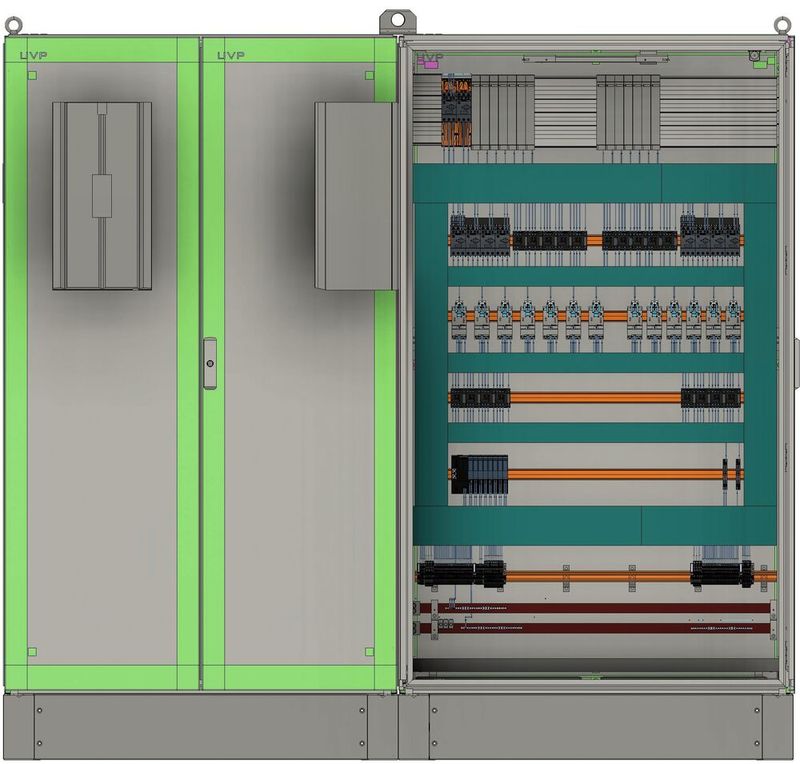
Digital twin: The paperless electrical enclosure corresponds 100 percent to the digital twin. At UVP, the digital twin stands above every process - from planning to final testing - and brings all data together as a digital representation of the enclosure.
(Image: RRP)
The digital production of enclosures places particularly high demands on the data and its quality. Digital production in enclosure construction is based on CAD (computer-aided design) and CAE (computer-aided engineering): All 3D and metadata is merged in a digital twin and transferred to the machines for enclosure processing and strand set production.
The desired level of automation can be achieved with the help of individual software tools. UVP Schaltschrankbau from Pleidelsheim produces all orders on the basis of digital twins with end-to-end processes.
Gallery
Macros form the basis of a consistent CAE process: A corresponding digital image is created for all components of an enclosure. The macro contains both 2D and 3D data. For example, a drawing can result in several connection options for a component. The exact positions in the 3D space must be shown in the macro. Only the assignment of descriptive information to the 3D model makes a macro complete.
After the macros, the circuit diagram is created if it has not been provided by the customer. If the circuit diagram comes from the customer, its parts list is imported into the software and checked to see whether a macro is available for all listed items. The missing ones are created, checked and released.
Complete and Error-Free Macros for the Digital Twin
Before creating the digital twin and the CAE process, all macros must be complete and error-free. If the macros are not maintained, important information will be missing: Usable cable cross-sections and wire treatment may not be named. Or a cable is routed upwards, although the connection is located at the bottom of the component, making the cable too short or too long.
The cables must also be defined correctly. Each cable is assigned to a suitable article, which clearly defines the cable type - this allows the filling level of the cable duct to be calculated correctly.
In the next step, the digital twin is created, which provides all the data for the design of the control cabinet. It is compared with the customer data, after which production begins. For automated production to be successful, the digital twin requires a consistent data basis.
First Step: Creating the Macros
While printed circuit diagrams on paper work internationally, they are not sufficient for digital production. The digital twin requires special circuit diagrams. UVP therefore completely reworks the information provided by the customer.
This is because existing macros are generally not maintained in the depth required by the digital twin. UVP replaces macros and adds missing information such as usable cable cross-sections or the specified wire treatment.
This makes the creation and maintenance of macros time-consuming. It is not uncommon for each component to require 30 minutes of work. During the inventory, the company counted around 1,700 components alone, but these only represent a fraction of the total: A comprehensive macro library can quickly comprise around 7,000 macros - but these can be used again and again for different projects.
Manufacturing with the digital twin means that large parts of the production time are shifted to the planning stage and the majority of the tasks are carried out by design and engineering. The creation and maintenance of macros alone account for around 70 percent of the total work. UVP's engineering team works from Turkey: As design is more expensive than production, a design department in Germany would not be worthwhile.
Why Standards Need to be Defined
Standards are another key factor in the process. They must be defined right at the start, known and practiced. Fixed, always identical parts in the enclosure have clear designations, such as the left or right side panels, doors or cable ducts.
Design and production must know these designations. The position of the parts is clear from the designation, and the employee no longer needs any further information to build the cabinet. UVP works with over 50 different standards. A lack of standards creates errors at the interface between design and production.
Date: 08.12.2025
Naturally, we always handle your personal data responsibly. Any personal data we receive from you is processed in accordance with applicable data protection legislation. For detailed information please see our privacy policy.
Consent to the use of data for promotional purposes
I hereby consent to Vogel Communications Group GmbH & Co. KG, Max-Planck-Str. 7-9, 97082 Würzburg including any affiliated companies according to §§ 15 et seq. AktG (hereafter: Vogel Communications Group) using my e-mail address to send editorial newsletters. A list of all affiliated companies can be found here
Newsletter content may include all products and services of any companies mentioned above, including for example specialist journals and books, events and fairs as well as event-related products and services, print and digital media offers and services such as additional (editorial) newsletters, raffles, lead campaigns, market research both online and offline, specialist webportals and e-learning offers. In case my personal telephone number has also been collected, it may be used for offers of aforementioned products, for services of the companies mentioned above, and market research purposes.
Additionally, my consent also includes the processing of my email address and telephone number for data matching for marketing purposes with select advertising partners such as LinkedIn, Google, and Meta. For this, Vogel Communications Group may transmit said data in hashed form to the advertising partners who then use said data to determine whether I am also a member of the mentioned advertising partner portals. Vogel Communications Group uses this feature for the purposes of re-targeting (up-selling, cross-selling, and customer loyalty), generating so-called look-alike audiences for acquisition of new customers, and as basis for exclusion for on-going advertising campaigns. Further information can be found in section “data matching for marketing purposes”.
In case I access protected data on Internet portals of Vogel Communications Group including any affiliated companies according to §§ 15 et seq. AktG, I need to provide further data in order to register for the access to such content. In return for this free access to editorial content, my data may be used in accordance with this consent for the purposes stated here. This does not apply to data matching for marketing purposes.
Right of revocation
I understand that I can revoke my consent at will. My revocation does not change the lawfulness of data processing that was conducted based on my consent leading up to my revocation. One option to declare my revocation is to use the contact form found at https://contact.vogel.de. In case I no longer wish to receive certain newsletters, I have subscribed to, I can also click on the unsubscribe link included at the end of a newsletter. Further information regarding my right of revocation and the implementation of it as well as the consequences of my revocation can be found in the data protection declaration, section editorial newsletter.
For example, the designer must always draw the cable duct from left to right when resetting. This standard ensures that the arrangement in production is clear and that the holes in the cable duct match the holes in the mounting plate. Deviations lead to assembly errors.
The Data During System Integration
The system integration that makes an automated process possible in the first place is carried out by software that ensures the accuracy and consistency of the data from step to step. Only then can the next task be initiated. For example, software checks whether all macros have been released. Another tool detects discrepancies between the circuit diagram and the parts list; each difference is checked and commented on in the program. This results in the correct final shopping list; incorrect parts in production are avoided thanks to this early comparison.
In the further process, data is exported from the digital twin to the machines: to the enclosure processing machine and to the fully automatic machine for cable assembly. The control cabinets are assembled in production using Eplan's Smart Production software; the necessary labels with the equipment identification of the parts can be exported from the digital twin using additional software, processed with internal software and automatically printed out in the appropriate quantity.
The Advantages of Automated Production
As this approach means that the main work takes place before the actual enclosure construction and assembly of the parts, integrated CAD/CAE processes primarily accelerate the production processes - by using machines and providing data at the right time. Cables automatically receive the correct wire treatment in the machine, and housing processing also takes place automatically - all relevant data is transferred from the digital twin to the machines.
In production, the digital twin specifies the correct connections and cables: The employee in assembly no longer has to think about which sleeve belongs on which pin or which ring cable lug needs to be inserted; the software guides them through all the work steps.
Since the cable positions and the filling level of the cable ducts are known, overfilling can be avoided. This is a major problem in conventional production, which only arises during final assembly when it becomes apparent after hundreds of cables have been laid that the trunking is becoming too full. This error is difficult to rectify this late in the process.
As such problems can be identified early on with the digital twin and rectified during the planning phase, costs are reduced - the components fit in the space planned for them, components do not collide and the parts lists are correct.
For example, a control cabinet with a width of 2.4 m (approx. 7.9 ft) was to be produced for a customer order. During the planning stage, it became apparent that the components would not fit in this format - the width was adjusted to 3 m (approx. 9.8 ft). This correction was possible before the actual production, which saved time and costs as no subsequent rescheduling was necessary.
The Advantages of Digital Processes in Enclosure Construction
It is becoming apparent that CAD/CAE processes and digital process chains are increasingly being used in manufacturing. In the future, the path will lead towards the "dark factory" - in which production is carried out exclusively with robots. To achieve this, the data basis must be 100 percent error-free. Artificial intelligence may also be able to digitize the data from PDF plans and make it available for the construction of the digital twin.
Digital production is also finding its way into switch cabinet construction, where digital twins bundle all information and form the basis for automation with machines. As a result, the proportion of work is shifting - towards engineering with planning and design and away from final production. There is an opportunity here to reduce errors in production to a minimum and increase output. The prerequisites for this are consistent, clean data and defined standards. (kr)
*Nadja Müller is a specialist journalist at Wordfinder.



:quality(80)/p7i.vogel.de/wcms/d9/43/d943b0ce33bdf921f37f14655bb0c376/cuscinetto-a-sfere-di-leonardo-da-vinci-in-una-mostra-su-leonardo-da-vinci-al-mulino-di-mora-bassa---morabassa-croppedv1.jpeg "Replica of Leonardo da Vinci's ball bearing: The inventor used wooden balls. Spacers prevent the balls from rubbing against each other. (Source: Capricornis crispus)")
:quality(80)/p7i.vogel.de/wcms/17/b8/17b8af0cb725e0e1d3e8d72458bab260/siemens-meet-at-the-machinev1.jpeg "“Meet at the Machine” is Siemens’ new initiative, which aims to bring together machine builders, software, and automation technologies to accelerate innovation in the machine tool industry and help manufacturers become productive more quickly. (Source: Siemens)")
:quality(80)/p7i.vogel.de/wcms/8e/7e/8e7e0cda4c68699bcc48283a38739769/0133316747v1.jpeg "A little-known hidden champion! When people think of laser cutting, the first thing that comes to mind is the power of the laser beam—and it is impressive to see the sparks flying. But Air Liquide—an exhibitor at Euroblech, by the way—wants to make it clear that the process gas is also key to success. (Image:AI-generated)")
:quality(80)/p7i.vogel.de/wcms/20/fa/20fa35e0af203c3464f7e7fdbb57a685/0133281172v1.jpeg "Since 2003, Etzinger AG has been developing and manufacturing high-quality coffee grinders, pepper mills, and grinding mechanisms for professional and home use. (Image:Etzinger)")
:quality(80)/p7i.vogel.de/wcms/b1/06/b106cf44923ce39565c3264982fd20eb/0133414574v1.jpeg "Robots Build Robots: At the new Ubtech factory, automated systems even handle parts of the material supply and logistics for the production of humanoid robots. (Image:Ubtech)")
:quality(80)/p7i.vogel.de/wcms/38/79/38799bfbbccd938b64c67068cfa68780/0133329362v1.jpeg "What exactly enables machines to act on their own? (Image:Shutterstock)")
:quality(80)/p7i.vogel.de/wcms/1b/9f/1b9fc9f113fc66212e2c0e17a3edaf9f/org-blobs-user-response-file-output-f317796f-57b7-483f-9403-5d9ac8a816f5-plugin-output-call-kdigtepb7be7us8xvbota0mh-1672x940v1.png "According to Barclays data, Europe leads the global trade in actuator components. With a 34 percent share, the region ranks ahead of China, which has a 26.3 percent share. (Source: Statista | CC BY-ND 4.0, AI-generated)")
:quality(80)/p7i.vogel.de/wcms/f5/4c/f54c9fc59ccb0604ab9219188469a45f/image1v1.jpeg "Christopher Savoia, Global Head of the UR+ Ecosystem at Universal Robots, presents the new SP7 Smart Panel on a UR17g-1300 robot during the unveiling of Gen 7—UR’s 7th-generation robot platform—at IMTS in Chicago on September 14, 2026. (Image:Image: Teradyne Robotics)")
:quality(80)/p7i.vogel.de/wcms/ca/46/ca462051dfb9a1fb37ca4053762af9df/org-blobs-user-response-file-output-908c701c-3b37-491e-bb5c-35fc3d336575-plugin-output-call-182851v1.png "Through extreme compression, high-energy lasers transform simple plastics into high-purity nanodiamonds. What was once used in planetary physics is now opening up entirely new possibilities for quantum sensors, novel catalysts, and extremely hard materials. (Illustrative image) (Source: VCG / AI-generated)")
:quality(80)/p7i.vogel.de/wcms/7c/7a/7c7a5eada63c7a36a365391c292f76d4/hot-fire-jarvisv1.jpeg "(Developed in record time: A “JARVIS-class” jet engine capable of up to 100 pounds of thrust. It was designed in a four-week sprint using generative AI and established CAD/CAE tools.MIT)")
:quality(80)/p7i.vogel.de/wcms/87/87/87870cf2b30aaef7b8a06212a4ef2c14/0133403885v1.jpeg "A digital twin and a real component demonstrate how closely simulation and manufacturing are converging. Stampack Xpress 2026.1 virtually models forming behavior and supports the validation of process and tool design. (Image:Stampack)")
:quality(80)/p7i.vogel.de/wcms/59/2a/592a7f2d0964e9e6846cae331f5daa3a/0133266065v1.jpeg "Perforated metal sheets are particularly well-suited for balcony railings, as they combine stability, privacy, and design versatility. (Image:Ripo Factory)")
:quality(80)/p7i.vogel.de/wcms/24/d5/24d546b8c00887feaef1cbc207b9e2af/0133433032v1.jpeg "Mahle CEO Arnd Franz was recently asked about his vision for the future of the commercial vehicle business—particularly regarding the industry's transition to electric vehicles... (Image:Kai R. Joachim / Mahle)")
:quality(80)/p7i.vogel.de/wcms/8b/c5/8bc5c0c40b6d706aca4e3f3ddcc99958/0133387335v1.jpeg "At InnoTrans, Stadler is unveiling for the first time its new four-axle EURO DuFour locomotive for freight service, which SBB Cargo has ordered. Compared to the existing fleet, it is expected to be significantly more energy-efficient in operation. (Image:Stadler)")
:quality(80)/p7i.vogel.de/wcms/49/97/49978469e969283ccb68531ebef1f412/klaus-zellmer-1v1.jpeg "Klaus Zellmer will become CEO of Volvo no later than October 2027. (Source: Volvo)")
:quality(80)/p7i.vogel.de/wcms/cf/e1/cfe1f3824102bd030f4fe5e4e13e1e0e/0133433007v1.jpeg "The situation in the German automotive manufacturing industry is not exactly rosy, especially when viewed in the context of global competition. Read here to find out what a recent analysis of the situation reveals ... (Image:AI-generated)")
:quality(80)/p7i.vogel.de/wcms/f3/d9/f3d91ebfd703e24d4065b0ae7898e46b/0133177388v1.jpeg "The Evolution of Coding: In the past, programs were written by hand and fed into the computer using punch cards and switches. Today, in the age of “vibe coding,” computers can largely program themselves. (Image:Dall-E / AI-generated)")
:quality(80)/p7i.vogel.de/wcms/00/cd/00cd7c51cf41652dbb295c14634cd34f/0133438409v1.jpeg "Flash memory from Spansion dating back to 2004, before the company merged with Cypress. Infineon is divesting its NOR flash and FRAM memory business. Winbond, which is acquiring the division for $1.12 billion, plans to continue operating it as a separate company under the Spansion name starting next year. (Image:Raimond Spekking / CC BY-SA 4.0 / Wikimedia Commons)")
:quality(80)/p7i.vogel.de/wcms/09/dc/09dcc37616c3a9d5d7a289c97a352a89/0133428369v1.jpeg "(Image:Gemini / AI-generated)")
:quality(80)/p7i.vogel.de/wcms/4c/53/4c534208d09a9b1ce597938715e7fc19/0133288763v1.jpeg "Logic Folding: In its latest Kirin 9050 Pro, Huawei uses hybrid bonding to distribute the computing units across two silicon layers in order to increase the effective transistor density without resorting to finer manufacturing processes. (Image:Huawei)")
:fill(fff,0)/images.vogel.de/vogelonline/companyimg/76800/76895/65.jpg "FAULHABER_120mm.jpg ()")
:fill(fff,0)/p7i.vogel.de/companies/69/88/69882c428938e/tmts2026-ticec-banner-en-2000px.png "tmts2026-ticec-banner-en-2000px (https://www.tmts.tw/en)")
:fill(fff,0)/p7i.vogel.de/companies/69/de/69de1b7403b0d/simtos-logo.jpeg "simtos-logo (SIMTOS)")
:quality(80)/p7i.vogel.de/wcms/ae/89/ae89df1f2ba4db1236d175e9007e2ddd/0130178513v1.jpeg "Figure 3: Paperless control cabinet produced on the basis of the digital twin in production.(Image: RRP)")
:quality(80)/p7i.vogel.de/wcms/a6/60/a660a44f19d32322b8aafd8846a2807a/0130122789v1.jpeg "Figure 1: The drilling pattern for the housing machining is exported from the digital twin, and a software specially developed by UVP prevents errors during machining.(Image: Stonecutter)")
:quality(80)/p7i.vogel.de/wcms/25/62/256203374e8a7063fb8a70222d2ad820/0130122795v1.jpeg "Figure 2: Cable assembly is fully automated.(Image: Komax)")
:quality(80)/p7i.vogel.de/wcms/d4/01/d4019d1ac8781d762ce7561f6578617d/0130178510v1.jpeg "Digital twin: The paperless electrical enclosure corresponds 100 percent to the digital twin. At UVP, the digital twin stands above every process - from planning to final testing - and brings together all data as a digital representation of the enclosure.(Image: RRP)")
:quality(80)/p7i.vogel.de/wcms/9c/ab/9cab21491606aa2307666fe98ecd6e71/0129075731v1.jpeg "The AI-generated demonstration cabinet, which was shown for the first time at SPS 2025, was created as a joint project between WSCAD, ABB, Phoenix Contact and häwa. (Image:Phoenix Contact)")
:quality(80)/p7i.vogel.de/wcms/78/10/7810cea1046df8ccf33db854c1bc73ae/img02-dual-monitor-setupv1.jpeg "The requirements for industrial automation solutions are changing rapidly. Systems are becoming more individualized, project lead times shorter - and international standards more complex. (Source: WSCAD)")