Weeks of counting components and typing lists? Those who analyze circuit boards without documentation often lose an enormous amount of time. The Munich-based R&D agency Eigenblue is now turning the tables: A newly developed machine uses AI to scan and recognize circuit boards in just 15 minutes.
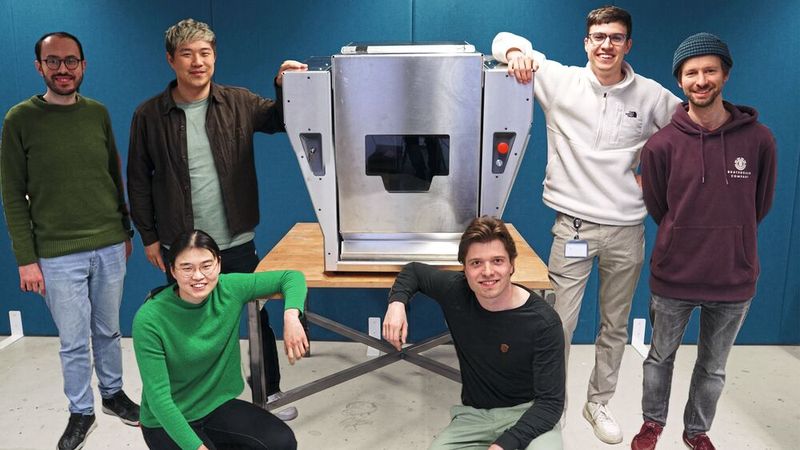
The Eigenblue team with the eigenScan (from left to right): Ata Keşfeden, Shiyue Liu, Qiao Qiao, Johannes Zimmerer, Raphael Joppi and Tizian Unkauf.
(Image: Eigenblue GmbH)
Anyone who has ever tried to recapitulate the bill of materials (BOM) of a complex, unfamiliar circuit board without a circuit diagram will be familiar with the problem. Traditionally, engineers have to identify components individually under a microscope, read off values and laboriously enter them into lists. Specialists who have to analyze and calculate such assemblies can easily spend several weeks doing this. A massive time and cost factor that is now to be drastically minimized: According to the manufacturer, the new system completes this process up to 150 times faster.
Although there are now software tools for automatic component recognition, these often still require a lot of manual work in practice: circuit boards have to be laboriously photographed manually, images uploaded and suggestions validated. On the other hand, there are classic, high-precision hardware scanners for the aviation and military sectors, which often lack the smart, fast AI link. A real automation breakthrough has been missing here until now. The Munich-based company Eigenblue is now closing precisely this gap: Under the project name "Guess the BOM", the team developed an optical analysis system as a complete solution comprising hardware and software that fully automates the entire inspection job. The machine is now to be launched on the market under the name "eigenScan".
Gallery
From Student Project to Your Own Machine
The fact that an R&D service provider is suddenly building its own hardware is surprising at first. "We're a bit like Fraunhofer, but private," explains Project Manager Raphael Joppi in an interview with Elektronikpraxis. "Our focus is on developing or integrating new technologies, as SMEs often find this difficult."
The roots of the company go back 13 years, as a foundation from the university "Manage&More" program. "Back then, the founders thought that students were at the cutting edge anyway, so they offered 'student engineering'. The students got older and student engineering became professional engineering," Joppi looks back. Today90 people work at Eigenblue and cover an enormous spectrum: from software to AI and mechanical engineering to chip development.
The idea for the PCB machine came from practical experience: a DAX-listed customer from the automotive industry needed a production-ready system to scan PCBs precisely and in high resolution. From this exclusive customer project, the "Guess the BOM" system eventually grew into a market-ready product whose hardware is already fully functional and in use. The system has not yet been presented to the public anywhere, and is therefore celebrating its official premiere here.
Hardware Setup: A Look into the "Circuit Board Oven"
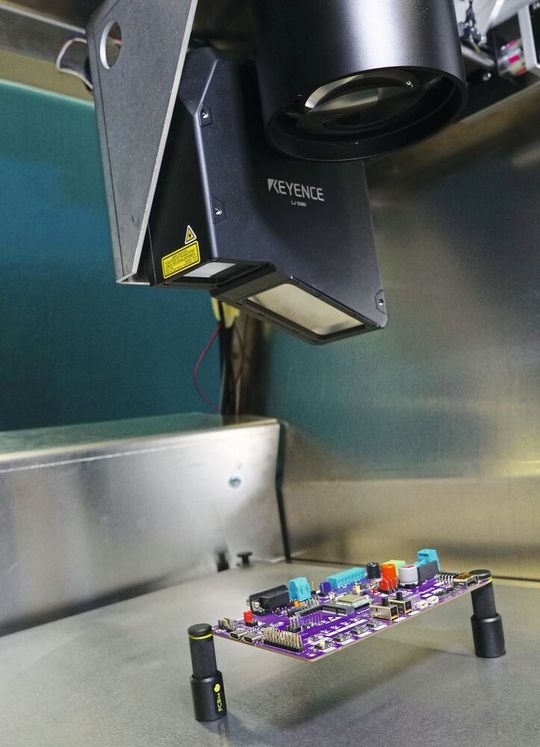
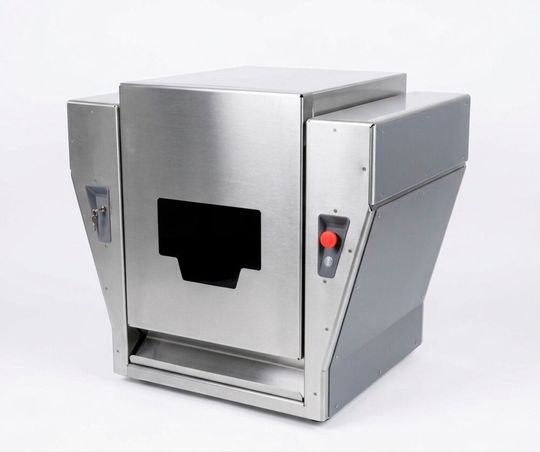
How does the machine work? Seen from the outside, there is a completely enclosed box about the size of an oven. The housing shields out interfering light, keeping the lighting constant so that the computer vision works reliably.
A circuit board under the scanner: Automated image analysis makes manual visual inspection superfluous.
(Image: Eigenblue GmbH)
Internally, the developers affectionately refer to the system as a "pizza oven" or "baking oven", says Joppi. The user pushes the circuit board in and closes the flap. The hardware easily processes large-format PCBs measuring up to 20 × 20 inches. Inside, a camera system scans the assembly in small sections. High-resolution 2D cameras capture every detail at 10 micrometers per pixel, while a 3D camera simultaneously records the exact spatial height profiles of the assembled component.
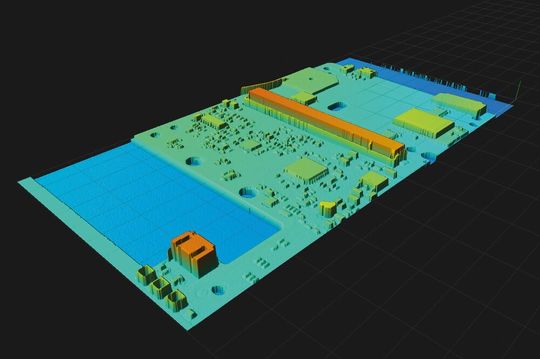
Anyone familiar with automatic optical inspection (AOI) knows about the physical pitfalls of assembled PCBs: Tall components such as electrolytic capacitors or large connectors inevitably cast shadows on neighboring, tiny SMD components. This is precisely where the 3D camera comes into its own, as it creates a topographical profile of the assembly. The software can thus precisely distinguish whether a dark area on the 2D image is merely a shadow or actually a flat, black IC housing. As the sensor system naturally scans the components from above, a small manual intermediate step is necessary: After the first half of the scan, the user must manually turn the PCB once so that the system also digitizes the underside.
Software And AI: Seven Models Think in Parallel
The hardware provides the images, the software does the actual thinking. Instead of rigid image recognition rules, an ensemble of several AI models working in parallel evaluates the images:
Date: 08.12.2025
Naturally, we always handle your personal data responsibly. Any personal data we receive from you is processed in accordance with applicable data protection legislation. For detailed information please see our privacy policy.
Consent to the use of data for promotional purposes
I hereby consent to Vogel Communications Group GmbH & Co. KG, Max-Planck-Str. 7-9, 97082 Würzburg including any affiliated companies according to §§ 15 et seq. AktG (hereafter: Vogel Communications Group) using my e-mail address to send editorial newsletters. A list of all affiliated companies can be found here
Newsletter content may include all products and services of any companies mentioned above, including for example specialist journals and books, events and fairs as well as event-related products and services, print and digital media offers and services such as additional (editorial) newsletters, raffles, lead campaigns, market research both online and offline, specialist webportals and e-learning offers. In case my personal telephone number has also been collected, it may be used for offers of aforementioned products, for services of the companies mentioned above, and market research purposes.
Additionally, my consent also includes the processing of my email address and telephone number for data matching for marketing purposes with select advertising partners such as LinkedIn, Google, and Meta. For this, Vogel Communications Group may transmit said data in hashed form to the advertising partners who then use said data to determine whether I am also a member of the mentioned advertising partner portals. Vogel Communications Group uses this feature for the purposes of re-targeting (up-selling, cross-selling, and customer loyalty), generating so-called look-alike audiences for acquisition of new customers, and as basis for exclusion for on-going advertising campaigns. Further information can be found in section “data matching for marketing purposes”.
In case I access protected data on Internet portals of Vogel Communications Group including any affiliated companies according to §§ 15 et seq. AktG, I need to provide further data in order to register for the access to such content. In return for this free access to editorial content, my data may be used in accordance with this consent for the purposes stated here. This does not apply to data matching for marketing purposes.
Right of revocation
I understand that I can revoke my consent at will. My revocation does not change the lawfulness of data processing that was conducted based on my consent leading up to my revocation. One option to declare my revocation is to use the contact form found at https://contact.vogel.de. In case I no longer wish to receive certain newsletters, I have subscribed to, I can also click on the unsubscribe link included at the end of a newsletter. Further information regarding my right of revocation and the implementation of it as well as the consequences of my revocation can be found in the data protection declaration, section editorial newsletter.
Classify: First, the system assigns the basic component type. Is it an IC, a resistor, a coil or a capacitor?
Extract attributes: The AI then filters out secondary features such as the package, the design and the exact dimensions.
Reading text and logos: Optical character recognition (OCR) is particularly effective for ICs. It deciphers the surface text, recognizes manufacturer logos and counts the pins.
The system then compares all these optical findings fully automatically with a database containing over 1.5 million integrated circuits. A specific component entry for the parts list is created from various optical fragments. You can use your own database via API or purchase one from Eigenblue.
The Digital Twin: Bounding Boxes And Confidence Values
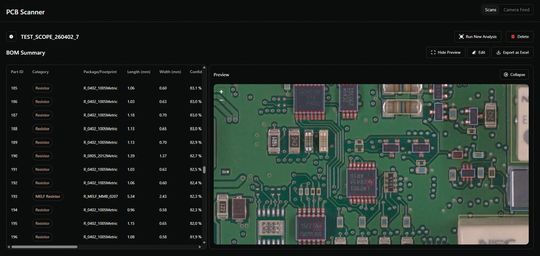
But how does the result present itself to the user after the 15-minute waiting time? In addition to an Excel table, the Eigenblue software generates an interactive 3D model of the PCB and an interactive overview. Here, the PCB is displayed like a map and the user can zoom in and move the displayed area. Each detected component is highlighted in color via the bounding box. When clicking on these components, the component and the corresponding values are displayed in the table.
The self-scan software: It automatically recognizes and classifies components, including a preview and exportable parts list.
(Image: Eigenblue GmbH)
A developer will then see markings such as "resistor 0.81" for a resistor with an 81% probability of detection or "capacitor_cylindrical 0.92" for a cylindrical capacitor directly in the image overlay. Above a (freely configurable) limit value, a disputed value is marked in red and can then be checked individually. Even manufacturers and chip families such as Infineon TriCore are visualized directly as soon as the logo recognition takes effect. This makes the process efficient: the engineer does not have to blindly compare lists, but simply scrolls to the components with low confidence values and visually approves or corrects them.
According to Eigenblue, the machine delivers reliable values. In the case of integrated circuits (ICs), it correctly identifies up to 99% of chips. Even with small passive components, which are often unlabeled and only reveal themselves through their design, color or reflection, the hit rate is still a strong 97 to 98 percent.
At the same time, the system does not hide its physical limitations: where a camera lens cannot reach, the AI has to pass. With ball grid arrays (BGAs), for example, whose solder joints and contacts are completely concealed under the chip, the system can naturally only recognize the package itself, but not the hidden routing underneath. This is where technical specialists are absolutely essential. If a person ("human-in-the-loop") confirms or corrects a component, the models learn from this immediately and do not make the same mistake the next time.
Benchmarking, Cost Engineering And Obsolescence
In practice, the economic levers of this automation are particularly evident in three central use cases. The first is competition benchmarking: If you want to understand how the competition solves a technical problem, which specific microcontrollers they use or how their power management is structured, there is no way around reverse engineering other companies' circuit boards. What used to be a laborious dissection becomes a fast, standardized process thanks to AI-supported BOM generation. Development departments thus gain deep insights into the architecture decisions of the competition in the shortest possible time.
D-reconstruction of a printed circuit board: Components are measured with millimeter precision using the depth map.
(Image: Eigenblue GmbH)
Cost engineering is closely linked to this. In order to calculate the exact cost structure of an assembly, be it a competitor's product or an assembly from one of our own suppliers, every SMD component, no matter how small, must be recorded. This is precisely where the machine provides massive relief: instead of spending weeks counting components under a microscope, the system delivers the finished parts list as a direct basis for calculation in a matter of minutes. This drastically reduces the time and effort required for price and margin analyses.
The third major use case is obsolescence management. So-called "orphan PCBs" from decades-old systems are a major headache for maintenance engineers in practice. If such a PCB fails and there is no circuit diagram or documentation, the worst-case scenario is that an entire production line comes to a standstill. Manual reconstruction often fails due to discontinued components whose imprints are barely legible. However, if the engineer knows exactly what specifications the defective old chip had after a few minutes thanks to the AI database comparison, he can search specifically for suitable drop-in replacements (pin-compatible replacement types) from today's manufacturers or quickly convert the board design into a modern redesign.
IP Protection: The Competitive Issue And Market Demand
Across all these use cases, personnel costs are the biggest economic factor. But who are the direct competitors here? "There is inexpensive reverse engineering in China," reveals Joppi , who went to Shenzhen to see for himself. Until now, the solution for companies has often been to send a circuit board to be analyzed to Asia, where it is disassembled by hand for hours at low hourly rates. However, this approach poses massive risks for European companies when it comes to protecting their intellectual property: "It's always a compliance issue and whether the exact same circuit board will end up somewhere on the black market," warns Joppi. For many companies, such a loss of IP is naturally unacceptable.
The self-scan captures printed circuit boards fully automatically using a camera, and the AI then takes over the evaluation.
(Image: Eigenblue GmbH)
It is precisely from this mixed situation that the specific need for the new machine arises. This is because other technical alternatives are also reaching their limits here: Although there are hardware scanners on the market, some of these are 15 years old and work completely without AI. And classic inspection cameras (AOI) at the end of production lines are not trained to decode completely unfamiliar PCBs. "That's why we are actually the only ones in this field who are actually making such systems with machine plus AI," summarizes Joppi.
The business model should also adapt to different company sizes. Those who do not want to buy the system straight away will be able to use "scanning as a service" in future. Customers simply send in their circuit board and receive the finished parts list and the digital twin back after analysis. Or, if the volume is sufficient, a machine is provided and the customer pays per scan, which better protects the IP design.
For the future, Eigenblue is not only planning new business models based on individual customer requirements: a more compact desktop version will soon also serve companies with smaller board formats. (mc)
Future-Proof Authentication with Universal RFID Readers



:quality(80)/p7i.vogel.de/wcms/ed/78/ed786ed6b280ff6c692908f01f715e3d/0113143253v1.jpeg "In our China Market Insider, we regularly provide you with relevant information straight from China. (Image:© Eisenhans - stock.adobe.com)")
:quality(80)/p7i.vogel.de/wcms/68/a5/68a5ce0896756c1dcf48dbeceefafbd3/0132300990v1.jpeg "Christoph Geigges is President and CEO of Walter AG. Headquartered in Tübingen (Germany), the company is one of the world’s leading suppliers of precision tools for metalworking. Under Geigges’ leadership, this long-established company is increasingly transforming itself from a tool manufacturer into an engineering partner that supports the entire manufacturing process. (Image: Walter AG)")
:quality(80)/p7i.vogel.de/wcms/3e/7c/3e7c26f44c68545fc7318597b6b65903/0133649650v1.jpeg "The flexible Heller circular storage system can store and process pallets measuring both 630 millimeters by 630 millimeters and 800 millimeters by 800 millimeters—even in mixed-mode operation. This makes the entire production line particularly flexible. (Image:Brighter)")
:quality(80)/p7i.vogel.de/wcms/16/29/162983885950ec1df27ab441bfe88613/0133132549v1.jpeg "Bernd Hermeler is the CEO of Cemecon AG. He studied mechanical engineering at RWTH Aachen University (Germany)—the very university from which the company emerged as a spin-off 40 years ago. Today, Hermeler is responsible for the global strategy of the coating specialist, which, with branches in Europe, the U.S., China, Japan, and India, is considered the global technology leader in the coating of cutting tools. (Image: Cemecon AG)")
:quality(80)/p7i.vogel.de/wcms/4b/7c/4b7c11f510878f154012d04c18a7c3cc/0133798118v1.jpeg "RobCo Becomes a Unicorn: The Munich-based robotics company has reached a valuation of more than one billion U.S. dollars and is driving the next generation of autonomous industrial robotics with Alfie. (Image:RobCo)")
:quality(80)/p7i.vogel.de/wcms/c8/a9/c8a96d5841d508c9e9c609c64168cbaa/0133758997v1.jpeg "Hospital Robotics: Neura Robotics' autonomous healthcare platform is designed to independently transport empty hospital beds between wards and floors. (Image:Neura Robotics)")
:quality(80)/p7i.vogel.de/wcms/88/dc/88dc38a1a0b5e016192ab83b0850fbd0/0133514708v1.jpeg "Scalable data sovereignty is the foundation for the transition from computationally intensive AI processing and growing data streams to sustainable, energy-efficient storage systems. (Image:Gemini / AI-generated)")
:quality(80)/p7i.vogel.de/wcms/1c/ef/1cef66e13c5cc02c5731fefcc99c00d2/0133697754v1.jpeg "Embodied AI in Industry: FMC³ Robotics combines AI-based perception and adaptation with traditional robot control to prepare robots for use in industrial manufacturing. (Image:FMC³/processed by AI)")
:quality(80)/p7i.vogel.de/wcms/a7/8a/a78a582a42a96aaaff38bd6b8f97a015/vishal-lal-mit-kernuhrv1.jpeg "It's ticking: Researchers have stabilized the first atomic clock. (Source: PTB)")
:quality(80)/p7i.vogel.de/wcms/36/f9/36f96a206fc408c9a632ce849de1f7fa/newsimage428299v1.jpeg "Polystyrene is used in protective packaging for televisions and electronic devices, in decorative moldings and baseboards for interior home construction, and even in Petri dishes. (Source: Hereon/Marcel Schwickerath)")
:quality(80)/p7i.vogel.de/wcms/90/30/90300137452b00d22f95113eff065ac3/fliehkraftkupplungen-und-bremsen-montage-centrifugal-clutches-and-brakes-assembly-1v1.jpeg "Installation: Centrifugal clutches should always be precisely matched to the machine. (Source: Amsbeck Machine Technology)")
:quality(80)/p7i.vogel.de/wcms/93/84/9384230e840a99a2015fdd3e0af11e2b/newsimage428236v1.jpeg "The crutch replicates the natural, biomechanical movement pattern of the human body. (Source: Leon Kast)")
:quality(80)/p7i.vogel.de/wcms/50/23/5023ffaefac8f9a47286b368143b88eb/0133801078v1.jpeg "Life isn't exactly a walk in the park for Porsche right now. And now Porsche management is saying that next year will be even worse. Read here to find out why that's supposed to be the case... (Image: Porsche)")
:quality(80)/p7i.vogel.de/wcms/2f/ab/2fabf62cdd2f57cb279e00931c91c869/0133794991v1.jpeg "The Atto 2 SUV is one of BYD's most popular plug-in hybrids. (Image:BYD)")
:quality(80)/p7i.vogel.de/wcms/e9/6e/e96e34d467ca1017f2a689275ae07302/0133815122v1.jpeg "Porsche CEO Leiters has shared new information about the company's model plans. (Image:Porsche)")
:quality(80)/p7i.vogel.de/wcms/0a/50/0a50938be0b598b36efc4e5457ed56dd/forvia-siege-zen-massage-16-9-06v1.jpeg "Seat with massage function by Forvia. (Source: Forvia)")
:quality(80)/p7i.vogel.de/wcms/4d/eb/4debf44ac7c0349544c70033bb9a182c/0133750488v1.jpeg "AI-enabled hardware: is a prerequisite for successful AI projects. (Image:Tung Lam)")
:quality(80)/p7i.vogel.de/wcms/36/f0/36f0472d20227013871aa790f4d48ac6/0133726018v1.jpeg "Ion beams can ablate, coat, or smooth surfaces down to the atomic level. Such processes are used, among other things, in optical chips, precision optics, and superconducting materials. (Image:AI-generated)")
:quality(80)/p7i.vogel.de/wcms/1f/47/1f47da6ee12c38a745eb478a04157a65/0133726100v1.jpeg "The schematic diagram shows the structure of a 3D NAND memory device with memory cells stacked on top of one another and vertical connections for high storage density. (Image:Dall-E / AI-generated)")
:quality(80)/p7i.vogel.de/wcms/b6/06/b6060e0b986e103e442b3971b6c0724c/0133731535v1.jpeg "Rendering of the planned Terafab facility in Texas (presumably generated using AI). Elon Musk does not seem to be making progress with his plans to operate his own semiconductor manufacturing facility. The SpaceX CEO has confirmed that he is currently in talks with TSMC regarding a stake in the Terafab project. (Image:SpaceX)")
:fill(fff,0)/images.vogel.de/vogelonline/companyimg/76800/76895/65.jpg "FAULHABER_120mm.jpg ()")
:fill(fff,0)/p7i.vogel.de/companies/69/de/69de1b7403b0d/simtos-logo.jpeg "simtos-logo (SIMTOS)")
:quality(80)/p7i.vogel.de/wcms/99/42/9942a54d9a9e27ed4f2d16625ba228d0/0131087230v1.jpeg "A circuit board under the scanner: Automated image analysis makes manual visual inspection superfluous.(Image: Eigenblue GmbH)")
:quality(80)/p7i.vogel.de/wcms/e5/65/e5656ee71d62d1d721b9559f38399568/0131087221v1.jpeg "The self-scan captures printed circuit boards fully automatically using a camera, and the AI then takes over the evaluation.(Image: Eigenblue GmbH)")
:quality(80)/p7i.vogel.de/wcms/2f/8e/2f8e5046cb7aa27f1297aa70a4a5bb27/0131146752v1.jpeg "The Eigenblue team with the eigenScan (from left to right): Ata Keşfeden, Shiyue Liu, Qiao Qiao, Johannes Zimmerer, Raphael Joppi and Tizian Unkauf.(Image: Eigenblue GmbH)")
:quality(80):fill(efefef,0)/p7i.vogel.de/wcms/67/ae/67ae0b9ac31f8/elatec-wp-universal-reader.png "Elatec WP Universal Reader")
:quality(80)/p7i.vogel.de/wcms/4b/97/4b974b018c76a1e54ed5a624a213ce2f/0130907348v1.jpeg "During material and surface inspection, sources of error in the nm range must be reliably detected. Accordingly, the interaction between the positioning system and 3D measurement technology must be perfect. Even highly reflective or transparent surfaces must not lead to errors. (Picture:LMI and PEAK Metrology)")
:quality(80)/p7i.vogel.de/wcms/dd/cf/ddcf3cc7aee9449d8122ac7c9d19a268/0131288690v1.jpeg "0131288690v1 (Image:KiCad)")