The electric van offers seven or nine seats and is rated to have a range of 430 kilometers (267 miles). Here's the test drive report on interior space, fuel economy, and charging performance.
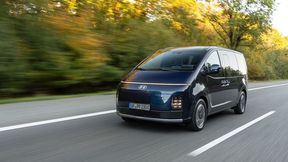
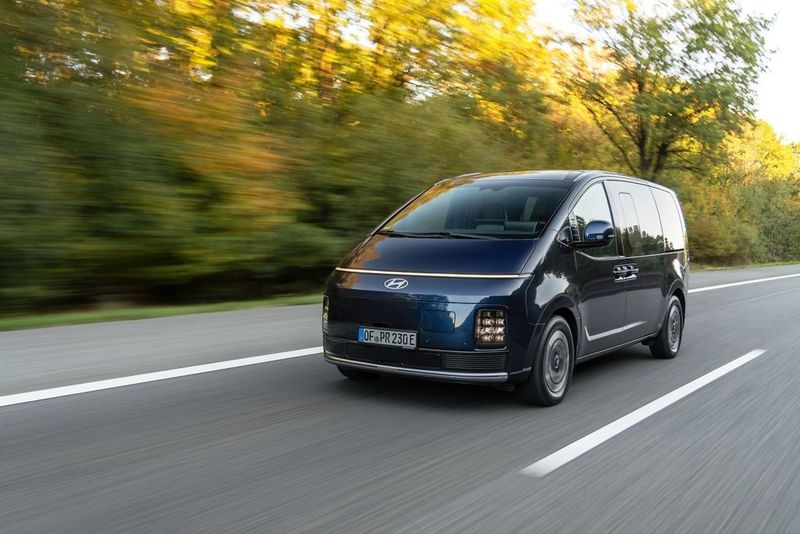
With the Staria, Hyundai now offers a comfortable electric van.
(Source: Hyundai)
Vans are back. After many years of being derided as “Pampas bombers” or “moms’ cars,” and relegated to the “mini-segment” by SUVs in terms of new registrations—resulting in a corresponding decline in the range of available models—these practical, spacious vehicles have been making a tentative, mostly electric comeback for some time now. Models like the Mercedes VLE or Xpeng X9 represent a modern lineup aimed primarily at larger families, business travelers who need space, transportation companies, and even hotels. The new Hyundai Staria is no exception.
It is available as a commercial vehicle (Cargo) and as a passenger vehicle (Electric), the latter in three trim levels with seven or nine seats. Power is delivered exclusively to the front wheels, always by a 160-kW electric motor. The 84 kWh battery is rated to provide a range of 430 kilometers (267 miles) according to the standard. Prices start at just over 57,000 euros (US$64,410) for the Trend variant and range from the mid-range Prime version (63,650 euros / US$71,924)—both with nine seats—up to the seven-seat top-of-the-line Calligraphy model for a hefty 66,950 euros (US$75,653.50).
Bright and Thoughtfully Furnished
What stands out when getting into the Staria is the large amount of glass—primarily on the sides—resulting from the low waistline, which makes the interior feel exceptionally airy and inviting. It’s also remarkably well-thought-out, with practical storage compartments and easy-to-use controls. Especially in the seven-seater version, the second and third rows offer downright regal amounts of space. The plastics used are well-finished but still exude a touch of that classic commercial vehicle charm.
The seats in the second and third rows can be slid and folded up. The seven-seater features a 2-2-3 configuration with two very comfortable individual seats in the front and in the middle. The nine-seater comes in a 3-3-3 configuration with three benches; however, the front center seat between the driver and front passenger can only be used comfortably by smaller people.
Too Big for Narrow Streets and Parking Spaces
As expected, the electric motor has no trouble handling the Staria—which weighs about 2.7 metric tons—in city and suburban traffic, even if acceleration from a stoplight naturally isn’t quite as vigorous as with smaller or more powerful electric cars. On the highway, the car also accelerates briskly at first; it’s only when you approach the Vmax of 184 km/h (114 mph) that you feel how the weight and air resistance significantly slow down the car’s forward momentum.
In the city, the Staria handles large, sweeping turns with ease. On smaller streets or alleys, or when maneuvering and turning around, you really notice its length of 5.25 meters (17 feet 3 inches)—and even more so its width of 2.00 meters (6 feet 7 inches)—and the vehicle becomes unwieldy.
Surprisingly Efficient
We were surprised by how efficient the large car was. On a roughly one-and-a-half-hour, 50-kilometer (31-mile) drive through Munich’s heavy city traffic—mostly at speeds of 30 to 50—as well as a short but fast stretch on the highway, the battery, which had been fully charged beforehand, still showed a charge level of about 89 percent, which corresponds to a consumption of roughly nine kWh. This figure demonstrates just how efficiently you can drive the large Hyundai and how well the Koreans have mastered electric technology by now.
Since the Staria is built on an 800-volt platform, there’s little to complain about when it comes to maximum charging power and charging time. With up to 256 kW, it really gets going at the fast charger; after about 20 minutes, a battery that has dropped to 10 percent is back up to 80 percent. However, the rated range of 430 kilometers (267 miles) isn’t outstanding, and in practice, it’s likely only achievable with extremely conservative driving and primarily in city traffic.
For those with a Lot of Luggage and for Tradespeople
Hyundai also touts the Staria as a long-distance vehicle. However, we think that’s only feasible for people who have enough time to recharge the battery at highway rest stops every two to three hours. For large families with significant space requirements, as well as for taxis or hotel shuttles, the Staria is ideally suited—and, of course, the Cargo version is a viable option for tradespeople. This is especially true because the few real competitors that can match it in terms of space, features, and performance are significantly more expensive.
Date: 08.12.2025
Naturally, we always handle your personal data responsibly. Any personal data we receive from you is processed in accordance with applicable data protection legislation. For detailed information please see our privacy policy.
Consent to the use of data for promotional purposes
I hereby consent to Vogel Communications Group GmbH & Co. KG, Max-Planck-Str. 7-9, 97082 Würzburg including any affiliated companies according to §§ 15 et seq. AktG (hereafter: Vogel Communications Group) using my e-mail address to send editorial newsletters. A list of all affiliated companies can be found here
Newsletter content may include all products and services of any companies mentioned above, including for example specialist journals and books, events and fairs as well as event-related products and services, print and digital media offers and services such as additional (editorial) newsletters, raffles, lead campaigns, market research both online and offline, specialist webportals and e-learning offers. In case my personal telephone number has also been collected, it may be used for offers of aforementioned products, for services of the companies mentioned above, and market research purposes.
Additionally, my consent also includes the processing of my email address and telephone number for data matching for marketing purposes with select advertising partners such as LinkedIn, Google, and Meta. For this, Vogel Communications Group may transmit said data in hashed form to the advertising partners who then use said data to determine whether I am also a member of the mentioned advertising partner portals. Vogel Communications Group uses this feature for the purposes of re-targeting (up-selling, cross-selling, and customer loyalty), generating so-called look-alike audiences for acquisition of new customers, and as basis for exclusion for on-going advertising campaigns. Further information can be found in section “data matching for marketing purposes”.
In case I access protected data on Internet portals of Vogel Communications Group including any affiliated companies according to §§ 15 et seq. AktG, I need to provide further data in order to register for the access to such content. In return for this free access to editorial content, my data may be used in accordance with this consent for the purposes stated here. This does not apply to data matching for marketing purposes.
Right of revocation
I understand that I can revoke my consent at will. My revocation does not change the lawfulness of data processing that was conducted based on my consent leading up to my revocation. One option to declare my revocation is to use the contact form found at https://contact.vogel.de. In case I no longer wish to receive certain newsletters, I have subscribed to, I can also click on the unsubscribe link included at the end of a newsletter. Further information regarding my right of revocation and the implementation of it as well as the consequences of my revocation can be found in the data protection declaration, section editorial newsletter.
The Staria thus occupies a small but promising niche in the segment of spacious electric vehicles and could play its part in the remarkable comeback of vans.