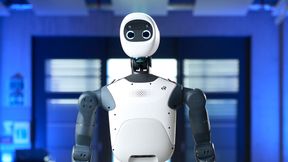
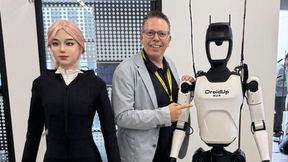
A humanoid robot is not yet a complete automation solution. Its usefulness depends on suitable applications, training data, and integration into existing processes. Thanks to the experience gained with cobots, the industry is now learning more quickly from the humanoid hype, according to safety expert Jens Müller in an interview.
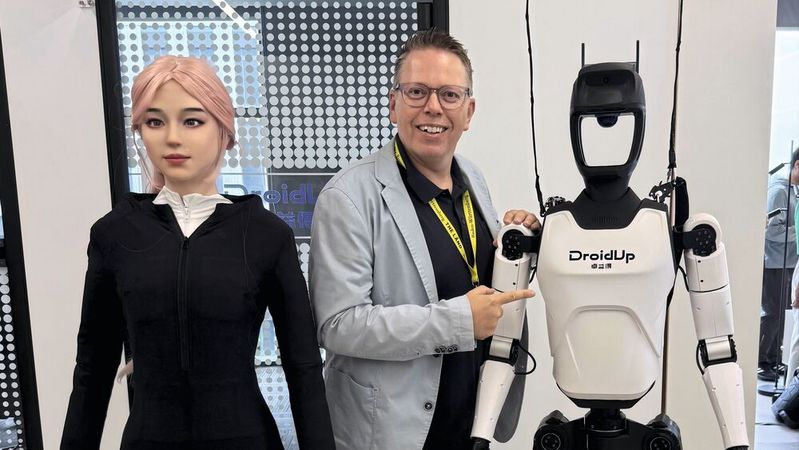
Humanoids: Between Hype and Everyday Industrial Life: Safety expert Jens Müller explains why technical maturity, safe motion sequences, and integration into existing processes are key to determining the practical utility of these robots.
(Image: Jens Müller)
Humanoid robots are considered the next step in industrial robotics. But how mature is the technology, and how can these robots be used safely? Safety expert Jens Müller will address these questions on October 27, 2026, at the Cobots4You event at the Vogel Convention Center in Würzburg, Germany. Ahead of his presentation, “Humanoids—the New Cobot?,” he explains what the technology can do and where standards still need to catch up.
Humanoids are the subject of much discussion, but have hardly been used in industry so far. What role do they play in your professional practice?
Jens Müller: Humanoids currently account for a large portion of my consulting work. Many companies have made them a priority. They want to gain experience and not wait until the new ISO standard is published.
To me, this feels like déjà vu. We went through the same phase with cobots: Everyone bought one and gave it a try. Humanoids, however, are on an entirely different scale. It’s important to analyze early on where they can be used effectively and which technologies still need to mature. My advice, therefore, is this: analyze first; don’t buy blindly. Technologically speaking, humanoids are comparable to Level 5 autonomous driving.
While cobots have long been established in industry, humanoids are mostly still in the testing phase. What is holding them back from widespread industrial use?
Müller: If we consider not just the robot itself but the entire application, I estimate that we are only at about 25 percent technological maturity.
You can already buy the machine today. But I haven’t seen a humanoid yet that drags a cable behind it for communication. For industrial use, I need much more than just the robot. It requires a communication interface with the operating environment. On top of that, there’s the issue of data protection, especially with regard to Europe. That’s an additional burden.
At first, the robot is comparable to a newly purchased laptop: It has an operating system, but the actual application is still missing. I first have to teach it the movements it needs to perform its tasks, or obtain and install qualified training datasets. For that, I need expert knowledge. A cobot, on the other hand, is already at an industrial level and comes with pre-built program files. That’s still missing from humanoid robots. These devices can do somersaults, box, and dance, but an industrial application is significantly more complex.
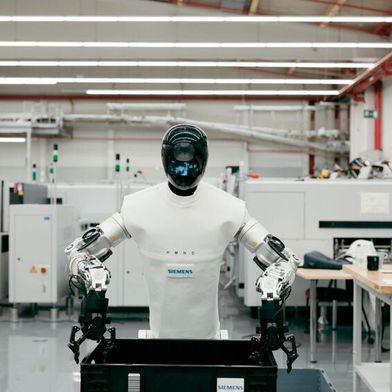
A humanoid robot is one of the most complex robotic systems we can build today. It is equipped with lidar, radar, ultrasonic sensors, and 2D/3D stereo cameras with varying resolutions to determine its location. It creates a map of its surroundings and must distinguish whether it is facing a machine or a human and determine how to interact with it.
How has the hype surrounding humanoids changed the industry so far? And why are some manufacturers now opting for wheels instead of legs?
Müller: There’s an interesting side effect: Thanks to all the hype, companies that previously said, “Our company isn’t ready for this yet; it’s all far too complex,” are once again looking into automation. They’ve put automation back on their to-do list.
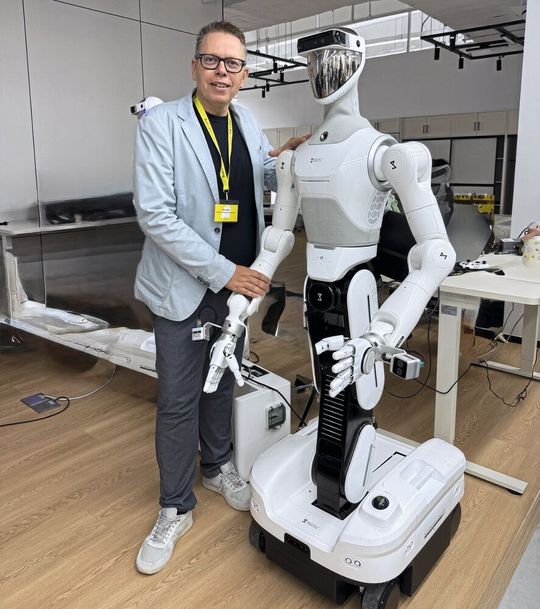
The hype began with bipedal humanoids. Now, we are increasingly seeing systems based on mobile platforms. In these systems, a humanoid’s upper body is combined with a mobile platform, sometimes supplemented by an additional vertical axis. This development is also driven by customer feedback and early applications.
One reason, among others, is energy consumption. A biped must constantly and actively maintain its balance, which consumes energy. Additionally, due to limited space, the battery capacity is lower than that of a large mobile platform. And legs aren’t always necessary. Driverless transport systems and autonomous mobile robots have long been established in industry. We understand their safety requirements and can draw on existing experience.
Another aspect is dual-arm systems. Many of them are still at the prototype stage. For example, you take a stable mobile platform and mount two small industrial robots on it. As far as humanoid platforms go, I believe the current limit is around 20 kilograms of payload. But the technology is continuing to advance.
Date: 08.12.2025
Naturally, we always handle your personal data responsibly. Any personal data we receive from you is processed in accordance with applicable data protection legislation. For detailed information please see our privacy policy.
Consent to the use of data for promotional purposes
I hereby consent to Vogel Communications Group GmbH & Co. KG, Max-Planck-Str. 7-9, 97082 Würzburg including any affiliated companies according to §§ 15 et seq. AktG (hereafter: Vogel Communications Group) using my e-mail address to send editorial newsletters. A list of all affiliated companies can be found here
Newsletter content may include all products and services of any companies mentioned above, including for example specialist journals and books, events and fairs as well as event-related products and services, print and digital media offers and services such as additional (editorial) newsletters, raffles, lead campaigns, market research both online and offline, specialist webportals and e-learning offers. In case my personal telephone number has also been collected, it may be used for offers of aforementioned products, for services of the companies mentioned above, and market research purposes.
Additionally, my consent also includes the processing of my email address and telephone number for data matching for marketing purposes with select advertising partners such as LinkedIn, Google, and Meta. For this, Vogel Communications Group may transmit said data in hashed form to the advertising partners who then use said data to determine whether I am also a member of the mentioned advertising partner portals. Vogel Communications Group uses this feature for the purposes of re-targeting (up-selling, cross-selling, and customer loyalty), generating so-called look-alike audiences for acquisition of new customers, and as basis for exclusion for on-going advertising campaigns. Further information can be found in section “data matching for marketing purposes”.
In case I access protected data on Internet portals of Vogel Communications Group including any affiliated companies according to §§ 15 et seq. AktG, I need to provide further data in order to register for the access to such content. In return for this free access to editorial content, my data may be used in accordance with this consent for the purposes stated here. This does not apply to data matching for marketing purposes.
Right of revocation
I understand that I can revoke my consent at will. My revocation does not change the lawfulness of data processing that was conducted based on my consent leading up to my revocation. One option to declare my revocation is to use the contact form found at https://contact.vogel.de. In case I no longer wish to receive certain newsletters, I have subscribed to, I can also click on the unsubscribe link included at the end of a newsletter. Further information regarding my right of revocation and the implementation of it as well as the consequences of my revocation can be found in the data protection declaration, section editorial newsletter.
How are manufacturers and users currently addressing the issue of humanoid safety?
Müller: You have to view safety within the broader context. It is one component and should not be dismissed with the attitude that “it can’t be solved anyway.” The issue is complex, which is why we need uniform rules.
There are now two camps. One says: We can’t do anything because there aren’t any rules yet. The other says: It doesn’t matter—it’s all just a prototype; let’s do a proof of concept and just get started. I’m a realist. We have to follow certain rules. Otherwise, it’ll be the Wild West.
A bipedal humanoid robot can tip over if its drives are shut off. How can this risk be managed from a safety perspective?
Müller: Those are exactly the kinds of factors that come into play. With bipedal systems, we need a continuous control loop just to ensure that the robot remains stable.
Consider the following scenario: The robot is carrying a 10-kilogram workpiece in a small load carrier and begins to move. A hazardous situation arises, and someone presses the wireless emergency stop button. The robot immediately enters Safe Torque Off mode, and all drives are shut down. Then it tips over like a tree. If it is still moving, it falls over and may slide a little further.
These are the worst-case scenarios. There are already robotic systems capable of assuming a safe position. For example, the AEON from Hexagon Robotics can kneel. The new robot from Agility also assumes a safe, kneeling position from which it cannot tip over.
Safety expert Jens Müller: The expert in robot safety addresses the technical challenges posed by humanoid robots and works on international safety standards for their industrial use.
(Image: Jens Müller)
What set of standards is the ISO committee currently working on, and when is it scheduled to be published?
Müller: Working Group 12 of the ISO Technical Committee TC 299 is working on this. We are currently developing ISO 25785, a set of standards for mobile industrial robots that must actively control their stability. This includes, in particular, bipedal humanoids. The draft of the first part is designated ISO/CD 25785-1.
According to current plans, the standard is scheduled to be published in October 2028. Typically, it takes five years for a new ISO standard to go from draft to publication. For humanoids, this timeframe has been reduced to three years.
We aim to complete Part 1 (Draft) by the end of the year or around the turn of the year. In the spring of 2027, we will begin work on Part 2, which will follow a structure similar to that of ISO 10218. Part 1 specifies the technological design requirements for a humanoid, particularly with regard to safety technology. Part 2 builds on this and addresses the specific requirements for integration.
What does this timeline mean for companies that want to start using humanoids today? And what additional requirements apply in Europe?
Müller: By 2028, we will have a set of rules that applies internationally. However, we are in Europe. An ISO standard is first published internationally. Then a decision must be made as to whether we will adopt it in Europe exactly as is. Once adopted, it is designated EN ISO. The German edition is called DIN EN ISO. However, the basis is global.
In the European Economic Area, there are additional requirements. The Machinery Directive takes effect in January 2027, and there is also the Cyber Resilience Act, which covers all aspects of cybersecurity. These requirements must be specifically incorporated into the robot’s architecture for the European market.
When someone remotely controls a humanoid robot in a production setting without authorization, that’s no longer a laughing matter. At the same time, we need to strike a balance between determining the minimum requirements necessary and avoiding overengineering. That’s why the experts are working together. In the ISO committee, these are primarily the robot manufacturers. They know their devices and their architecture best.
AI-based functions pose new challenges for machine safety. How does the ISO committee address these risks?
Müller: There is an additional working group specifically for AI that focuses on AI in humanoids. It has been determined that this topic is so complex that certain core requirements must be addressed separately.
There are interdependencies and points of intersection between AI and safety. However, the topic of AI itself is being evaluated separately. There are differing views and perspectives on this matter. The goal is to reach a consensus that can lead to the development of an international standard.
How do humanoids learn new tasks today? And how can we prevent AI from changing their behavior in ways that could compromise safety?
Müller: The ideal scenario is that the robot is at the customer's location, I give it a new task via voice command, and it teaches itself everything using AI.
In fact, companies are currently setting up what are known as “gyms”—training labs for humanoids. As a customer, I bring my components there, my application is simulated, and I can train the robot myself—physically.
I recently visited a manufacturer in China and was given the opportunity to tour the training lab. There were 800 people working there. They were wearing replicas of the humanoid’s grippers and hands and held a control device in each hand. They used these to physically record the movements. One person put a trash bag into a trash can; the next took fruit out of a bag and placed it on the table. Another wrapped the power cord around a hair dryer.
I asked if everything here was simulated. The manufacturer explained to me: “We’ve also gathered experience and are now starting to record real-world movement data. These data sets are then optimized using AI. The recorded movements can also be used in simulations to generate additional training scenarios and enhance the training effect.”
When it comes to safety, the problem could be mitigated. AI optimizes a task. Once that task is implemented on the robot, AI no longer has any influence. It’s important to distinguish at what stage AI is used and what functions it performs.
We’re already familiar with an example from bin picking: Cameras and other sensors detect objects, and the AI determines the best gripping point. At first glance, this isn’t a safety function—it’s the actual application. Safety functions, on the other hand, include, for example, person detection. In that context, of course, the AI must not alter any safety-critical parameters.
A humanoid robot is designed to flexibly perform a variety of tasks. Does that mean safety must be reassessed every time the robot switches tasks?
Müller: I’d draw a comparison to an automated guided vehicle (AGV) as a mobile platform. AGVs have safety parameters. An AGV operating in a production facility constantly adjusts its safety zones.
Applied to humanoids, this means: The mobile platform is safe to begin with. Then I have to assess what the robot is moving. Does it have two arms? What kinds of loads does it handle? What obstructing contours are created?
There are still a number of issues to consider, including whether this can ultimately be fully implemented. The specific requirements involved are the subject of ongoing standardization efforts. That is why I cannot answer every question at this time.
When it comes to cobots, it has become clear that what is technically feasible is not always economically viable. What lessons do you draw from this for humanoids?
Müller: Today, we know pretty much exactly where a cobot can be used effectively. Even the term itself is now viewed critically, since “cobot” no longer exists as a standard. With the new standard, which has now been published in the Official Journal of the EU (EN ISO 10218-1:2025 and EN ISO 10218-2:2025), we refer to “collaborative applications.”
In other words: I have a robot with built-in safety features that, in power- and force-limiting modes, allow for contact—that is, a collision with an employee. Only a small fraction of the devices equipped with this feature are actually used in this way.
It has been determined that when we work without a protective fence and without additional area monitoring, we must simulate potential collision scenarios. There are permissible collision forces and pressures that we must validate through measurements. At higher path speeds, these forces and pressures increase. To stay within these limits, it may be necessary to reduce the speed. This results in a longer cycle time.
From a business perspective, it may make more sense to use a conventional industrial robot with a safety fence because it works faster. We want to automate in order to have a continuous process, not so that someone is constantly walking into the area. Of course, we can have it all. The question is always: Does it make economic sense to implement high-end technology, or should we “keep it simple”?
What is the biggest misconception about humanoids that you encounter among your customers?
Müller: That humanoids are often seen as a “jack-of-all-trades.” The market is flooded with videos. As a result, the lines between industrial applications and home use are blurring: the humanoid that loads and unloads the dishwasher or vacuums the apartment.
But these are two different areas. Trained specialists work in industry, and we must comply with the Industrial Safety Regulations. In the private sector, different operating conditions and safety requirements apply. The robot architecture also differs. Here we’re talking about service robots, for which there is a separate standard that is currently being revised.
In the industrial sector, integration remains a key challenge. We purchase an incomplete machine, use it to implement an application, and must, among other things, conduct a risk assessment. After all, the manufacturer does not know whether the humanoid will later pick up a box, a heavy component, or a powered tool.
When working with humanoids, we must once again develop the same technical and safety expertise that has long been established in traditional industrial robotics. There are useful applications, some of them in niche markets. But every application must be evaluated from both a technical and a safety perspective. Sometimes the simpler solution—the one that looks less like a gimmick—is the better choice in terms of process quality and overall effort.