Global Expansion from ChinaChina's Cockpit Market Leader Desay SV on the Move to Europe
From
Henrik Bork
| Translated by AI
5 min Reading Time
Chinese supplier Desay SV is pushing ahead with its international expansion and is preparing a second IPO in Hong Kong. The company intends to use the fresh capital to grow primarily in Europe, expand its position in domain controllers and invest in new business areas.
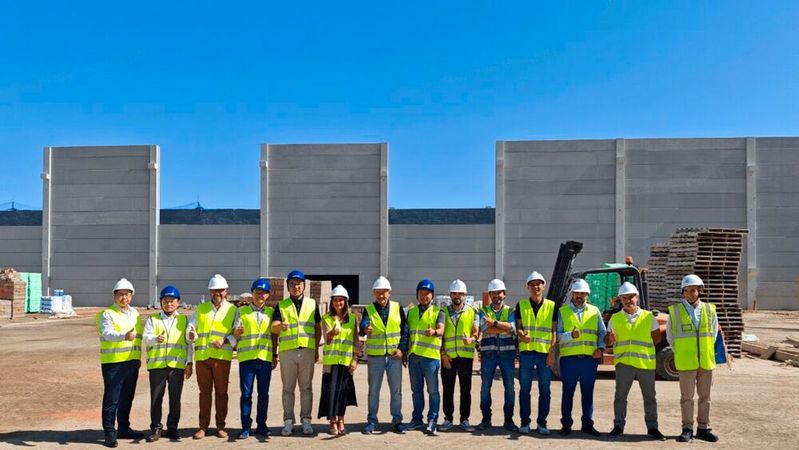
In Linares, Spain, Desay SV Automotive completed the shell construction of its new plant in September 2025.
(Image: Desay SV)
For this Chinese supplier, the road to Europe begins in Hong Kong: Desay SV Automotive from Huizhou, China's market leader in domain controllers for smart cockpits and smart driving, is preparing for a second IPO in Hong Kong, reported the Chinese automotive portal Gasgoo.
The company is already the leading manufacturer of cockpit domain controllers in China. Now it is raising money for its plan to become a global leader in this segment. The new capital from Hong Kong, according to the company's own prospectus and analysts' expectations, will be used for expansion in Europe, among other things.
Desay SV currently holds 17.9% of cockpit domain controllers in China. Worldwide, the figure is 8.4 percent, and the company headquarters believes there is still plenty of room for improvement. For smart driving domain controllers, the figure is 21.2 percent at home and 8.8 percent on the global market. More international business is not only an imperative for further growth for the company, which has been listed on the Shenzhen stock exchange since 2017. The international presence is also necessary in order to better serve existing customers.
Suppliers Must Follow Suit
Nine of the ten top-selling car manufacturers in the world and all fifteen leading Chinese OEMs (Original Equipment Manufacturers) are among Desay SV's customers, including Volkswagen, Toyota, Mercedes-Benz, BMW, Chery and Geely. While the major Chinese car manufacturers are increasingly investing in Europe and other regions of the world, their Chinese suppliers have to follow suit. This costs a lot of money.
Desay SV is currently building an intelligent factory for smart cockpit and ADAS products in Linares in the Spanish region of Andalusia. The shell is already complete and series production is set to begin in the second half of 2026. Several hundred new jobs will be created in Linares. "By leveraging Spain's strategic geographical location and our expertise in service and technology, Desay SV aims to make Europe a key stage for technological innovation and brand development," said Chairman Gao Dapeng at the groundbreaking ceremony.
New Business Areas
At the same time, the Group needs fresh capital for its two new business areas: autonomous delivery vehicles (under the "Chuanxing Zhiyuan" brand) and the "AI Cube" robotics platform. In view of the current market development in China, both future technologies have great growth potential but, according to publicly available information, have not yet generated any sales by the end of 2025.
Under "Chuanxing Zhiyuan", Desay SV's new brand name launched in 2025, low-speed autonomous vehicles are being developed for industrial park logistics, urban delivery services and cold chain transportation. With the "AI Cube" robotics platform, the company also wants to take advantage of the emerging convergence between the automotive and robotics industries. It wants to transfer computing architectures that have proven themselves in cars to robots.
AI Cube integrates sensor suite interfaces, middleware and central computing functions for smart robots, according to the prospectus. The modular plug-and-play design ensures the integration of cameras, radar and LiDAR (Light Detection and Ranging). According to the Chinese trade magazine Qiche Dianzi Sheji, the core capabilities of perception, calculation and control can be used for various applications, making the step from automotive electronics to robotics a natural one.
Desay SV does not want to be reduced to a simple supplier of components. "We don't want to be a pipeline supplier. We want to define intelligent driving together with the car manufacturers," said Desay SV CEO Gao Dapeng recently at the China EV100 Forum.
Date: 08.12.2025
Naturally, we always handle your personal data responsibly. Any personal data we receive from you is processed in accordance with applicable data protection legislation. For detailed information please see our privacy policy.
Consent to the use of data for promotional purposes
I hereby consent to Vogel Communications Group GmbH & Co. KG, Max-Planck-Str. 7-9, 97082 Würzburg including any affiliated companies according to §§ 15 et seq. AktG (hereafter: Vogel Communications Group) using my e-mail address to send editorial newsletters. A list of all affiliated companies can be found here
Newsletter content may include all products and services of any companies mentioned above, including for example specialist journals and books, events and fairs as well as event-related products and services, print and digital media offers and services such as additional (editorial) newsletters, raffles, lead campaigns, market research both online and offline, specialist webportals and e-learning offers. In case my personal telephone number has also been collected, it may be used for offers of aforementioned products, for services of the companies mentioned above, and market research purposes.
Additionally, my consent also includes the processing of my email address and telephone number for data matching for marketing purposes with select advertising partners such as LinkedIn, Google, and Meta. For this, Vogel Communications Group may transmit said data in hashed form to the advertising partners who then use said data to determine whether I am also a member of the mentioned advertising partner portals. Vogel Communications Group uses this feature for the purposes of re-targeting (up-selling, cross-selling, and customer loyalty), generating so-called look-alike audiences for acquisition of new customers, and as basis for exclusion for on-going advertising campaigns. Further information can be found in section “data matching for marketing purposes”.
In case I access protected data on Internet portals of Vogel Communications Group including any affiliated companies according to §§ 15 et seq. AktG, I need to provide further data in order to register for the access to such content. In return for this free access to editorial content, my data may be used in accordance with this consent for the purposes stated here. This does not apply to data matching for marketing purposes.
Right of revocation
I understand that I can revoke my consent at will. My revocation does not change the lawfulness of data processing that was conducted based on my consent leading up to my revocation. One option to declare my revocation is to use the contact form found at https://contact.vogel.de. In case I no longer wish to receive certain newsletters, I have subscribed to, I can also click on the unsubscribe link included at the end of a newsletter. Further information regarding my right of revocation and the implementation of it as well as the consequences of my revocation can be found in the data protection declaration, section editorial newsletter.
Fear of Pipelinization
It is precisely this "pipelinization" that Chinese suppliers fear more than any competition, commented the trade journal specializing in the design of automotive electronics. "You supply components, I assemble them. There is no technological impact, no collaborative barrier, no irreplaceability," is how Qiche Dianzi Sheji describes this nightmare for Chinese automotive suppliers.
So while business with domain controllers is going well, Desay SV is working in parallel on its entry into the two new business areas. Initial order commitments for robot domain controllers have been received, with series production set to begin in 2026. According to media reports, initial tests for unmanned delivery vehicles have begun in several Chinese cities. This means that both new business areas are still in the pilot phase and the company is currently spending a lot of money on research and development. The whole thing is an expensive, calculated bet on the future.
According to a forecast by Frost & Sullivan, the global market for unmanned delivery vehicles could grow from 5.2 billion yuan (around 720 million USD) in 2025 to 626 billion yuan (around 87 billion USD) in 2030, while the market for smart robots could even grow to 797.5 billion yuan (around 111 billion USD). Such predictions should always be taken with a pinch of salt, but the direction is pretty clear. Desay SV is forty years old and very successful with its domain controllers and smart cockpit products. Based in Huizhou in Guangdong province, the group employs more than 11,000 people and achieved a turnover of 32.5 billion yuan in 2025 (around 4.6 billion USD), an increase of 17.88% compared to the previous year. Net profit increased by 22.38 percent to 2.45 billion yuan (around 340 million USD).
The Need for Diversification
However, the latest financial data also shows that the company is a vivid example of the strong pressure that the transformation of the automotive industry is exerting even on Chinese "dropouts". Desay SV's overall gross margin has fallen from 24.6% in 2021 to 19.07% in 2025. In the smart driving business in particular, price wars have recently pushed margins down from 19.9% to 16.4%. The average sales price of a smart driving product fell from 856 yuan (around 120 USD) to 651 yuan (around 90 USD) within a year.
The need for internationalization can also be substantiated with concrete figures. 92.6 percent of turnover currently comes from the People's Republic, while the proportion of foreign sales is less than eight percent. In view of the gradual slowdown in economic growth in China, this would not be a sustainable business model for a listed company in the long term. Accordingly, with the planned second IPO in Hong Kong, the company not only wants to raise cash, of which it seems to have enough. Above all, it intends to create a second route for further financing rounds in a forward-looking manner in order to be able to maintain its expansion outside China and its technical innovations in the coming years.
For the established European Tier 1 suppliers, this means that a new competitor is growing up right on their doorstep. If series production starts at the new factory in Linares in the second half of the year as announced, a Chinese supplier will be the first to offer modern smart cockpits and intelligent driving solutions directly from southern Europe. However, Continental, Bosch and Harman Becker will also have a stronger competitor on the global market with Desay SV. The company's factories in Indonesia and Mexico started operations last year. There are new research centers in China, Singapore, Japan and Germany. For decades, the Hong Kong financial center was primarily a gateway for business in China. Now it is increasingly becoming a gateway to the European market for Chinese suppliers. (sb)



:quality(80)/p7i.vogel.de/wcms/d1/ef/d1ef6b6f7d4543f7999980bacccaf22b/0133499261v1.jpeg "As the growing imbalance in trade relations with China continues to widen, the EU Chamber of Commerce foresees a day when trade with China will have to be seriously reevaluated ... (Image: AI-generated)")
:quality(80)/p7i.vogel.de/wcms/fe/1f/fe1fa5ee713f94deaba963dc24c3abc5/0133299273v1.jpeg "The Flexistar enables highly flexible production of laser-welded tubes thanks to its tool-free clamping system. (Image:Because Technology, LLC)")
:quality(80)/p7i.vogel.de/wcms/1b/5a/1b5ac72f83db4dbee3ff91e51bc398f4/0133496095v1.jpeg "BASF announces that it will take the next step toward producing the polyurethane precursor MDI in India ... (Image:BASF)")
:quality(80)/p7i.vogel.de/wcms/3f/cf/3fcfa390902944ffcf24e7fe973cc3ee/0133486258v1.jpeg "Do you need to create secure connections on structures using blind rivets, but space is tight? Then you should take a closer look at the Universalgrip from Gesipa ... (Image: Gesipa)")
:quality(80)/p7i.vogel.de/wcms/60/ef/60ef4f07e4829b2c2929befc0f353c58/0133511729v1.jpeg "Humanoid robots can match human performance in certain tasks. (Image:Gemini / AI-generated)")
:quality(80)/p7i.vogel.de/wcms/2e/99/2e99726b522e4b35b690e25eb6a42643/0133463991v1.jpeg "Robotics: In AMR applications, connection technology must reliably transmit power, signals, and data despite vibration and shock loads—in very confined spaces and in a way that allows for regular maintenance. (Image:Hyperever)")
:quality(80)/p7i.vogel.de/wcms/d0/18/d01801e3d5dbd7bc9d0b4f60408b630c/0133468429v1.jpeg "Quality requirements for film packaging are on the rise. At the same time, many companies are turning to recyclable film materials, which, however, have their own challenges. Fraunhofer researchers have therefore developed a fast system that detects problems in real time. (Image:Fraunhofer IKTS)")
:quality(80)/p7i.vogel.de/wcms/b1/06/b106cf44923ce39565c3264982fd20eb/0133414574v1.jpeg "Robots Build Robots: At the new Ubtech factory, automated systems even handle parts of the material supply and logistics for the production of humanoid robots. (Image:Ubtech)")
:quality(80)/p7i.vogel.de/wcms/c0/52/c052f405eb55fc3d08c4837e77206fc0/adobestock-2021845957--aucartstudio-stock-adobe-com-ki-generiertv1.jpeg "An innovation from China to combat extreme summer heat: A novel coating lowers temperatures. (Source: © AucArtStudio – stock.adobe.com_AI-generated)")
:quality(80)/p7i.vogel.de/wcms/66/a7/66a7b78159caeacce57136529688799f/0133503398v1.jpeg "Sunlight Makes Stone! These stone blocks weren't made the traditional way. Instead, they were additively manufactured from sand using a laser. In the future, however, the laser is set to be replaced by concentrated sunlight—if the startup Addisol is successful... (Image:Addisol / F. Fiedler)")
:quality(80)/p7i.vogel.de/wcms/72/b9/72b995c2c8d812c5e2115cbef31e035a/0133462727v1.jpeg "Eggl manufactures center hoods that are precisely tailored to each cooking island—whether standard size or custom shape. They are made entirely of stainless steel and are individually customized in terms of size and filter arrangement. (Image:SPI)")
:quality(80)/p7i.vogel.de/wcms/13/5d/135dfae6229ceaf5c55467a43e8f7257/adobestock-1879961393--ardi-stock-adobe-com-ki-generiertv1.jpeg "Annoying chatterboxes or awkward silences in response to questions—a moderator should specifically prepare for difficult situations in order to navigate them effectively. (Image:ardi - stock.adobe.com_AI-generated)")
:quality(80)/p7i.vogel.de/wcms/aa/a2/aaa2c6dd2daa24b485cddbf9297590c0/0133467318v1.jpeg "Battery Monitoring: Battery monitoring using electrochemical impedance spectroscopy offers several advantages. (Image:TI)")
:quality(80)/p7i.vogel.de/wcms/39/b2/39b21bf03be1683831862239a369987c/0133469638v1.jpeg "Data from autonomous vehicles and robots operating autonomously is in high demand, and Ruqi wants to capitalize on this. (Image:Ruqi Mobility)")
:quality(80)/p7i.vogel.de/wcms/8a/bb/8abbb6217220595edc1549ac9b84f307/0133429906v1.jpeg "The IAA in Hanover showcased the ambitions of Chinese commercial vehicle manufacturers in Europe. (Image:Wehner - VCG)")
:quality(80)/p7i.vogel.de/wcms/0c/53/0c5313ef91c14b6df0d0996efc33c8ad/jpg03568-bearbeitetv1.jpeg "The category winners of the 2027 German Car of the Year award. (Source: GCOTY)")
:quality(80)/p7i.vogel.de/wcms/ca/b4/cab46fd26d19d6a2febca032048200b6/0133471827v1.jpeg "Photonics SDK for C and Python: Computational operations are now abstracted as standard mathematical functions. (Image:Q.ANT)")
:quality(80)/p7i.vogel.de/wcms/92/b2/92b2ed5299cde450c0764f4f64468395/0133505895v1.jpeg "The \"Iris 100\" test system for high-precision volume production of microLEDs uses a spectrometer and a high-resolution camera. (Image:Teradyne)")
:quality(80)/p7i.vogel.de/wcms/f3/d8/f3d870d8f31a5a5110449c929ea3e641/0133470449v1.jpeg "The new Nexora sensor family from Teledyne e2v: These CMOS image sensors combine BSI technology with a global shutter and are available in 12- and 16-megapixel versions. (Image:Teledyne)")
:quality(80)/p7i.vogel.de/wcms/11/2e/112eabc5fb41e1a401f0e93e9326ef51/0133489329v1.jpeg "A sandbox limits the actions an AI agent can take, but it is not an impenetrable barrier. Only multiple independent layers of protection prevent an escape from immediately granting access to production systems. (Image:freely licensed)")
:quality(80):fill(efefef,0)/p7i.vogel.de/wcms/69/ae/69ae6d6a29571/wpcover-eviom-lc-wp-aai.png "WPCover_Eviom_LC_WP_AAI")
:quality(80)/p7i.vogel.de/wcms/a7/38/a73840cb81da9dc3c503f4c04bf66b96/0132892768v1.jpeg "Unitree's IPO symbolizes the high expectations for humanoid robots and embodied AI. (Image:Dall-E / AI-generated)")
:quality(80)/p7i.vogel.de/wcms/57/d2/57d2b75d884c18866b46e776126fb46b/org-blobs-user-response-file-output-dac07b02-0e97-4452-9a3a-26528da583b3-file-1787126178766-jpgv1.jpeg "The memory manufacturer CXMT has had an extremely successful IPO. Among the investors are several car manufacturers. (Image:KI-generiert)")