Nitrogen oxides are a by-product of the combustion of fossil fuels. They are among the most strictly regulated pollutants and are among the most harmful to human health. The compounds collectively known as "NOx" cause the brown smog that still hangs over some city skylines despite stricter air pollution regulations.
Yanmar America, manufacturer of agricultural equipment, energy systems and industrial engines, relies on deep reinforcement learning to optimize its exhaust aftertreatment technology.
(Image: Yanmar America)
The California Air Resources Board is setting limits for pollutant emissions from off-road diesel engines. The proposed Tier 5 standards, which are to be introduced gradually over the next decade, require a 90 percent reduction in NOx emissions in some performance categories. Manufacturers in the USA are already responding to stricter requirements with more complex exhaust gas aftertreatment: SCR catalytic converters (selective catalytic reduction) are being used in diesel engines for industrial applications, particularly in the power range above 56 kW—a consequence of the NOx limits of the EPA Tier 4 final regulations in force since 2014.
With ever stricter emission limits, additional NOx reductions are required, resulting in ever more complex and technically sophisticated systems and further increasing development costs. As a result, the need for more efficient solutions is increasing. Engineers at Yanmar America, a manufacturer of agricultural equipment, energy systems and industrial engines, are using deep reinforcement learning to optimize their exhaust aftertreatment technology.
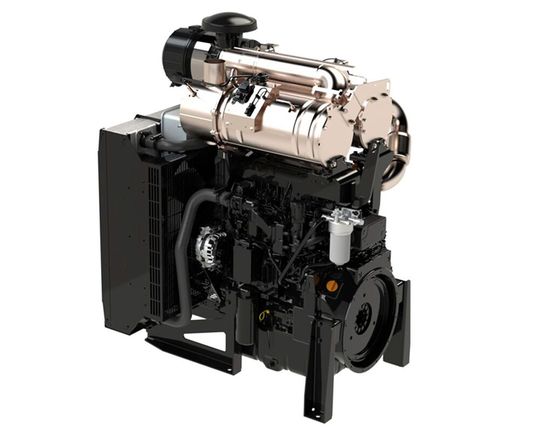
The Yanmar 4TN107FTT engine is equipped with SCR technology.
(Image: Yanmar America)
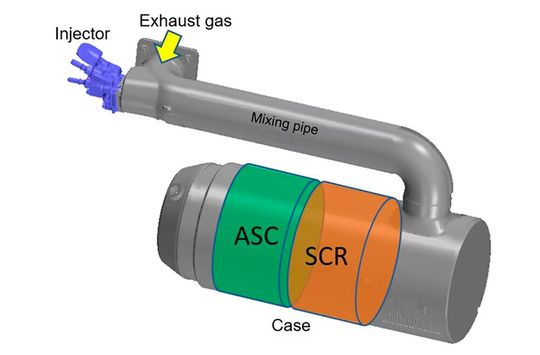
When the engineers at Yanmar America began working on a solution a few years ago, their engines were already equipped with SCR catalytic converters. These minimized emissions through a chemical reaction between ammonia and NOx. Ammonia is added to the exhaust gas flow via a Diesel Exhaust Fluid (DEF) injector. DEF is a urea-water solution that decomposes into ammonia in the hot exhaust gases. In the catalytic converter, the ammonia reacts with the NOx compounds and converts them into harmless nitrogen—a natural component of the air.
Despite this cleaning process, small amounts of NOx can still escape into the air and ammonia, itself a harmful pollutant, can also escape into the air. This undesirable phenomenon is known as ammonia slip. "You should try to store as much ammonia as possible in the SCR to increase the NOx conversion capability," explains Martin Muinos, Research and Development Engineer at Yanmar America. "However, this is not easy because ammonia storage is temperature-dependent." For example, a rapid increase in exhaust gas temperature can lead to ammonia slip.
Process of NOx emission minimization using SCRs.
(Image: Yanmar America)
The size of the SCR is another limiting factor. "The performance of SCR systems is highly dependent on size. This means that they do not have unlimited space for ammonia injection," says Shota Nomura, test engineer at Yanmar America.
From Test Bench to Simulation
SCR development typically involves a lengthy calibration process to ensure adequate NOx reduction—often requiring over 240 man-hours. "There are over 20 calibration maps that define SCR controls, and we need extensive data to calibrate these maps," Muinos emphasizes. "To collect this data, an engine test bench has to be operated for a few weeks at a time, then the maps calibrated and then the performance checked." And Nomura adds: "There is no autonomous way to calibrate the system. Since SCR affects several maps at the same time, every adjustment has an impact on performance." Achieving the optimum balance based on the test results therefore required extensive manual adjustments in the past.
To reduce the time and cost of physical testing, the Yanmar team switched to a model-in-the-loop approach. Engineers used Simulink and separate catalyst simulation software to model their SCR. "Without Simulink, we would have to propose changes to our controls, hand them over to our engine control unit supplier, have the control logic and software developed and then test them on a real test bench," says Muinos. "But Simulink is like a sandbox for the development of control systems."
Using the sandbox, the team quickly realized that their current SCR control methods would not be sufficient to meet the new Tier 5 requirements.
Date: 08.12.2025
Naturally, we always handle your personal data responsibly. Any personal data we receive from you is processed in accordance with applicable data protection legislation. For detailed information please see our privacy policy.
Consent to the use of data for promotional purposes
I hereby consent to Vogel Communications Group GmbH & Co. KG, Max-Planck-Str. 7-9, 97082 Würzburg including any affiliated companies according to §§ 15 et seq. AktG (hereafter: Vogel Communications Group) using my e-mail address to send editorial newsletters. A list of all affiliated companies can be found here
Newsletter content may include all products and services of any companies mentioned above, including for example specialist journals and books, events and fairs as well as event-related products and services, print and digital media offers and services such as additional (editorial) newsletters, raffles, lead campaigns, market research both online and offline, specialist webportals and e-learning offers. In case my personal telephone number has also been collected, it may be used for offers of aforementioned products, for services of the companies mentioned above, and market research purposes.
Additionally, my consent also includes the processing of my email address and telephone number for data matching for marketing purposes with select advertising partners such as LinkedIn, Google, and Meta. For this, Vogel Communications Group may transmit said data in hashed form to the advertising partners who then use said data to determine whether I am also a member of the mentioned advertising partner portals. Vogel Communications Group uses this feature for the purposes of re-targeting (up-selling, cross-selling, and customer loyalty), generating so-called look-alike audiences for acquisition of new customers, and as basis for exclusion for on-going advertising campaigns. Further information can be found in section “data matching for marketing purposes”.
In case I access protected data on Internet portals of Vogel Communications Group including any affiliated companies according to §§ 15 et seq. AktG, I need to provide further data in order to register for the access to such content. In return for this free access to editorial content, my data may be used in accordance with this consent for the purposes stated here. This does not apply to data matching for marketing purposes.
Right of revocation
I understand that I can revoke my consent at will. My revocation does not change the lawfulness of data processing that was conducted based on my consent leading up to my revocation. One option to declare my revocation is to use the contact form found at https://contact.vogel.de. In case I no longer wish to receive certain newsletters, I have subscribed to, I can also click on the unsubscribe link included at the end of a newsletter. Further information regarding my right of revocation and the implementation of it as well as the consequences of my revocation can be found in the data protection declaration, section editorial newsletter.
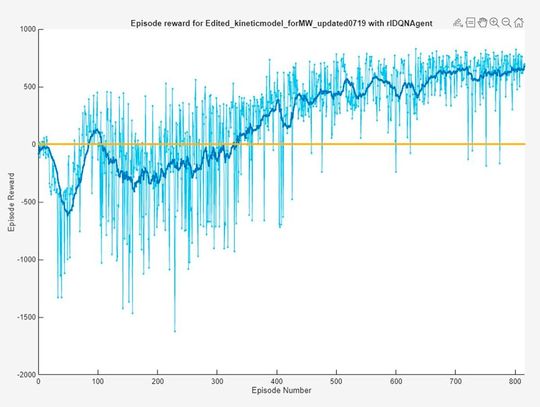
Insight into the Reinforcement Learning Training Monitor available in MathWorks' Reinforcement Learning Toolbox. It shows the progress graph during the training of a DRL model that Yanmar used for this project.
(Image: Yanmar America)
Nomura wondered whether artificial intelligence (AI), in particular deep reinforcement learning, could help. Reinforcement learning is an AI method that learns by absorbing information from the environment in order to achieve a desired result. It evolves through trial and error. Because the team was already using Matlab and Simulink but had little knowledge of AI, they used MathWorks Consulting Services to find out if deep reinforcement learning could help determine the best DEF dosage rate for their SCR.
Using the Reinforcement Learning Toolbox and Deep Learning Toolbox, MathWorks consultants helped Nomura select the right reinforcement learning algorithms for Yanmar's project from the various reinforcement learning algorithms provided. "After working with the team and analyzing the pros and cons of the approach proposed by Yanmar, we realized that the Deep Q-Network algorithm would help them develop a good reinforcement learning agent," summarized Mohammad Muquit, Senior Technical Consultant at MathWorks.
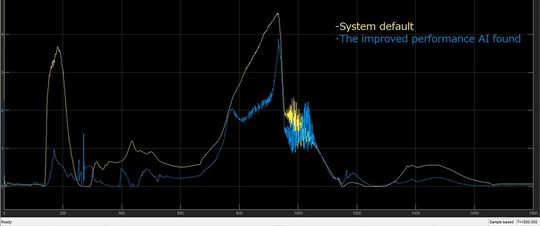
NOX emissions in comparison: standard value of the Yanmar system (yellow line) versus the DRL model developed in this project (blue line).
(Image: Yanmar America)
Learning from Experience
Equipped with the DQN algorithm, the Yanmar team began training its Deep Reinforcement Learning (DRL) agent to optimize the ammonia dosing profile for SCR performance. The model output was used to understand the extent to which the calibration values suggested by the agent matched those from existing systems. The visualizations of the reinforcement learning toolbox also made it easier for them to understand the model results.
Muinos explains: "Once we have a good understanding of why the reinforcement learning agent delivers better emission results, we can understand which control mechanisms we need to implement." "This gives us a better starting point for calibration." The results speak for themselves: after the simulation, which took just 30 minutes, the system delivered an optimal dosing profile that improved NOx emission reduction by 60 percent, according to Nomura.
The agent also halved the calibration time, reducing the total number of hours required for the project by 30 percent. "It only took six months—we hadn't expected such a short development time," says Nomura. "It far exceeded my expectations."
The time saved and the reduction in physical checks also led to a cost saving of 41 percent compared to the normal manual calibration process.
The AI-powered SCR calibration tool currently provides Yanmar engineers with a better starting point for calibrating their engines. The next step is to develop prototypes for rapid control. The Yanmar team recently procured the necessary hardware to put their modeling results to the test. The goal is to further automate this process. The DRL agent is currently searching for optimal values, but these still have to be manually transferred to the control units. For future projects, the engineers hope to use the AI in such a way that it automatically generates initial calibration values for the control units and reduces manual adjustments.
Matlab and Simulink played a crucial role in this project, and the team plans to use them and other related toolboxes for future developments. (se)
Christoph Stockhammer is a Senior Application Engineer at MathWorks.



:quality(80)/p7i.vogel.de/wcms/21/b6/21b61c2ac1df28254fb0dad1574fb2d7/0132853015v1.jpeg "The rose-gold, TiAlSiN-based coating material InoxaCon contributes significantly to the stability and service life of HPTec's new RQR-350 milling tool. It enables safe and efficient automated processes in the manufacturing of surgical instruments. (Image:Cemecon)")
:quality(80)/p7i.vogel.de/wcms/d2/73/d273374d6347651e4e6200cf6061ea4e/0132860560v1.jpeg "Even in July, the flag of the Chinese economy did not flutter particularly briskly in the air. Read here what’s happening and why production in China is apparently declining ... (Image:AI-generated)")
:quality(80)/p7i.vogel.de/wcms/18/47/1847f131e3afda201d1dbb98ad0ecb04/0132826776v1.jpeg "Image 1: Difender armored steels from Dillinger stand out with top scores in ballistic testing and cold bending. Defense companies therefore readily choose them. They can be found, for example, in the armored vehicles Fuchs and GTK Boxer of the German Armed Forces. (Image: Dillinger)")
:quality(80)/p7i.vogel.de/wcms/1e/7d/1e7d651782e0e97b3efc25abf2b52350/img-3485v1.jpeg "The Siemens Energy employees attach balancing weights at the precisely calculated and adjusted angular position to achieve the best possible result. (Source: Schenck Rotec)")
:quality(80)/p7i.vogel.de/wcms/a7/38/a73840cb81da9dc3c503f4c04bf66b96/0132892768v1.jpeg "Unitree's IPO symbolizes the high expectations for humanoid robots and embodied AI. (Image:Dall-E / AI-generated)")
:quality(80)/p7i.vogel.de/wcms/1c/a5/1ca5e3ef5d834c3a42de8909c872e3c6/0132876444v1.jpeg "The autonomous transport system Active Shuttle marketed by Bosch Rexroth has been sold to Neura Robotics. (Image:Bosch Rexroth)")
:quality(80)/p7i.vogel.de/wcms/30/1a/301a1aa59e093d848b69e9ff7006b83e/image1v1.jpeg "Wireless switching devices offer advantages in numerous industrial applications – wherever wired communication reaches its limits (Image: Steute) (Image:)")
:quality(80)/p7i.vogel.de/wcms/a2/85/a285b12508af812e28b17be3482a736c/0132488872v1.jpeg "NIS2 is no longer an abstract requirement in the distant future for many industrial companies. (Image:AI-generated)")
:quality(80)/p7i.vogel.de/wcms/41/fc/41fc456ff1ff8f30807924663e8df127/img-0942v1.jpeg "In industrial additive manufacturing, the production strategy must influence the design from the very beginning. (Source: Materialise)")
:quality(80)/p7i.vogel.de/wcms/44/fe/44fe86a16c26c09bb363b3671bf0b930/0132847771v1.jpeg "CoreTechnologie (CT) points out that the 3D printing software 4D_Additive has been equipped with additional application possibilities. Here you can learn more about what the new version 1.8 can do – such as generating complex lattice structures or optimizing faulty data ... (Image:CT)")
:quality(80)/p7i.vogel.de/wcms/b4/f2/b4f2c272247f79c5e87334a6839f20cb/0132549860v1.jpeg "Morefire analysis: Many mechanical engineering websites focus on technical specs instead of customer benefits. Translating features into clear benefits increases visibility, inquiries, and competitiveness. (Image: ©peopleimages.com - stock.adobe.com)")
:quality(80)/p7i.vogel.de/wcms/b4/9a/b49aaad0500e06e253f7d75ecb77338a/adobestock-4840668--dani-kreienb-hl-stock-adobe-comv1.jpeg "Metal processing in 2026 will be more digital, automated, and data-driven – but not automatically easier. (Image:© Dani Kreienbühl - stock.adobe.com)")
:quality(80)/p7i.vogel.de/wcms/5b/88/5b88d94e6a43f2b857462cd1921f7386/0132281427v1.jpeg "The eTurbo solves a well-known turbocharger problem: by combining an exhaust gas turbocharger and a permanently excited synchronous motor into a highly integrated core assembly, the compressor achieves sufficient speed even when the exhaust energy is actually not yet sufficient. (Image: BorgWarner)")
:quality(80)/p7i.vogel.de/wcms/75/fe/75feffb63bc6275786606d78a8d797c4/0132901853v1.jpeg "Steyr Motors reports similar business results as last year. Here you can learn more about the details of the Austrian company's situation ... (Image:E-Steyr)")
:quality(80)/p7i.vogel.de/wcms/57/d2/57d2b75d884c18866b46e776126fb46b/org-blobs-user-response-file-output-dac07b02-0e97-4452-9a3a-26528da583b3-file-1787126178766-jpgv1.jpeg "The memory manufacturer CXMT has had an extremely successful IPO. Among the investors are several car manufacturers. (Image:KI-generiert)")
:quality(80)/p7i.vogel.de/wcms/d0/68/d0681c9d26012538a22ff5c103429612/0132875205v1.jpeg "Electric vehicles: Structure of the zone architecture in a modern vehicle. (Image:TI)")
:quality(80)/p7i.vogel.de/wcms/22/82/22826566c11220ed61efac5982fb94a2/0132896083v1.jpeg "Electrodes made from paper and copper paste deliver comparable signal quality to the established gold standard. They perform significantly better in all environmental impact analyses. (Image:Screentec)")
:quality(80)/p7i.vogel.de/wcms/c4/9f/c49f5b8173f678f7ef071355b1fbbd7c/yamu-jay-ai-generated-9088888v1.jpeg "As part of a strategic partnership, Siemens and Reinhausen are advancing the future of energy supply solutions for AI data centers. (Symbol image) (Source: pixabay / AI-generated)")
:quality(80)/p7i.vogel.de/wcms/28/20/28204a4592a69a8682bfbf9a8f7e1dc2/0132846993v1.jpeg "The health status of a lithium-ion battery changes with increasing aging. AI models can utilize characteristic changes in the charge and voltage curves to estimate the state of health. (Image:freely licensed)")
:quality(80)/p7i.vogel.de/wcms/90/dc/90dc332e30a3e4bd3ff77646ed0633b7/0132833369v1.jpeg "Through a compromised repository of the widely used open-source tool LiteLLM, attackers were able to capture several terabytes of data and login credentials. Security company CloudSEK concludes, after analyzing the data, that the attack conducted in March of this year affected more than 2,000 companies, including major players like Microsoft, Nvidia, AWS, and Deutsche Bahn. (Image:freely licensed)")
:fill(fff,0)/p7i.vogel.de/companies/68/a4/68a47beec75ce/logo-cmyk-de.jpeg "logo-cmyk-de (https://www.datatec.eu/)")
:fill(fff,0)/p7i.vogel.de/companies/69/de/69de1b7403b0d/simtos-logo.jpeg "simtos-logo (SIMTOS)")

:quality(80):fill(efefef,0)/p7i.vogel.de/wcms/65/a6/65a678f1a2373/etmm-artificial-intelligence.png "ETMM Artificial Intelligence")
:quality(80)/p7i.vogel.de/wcms/b5/0f/b50fdf6e9de3851c1659b521a856f35a/0128794769v1.jpeg "An NPU is an economical, energy-efficient solution designed for efficient AI inference and neural network calculations in embedded systems. (Image:Yuichiro Chino / MathWorks)")
:quality(80)/p7i.vogel.de/wcms/5b/88/5b88d94e6a43f2b857462cd1921f7386/0132281427v1.jpeg "The eTurbo solves a well-known turbocharger problem: by combining an exhaust gas turbocharger and a permanently excited synchronous motor into a highly integrated core assembly, the compressor achieves sufficient speed even when the exhaust energy is actually not yet sufficient. (Image: BorgWarner)")