Maritime Energy TransitionWorld's Largest PEM Fuel Cell Stack Unveiled
From
Sandra Häuslein | Translated by AI
5 min Reading Time
Powering ships efficiently and without emissions over long distances is a key step in the maritime energy transition. The ZSW has developed a large-scale PEM fuel cell stack for this purpose, which is specially designed for shipping, but also for stationary applications and is powered by hydrogen.
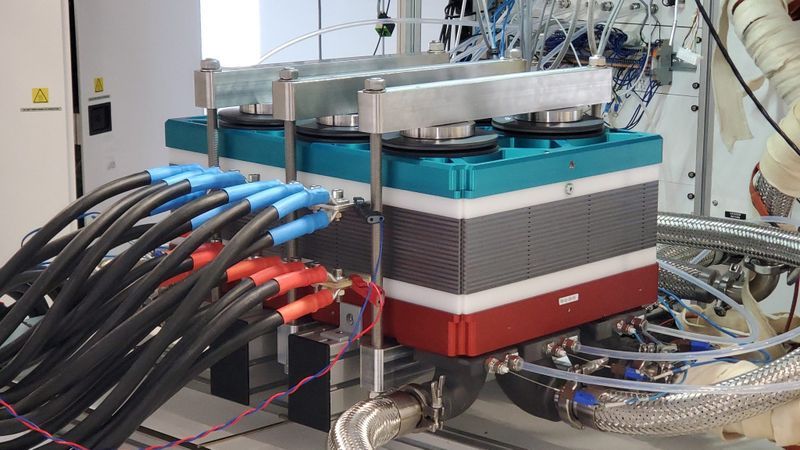
The Center for Solar Energy and Hydrogen Research Baden-Württemberg (ZSW) presents a concept for the world's largest PEM fuel cell stack with an active area of 1,300 square centimetres. Pictured is the 15-cell demonstrator in the test stand at HyFaB.
(Image: ZSW / Elvira Eberhardt)
In addition to trucks and cars, shipping is also a future application area for fuel cell stacks. However, ship propulsion systems require high outputs of several megawatts. Current stack designs developed for cars and trucks typically offer outputs below 200 kilowatts. For a ship propulsion system, numerous such stacks would need to be combined, which would result in complex wiring and high costs.
The large-format high-performance stack design developed by the Center for Solar Energy and Hydrogen Research Baden-Württemberg (ZSW) can be scaled up to 500 kilowatts. This is intended not only to save space and costs but also to significantly ease the integration and future maintenance of such fuel cell propulsion systems in ships.
“With this large stack design, we demonstrate that emission-free shipping—soon with green hydrogen—is technically feasible and economically attractive. The tests confirm the performance of our stack, which sets standards for the entire fuel cell industry,” says Prof. Dr. Markus Hölzle, ZSW board member and head of the Electrochemical Energy Technologies division in Ulm.
The Heart of the Bipolar Plate: Why Design Counts
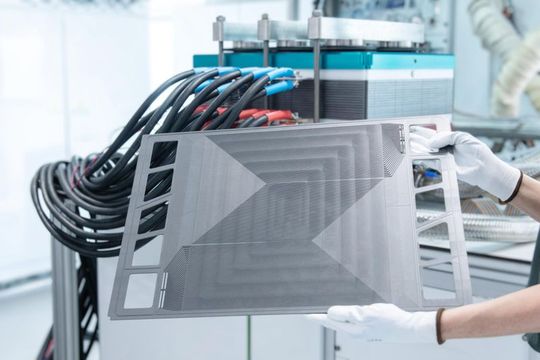
The graphite bipolar plate measures 1,300 square centimeters.
(Image: ZSW / Elvira Eberhardt)
The development began with the design of the so-called bipolar plate. It not only ensures electrical conductivity in the stack, but also distributes the reaction gases hydrogen and atmospheric oxygen evenly over the entire active surface of the fuel cell. It also cools the stack.
The cooling function is particularly important for such large active surfaces, as more waste heat must be dissipated as uniformly as possible. The media-conducting structures of the bipolar plate, which in this case is made of graphite, were therefore iteratively optimized by the researchers using CFD simulations. After numerous optimization loops, bipolar plates with an active area of over 1,300 square centimetres were finally produced.
In order to ensure reliable sealing and stable electrical contact between the bipolar plate and the gas diffusion layer, the stacked plates are tensioned with a force of around 150 kilonewtons, which corresponds to a pressure of around ten bar. The ZSW researchers used FEM simulations to design the tensioning system consisting of disc springs, threaded rods and end plates developed for this purpose and then had it manufactured by specialized companies on behalf of ZSW.
Demonstrator Impresses on the Test Stand
In the production area of the HyFaB research factory - the research factory for hydrogen fuel cells at ZSW in Ulm - the scientists applied the seals directly to the bipolar plates using a precise jet dispensing process and then thermally cured them. The ZSW team also produced the seven-layer membrane gas diffusion layer units required for the fuel cell assembly themselves.
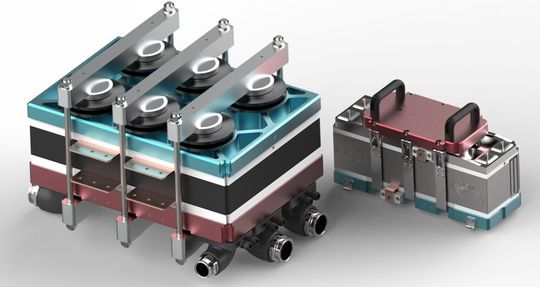
The 1,300 square centimeter stack is shown as a short stack with 15 cells in comparison to the generic stack with 100 cells.
(Image: ZSW)
Based on these developments, a first so-called short stack with 15 cells was built and validated in the in-house HyFaB test center. A stack output of around 25 kilowatts was demonstrated. Under these conditions, the stack generates an electrical current of over 3,000 amperes. Extrapolated to a full stack with 300 cells, this corresponds to an output of 500 kilowatts. The test results at the ZSW confirmed the stable operation of the fuel cell stack at this high output without any local overheating of the stack.
The ZSW at the Hannover Messe 2026
The ZSW will be presenting the new development and other innovations relating to hydrogen, fuel cells and electrolysis from April 20 to 24, 2026 at the Hannover Messe, Hall 11, Stand E07. The maritime fuel cell stack is also the subject of a presentation by ZSW researcher Frank Häußler at the Hydrogen + Fuel Cells Europe - Masterclass at the Hannover Messe.
Maximum Performance Through Optimization of Surface Area and Height
Fuel cells consist of stacked individual cells made up of a catalyst membrane unit and a bipolar plate. If high performance is required, the active surface area, i.e. the size of these units, is increased first, as the larger the surface area, the greater the current flow through the fuel cell. However, there are limits to this increase, so in a second step several layers are stacked on top of each other. This increases the voltage of the fuel cell stack. The product of current and voltage gives the power, which thus increases over the surface area and height of the stack.
Date: 08.12.2025
Naturally, we always handle your personal data responsibly. Any personal data we receive from you is processed in accordance with applicable data protection legislation. For detailed information please see our privacy policy.
Consent to the use of data for promotional purposes
I hereby consent to Vogel Communications Group GmbH & Co. KG, Max-Planck-Str. 7-9, 97082 Würzburg including any affiliated companies according to §§ 15 et seq. AktG (hereafter: Vogel Communications Group) using my e-mail address to send editorial newsletters. A list of all affiliated companies can be found here
Newsletter content may include all products and services of any companies mentioned above, including for example specialist journals and books, events and fairs as well as event-related products and services, print and digital media offers and services such as additional (editorial) newsletters, raffles, lead campaigns, market research both online and offline, specialist webportals and e-learning offers. In case my personal telephone number has also been collected, it may be used for offers of aforementioned products, for services of the companies mentioned above, and market research purposes.
Additionally, my consent also includes the processing of my email address and telephone number for data matching for marketing purposes with select advertising partners such as LinkedIn, Google, and Meta. For this, Vogel Communications Group may transmit said data in hashed form to the advertising partners who then use said data to determine whether I am also a member of the mentioned advertising partner portals. Vogel Communications Group uses this feature for the purposes of re-targeting (up-selling, cross-selling, and customer loyalty), generating so-called look-alike audiences for acquisition of new customers, and as basis for exclusion for on-going advertising campaigns. Further information can be found in section “data matching for marketing purposes”.
In case I access protected data on Internet portals of Vogel Communications Group including any affiliated companies according to §§ 15 et seq. AktG, I need to provide further data in order to register for the access to such content. In return for this free access to editorial content, my data may be used in accordance with this consent for the purposes stated here. This does not apply to data matching for marketing purposes.
Right of revocation
I understand that I can revoke my consent at will. My revocation does not change the lawfulness of data processing that was conducted based on my consent leading up to my revocation. One option to declare my revocation is to use the contact form found at https://contact.vogel.de. In case I no longer wish to receive certain newsletters, I have subscribed to, I can also click on the unsubscribe link included at the end of a newsletter. Further information regarding my right of revocation and the implementation of it as well as the consequences of my revocation can be found in the data protection declaration, section editorial newsletter.
Stainless steel bipolar plates are usually used in the automotive sector as they are lightweight and can be manufactured very thinly. However, graphite bipolar plates are required for large-area fuel cells, such as those used in the shipping industry, as they can still be produced in large surface formats and are dimensionally stable and flat, which is difficult to achieve with stainless steel plates above a certain size.
ZSW: Many Years of Experience and Leading Infrastructure
The ZSW in Ulm has more than 30 years of experience in the research and development of fuel cells and has realized more than 1,600 stacks in the power range from 50 watts to 150 kilowatts during this time. In the HyFaB fuel cell research factory, ZSW operates one of the largest test centers in Europe with 50 test stands for power tests up to 250 kilowatts as well as the HyLaB laboratory, one of only three independent laboratories for hydrogen analysis in the world.
With its in-house development "Generic Stack", the ZSW provides an open, scalable stack design for research and development that maps over 150 kilowatts of power and supports both stationary and mobile applications. The platform serves as a standard for research projects with industrial partners.
Close cooperation with partners from industry and science - including the Fraunhofer ISE in Freiburg and the VDMA, which are also involved in HyFaB - ensures a technological edge and facilitates the rapid transfer of research results into industrial applications.
PEM Fuel Cells: Clean, Efficient and Versatile
PEM (Proton Exchange Membrane) fuel cells convert hydrogen and oxygen directly into electrical energy, with only water being produced during operation. Their high power density, fast dynamics and modularity make them ideal for mobile applications in trucks, buses, cars and ships as well as for stationary energy supply. With the large-format 1,300 square centimeter stack concept, ZSW is providing a decisive technological impetus for the use of PEM fuel cells in applications such as climate-neutral shipping. In addition, the stack concept is also suitable for stationary applications, such as the reconversion of hydrogen into electricity.



:quality(80)/p7i.vogel.de/wcms/8e/7e/8e7e0cda4c68699bcc48283a38739769/0133316747v1.jpeg "A little-known hidden champion! When people think of laser cutting, the first thing that comes to mind is the power of the laser beam—and it is impressive to see the sparks flying. But Air Liquide—an exhibitor at Euroblech, by the way—wants to make it clear that the process gas is also key to success. (Image:AI-generated)")
:quality(80)/p7i.vogel.de/wcms/20/fa/20fa35e0af203c3464f7e7fdbb57a685/0133281172v1.jpeg "Since 2003, Etzinger AG has been developing and manufacturing high-quality coffee grinders, pepper mills, and grinding mechanisms for professional and home use. (Image:Etzinger)")
:quality(80)/p7i.vogel.de/wcms/69/91/6991413943488b4a2f6fde9dcd88c5b0/0133256686v1.jpeg "The CMA-patented pendulum mount can compensate for radial tolerances of up to one millimeter. (Image:Schwiening)")
:quality(80)/p7i.vogel.de/wcms/0b/cd/0bcd6d502ffcd087c4fc12b7b760b3ce/0133317507v2v1.jpeg "The new Multi Center from J.G. Weisser. (Image:J.G. Weisser)")
:quality(80)/p7i.vogel.de/wcms/bd/4e/bd4ef09ab0f84932ea76ca0330ffe789/0133329802v1.jpeg "The robotics boom and its consequences: According to a study, a significant portion of value creation occurs in the electronics industry. (Image:Fraunhofer IPA)")
:quality(80)/p7i.vogel.de/wcms/35/81/35815f36be1b1c13f9abef4cea2a3e2b/0133171739v1.jpeg "Humanoid robots in industry: Despite impressive progress, many systems are still in the pilot phase. (Image:AI-generated)")
:quality(80)/p7i.vogel.de/wcms/81/dc/81dc63ed24c562521413023779495e7d/chris-kramerv1.jpeg "Chris Kramar, Director and General Manager of OEM Solutions for Germany, Austria, and Switzerland at Dell Technologies (Source: Dell Technologies)")
:quality(80)/p7i.vogel.de/wcms/bb/f5/bbf5342f532debc1bd7c09c2b9a0bf42/0133176497v1.jpeg "Over the past two years, AI has emerged as the most important growth driver in the industry. (Image: ©Gorodenkoff - stock.adobe.com)")
:quality(80)/p7i.vogel.de/wcms/e9/19/e91905d37afe605bc348a690a4fed72e/0133350592v1.jpeg "At Autodesk University, Autodesk is introducing new AI features for CAD and PLM. (Image:Autodesk)")
:quality(80)/p7i.vogel.de/wcms/98/73/98731d23cbd95ff22391993a74cfefbf/mit-bifurcatedcircuits-01-pressv1.jpeg "A sample of the variety of configurations that Bifur circuits can form. (Source: Courtesy of the researchers)")
:quality(80)/p7i.vogel.de/wcms/f4/3d/f43d1f4297d9ae0cd1b6d2adfcb5ffe1/0133276470v1.jpeg "Simulation: Electric arcs in the electrical industry, including associated field simulation. (Image:CADFEM)")
:quality(80)/p7i.vogel.de/wcms/3e/f1/3ef196715e1b291ec7ae84f02c875c63/0133310495v1.jpeg "The Next Phase of Ethernet in Vehicles: End-to-end Ethernet integrates all high-data-rate devices into the network, including displays and central high-performance computing units. (Image:Infineon Technologies)")
:quality(80)/p7i.vogel.de/wcms/b4/b8/b4b89c48bb797df7251706d4ee096a80/0133359349v1.jpeg "To advance modern rail transportation, Knorr-Bremse and CARS have signed a memorandum of understanding regarding the China Freight Cooperation Program. Pictured here is Rail Executive Board Member Nicolas Lange at the signing ceremony in Beijing. (Image: Knorr-Bremse)")
:quality(80)/p7i.vogel.de/wcms/99/8c/998cb26cfb3110e8444a4ecbfe2dc799/0133338279v1.jpeg "Electric car manufacturer Rivian is launching its R2 SUV in the U.S. (Image:Rivian)")
:quality(80)/p7i.vogel.de/wcms/cc/d1/ccd1607af856c9cff96c73a5ffccfcad/p90652283-highres-demonstrator-woodenv1.jpeg "The FSCM research project, which was recently completed, is delivering innovations close to production for plastics, metals, and design at BMW. (Source: BMW)")
:quality(80)/p7i.vogel.de/wcms/4c/53/4c534208d09a9b1ce597938715e7fc19/0133288763v1.jpeg "Logic Folding: In its latest Kirin 9050 Pro, Huawei uses hybrid bonding to distribute the computing units across two silicon layers in order to increase the effective transistor density without resorting to finer manufacturing processes. (Image:Huawei)")
:quality(80)/p7i.vogel.de/wcms/56/d1/56d131e0b5bd05ef47411e92ad740cb4/0133351029v1.jpeg "Researchers at DTU have developed a nanolaser in a semiconductor membrane. The structure concentrates charge carriers and the light field into a small area (shaded in blue). If data is transmitted on microchips using light instead of electrical signals, transmission speeds can be increased and energy losses reduced. (Image:Yi Yu, DTU)")
:quality(80)/p7i.vogel.de/wcms/5e/55/5e55101ddc6338f755fcf3244db1367f/0133331863v1.jpeg "For data center projects, it is becoming increasingly important to also obtain the consent of the affected community. (Image:Dall-E / AI-generated)")
:quality(80)/p7i.vogel.de/wcms/8d/f9/8df95d3f58408673986b3d643e6b63ba/0133252773v1.jpeg "TXC targets high-speed optical links in AI data centers with 312.5 MHz oscillators, among other solutions. As data rates increase, requirements for jitter and frequency stability become more demanding as well. (Bild: TXC)")
:quality(80)/p7i.vogel.de/wcms/0d/75/0d757e099f6f162dc8d687cd80f90c00/0126756536v1.jpeg "0126756536v1 (Image:acp systems)")
:quality(80)/p7i.vogel.de/wcms/23/d4/23d41c95fc179d61e55f5cc4bce27c92/0131859128v1.jpeg "For the aviation industry, fuel cell propulsion systems can help improve sustainability. However, their use presents certain challenges. (Image:FEV)")