From Deepseek to SiEngine to Watson Rally: These seven startups provide AI, chips, and digital chassis. BMW, VW, and Audi are also among their customers. An overview.
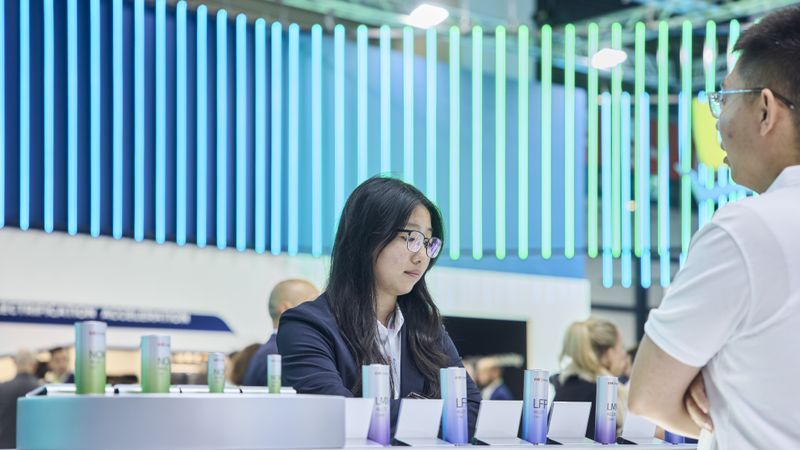
At the IAA 2025, companies from China were represented in large numbers, including many highly regarded startups.
(Image: Image: IAA Mobility/Messe München)
The transformation of the automotive industry is already entering its third phase. Nevertheless, the first two phases of electrification and digitalization, including autonomous and connected driving, are not yet fully completed. The trigger for the third phase is the use of artificial intelligence, which is fundamentally changing not only how vehicles operate but also how they are developed, built, and networked via the cloud.
"In the next decade, AI will bring about a transformation in the automotive industry that goes far beyond electrification," says He Xiaopeng, the founder of the Chinese electric vehicle start-up Xpeng.
Alongside these technological disruptions, the business models of the automotive industry and all supply chains are also changing. We are introducing a series of start-ups and successful young companies that are currently part of this industrial new beginning in China.
1. Deepseek
Artificial Intelligence
Founded: 2023
Headquarters: Hangzhou
It has been just over a year since Deepseek suddenly became globally famous when it launched a large language model (LLM) named "DeepSeek-R" in early 2025. It is almost as powerful as comparable models from the USA; however, according to the company, training the base model reportedly cost only about $5.6 million—which is considered relatively low in the world of LLMs.
Over the past year, automotive companies have queued up in Hangzhou to establish partnerships with Deepseek. The Geely Group, China's second-largest automaker after BYD, was the first to announce on February 6, 2025, that it had implemented a "deep integration" of its self-developed AI models with Deepseek.
Among Deepseek's other OEM partners are BMW, Leapmotor, GAC, Dongfeng with several of its automotive brands, and Great Wall Motors. On one hand, it involves interaction with the driver, better context understanding, and similar aspects; on the other hand, it relates to controlling other functions in the vehicles via software interfaces.
"Central advancements in artificial intelligence are taking place here. We are specifically expanding our AI partnerships for integration into our vehicles in China," said Oliver Zipse, CEO of BMW, during the announcement of the partnership between BMW and Deepseek at the Shanghai Auto Show last April.
2. XiZ Technology
Power Electronics
Founded: 2022
Headquarters: Suzhou
With the ongoing trend towards 800-volt architectures in powertrains, there is an increasing demand for SiC and GaN power modules and high-frequency power supply modules, which this start-up from Suzhou, near Shanghai, specializes in developing and producing.
Following a funding round in December 2025 that raised over 250 million yuan (around 30 million euros), the company plans to expand its research and development in the field of automotive power semiconductors of the so-called third generation and WBG modules. The business unit AIDC (Artificial Intelligence Data Center) is also set to be expanded with the new capital.
Liu Bo, the founder of the company, holds a master's degree in energy technology and automation from Zhejiang University. Part of his team previously worked at Delta Electronics for clients such as Nvidia and HP.
The market for power modules in electric drives is currently still heavily dominated in China by international suppliers like Infineon and ON Semiconductor. From a Chinese perspective, this opens up significant growth opportunities for "domestic substitution," meaning the takeover of market shares by local suppliers like XiZ.
3. SiEngine Technology
System-on-Chip Manufacturer (SoC)
Founded: 2018
Headquarters: Wuhan
The start-up rooted in automotive manufacturing in the central Chinese city of Wuhan has achieved "unicorn status" following several funding rounds, meaning a valuation of over one billion US dollars within its first years of existence. It specializes in the development and production of automotive chips for smart cockpits and autonomous driving functions.
Date: 08.12.2025
Naturally, we always handle your personal data responsibly. Any personal data we receive from you is processed in accordance with applicable data protection legislation. For detailed information please see our privacy policy.
Consent to the use of data for promotional purposes
I hereby consent to Vogel Communications Group GmbH & Co. KG, Max-Planck-Str. 7-9, 97082 Würzburg including any affiliated companies according to §§ 15 et seq. AktG (hereafter: Vogel Communications Group) using my e-mail address to send editorial newsletters. A list of all affiliated companies can be found here
Newsletter content may include all products and services of any companies mentioned above, including for example specialist journals and books, events and fairs as well as event-related products and services, print and digital media offers and services such as additional (editorial) newsletters, raffles, lead campaigns, market research both online and offline, specialist webportals and e-learning offers. In case my personal telephone number has also been collected, it may be used for offers of aforementioned products, for services of the companies mentioned above, and market research purposes.
Additionally, my consent also includes the processing of my email address and telephone number for data matching for marketing purposes with select advertising partners such as LinkedIn, Google, and Meta. For this, Vogel Communications Group may transmit said data in hashed form to the advertising partners who then use said data to determine whether I am also a member of the mentioned advertising partner portals. Vogel Communications Group uses this feature for the purposes of re-targeting (up-selling, cross-selling, and customer loyalty), generating so-called look-alike audiences for acquisition of new customers, and as basis for exclusion for on-going advertising campaigns. Further information can be found in section “data matching for marketing purposes”.
In case I access protected data on Internet portals of Vogel Communications Group including any affiliated companies according to §§ 15 et seq. AktG, I need to provide further data in order to register for the access to such content. In return for this free access to editorial content, my data may be used in accordance with this consent for the purposes stated here. This does not apply to data matching for marketing purposes.
Right of revocation
I understand that I can revoke my consent at will. My revocation does not change the lawfulness of data processing that was conducted based on my consent leading up to my revocation. One option to declare my revocation is to use the contact form found at https://contact.vogel.de. In case I no longer wish to receive certain newsletters, I have subscribed to, I can also click on the unsubscribe link included at the end of a newsletter. Further information regarding my right of revocation and the implementation of it as well as the consequences of my revocation can be found in the data protection declaration, section editorial newsletter.
SiEngine is currently one of the few Chinese companies capable of producing smart cockpit SoCs on 7-nanometer processes in significant volumes—having done so since 2021.
In December 2025, SiEngine began series production of its new ADAS chip "Xinchen 1." A single chip achieves an NPU processing power of 512 TOPS. When multiple chips are interconnected, they reach 2,048 TOPS.
The company’s customers include automotive brands such as Volvo, Lynk & Co, FAW Hongqi, Changan, and Volkswagen—according to Chinese media reports, also for VW models sold in Europe and the USA.
The company has greatly benefited from state support since the USA has been trying to slow down the Chinese industry by boycotting high-performance semiconductors. The "China State-owned Enterprise Structural Reform Fund (Phase II)" is one of the early investors in this rapidly growing company.
Public investment funds at the provincial level, state banks, and many enthusiastic private investors have since overwhelmed the company with capital, which it uses for research and development at globally leading levels.
4. Trugo Tech (Qiangpu)
Chassis-by-Wire
Founded: 2015
Headquarters: Shanghai
This successful new company specializes in the digital control of vehicle functions of all kinds, known as X-by-Wire. Its most well-known product is an electronic hydraulic brake system called EHBI-Onebox.
Since its founding, the company has reportedly sold 600 million chassis-by-wire solutions, according to the Chinese automotive portal Gasgoo. About a dozen leading automakers count among its customers.
The founder and CEO Chen Jingjie has stated that he aims to make Trugo Tech the leading Chinese company in this niche. He is already competing with international Tier-1 suppliers that also manufacture such high-tech components for increasingly digitized cars, whether they are electric vehicles, hybrids, or internal combustion engine cars.
5. LEEKR Technology
Chassis-by-Wire
Founded: 2021
Headquarters: Shanghai
As more autonomous driving functions are implemented in the Chinese automotive industry, the demand for completely digital X-by-Wire products is growing. Central processing units can steer the vehicle autonomously best when their digital commands arrive quickly and smoothly—via electrical and electronic impulses, but without mechanical bridges at the endpoint.
LEEKR Technology offers products for digital steering (steer-by-wire), digital braking (brake-by-wire), as well as chassis domain controllers and integrated chassis systems.
The company is also an example of how quickly Chinese start-ups in the automotive industry seek opportunities for expansion abroad after initial successes in the domestic market.
In December, LEEKR signed a memorandum of understanding for cooperation with the Vietnamese Geleximco Group. In Vietnam, the market for electric vehicles and hybrids is currently growing at annual growth rates of 25 to 30 percent.
6. Watson Rally
Brake-by-Wire
Founded: 2022
Headquarters: Shanghai
Shanghai Watson Rally Automotive Technology Co. develops electromechanical brake-by-wire systems (EMB). The founder and CEO is Cai Xudong. He has recruited a team of specialists from international Tier-1 suppliers.
At the beginning of last year, the start-up received 100 million yuan (approximately 12 million euros) from investors such as Blue Lake Capital, Vinno Capital, and Junke Danmu Investment, as well as industrial investments, including from Xiaomi Strategic Investment.
The start-up benefits, like many others, from the rapid transformation of the Chinese automotive industry. With the electrification and the similarly rapid growth of autonomous driving functions comes a quick digitization of many vehicle components.
7. ZYT
Assistance Systems
Founded: 2023
Headquarters: Shenzhen
Although the roots of this rapidly growing provider of automated driving systems trace back to 2016, it has only existed in its current form since 2023, when it was spun off from the Chinese drone manufacturer DJI.
With its combination of hardware and software for assistance systems (ADAS), "Zhuoyu Technology" supplies an impressive list of OEM partners, including VW, Audi, SAIC-GM-Wuling, Chery, Great Wall Motor, FAW Group, and Dongfeng Motor.
A key factor for the start-up's breakthrough into the growth phase was an investment from the FAW Group, as such stakes from customers usually lead to firm orders and other synergy effects.
At the recent IAA in Munich, the company announced the establishment of a European headquarters in Braunschweig. The company aims to be closer to its customers in the German and European automotive industry with a strategy of "in Europe for Europe." Additionally, it hopes for contracts from Chinese OEMs investing in Europe.



:quality(80)/p7i.vogel.de/wcms/8e/7e/8e7e0cda4c68699bcc48283a38739769/0133316747v1.jpeg "A little-known hidden champion! When people think of laser cutting, the first thing that comes to mind is the power of the laser beam—and it is impressive to see the sparks flying. But Air Liquide—an exhibitor at Euroblech, by the way—wants to make it clear that the process gas is also key to success. (Image:AI-generated)")
:quality(80)/p7i.vogel.de/wcms/20/fa/20fa35e0af203c3464f7e7fdbb57a685/0133281172v1.jpeg "Since 2003, Etzinger AG has been developing and manufacturing high-quality coffee grinders, pepper mills, and grinding mechanisms for professional and home use. (Image:Etzinger)")
:quality(80)/p7i.vogel.de/wcms/69/91/6991413943488b4a2f6fde9dcd88c5b0/0133256686v1.jpeg "The CMA-patented pendulum mount can compensate for radial tolerances of up to one millimeter. (Image:Schwiening)")
:quality(80)/p7i.vogel.de/wcms/0b/cd/0bcd6d502ffcd087c4fc12b7b760b3ce/0133317507v2v1.jpeg "The new Multi Center from J.G. Weisser. (Image:J.G. Weisser)")
:quality(80)/p7i.vogel.de/wcms/bd/4e/bd4ef09ab0f84932ea76ca0330ffe789/0133329802v1.jpeg "The robotics boom and its consequences: According to a study, a significant portion of value creation occurs in the electronics industry. (Image:Fraunhofer IPA)")
:quality(80)/p7i.vogel.de/wcms/35/81/35815f36be1b1c13f9abef4cea2a3e2b/0133171739v1.jpeg "Humanoid robots in industry: Despite impressive progress, many systems are still in the pilot phase. (Image:AI-generated)")
:quality(80)/p7i.vogel.de/wcms/81/dc/81dc63ed24c562521413023779495e7d/chris-kramerv1.jpeg "Chris Kramar, Director and General Manager of OEM Solutions for Germany, Austria, and Switzerland at Dell Technologies (Source: Dell Technologies)")
:quality(80)/p7i.vogel.de/wcms/bb/f5/bbf5342f532debc1bd7c09c2b9a0bf42/0133176497v1.jpeg "Over the past two years, AI has emerged as the most important growth driver in the industry. (Image: ©Gorodenkoff - stock.adobe.com)")
:quality(80)/p7i.vogel.de/wcms/e9/19/e91905d37afe605bc348a690a4fed72e/0133350592v1.jpeg "At Autodesk University, Autodesk is introducing new AI features for CAD and PLM. (Image:Autodesk)")
:quality(80)/p7i.vogel.de/wcms/98/73/98731d23cbd95ff22391993a74cfefbf/mit-bifurcatedcircuits-01-pressv1.jpeg "A sample of the variety of configurations that Bifur circuits can form. (Source: Courtesy of the researchers)")
:quality(80)/p7i.vogel.de/wcms/f4/3d/f43d1f4297d9ae0cd1b6d2adfcb5ffe1/0133276470v1.jpeg "Simulation: Electric arcs in the electrical industry, including associated field simulation. (Image:CADFEM)")
:quality(80)/p7i.vogel.de/wcms/3e/f1/3ef196715e1b291ec7ae84f02c875c63/0133310495v1.jpeg "The Next Phase of Ethernet in Vehicles: End-to-end Ethernet integrates all high-data-rate devices into the network, including displays and central high-performance computing units. (Image:Infineon Technologies)")
:quality(80)/p7i.vogel.de/wcms/b4/b8/b4b89c48bb797df7251706d4ee096a80/0133359349v1.jpeg "To advance modern rail transportation, Knorr-Bremse and CARS have signed a memorandum of understanding regarding the China Freight Cooperation Program. Pictured here is Rail Executive Board Member Nicolas Lange at the signing ceremony in Beijing. (Image: Knorr-Bremse)")
:quality(80)/p7i.vogel.de/wcms/99/8c/998cb26cfb3110e8444a4ecbfe2dc799/0133338279v1.jpeg "Electric car manufacturer Rivian is launching its R2 SUV in the U.S. (Image:Rivian)")
:quality(80)/p7i.vogel.de/wcms/cc/d1/ccd1607af856c9cff96c73a5ffccfcad/p90652283-highres-demonstrator-woodenv1.jpeg "The FSCM research project, which was recently completed, is delivering innovations close to production for plastics, metals, and design at BMW. (Source: BMW)")
:quality(80)/p7i.vogel.de/wcms/4c/53/4c534208d09a9b1ce597938715e7fc19/0133288763v1.jpeg "Logic Folding: In its latest Kirin 9050 Pro, Huawei uses hybrid bonding to distribute the computing units across two silicon layers in order to increase the effective transistor density without resorting to finer manufacturing processes. (Image:Huawei)")
:quality(80)/p7i.vogel.de/wcms/56/d1/56d131e0b5bd05ef47411e92ad740cb4/0133351029v1.jpeg "Researchers at DTU have developed a nanolaser in a semiconductor membrane. The structure concentrates charge carriers and the light field into a small area (shaded in blue). If data is transmitted on microchips using light instead of electrical signals, transmission speeds can be increased and energy losses reduced. (Image:Yi Yu, DTU)")
:quality(80)/p7i.vogel.de/wcms/5e/55/5e55101ddc6338f755fcf3244db1367f/0133331863v1.jpeg "For data center projects, it is becoming increasingly important to also obtain the consent of the affected community. (Image:Dall-E / AI-generated)")
:quality(80)/p7i.vogel.de/wcms/8d/f9/8df95d3f58408673986b3d643e6b63ba/0133252773v1.jpeg "TXC targets high-speed optical links in AI data centers with 312.5 MHz oscillators, among other solutions. As data rates increase, requirements for jitter and frequency stability become more demanding as well. (Bild: TXC)")
:fill(fff,0)/images.vogel.de/vogelonline/companyimg/76800/76895/65.jpg "FAULHABER_120mm.jpg ()")
:fill(fff,0)/p7i.vogel.de/companies/69/de/69de1b7403b0d/simtos-logo.jpeg "simtos-logo (SIMTOS)")
:quality(80)/p7i.vogel.de/wcms/0d/b6/0db658447c8e0574cdc52f0823657ae0/25c0100-071-5728x3219v1v1.jpeg "Mercedes-Benz presented the CLA with a long wheelbase at Auto Shanghai 2025. (Image:Image: Mercedes-Benz)")
:quality(80)/p7i.vogel.de/wcms/de/d6/ded641c0d57f9de47645d1bbab396905/b02-25c0327-001-copy-mercedes-benz-4957x2790v1v1.jpeg "Robotaxi service in Abu Dhabi: With Momenta, a Chinese AI specialist for autonomous driving, and the local partner Lumo, Mercedes-Benz aims to establish a shuttle service with highly automated S-Class vehicles in the United Arab Emirates. (Image:Mercedes-Benz)")
:quality(80)/p7i.vogel.de/wcms/a8/d7/a8d748a29612695eec22e0fad4cbf61a/0128735143v1.jpeg "The CES takes place in Las Vegas from January 6 to 9, 2026. (Image:Consumer Technology Association (CTA))")
:quality(80)/p7i.vogel.de/wcms/57/d2/57d2b75d884c18866b46e776126fb46b/org-blobs-user-response-file-output-dac07b02-0e97-4452-9a3a-26528da583b3-file-1787126178766-jpgv1.jpeg "The memory manufacturer CXMT has had an extremely successful IPO. Among the investors are several car manufacturers. (Image:KI-generiert)")
:quality(80)/p7i.vogel.de/wcms/89/e2/89e2226e826f23fb666222b66c737531/0129393966v1.jpeg "Chinese car manufacturers and suppliers want to produce small batches of brake-by-wire systems this year. (Image:Chery)")