At CES in Las Vegas, suppliers showcased AI systems, digital cockpits, and processors for software-defined vehicles. Additionally, there were new development tools. An overview.
The CES takes place in Las Vegas from January 6 to 9, 2026.
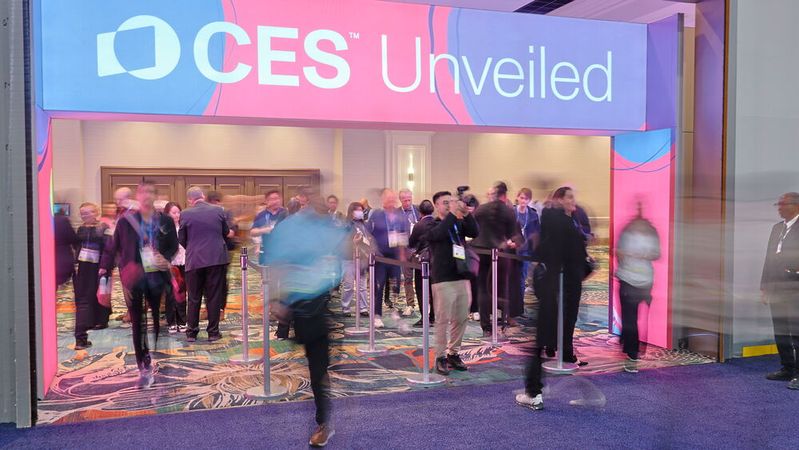
(Image: Consumer Technology Association (CTA))
At the Consumer Electronics Show (CES) in Las Vegas, automotive suppliers and service providers showcase their latest developments for software-defined vehicles, AI-driven systems, and digital cockpits. The report summarizes the announcements alphabetically.
3SS
The Stuttgart-based company 3SS introduced the 3Ready Content Bundle, a production-ready entertainment ecosystem for vehicles. According to the company, the system offers over 2,000 Hollywood movies, more than 25 international news providers such as Bloomberg, DW, Euronews, and France24, access to over five streaming platforms, more than 15 sports channels, as well as children's content, karaoke, and games. The platform operates via AOSP, Linux, Android Automotive OS, and hybrid architectures.
Aptiv
Aptiv showcased its next-generation end-to-end AI-driven ADAS platform for automated driving on highways and in urban environments. The core features include the Gen-8 radar sensors with improved range, resolution, and object detection, as well as the Aptiv PULSE sensor, which combines surround-view cameras with ultra-short-range radar for 360-degree perception.
In addition, the company showcased its Cockpit Sound Suite with directional audio warnings and face ID features. In collaboration with Verizon, Aptiv demonstrated a Cellular Vehicle-to-Everything (C-V2X) technology based on the cloud-native Aptiv LINC platform with Wind River technology.
Aumovio
The supplier (formerly Continental Automotive) presented the latest generation of its Vehicle Control High-Performance Computer with the super-integration processor S32N79 from NXP Semiconductors. According to the company, the computer combines functions from chassis, driving dynamics, and comfort, enabling a secure, modular computing system with hardware-based function separation. Through intelligent performance modes, the system adjusts its energy consumption to different operating states. Aumovio developed the software using a digital twin even before the physical chip was available.
The supplier expects to generate revenue of more than six billion euros from software and services by the beginning of the next decade, with about two-thirds coming from the Mobility business sector. By the end of 2027, Bosch plans to invest more than 2.5 billion euros (~$2.9 Billion) in AI. At the CES, the company showcased an AI-based cockpit with an AI language model for natural dialogues as well as a visual language model that interprets events inside and outside the vehicle.
The new Radar Gen 7 Premium detects objects such as pallets and car tires at over 200 meters (~656 feet). Additionally, Bosch announced a collaboration with Kodiak AI for redundant platforms for driverless trucks.
Together with Microsoft, Bosch is expanding its Manufacturing Co-Intelligence offering with agentic AI for production. The collaboration aims to combine Bosch's industrial expertise with Microsoft's IT infrastructure and software expertise. One of the first customers is Sick AG.
Clarios
Clarios announced progress in its sodium-ion strategy. The provider of low-voltage batteries expanded its partnership with the Swedish company Altris. Both have agreed on a joint venture focusing on the Power Sodium platform. According to the company, the supplier also increased its equity stake in Altris. Furthermore, Clarios, Altris, and the Slovak manufacturer Inobat are preparing the assembly of the first sodium-ion test cells for automotive applications. The prototype batteries are based on test cells produced at Inobat's pilot plant using Altris' sodium-ion technology. According to the company, the cells demonstrate strong cold-start capability down to minus 25 degrees Celsius, low internal resistance, and high power density. Series production is planned by the end of the decade.
Date: 08.12.2025
Naturally, we always handle your personal data responsibly. Any personal data we receive from you is processed in accordance with applicable data protection legislation. For detailed information please see our privacy policy.
Consent to the use of data for promotional purposes
I hereby consent to Vogel Communications Group GmbH & Co. KG, Max-Planck-Str. 7-9, 97082 Würzburg including any affiliated companies according to §§ 15 et seq. AktG (hereafter: Vogel Communications Group) using my e-mail address to send editorial newsletters. A list of all affiliated companies can be found here
Newsletter content may include all products and services of any companies mentioned above, including for example specialist journals and books, events and fairs as well as event-related products and services, print and digital media offers and services such as additional (editorial) newsletters, raffles, lead campaigns, market research both online and offline, specialist webportals and e-learning offers. In case my personal telephone number has also been collected, it may be used for offers of aforementioned products, for services of the companies mentioned above, and market research purposes.
Additionally, my consent also includes the processing of my email address and telephone number for data matching for marketing purposes with select advertising partners such as LinkedIn, Google, and Meta. For this, Vogel Communications Group may transmit said data in hashed form to the advertising partners who then use said data to determine whether I am also a member of the mentioned advertising partner portals. Vogel Communications Group uses this feature for the purposes of re-targeting (up-selling, cross-selling, and customer loyalty), generating so-called look-alike audiences for acquisition of new customers, and as basis for exclusion for on-going advertising campaigns. Further information can be found in section “data matching for marketing purposes”.
In case I access protected data on Internet portals of Vogel Communications Group including any affiliated companies according to §§ 15 et seq. AktG, I need to provide further data in order to register for the access to such content. In return for this free access to editorial content, my data may be used in accordance with this consent for the purposes stated here. This does not apply to data matching for marketing purposes.
Right of revocation
I understand that I can revoke my consent at will. My revocation does not change the lawfulness of data processing that was conducted based on my consent leading up to my revocation. One option to declare my revocation is to use the contact form found at https://contact.vogel.de. In case I no longer wish to receive certain newsletters, I have subscribed to, I can also click on the unsubscribe link included at the end of a newsletter. Further information regarding my right of revocation and the implementation of it as well as the consequences of my revocation can be found in the data protection declaration, section editorial newsletter.
Elektrobit
The company announced the launch of EB civion, a suite designed to accelerate cockpit development. It includes EB civion Creator (cloud-native development environment), EB civion Core (hardware-independent software package), and EB civion Cockpit (cockpit domain controller systems with build-to-print designs). According to CEO Maria Anhalt, the platform shortens time-to-market and reduces total cost of ownership through modular target software. Elektrobit collaborates with AMD, AWS, Google, Infineon, and Qualcomm.
Gentex
Gentex introduced the next generation of its Full Display Mirror (FDM). The system combines a specially adapted camera with a mirror-integrated video display. The new generation integrates Dynamic View Assist, a series of dynamic display modes designed to enhance driving safety. The system automatically expands the digital mirror view when the vehicle moves slowly, tilts downward when the vehicle is in reverse, broadens sideways to show vehicles in the blind spot, and monitors the cargo bed on pickup trucks.
The supplier also showcased the next generation of its large-scale dimmable components, including auto-dimming sunroofs and sun visors with various integrated makeup mirror designs. For CES 2026, Gentex developed an entirely new demonstrator for driver and interior monitoring. The system detects sudden illnesses and the return to manual control in semi-autonomous vehicles. Gentex's latest software suite includes new features such as cognitive state detection, impairment detection, vital sign monitoring, and post-accident communication.
Hella
The automotive suppliers Forvia Hella and NXP Semiconductors are collaborating in the field of high-resolution radar. The focus is on the latest generation radar sensors ("ForWave7HD") with up to 32 transmit and receive channels each. The core of the third-generation imaging radar chipset is the radar processor S32R47. The new radar sensor, thanks to the enhanced resolution and high number of transmit and receive channels, detects even small objects with precision and covers a detection range of up to 400 meters (~1,300 feet. Additionally, the field of view has been expanded. Hella will bring its first high-resolution radar into series production for a premium manufacturer starting mid-2028. The order volume for the customer project is in the triple-digit million-euro range, the company reports.
Infineon
Together with Flex, Infineon introduced a Zone Controller Development Kit (ZCU) designed to accelerate the development of SDV-capable E/E architectures. The kit is based on reusable components that combine around 30 unique parts. With the modular concept, developers can flexibly adapt their designs to individual implementations while preserving room for future functionalities. According to the company, the design platform can implement over 50 power distribution channels, 40 connectivity channels, and 10 load control channels. For high-end ZCU implementations, a plug-on module with two MCUs is available.
The pre-validated hardware combines automotive semiconductor components from Infineon, such as the Aurix microcontroller, OPTIREG power supplies, PROFET and SPOC smart power switches, as well as MOTIX motor control solutions, with Flex's expertise in design, integration, and industrialization. The software stack includes contributions from Vector. The kit can be pre-ordered now, with shipping expected to begin at the end of the first quarter of 2026.
Intellias
Intellias and Zeekr introduced an AI-based innovation for visual testing of in-vehicle infotainment systems. By combining vision-language models (VLMs) and computer vision, the system fully automates end-to-end UI testing. It derives test cases directly from documented functional and system requirements and executes them automatically. According to Christian Hering, Head of Intelligent Software at Zeekr Technology Europe, the system operates up to four times faster than manual testing with an accuracy of over 95 percent.
IPG Automotive
IPG and Synopsys showcased virtualization systems for System-on-Chips (SoC) and domain controllers. At the core is an advanced multi-ECU prototype with multi-fidelity and multi-ECU electronic simulation, integrating IPG Automotive's Carmaker and Synopsys' virtualization technology via SIL Kit. According to the companies, this enables early integration and testing of vehicle behavior, electronics, and software before hardware is available.
Magna
Magna expanded its collaboration with Nvidia to support OEM implementations on the Drive Hyperion platform. The supplier offers a portfolio of system integration, validation, and vehicle launch services for the Nvidia Drive AV stack on the Drive AGX Thor platform. The scope includes assistance and automated driving systems across autonomy levels Level 2++, Level 3, and Level 4. OEMs can utilize system launch activities including system integration, verification, validation, safety approval, and market introduction.
Nvidia
Nvidia is bringing its Drive AV software with enhanced Level 2 driving assistance features to U.S. roads. The launch partner is Mercedes-Benz with the new CLA, the first vehicle based on the MB.OS platform. The software utilizes a dual architecture with an AI end-to-end stack for driving and a parallel classical safety stack based on the Nvidia Halos system. The architecture enables Level 2 features with advanced capabilities such as urban point-to-point navigation, proactive collision avoidance, and automated parking. In addition to Mercedes-Benz, Nvidia is collaborating with other global automakers.
Even before CES, Nvidia hinted in a press release that there will be an autonomous S-Class from Mercedes, apparently for private customers.
NXP introduced the new S32N7 super-integration processor series, based on 5-nm technology. According to the company, the processor family fully digitizes and centralizes key vehicle functions – powertrain, driving dynamics, body, gateway, and safety domains. It consolidates software and data into a central hub at the vehicle core while ensuring uncompromising safety and security. Manufacturers can significantly simplify vehicle architectures while reducing overall operating costs by up to 20 percent. This is achieved through the elimination of numerous hardware modules as well as optimized wiring, electronics, and software.
The S32N7 series offers a scalable portfolio with 32 compatible variants. These combine application and real-time computing with high-performance networking, hardware isolation technology, and AI and data acceleration on a single system-on-chip. By centralizing vehicle intelligence, automakers gain the foundation to scale AI innovations across the entire vehicle. The processor series features a powerful data backbone that enables upgrades to the latest AI silicon technology without requiring a redesign of the vehicle architecture.
Bosch is the first to implement the S32N7 in its vehicle integration platform. "Our close collaboration with NXP on the S32N7 processor series demonstrates how we combine leading semiconductor technologies with our system expertise and the highest standards for safety and security," says Matthias Breunig, SVP Compute Enhanced at Bosch Mobility. Together, NXP and Bosch have developed reference designs, safety frameworks, hardware integrations, and an expert program. Bosch is already providing ECU samples based on the initial S32N7 prototypes. The S32N79 is currently being sampled with customers.
Qorix
The joint venture of KPIT Technologies, ZF, and Qualcomm Ventures showcased itself at CES with four demonstrators at ECARX, Red Hat, KPIT, and ZF, all based on Qorix Performance. The middleware uses the open-source project Eclipse S-CORE as a foundation and extends it for real-world vehicle programs with deterministic orchestration, functional separation, cross-SoC and operating system integration, and commercial support. Qorix also introduced an AI-assisted developer that simplifies the configuration and integration of SDV platforms.
Smart Eye and Green Hills Software
The companies demonstrated an integrated driver monitoring platform for modern vehicle architectures. The production-ready foundation shows how Smart Eye's driver monitoring software runs alongside a digital instrument cluster on a single ECU, powered by Green Hills' ASIL-certified Integrity real-time operating system. Green Hills' development environment provides a unified view across all applications and ECUs.
Sonatus
Sonatus showcased a range of AI-powered products at CES. The company, together with partners such as Nissan, Michelin, Bosch Engineering, Renesas, Hagiwara, AWS, and NXP, demonstrated how software and AI are used in diagnostics, smart vehicle functions, and fleet management.
Using a 2026 Nissan Leaf as an example, Sonatus demonstrated how AI tools accelerate vehicle development. Nissan uses the products Collector AI and AI Technician to build its engineering workflows faster and more efficiently than before. In a joint presentation with Bosch Engineering, Bosch's E/E architecture was showcased, combined with the capture of real vehicle data and OTA updates through Collector AI and Updater.
With the newly announced AI Director, the company demonstrated how in-vehicle AI models can enable new functions. Using a Ford Bronco (1970 model) modified by Sonatus, a Michelin AI model for tire wear was showcased, running on NXP S32 vehicle processors and enabling predictive maintenance.
Texas Instruments
TI introduced the TDA5 family of high-performance computing SoCs with a proprietary NPU and chiplet-compatible design, offering edge AI performance of up to 1,200 TOPS. The SoCs feature Arm Cortex-A720AE cores and support vehicle autonomy up to SAE Level 3. In collaboration with Synopsys, TI offers a Virtualizer Development Kit for TDA5 SoCs, which, according to the company, reduces the time-to-market for SDVs by up to twelve months. Samples of the TDA54-Q1 SoC will be available for selected automotive customers by the end of 2026.
Together with Seeing Machines, Valeo showcased in-cabin monitoring systems (ICMS) for driver and occupant applications. The combination of Valeo's system expertise and Seeing Machines' perception technology enables a fully integrated interior sensing solution. The demonstrations include the Valeo Panovision head-up display with an adaptive warning system based on eye tracking, the Valeo Safe InSight demonstration vehicle, and a smart cluster helmet detection system for two-wheelers.
Vector
In Las Vegas, Vector presented "Alloy Kore." It is a foundational vehicle software platform developed with QNX. The platform combines QNX's safety-certified operating system and virtualization technology with Vector's secure middleware. According to the company, the unified platform reduces integration efforts and accelerates development. An early-access version is now available through various distributions from Vector or QNX.
Mercedes-Benz is already evaluating the integration of Alloy Kore into the next SDV generations. The certified version, meeting the highest requirements in functional safety (up to ISO 26262 ASIL D) and cybersecurity (ISO/SAE 21434), will be released at the end of 2026. QNX and Vector aim to support leading passenger and commercial vehicle OEMs, as well as industry initiatives like Eclipse S-CORE and SOAFEE, in using Alloy Kore as a reference architecture.
ZF
ZF is bringing the chassis into the digital age with its Chassis 2.0 strategy. With AI Road Sense, the company presented an AI-based system that detects road conditions and adjusts the chassis in real time. The software processes sensor data and coordinates the control of intelligent actuators like the semi-active damping system Continuous Damping Control (CDC) or the fully active "sMOTION". The system is available in three versions: Standard (CAN bus signals), Advanced (with camera data), and Premium (with lidar technology for 3D terrain profiles up to 25 meters ahead). Additionally, ZF introduced Active Noise Reduction, a software function to reduce tire noise in the interior. Series production is planned for 2028.



:quality(80)/p7i.vogel.de/wcms/8e/7e/8e7e0cda4c68699bcc48283a38739769/0133316747v1.jpeg "A little-known hidden champion! When people think of laser cutting, the first thing that comes to mind is the power of the laser beam—and it is impressive to see the sparks flying. But Air Liquide—an exhibitor at Euroblech, by the way—wants to make it clear that the process gas is also key to success. (Image:AI-generated)")
:quality(80)/p7i.vogel.de/wcms/20/fa/20fa35e0af203c3464f7e7fdbb57a685/0133281172v1.jpeg "Since 2003, Etzinger AG has been developing and manufacturing high-quality coffee grinders, pepper mills, and grinding mechanisms for professional and home use. (Image:Etzinger)")
:quality(80)/p7i.vogel.de/wcms/69/91/6991413943488b4a2f6fde9dcd88c5b0/0133256686v1.jpeg "The CMA-patented pendulum mount can compensate for radial tolerances of up to one millimeter. (Image:Schwiening)")
:quality(80)/p7i.vogel.de/wcms/0b/cd/0bcd6d502ffcd087c4fc12b7b760b3ce/0133317507v2v1.jpeg "The new Multi Center from J.G. Weisser. (Image:J.G. Weisser)")
:quality(80)/p7i.vogel.de/wcms/bd/4e/bd4ef09ab0f84932ea76ca0330ffe789/0133329802v1.jpeg "The robotics boom and its consequences: According to a study, a significant portion of value creation occurs in the electronics industry. (Image:Fraunhofer IPA)")
:quality(80)/p7i.vogel.de/wcms/35/81/35815f36be1b1c13f9abef4cea2a3e2b/0133171739v1.jpeg "Humanoid robots in industry: Despite impressive progress, many systems are still in the pilot phase. (Image:AI-generated)")
:quality(80)/p7i.vogel.de/wcms/81/dc/81dc63ed24c562521413023779495e7d/chris-kramerv1.jpeg "Chris Kramar, Director and General Manager of OEM Solutions for Germany, Austria, and Switzerland at Dell Technologies (Source: Dell Technologies)")
:quality(80)/p7i.vogel.de/wcms/bb/f5/bbf5342f532debc1bd7c09c2b9a0bf42/0133176497v1.jpeg "Over the past two years, AI has emerged as the most important growth driver in the industry. (Image: ©Gorodenkoff - stock.adobe.com)")
:quality(80)/p7i.vogel.de/wcms/e9/19/e91905d37afe605bc348a690a4fed72e/0133350592v1.jpeg "At Autodesk University, Autodesk is introducing new AI features for CAD and PLM. (Image:Autodesk)")
:quality(80)/p7i.vogel.de/wcms/98/73/98731d23cbd95ff22391993a74cfefbf/mit-bifurcatedcircuits-01-pressv1.jpeg "A sample of the variety of configurations that Bifur circuits can form. (Source: Courtesy of the researchers)")
:quality(80)/p7i.vogel.de/wcms/f4/3d/f43d1f4297d9ae0cd1b6d2adfcb5ffe1/0133276470v1.jpeg "Simulation: Electric arcs in the electrical industry, including associated field simulation. (Image:CADFEM)")
:quality(80)/p7i.vogel.de/wcms/3e/f1/3ef196715e1b291ec7ae84f02c875c63/0133310495v1.jpeg "The Next Phase of Ethernet in Vehicles: End-to-end Ethernet integrates all high-data-rate devices into the network, including displays and central high-performance computing units. (Image:Infineon Technologies)")
:quality(80)/p7i.vogel.de/wcms/b4/b8/b4b89c48bb797df7251706d4ee096a80/0133359349v1.jpeg "To advance modern rail transportation, Knorr-Bremse and CARS have signed a memorandum of understanding regarding the China Freight Cooperation Program. Pictured here is Rail Executive Board Member Nicolas Lange at the signing ceremony in Beijing. (Image: Knorr-Bremse)")
:quality(80)/p7i.vogel.de/wcms/99/8c/998cb26cfb3110e8444a4ecbfe2dc799/0133338279v1.jpeg "Electric car manufacturer Rivian is launching its R2 SUV in the U.S. (Image:Rivian)")
:quality(80)/p7i.vogel.de/wcms/cc/d1/ccd1607af856c9cff96c73a5ffccfcad/p90652283-highres-demonstrator-woodenv1.jpeg "The FSCM research project, which was recently completed, is delivering innovations close to production for plastics, metals, and design at BMW. (Source: BMW)")
:quality(80)/p7i.vogel.de/wcms/4c/53/4c534208d09a9b1ce597938715e7fc19/0133288763v1.jpeg "Logic Folding: In its latest Kirin 9050 Pro, Huawei uses hybrid bonding to distribute the computing units across two silicon layers in order to increase the effective transistor density without resorting to finer manufacturing processes. (Image:Huawei)")
:quality(80)/p7i.vogel.de/wcms/56/d1/56d131e0b5bd05ef47411e92ad740cb4/0133351029v1.jpeg "Researchers at DTU have developed a nanolaser in a semiconductor membrane. The structure concentrates charge carriers and the light field into a small area (shaded in blue). If data is transmitted on microchips using light instead of electrical signals, transmission speeds can be increased and energy losses reduced. (Image:Yi Yu, DTU)")
:quality(80)/p7i.vogel.de/wcms/5e/55/5e55101ddc6338f755fcf3244db1367f/0133331863v1.jpeg "For data center projects, it is becoming increasingly important to also obtain the consent of the affected community. (Image:Dall-E / AI-generated)")
:quality(80)/p7i.vogel.de/wcms/8d/f9/8df95d3f58408673986b3d643e6b63ba/0133252773v1.jpeg "TXC targets high-speed optical links in AI data centers with 312.5 MHz oscillators, among other solutions. As data rates increase, requirements for jitter and frequency stability become more demanding as well. (Bild: TXC)")
:quality(80)/p7i.vogel.de/wcms/be/cb/becb9a59551192587f0b46a25a259846/0128798986v1.jpeg "Hella integrates the new S32 chip technology from NXP into its \"ForWave7HD\" radar sensors.(Image: Forvia Hella)")
:quality(80)/p7i.vogel.de/wcms/b3/55/b3558ecf7d9c40c54940c46ca5d26a4e/0128733257v1.jpeg "The collaboration between Magna and NVIDIA is designed to help OEMs accelerate the adoption of software-defined vehicles.(Image: Magna)")
:quality(80)/p7i.vogel.de/wcms/de/d6/ded641c0d57f9de47645d1bbab396905/b02-25c0327-001-copy-mercedes-benz-4957x2790v1v1.jpeg "Robotaxi service in Abu Dhabi: With Momenta, a Chinese AI specialist for autonomous driving, and the local partner Lumo, Mercedes-Benz aims to establish a shuttle service with highly automated S-Class vehicles in the United Arab Emirates. (Image:Mercedes-Benz)")
:quality(80)/p7i.vogel.de/wcms/e2/f7/e2f7eca3788b0262520f33c257774358/0128746746v1.jpeg "Nvidia presented its open ecosystem Drive Hyperion at CES 2026. (Image:Nvidia)")
:quality(80)/p7i.vogel.de/wcms/eb/94/eb94a9e1462da95af76b560f1dd32c19/0126804626v1.jpeg "The requirements for automotive chips are clear. However, opinions differ on the right chip technology. (Image:NXP)")