Researchers at KIT and the University of Tsukuba have developed a cooling system that uses heat as a source of power for refrigeration. The elasto-caloric prototype could harness waste heat and solar energy for more energy-efficient cooling.
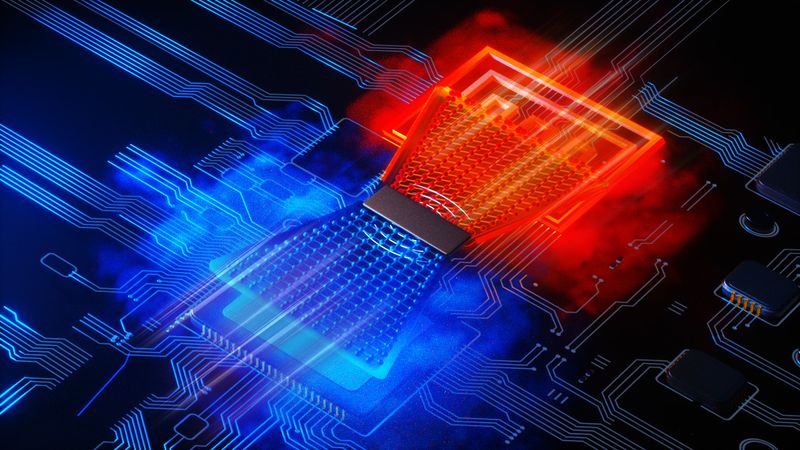
Researchers at KIT and the University of Tsukuba are combining two nickel-titanium films that first convert heat into motion and then into cold.
(Source: Concept by Yi-Ting Hsiau and Jingyuan Xu, KIT; visual design by Ella Maru Studio)
Researchers at the Karlsruhe Institute of Technology (KIT) (Germany) and the University of Tsukuba in Japan have developed a heat-driven elasto-caloric cooling system. The prototype uses two ultra-thin films made of a nickel-titanium shape-memory alloy to convert thermal energy first into mechanical work and then into cooling. This allows waste heat or solar energy to be used directly for solid-state cooling.
Heat Instead of Electricity as a Power Source
Refrigerators, air conditioners, and data centers consume large amounts of energy. Conventional cooling systems typically use an electrically powered compressor that transfers heat from one place to another using a refrigerant. Many of the refrigerants used can also contribute to global warming.
One possible alternative is elastocaloric cooling. In this process, shape-memory alloys change their temperature when they are subjected to mechanical stress and then released. Until now, however, even such systems required an electrically powered actuator to generate the necessary force. As a result, heat sources such as industrial waste heat or solar energy could not be used directly as a power source.
The new design combines two films with different functions. When the first nickel-titanium film is heated, it contracts due to the shape memory effect. In doing so, it converts thermal energy directly into mechanical work. This movement is transferred to the second film.
Two Films, Two Functions
The second film acts as an elasto-caloric refrigerant. Repeated mechanical loading and unloading causes its crystal structure to change reversibly. This results in a measurable temperature change that can be used for cooling.
“The key innovation is that we combine two complementary functions of shape-memory alloys, so that one film converts heat into mechanical work, while the other converts that work into cold,” says Dr. Jingyuan Xu, head of the Young Investigator Group at the ZEco Thermal Lab at the Institute for Microstructure Technology (IMT) at KIT.
In this way, heat replaces the electrically powered actuator that has previously driven elastocaloric cooling systems. The basic principle could thus also be applied in situations where waste heat or solar-generated heat is available.
Initial Cooling Capacity in the Laboratory
In the prototype, the system achieved a temperature difference of four degrees Celsius at the component level at an actuator temperature of 86 degrees Celsius s (186.8 degrees Fahrenheit). The elasto-caloric refrigerant itself exhibited a temperature change of just under 13 degrees Celsius (55.4 degrees Fahrenheit). The researchers thus experimentally demonstrated the fundamental feasibility of the concept.
The setup also functioned reliably when using an external heat source with a temperature of 130 degrees Celsius. “For us, the decisive moment was seeing measurable cold for the first time that was actually generated by a heat-driven system,” says Yi-Ting Hsiau, first author of the study and a doctoral student at IMT.
The current setup serves primarily as a proof of concept and is not yet designed for maximum cooling capacity. The research team is therefore investigating how multiple films can be connected in parallel. This is expected to increase the cooling capacity.
Prospects for Waste Heat and Solar Energy
Possible applications include, among other things, the cooling of processors and other electronic components. In the future, computers could use at least some of their own waste heat for the cooling process. Vehicles could also benefit from this approach if heat from the powertrain is used to cool sensitive components.
Date: 08.12.2025
Naturally, we always handle your personal data responsibly. Any personal data we receive from you is processed in accordance with applicable data protection legislation. For detailed information please see our privacy policy.
Consent to the use of data for promotional purposes
I hereby consent to Vogel Communications Group GmbH & Co. KG, Max-Planck-Str. 7-9, 97082 Würzburg including any affiliated companies according to §§ 15 et seq. AktG (hereafter: Vogel Communications Group) using my e-mail address to send editorial newsletters. A list of all affiliated companies can be found here
Newsletter content may include all products and services of any companies mentioned above, including for example specialist journals and books, events and fairs as well as event-related products and services, print and digital media offers and services such as additional (editorial) newsletters, raffles, lead campaigns, market research both online and offline, specialist webportals and e-learning offers. In case my personal telephone number has also been collected, it may be used for offers of aforementioned products, for services of the companies mentioned above, and market research purposes.
Additionally, my consent also includes the processing of my email address and telephone number for data matching for marketing purposes with select advertising partners such as LinkedIn, Google, and Meta. For this, Vogel Communications Group may transmit said data in hashed form to the advertising partners who then use said data to determine whether I am also a member of the mentioned advertising partner portals. Vogel Communications Group uses this feature for the purposes of re-targeting (up-selling, cross-selling, and customer loyalty), generating so-called look-alike audiences for acquisition of new customers, and as basis for exclusion for on-going advertising campaigns. Further information can be found in section “data matching for marketing purposes”.
In case I access protected data on Internet portals of Vogel Communications Group including any affiliated companies according to §§ 15 et seq. AktG, I need to provide further data in order to register for the access to such content. In return for this free access to editorial content, my data may be used in accordance with this consent for the purposes stated here. This does not apply to data matching for marketing purposes.
Right of revocation
I understand that I can revoke my consent at will. My revocation does not change the lawfulness of data processing that was conducted based on my consent leading up to my revocation. One option to declare my revocation is to use the contact form found at https://contact.vogel.de. In case I no longer wish to receive certain newsletters, I have subscribed to, I can also click on the unsubscribe link included at the end of a newsletter. Further information regarding my right of revocation and the implementation of it as well as the consequences of my revocation can be found in the data protection declaration, section editorial newsletter.
Further development is being carried out in collaboration with the University of Tsukuba. The goal is to scale up the system and develop compact cooling solutions for various heat sources. The work was funded by, among others, the Carl Zeiss Foundation, the Baden-Württemberg Foundation (Germany), and the Hector Fellow Academy.
The original paper, “Heat-driven elastocaloric cooling with shape memory films,” was published in Nature Energy. DOI: 10.1038/s41560-026-02122-6



:quality(80)/p7i.vogel.de/wcms/cc/52/cc5215f3d9ba0e68096982e59228c24a/26-09-22-st-ber-ab-tiepner-bild-1v1.jpeg "Tiepner develops and designs systems for the production of credit and ID cards in the ID-1 format. Stöber supplies drive controllers, servo motors, and various gearboxes for these systems. (Source: Stöber Drive Technology)")
:quality(80)/p7i.vogel.de/wcms/7c/de/7cde60054b52df974f5251ce82c00319/0134168033v1.jpeg "That would certainly be an ideal scenario—South Korea as a good trading partner for Germany (and the EU)—and vice versa! But there are a few things that give these potential friends in this Asian country pause for thought... (Image: AI-generated)")
:quality(80)/p7i.vogel.de/wcms/26/07/2607ca9a55754c81c6d65effc806c420/0134125580v1.jpeg "The new XB series from Mazak made its European debut at Euroblech 2026. Pictured is the new Optonics XB 130-32A press brake from the series. (Image:Mazak)")
:quality(80)/p7i.vogel.de/wcms/e0/85/e085a26186d214436f5e854dcbc2b8a4/6-nicokleiner-cmykv1.jpeg "As part of his technical thesis, Nico Kleiner developed a compact laser engraving machine for Norelem to use at trade shows. (Source: Norelem)")
:quality(80)/p7i.vogel.de/wcms/5f/8c/5f8c8c18b25cb0b410b425ee8565cfef/newsimage429045v1.png "Racing with the Red Queen: Using Game Theory to Improve Software Security in the Age of AI (Source: CISPA/Chiara Schwarz)")
:quality(80)/p7i.vogel.de/wcms/3b/ea/3bea215f65935b4c429d8d1f5319bb3d/0134167887v1.jpeg "Global sales of mobile robots in intralogistics rose by 19 percent in 2025 to approximately 103,700 units. (Image:VDMA/IFR)")
:quality(80)/p7i.vogel.de/wcms/1f/7e/1f7eb8df75041d96602f297a5497d3ad/0134081637v1.jpeg "With Agile One SN, teams can develop, train, and validate humanoid robot capabilities for real-world applications, enabling them to bring their ideas from the lab to production more quickly. (Image:Agile Robots)")
:quality(80)/p7i.vogel.de/wcms/17/dd/17dd38fd7454673478427ec52780cd23/0134137180v1.jpeg "Humanoids: Between Hype and Everyday Industrial Life: Safety expert Jens Müller explains why technical maturity, safe motion sequences, and integration into existing processes are key to determining the practical utility of these robots. (Image:Jens Müller)")
:quality(80)/p7i.vogel.de/wcms/3e/1b/3e1be042a1fc59e7da9be9f6ef9400cd/bild-1v1.jpeg "In cable design, electrical, mechanical, and environmental requirements must all be taken into account. (Source: SAB Bröckskes)")
:quality(80)/p7i.vogel.de/wcms/70/ce/70cee969904bba9295b050329bae5ef5/optopatch-mosaic-2-1500x752-1v1.jpeg "High-tech patch: Bio-inspired technology simplifies measurements for cardiac diagnostics—without any electronics at all. (Source: NTNU)")
:quality(80)/p7i.vogel.de/wcms/c3/68/c368b4f6821557ec497c64bc17fe9f8d/adobestock-2051843806--kaliel-stock-adobe-com-ki-generiertv1.jpeg "To truly harness the full potential of virtual product development, teams and management must radically change their mindset. (Source: © kaliel – stock.adobe.com_AI-generated)")
:quality(80)/p7i.vogel.de/wcms/a3/c1/a3c19e028b66a6fd7c373ab94981631d/paprika-gripperv1.jpeg "For the final, additively manufactured gripper base, SoftGripping chose PA 2200, a material based on polyamide 12 (PA12). It offers balanced mechanical properties and high load-bearing capacity, making it ideal for robust gripper solutions with integrated pneumatics. (Source: SoftGripping GmbH)")
:quality(80)/p7i.vogel.de/wcms/24/56/2456f553e70bf00f88a43c6e6aa4e776/db2024fa00085-largev1.jpeg "Things continue to go poorly for German manufacturers in China. (Source: Volkswagen AG)")
:quality(80)/p7i.vogel.de/wcms/09/90/0990ce85c5d9065ea17e0368bf6ad475/0134169786v1.jpeg "Scenes like these are fueling outrage among leftists, the Greens, and within the Volkswagen Group. That’s because Audi CEO Gernot Döllner (left) spoke publicly alongside U.S. President Donald Trump. The issue concerns a planned Audi plant in the U.S. Döllner is said to have allowed himself to be used for campaign purposes... (Image:Reuters / E. Su)")
:quality(80)/p7i.vogel.de/wcms/6a/49/6a49554426ff472a0b1887a2ea21cba7/redhatv1.png "The global automaker has reduced the time required for infrastructure configurations from 60 hours to 20 minutes—30,000 employees are benefiting from the resulting increase in operational efficiency (Source: Red Hat)")
:quality(80)/p7i.vogel.de/wcms/2b/5d/2b5dcef385a5d1340f5f596520a5d855/a231598-largev1.jpeg "Audi is seeing a rapid decline in sales in China. A new leadership duo is set to turn things around. (Image:Audi AG)")
:quality(80)/p7i.vogel.de/wcms/be/16/be1630b0b876b3f8c6d21e96986d57f2/0134180147v1.jpeg "Intel has announced the acquisition of the Israeli company Classiq. The startup specializes in tools and algorithms for the practical development of scalable, efficient quantum applications. (Image:Classiq)")
:quality(80)/p7i.vogel.de/wcms/f2/c0/f2c0bfc2c3c323220c2b1154cacda57a/0134132255v1.jpeg "Established semiconductor processes: While some foundries are reducing their manufacturing capacity, others are making targeted investments in specialized technologies. For developers in industrial electronics, the automotive industry, and medical technology, the long-term availability and cost of components are crucial. (Image:Dall-E / AI-generated)")
:quality(80)/p7i.vogel.de/wcms/71/c4/71c49858dd5195cbf540c4c37debab03/0134099748v1.jpeg "The Future of Space Travel: At Pretzl Connect 2026, ESA engineer Kate Underhill explained how sensor technology, software, and AI are transforming the development of future space transportation systems. (Image:mc/VCG)")
:quality(80)/p7i.vogel.de/wcms/20/b3/20b3ea557032591a4699c28076d349e3/0134117110v1.jpeg "Thermal simulation of a 3D IC visualizes the temperature distribution within the chip structure. Siemens and Nvidia aim to automate and accelerate such electrothermal analyses using AI-powered EDA workflows. (Image: Siemens EDA)")
:fill(fff,0)/images.vogel.de/vogelonline/companyimg/76800/76895/65.jpg "FAULHABER_120mm.jpg ()")
:quality(80)/p7i.vogel.de/wcms/59/a2/59a2b11f0aa1b700eff02addd5de8703/adobestock-1788280853--c2-a9-20satria-20-e2-80-93-20stock-adobe-com-5081x2860v1v1.jpeg "Quantum computers require extreme cooling to temperatures close to absolute zero in order to keep qubits stable. (Image:satria - stock.adobe.com)")
:quality(80)/p7i.vogel.de/wcms/44/0e/440ea9f678da868f9dde619ab1b94c9f/valeo-20smart-20immersive-20battery-20cooling-20systemv1.png "The thermal management of battery modules and entire vehicles is being improved in China with AI software. (Image:Valeo)")