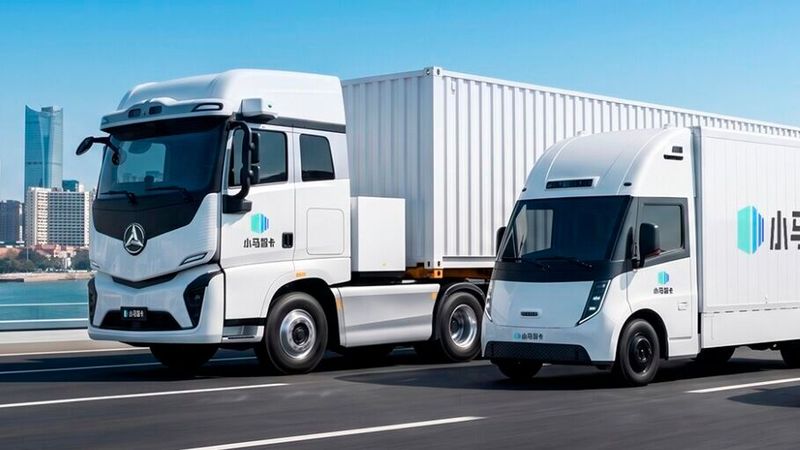
Following initial tests with its robotaxis in Europe, Pony.ai now plans to bring robotrucks—that is, autonomous electric trucks—to Europe as well. Company executives say they are already in talks with ports and various governments in Europe about pilot projects of this kind.
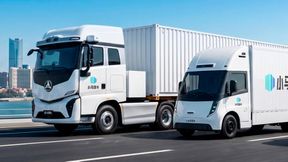
Following initial tests with its robotaxis in Europe, Pony.ai now plans to bring robot trucks to Europe as well.
(Image: Pony.ai)
Pony.ai and GAC chose the IAA Transportation trade show in Hanover (Germany) for the world premiere of the new truck, where they unveiled it on September 14. The Chinese company developed the fourth generation of a fully electric heavy-duty truck—equipped with Pony.ai’s Level 4 autonomous driving software—in collaboration with the manufacturer GAC. The truck is based on GAC’s battery-electric T9 and Pony.ai’s AI world model, and the two software and hardware partners have announced that it is set to enter series production for the first time later this year.
Drivers: Driver Shortage and High Gas Prices
Pony.ai, a company specializing in autonomous driving, was founded in 2016 by James Peng and Tiancheng Lou, who had previously worked for the Chinese internet giant Baidu in Silicon Valley. The company has offices in Guangzhou, southern China, and Fremont, California. From the very beginning, its ambitions were international. “We’re looking at markets where labor costs are high or where there is a significant labor shortage,” He Xing, vice president of Pony.ai and head of the Robotruck business, told the Reuters news agency at the launch. Europe is therefore an important market.
The first step is to seek approval for road testing and to make initial sales to fleet operators in a manageable environment that is relatively safe for autonomous trucks. “We have already approached several ports and European governments regarding this matter,” said He Xing. According to media reports, Pony.ai’s autonomous trucks are set to be deployed at the Mawan Port in Shenzhen. The company has secured a contract for this and plans to deliver “dozens of the vehicles,” CNEVPOST reported.
When operating at Autonomy Level 4, trucks are permitted to operate entirely without a human driver under certain conditions. For fleet operators in mines and ports, as well as for freight carriers in heavy-duty transport with well-defined logistics routes, this is becoming increasingly attractive as it becomes harder to find truck drivers and diesel prices continue to rise.
Focus on Low Shipping Costs
Now, production costs for the vehicles in China are also falling. Pony.ai explained in its September announcement at the IAA that the bill of materials for its autonomous driving hardware package has dropped by 70 percent compared to the previous generation. The company claims that transportation costs per metric ton-kilometer for freight carriers are reportedly 30 percent lower than those for conventional heavy-duty trucks. There is no independent confirmation of either figure yet.
The experience gained and the first series production runs in the robotaxi business are helping the company reduce the costs of robot trucks. The T9 uses the same central control computer as Pony.ai’s seventh-generation robotaxi. The company announced that nine laser-based lidar sensors, three radar sensors, and 13 cameras are also used to map the surrounding environment.
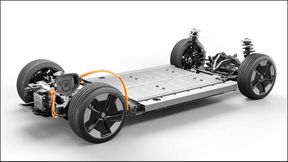
GAC supplies an electronically controlled chassis that is designed entirely as a “drive-by-wire” system. The steering, brakes, communication systems, power supply, computer, and sensors are all designed with redundancy, meaning they remain operational even if individual components fail.
However, there are limits to how much of this development experience can be applied. Size, weight, and longer braking distances require additional adjustments for heavy trucks. It is therefore likely even more important that Pony.ai is able to obtain approvals for road testing more quickly in China than in the U.S. and Europe. Reuters reported in September that several hundred Level 4 trucks are currently operating on initial routes there, some without drivers and some with safety drivers. A few weeks ago, the company announced plans to deploy 500 to 1,000 heavy-duty trucks in China within two to three years as part of its fourth-generation rollout.
Challenge: Bureaucratic Approval Procedures in Europe
The biggest hurdle for the recently announced expansion of autonomous trucks into Europe will be the particularly bureaucratic approval processes there. Pony.ai is patient, however, as evidenced by its recent progress in the area of robotaxis. Tests using the Peugeot e-Traveller are planned for Luxembourg. There is no commercial deployment of robotaxis yet. Still, the transportation minister did show up for a test drive.
Date: 08.12.2025
Naturally, we always handle your personal data responsibly. Any personal data we receive from you is processed in accordance with applicable data protection legislation. For detailed information please see our privacy policy.
Consent to the use of data for promotional purposes
I hereby consent to Vogel Communications Group GmbH & Co. KG, Max-Planck-Str. 7-9, 97082 Würzburg including any affiliated companies according to §§ 15 et seq. AktG (hereafter: Vogel Communications Group) using my e-mail address to send editorial newsletters. A list of all affiliated companies can be found here
Newsletter content may include all products and services of any companies mentioned above, including for example specialist journals and books, events and fairs as well as event-related products and services, print and digital media offers and services such as additional (editorial) newsletters, raffles, lead campaigns, market research both online and offline, specialist webportals and e-learning offers. In case my personal telephone number has also been collected, it may be used for offers of aforementioned products, for services of the companies mentioned above, and market research purposes.
Additionally, my consent also includes the processing of my email address and telephone number for data matching for marketing purposes with select advertising partners such as LinkedIn, Google, and Meta. For this, Vogel Communications Group may transmit said data in hashed form to the advertising partners who then use said data to determine whether I am also a member of the mentioned advertising partner portals. Vogel Communications Group uses this feature for the purposes of re-targeting (up-selling, cross-selling, and customer loyalty), generating so-called look-alike audiences for acquisition of new customers, and as basis for exclusion for on-going advertising campaigns. Further information can be found in section “data matching for marketing purposes”.
In case I access protected data on Internet portals of Vogel Communications Group including any affiliated companies according to §§ 15 et seq. AktG, I need to provide further data in order to register for the access to such content. In return for this free access to editorial content, my data may be used in accordance with this consent for the purposes stated here. This does not apply to data matching for marketing purposes.
Right of revocation
I understand that I can revoke my consent at will. My revocation does not change the lawfulness of data processing that was conducted based on my consent leading up to my revocation. One option to declare my revocation is to use the contact form found at https://contact.vogel.de. In case I no longer wish to receive certain newsletters, I have subscribed to, I can also click on the unsubscribe link included at the end of a newsletter. Further information regarding my right of revocation and the implementation of it as well as the consequences of my revocation can be found in the data protection declaration, section editorial newsletter.
Croatia is taking a bolder approach. In Zagreb, customers have been able to use a Verne app since April of this year to order a robotaxi equipped with Pony.ai technology right from their cell phones. A safety operator is still on board to intervene if necessary. Since August, the cars have also been available for booking through Uber. Verne operates the fleet, Pony.ai provides the driving system, and Uber, through its app (UberX and Comfort), provides the passengers.
Since last year, Pony.ai has also been collaborating with Stellantis to bring its software to midsize vans on Europe’s roads. Testing is underway in Luxembourg using the Peugeot e-Traveller. And Uber and Pony.ai also plan to begin testing in London soon.
So this is clearly a company that isn't deterred by either the traffic authorities in China and California or the notorious European red tape.