The machinery and plant manufacturer Dieffenbacher develops and implements production technologies and plants for producing especially lightweight components from different thermosetting and thermoplastic, fiber-reinforced plastics for lightweight construction.
Automated from sheets to complex components: In the SMC process, Teijin in the Czech Republic manufactures battery covers from thermosetting, fiber-reinforced plastics.
(Image: Dieffenbacher)
The future of mobility, in addition to traditional industries such as the automotive, aerospace, and sports and leisure industries, includes numerous other applications that can be summarized under the mega trend of e-mobility. Examples are transport and passenger drones, as well as electrically powered surfboards and jet skis. In this regard, Georg Obermaier, head of the Forming Business Unit at press manufacturer Dieffenbacher, says: "The mobility of the future is becoming more diverse every day. For this, we develop complete systems for the production of composite components."
Housing and structural components
Fiber-reinforced plastic components are now used, among other things, for battery housings, battery boxes and covers, for example, for vehicle underbodies. They also serve as structural components in further vehicles of the advancing e-mobility, for example in drones and bicycles. Methods for processing Sheet Molding Compound (SMC), GMT (glass mat reinforced thermoplastics) and the direct pressing of thermoplastics reinforced with cut fibers (Long Fiber Thermoplastic Direct-Molding, LFT and LFT-D) are suitable for manufacturing such components, such as bicycle rims or frames. Dieffenbacher designs plants for this purpose, which essentially consist of a hydraulic press and the necessary peripherals—often automation.
Gallery
Fully automated
In order to form fiber-reinforced plastics into three-dimensional workpieces, plates or flexible mats must first be placed in the molds on hydraulic presses. Sometimes, pressing compounds and additionally individually cut fiber mats or single fibers also need to be introduced into the molds. The press manufacturer in Eppingen, Germany, also implements suitable methods and systems for this. For example, they have installed a tailored blank line system, including Fiberforge and Fibercon tape laying and consolidation technologies, at the plastic processor Rein4ced in Leuven, Belgium. This provides the Belgian company with an efficient and economical technology for manufacturing complex components from thermoplastic materials. The company uses the system to produce bicycle frames. For this purpose, tapes (preformed strips and plates) reinforced with carbon fibers are automatically laid, consolidated (relaxed by heat), and reshaped in the heated mold to their final geometry. The hydraulic presses go through individually tailored pressing cycles for this.
Dieffenbacher has realized a plant for molding components made of thermosetting plastics using the SMC process at the production company Teijin in Milovice, Czech Republic. On it, the company produces stable battery covers in series.
Minimize energy and resource consumption
The general call to reduce energy and resource consumption is taken into account by the press manufacturer with numerous sophisticated functions and features of its hydraulic presses and automated installations. For instance, the Fiberpress hydraulic press, which is installed at the production company Teijin in the Czech Republic, is equipped with speed-variable pump drives. This minimizes energy consumption. The Fiberforge cutting system, which is part of the Tailored Blank Line automation at the Belgian component manufacturer Rein4ced, makes a significant contribution to using valuable raw materials as efficiently as possible. It can cut unidirectional (UD) tapes at angles between -45° and +45°, thus creating a contour with minimal cutting waste. The adaptive accumulator control of the hydraulic drive system optimizes the energy consumption of the hydraulic press. It automatically determines the exact energy requirement for the currently pending forming operation during the first pressing cycles. In all subsequent production cycles, the accumulator of the hydraulic drive is only loaded to the corresponding necessary pressure level.
More economical thanks to digitalization
In order to manufacture more efficiently and productively, many production companies use the digitization platform Evoris. This includes the Swiss company Autoneum in Sevelen, a manufacturer of high-quality plastic vehicle parts for acoustic and thermal insulation. They have been using the Evoris software since 2022 to digitize and optimize processes and complex systems, including elements of AI. Christoph Bless, Head of Operational Maintenance & Repair, explains: "Evoris gives us significantly better insights into ongoing production and thus much better influencing options. The plant manufacturer Dieffenbacher pursues an approach that stands out from the crowd. It offers the complete package from the platform, through the sensors and plant know-how, to technology knowledge for the entire production line."
Date: 08.12.2025
Naturally, we always handle your personal data responsibly. Any personal data we receive from you is processed in accordance with applicable data protection legislation. For detailed information please see our privacy policy.
Consent to the use of data for promotional purposes
I hereby consent to Vogel Communications Group GmbH & Co. KG, Max-Planck-Str. 7-9, 97082 Würzburg including any affiliated companies according to §§ 15 et seq. AktG (hereafter: Vogel Communications Group) using my e-mail address to send editorial newsletters. A list of all affiliated companies can be found here
Newsletter content may include all products and services of any companies mentioned above, including for example specialist journals and books, events and fairs as well as event-related products and services, print and digital media offers and services such as additional (editorial) newsletters, raffles, lead campaigns, market research both online and offline, specialist webportals and e-learning offers. In case my personal telephone number has also been collected, it may be used for offers of aforementioned products, for services of the companies mentioned above, and market research purposes.
Additionally, my consent also includes the processing of my email address and telephone number for data matching for marketing purposes with select advertising partners such as LinkedIn, Google, and Meta. For this, Vogel Communications Group may transmit said data in hashed form to the advertising partners who then use said data to determine whether I am also a member of the mentioned advertising partner portals. Vogel Communications Group uses this feature for the purposes of re-targeting (up-selling, cross-selling, and customer loyalty), generating so-called look-alike audiences for acquisition of new customers, and as basis for exclusion for on-going advertising campaigns. Further information can be found in section “data matching for marketing purposes”.
In case I access protected data on Internet portals of Vogel Communications Group including any affiliated companies according to §§ 15 et seq. AktG, I need to provide further data in order to register for the access to such content. In return for this free access to editorial content, my data may be used in accordance with this consent for the purposes stated here. This does not apply to data matching for marketing purposes.
Right of revocation
I understand that I can revoke my consent at will. My revocation does not change the lawfulness of data processing that was conducted based on my consent leading up to my revocation. One option to declare my revocation is to use the contact form found at https://contact.vogel.de. In case I no longer wish to receive certain newsletters, I have subscribed to, I can also click on the unsubscribe link included at the end of a newsletter. Further information regarding my right of revocation and the implementation of it as well as the consequences of my revocation can be found in the data protection declaration, section editorial newsletter.
The article was published first in SMM—Schweizer MaschinenMarkt, Switzerland



:quality(80)/p7i.vogel.de/wcms/9e/23/9e23111e49d73012e9e3b7c69428ad5c/0134019347v1.jpeg "The Dominant VA45 high-helix tap from Bass, made of lead-free brass. The long chips, which result from the absence of lead, are clearly visible. (Image:Bass, Inc.)")
:quality(80)/p7i.vogel.de/wcms/1d/09/1d0999956ef87709b72ab1d0402ba207/csf-minis-gruppe-final-01-outputv1.jpeg "Since mid-2026, Harmonic Drive has been offering its CSF Mini gearheads in size 7 as well, in six variants designed for different installation scenarios. (Source: Harmonic Drive)")
:quality(80)/p7i.vogel.de/wcms/ab/08/ab08675922c3a7edea45128248b45b00/0133857009v1.jpeg "In the aerospace industry—one of the most demanding sectors of all—the Shanghai-based company TOPNC has already made a name for itself. (Image:TOPNC)")
:quality(80)/p7i.vogel.de/wcms/ff/48/ff48b1154746e79128935f28bd73ba0e/0113143253v1.jpeg "In our China Market Insider, we regularly provide you with relevant information straight from China. (Image:© Eisenhans - stock.adobe.com)")
:quality(80)/p7i.vogel.de/wcms/6e/bb/6ebb687f573be847aa611b413c6a33b1/0134094461v1.jpeg "From left: Sepp Hochreiter, founder of Nxai and AI researcher, and David Reger, founder and CEO of Neura Robotics, are excited about their collaboration on Physical AI. (Image:Neura)")
:quality(80)/p7i.vogel.de/wcms/89/01/890193a30c52ffd4811d18db82170952/0113143253v1.jpeg "In our China Market Insider, we regularly provide you with relevant information straight from China. (Image:© Eisenhans - stock.adobe.com)")
:quality(80)/p7i.vogel.de/wcms/6b/8a/6b8ac7cd85db2d1d1f6ab30957648711/schaeffler-news-taicanglighthouse6v1.jpeg "At the Lighthouse Factory, robots assemble linear and rotary actuators, among other components. (Source: Schaeffler)")
:quality(80)/p7i.vogel.de/wcms/4f/5a/4f5a2417df55dae5967e90b331e0bbc5/physical-ai-robotics-ariv1.jpeg "With new hardware and software solutions, the productive use of AI in industry is becoming increasingly prominent. (Source: Nvidia)")
:quality(80)/p7i.vogel.de/wcms/c3/68/c368b4f6821557ec497c64bc17fe9f8d/adobestock-2051843806--kaliel-stock-adobe-com-ki-generiertv1.jpeg "To truly harness the full potential of virtual product development, teams and management must radically change their mindset. (Source: © kaliel – stock.adobe.com_AI-generated)")
:quality(80)/p7i.vogel.de/wcms/a3/c1/a3c19e028b66a6fd7c373ab94981631d/paprika-gripperv1.jpeg "For the final, additively manufactured gripper base, SoftGripping chose PA 2200, a material based on polyamide 12 (PA12). It offers balanced mechanical properties and high load-bearing capacity, making it ideal for robust gripper solutions with integrated pneumatics. (Source: SoftGripping GmbH)")
:quality(80)/p7i.vogel.de/wcms/51/b8/51b8e08d2105fdd9952aff385f154192/graphic-2-adma1v1.png "The new surface hardening process enhances the performance of corrosion-resistant alloys by improving their tribological and mechanical surface properties, while preserving the properties of the base material. (Source: Bodycote)")
:quality(80)/p7i.vogel.de/wcms/96/ef/96effc239916cb7e0f396ab75627b8c0/image-space-testingv1.jpeg "Two scientists in front of a vacuum chamber used for testing: As technical instruments for spaceflight become more sensitive, the test facilities are becoming a critical system. (Source: Busch Group)")
:quality(80)/p7i.vogel.de/wcms/4c/61/4c61e3d5582715f2cadafc911480a20a/0132455124v1.jpeg "Mercedes-Benz has announced that it is moving away from its platform-based manufacturing strategy. Management expects a modular design concept to deliver greater benefits... (Image:Mercedes-Benz)")
:quality(80)/p7i.vogel.de/wcms/0d/14/0d14c9be5fc47bc256002ce3df435f21/keb-automation-drive-controller-marinev1.jpeg "Certified for ships, offshore applications, and more: the Combivert F6 Drive Controllers from KEB Automation. (Source: KEB Automation / Miss Irine)")
:quality(80)/p7i.vogel.de/wcms/ba/d3/bad3d62389a59fe3cdbac386a0dce64b/0134098250v1.jpeg "Following initial tests with its robotaxis in Europe, Pony.ai now plans to bring robot trucks to Europe as well. (Image:Pony.ai)")
:quality(80)/p7i.vogel.de/wcms/78/d1/78d124651f6149aa9f33913fc00ef98a/bertrandt-standort-tschechienv1.jpeg "Bertrandt has opened a new facility in the Czech Republic—near Škoda. (Source: Bertrandt)")
:quality(80)/p7i.vogel.de/wcms/27/47/27472d923d2d60f883a5682cb7987558/0134050215v1.jpeg "China's semiconductor industry: At the China International Industry Fair (CIIF) in Shanghai, the chip industry was given its own exhibition area for the first time in 2026. More than 300 companies showcased their technologies and solutions for industrial manufacturing at the “IC Ecosystem Show.” (Image:CIIF)")
:quality(80)/p7i.vogel.de/wcms/bc/20/bc2034a1ba033f00e539d91bcc70e403/bopla-bonext-1-rgbv1.jpeg "A translucent base allows for ambient lighting, either as a design feature or to visually indicate status. (Source: Bopla)")
:quality(80)/p7i.vogel.de/wcms/cd/23/cd239aa506b3ace30e62f44c83fa31ca/0134051508v1.jpeg "Figure 1: Schematic representation of the DAB (Dual Active Bridge) topology. (Image:Texas Instruments)")
:quality(80)/p7i.vogel.de/wcms/8b/35/8b35660420abba32fb891a4c5cc42fbd/0134018092v1.jpeg "Long-range UVC LED with lens and reflector: Close-up of a square LED with a transparent, dome-shaped lens on a dark base plate. The hermetically sealed housing ensures greater reliability and durability under demanding environmental conditions. (Image:FBH_Schurian)")
:fill(fff,0)/images.vogel.de/vogelonline/companyimg/76800/76895/65.jpg "FAULHABER_120mm.jpg ()")
:fill(fff,0)/p7i.vogel.de/companies/69/88/69882c428938e/tmts2026-ticec-banner-en-2000px.png "tmts2026-ticec-banner-en-2000px (https://www.tmts.tw/en)")
:fill(fff,0)/p7i.vogel.de/companies/69/de/69de1b7403b0d/simtos-logo.jpeg "simtos-logo (SIMTOS)")
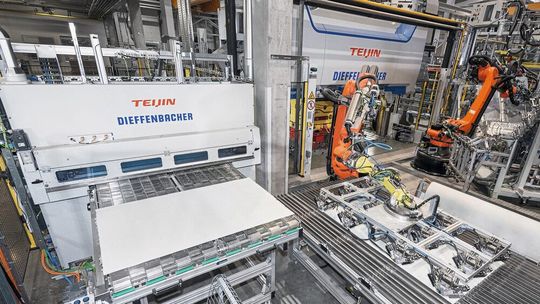
:quality(80)/p7i.vogel.de/wcms/37/5e/375e535f664ac660f2a60a1c6c5feede/0117901053v1.jpeg "Automated from sheets to complex components: In the SMC process, Teijin manufactures battery covers from thermosetting, fiber-reinforced plastics in the Czech Republic.(Image: Dieffenbacher)")
:quality(80)/p7i.vogel.de/wcms/0a/5e/0a5e2086953c92d0237aa2320f168d86/0117901278v1.jpeg "Conserve resources, produce more economically: The Fiberforge system ensures efficient use of raw materials when cutting and laying tapes.(Image: Luk Collet)")
:quality(80)/p7i.vogel.de/wcms/3e/4b/3e4b8e5e40744137d18a1e91be5c48ec/0117894668v1.jpeg "Thermoplastic components reinforced with long fibers can be automatically produced in one pass on Dieffenbacher systems, creating stable, large components.(Image: Dieffenbacher)")
:quality(80)/p7i.vogel.de/wcms/a6/e9/a6e953bb66750460fdad25708cd5e2d6/0133925000v1.jpeg "What you see here in the X-ray image is a lightweight sandwich-structured component that was developed at the Fraunhofer IMWS in Halle an der Saale in collaboration with partners. What makes it special is that it houses both electronic interfaces and the thermal management system for heat dissipation ... (Image:Fraunhofer IMWS)")
:quality(80)/p7i.vogel.de/wcms/41/fc/41fc456ff1ff8f30807924663e8df127/img-0942v1.jpeg "In industrial additive manufacturing, the production strategy must influence the design from the very beginning. (Source: Materialise)")