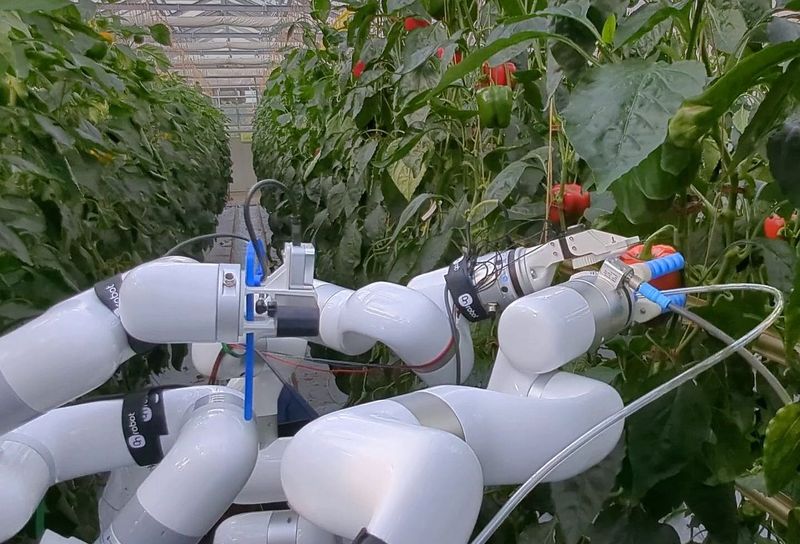
As part of the “AgriLoop” project, researchers from the University of Bonn (Germany) and Taiwan are developing a system designed to control greenhouse robots using natural language. Experts would be able to check on the condition of plants, issue instructions, and correct the robots’ actions.
As part of the “AgriLoop” project, researchers at the University of Bonn are developing a system designed to control greenhouse robots using natural language and to map plant populations in three dimensions.
(Source: University of Bonn)
Researchers at the University of Bonn, in collaboration with partners from Taiwan, are developing a system for collaboration between experts and greenhouse robots as part of the project “Learning Expert-Guided Crop Intervention through Human-in-the-Loop LLM Robotics,” or “AgriLoop” for short. With the help of artificial intelligence, 3D sensors, and natural language processing, robots will in the future be able to understand instructions such as “Examine this plant more closely” or “Remove this leaf” and translate them into safe actions. On the German side, the project is receiving 463,000 euros ($537,080) in funding from the Federal Ministry of Research, Technology, and Space (BMFTR).
Connecting Language with Spatial Perception
Modern greenhouse production faces challenges such as a shortage of skilled workers, increasing operational complexity, and the need for more sustainable cultivation methods. Robotic systems are already capable of monitoring plant populations and performing specific tasks. However, they often lack the ability to incorporate the experiential knowledge of plant experts and translate it into concrete actions.
This is where “AgriLoop” comes in. The project combines language models, image-language models, and vision-language-action models with physically embedded robotics and three-dimensional perception of crop stands. Experts will be able to use a natural-language user interface to ask questions about the condition of the plants, give instructions, and specifically influence the robots’ behavior.
To do this, the robot maps its surroundings using cameras and other sensors. The data is used to create a 3D model of the greenhouse, in which individual plants and plant parts are located. The AI links this model to the verbal instruction and uses it to generate an executable robot movement.
Humans Remain Part of the System
One example is the command “Remove this leaf.” For a human, the context usually makes it clear which plant and which leaf are being referred to, and how the action should be performed without damaging the plant. A robot, on the other hand, must first interpret the language, identify the correct object, determine its position, and plan an appropriate movement.
Until now, these abilities have often been developed separately. “People naturally associate language with their environment and with experiential knowledge,” explains Prof. Dr. Maren Bennewitz of the University of Bonn. “For a robot, this is much more difficult. It must interpret speech, identify the correct object in its environment, determine its spatial position, and derive an appropriate movement from that information.”
“AgriLoop” therefore takes a “human-in-the-loop” approach. Experts provide guidance, correct the robots, and evaluate their decisions. The system is designed to use this feedback to better adapt its actions to the situation at hand. The goal is not to replace human expertise, but to make it usable for robotic systems.
German-Taiwanese Cooperation
The German side is contributing robot platforms, methods for three-dimensional perception and reconstruction, real greenhouse environments, and expertise in crop production to the project. Among other things, the Taiwanese partners are developing components for multimodal speech processing, dialogue systems, the mapping of instructions to specific objects and actions, and learning from expert feedback.
In Bonn, Bennewitz and her doctoral student, Rohit Menon, are working on the project. Another doctoral position is also being funded by the project. “AgriLoop” is a partner project of the PhenoRob Cluster of Excellence and is based in the Transdisciplinary Research Area “Sustainable Futures” at the University of Bonn.
One goal of the project is to develop highly efficient AI models that can be deployed directly on robot platforms. This would eliminate the need for the systems to rely on large data centers for every request. The data collected in the project from communication between humans and robots is also intended to contribute to the further development of agricultural robotics systems.
Date: 08.12.2025
Naturally, we always handle your personal data responsibly. Any personal data we receive from you is processed in accordance with applicable data protection legislation. For detailed information please see our privacy policy.
Consent to the use of data for promotional purposes
I hereby consent to Vogel Communications Group GmbH & Co. KG, Max-Planck-Str. 7-9, 97082 Würzburg including any affiliated companies according to §§ 15 et seq. AktG (hereafter: Vogel Communications Group) using my e-mail address to send editorial newsletters. A list of all affiliated companies can be found here
Newsletter content may include all products and services of any companies mentioned above, including for example specialist journals and books, events and fairs as well as event-related products and services, print and digital media offers and services such as additional (editorial) newsletters, raffles, lead campaigns, market research both online and offline, specialist webportals and e-learning offers. In case my personal telephone number has also been collected, it may be used for offers of aforementioned products, for services of the companies mentioned above, and market research purposes.
Additionally, my consent also includes the processing of my email address and telephone number for data matching for marketing purposes with select advertising partners such as LinkedIn, Google, and Meta. For this, Vogel Communications Group may transmit said data in hashed form to the advertising partners who then use said data to determine whether I am also a member of the mentioned advertising partner portals. Vogel Communications Group uses this feature for the purposes of re-targeting (up-selling, cross-selling, and customer loyalty), generating so-called look-alike audiences for acquisition of new customers, and as basis for exclusion for on-going advertising campaigns. Further information can be found in section “data matching for marketing purposes”.
In case I access protected data on Internet portals of Vogel Communications Group including any affiliated companies according to §§ 15 et seq. AktG, I need to provide further data in order to register for the access to such content. In return for this free access to editorial content, my data may be used in accordance with this consent for the purposes stated here. This does not apply to data matching for marketing purposes.
Right of revocation
I understand that I can revoke my consent at will. My revocation does not change the lawfulness of data processing that was conducted based on my consent leading up to my revocation. One option to declare my revocation is to use the contact form found at https://contact.vogel.de. In case I no longer wish to receive certain newsletters, I have subscribed to, I can also click on the unsubscribe link included at the end of a newsletter. Further information regarding my right of revocation and the implementation of it as well as the consequences of my revocation can be found in the data protection declaration, section editorial newsletter.
The Demonstrator Is Intended to Illustrate the Approach
By the end of the project, a prototype will demonstrate how a greenhouse robot processes verbal instructions and translates them into specific movements. The initial focus is on integrating the individual technical components into a cohesive system and testing it under real-world conditions.
In the long term, such systems could assist specialists with time-consuming or repetitive tasks, such as inspecting plants or carrying out targeted maintenance measures. More precise interventions could also help ensure that water, pesticides, and other resources are used more efficiently. However, further research is needed before these systems can be put into practical use.
Four Questions for Maren Bennewitz
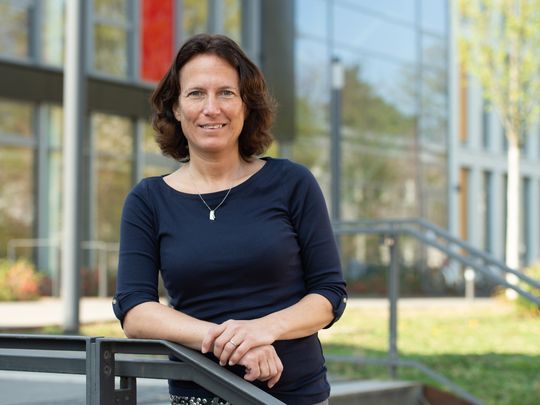
Prof. Dr. Maren Bennewitz of the University of Bonn is researching how AI, 3D perception, and robotics can improve collaboration between humans and greenhouse robots.
(Source: University of Bonn | Barbara Frommann)
Why haven't robots been able to understand such instructions so far?
People naturally associate language with their surroundings and with their experiential knowledge. When a professional says, “Remove this leaf,” she recognizes which plant and which leaf are being referred to, and also knows how to go about it without damaging the plant. For a robot, this is significantly more difficult. It must interpret the language, identify the correct object in its environment, determine its spatial position, and derive an appropriate movement from that information. Until now, multimodal AI models, 3D spatial perception, and physical robot control have mostly operated in isolation from one another. “AgriLoop” aims to combine these capabilities into a seamless system.
How is "AgriLoop" supposed to solve the problem?
The robot uses cameras and sensors to map its surroundings and creates a 3D model of the plants in the greenhouse. At the same time, the system processes verbal instructions from experts via a user interface.
Language models and vision-language models integrate this information. They cross-reference what was said with the specific detail in the 3D model to which the instruction refers. This integration is intended to result in a specific and safe robotic action. For example, the sentence “Examine this plant more closely” could result in the robot making a targeted movement toward a specific plant.
Why Do We Still Need People?
Especially when working with plants, not every decision can be planned in advance. Experts draw on experience-based knowledge that depends on the specific situation. For example, they assess how healthy a plant appears, which leaf should be removed, or where special care is needed.
Humans therefore provide guidance, correct the robot, and evaluate its decisions. The system is designed to use this feedback to better adapt its actions to the requirements of the greenhouse. The goal is to make human expertise available to robotics, not to replace the experts.
What specific changes could this bring about?
In the long term, such systems could assist skilled workers with time-consuming and repetitive tasks, such as monitoring plant populations or carrying out targeted maintenance measures. This would be particularly relevant in situations where there is a shortage of workers or where large populations need to be checked regularly.
More precise interventions could help plan the use of resources in greenhouses in a more targeted manner. “AgriLoop” is initially developing the technical foundations and aims to use a demonstrator to show that collaboration between humans and robots is fundamentally possible on this basis.



:quality(80)/p7i.vogel.de/wcms/9e/23/9e23111e49d73012e9e3b7c69428ad5c/0134019347v1.jpeg "The Dominant VA45 high-helix tap from Bass, made of lead-free brass. The long chips, which result from the absence of lead, are clearly visible. (Image:Bass, Inc.)")
:quality(80)/p7i.vogel.de/wcms/1d/09/1d0999956ef87709b72ab1d0402ba207/csf-minis-gruppe-final-01-outputv1.jpeg "Since mid-2026, Harmonic Drive has been offering its CSF Mini gearheads in size 7 as well, in six variants designed for different installation scenarios. (Source: Harmonic Drive)")
:quality(80)/p7i.vogel.de/wcms/ab/08/ab08675922c3a7edea45128248b45b00/0133857009v1.jpeg "In the aerospace industry—one of the most demanding sectors of all—the Shanghai-based company TOPNC has already made a name for itself. (Image:TOPNC)")
:quality(80)/p7i.vogel.de/wcms/ff/48/ff48b1154746e79128935f28bd73ba0e/0113143253v1.jpeg "In our China Market Insider, we regularly provide you with relevant information straight from China. (Image:© Eisenhans - stock.adobe.com)")
:quality(80)/p7i.vogel.de/wcms/6e/bb/6ebb687f573be847aa611b413c6a33b1/0134094461v1.jpeg "From left: Sepp Hochreiter, founder of Nxai and AI researcher, and David Reger, founder and CEO of Neura Robotics, are excited about their collaboration on Physical AI. (Image:Neura)")
:quality(80)/p7i.vogel.de/wcms/89/01/890193a30c52ffd4811d18db82170952/0113143253v1.jpeg "In our China Market Insider, we regularly provide you with relevant information straight from China. (Image:© Eisenhans - stock.adobe.com)")
:quality(80)/p7i.vogel.de/wcms/6b/8a/6b8ac7cd85db2d1d1f6ab30957648711/schaeffler-news-taicanglighthouse6v1.jpeg "At the Lighthouse Factory, robots assemble linear and rotary actuators, among other components. (Source: Schaeffler)")
:quality(80)/p7i.vogel.de/wcms/4f/5a/4f5a2417df55dae5967e90b331e0bbc5/physical-ai-robotics-ariv1.jpeg "With new hardware and software solutions, the productive use of AI in industry is becoming increasingly prominent. (Source: Nvidia)")
:quality(80)/p7i.vogel.de/wcms/c3/68/c368b4f6821557ec497c64bc17fe9f8d/adobestock-2051843806--kaliel-stock-adobe-com-ki-generiertv1.jpeg "To truly harness the full potential of virtual product development, teams and management must radically change their mindset. (Source: © kaliel – stock.adobe.com_AI-generated)")
:quality(80)/p7i.vogel.de/wcms/a3/c1/a3c19e028b66a6fd7c373ab94981631d/paprika-gripperv1.jpeg "For the final, additively manufactured gripper base, SoftGripping chose PA 2200, a material based on polyamide 12 (PA12). It offers balanced mechanical properties and high load-bearing capacity, making it ideal for robust gripper solutions with integrated pneumatics. (Source: SoftGripping GmbH)")
:quality(80)/p7i.vogel.de/wcms/51/b8/51b8e08d2105fdd9952aff385f154192/graphic-2-adma1v1.png "The new surface hardening process enhances the performance of corrosion-resistant alloys by improving their tribological and mechanical surface properties, while preserving the properties of the base material. (Source: Bodycote)")
:quality(80)/p7i.vogel.de/wcms/96/ef/96effc239916cb7e0f396ab75627b8c0/image-space-testingv1.jpeg "Two scientists in front of a vacuum chamber used for testing: As technical instruments for spaceflight become more sensitive, the test facilities are becoming a critical system. (Source: Busch Group)")
:quality(80)/p7i.vogel.de/wcms/4c/61/4c61e3d5582715f2cadafc911480a20a/0132455124v1.jpeg "Mercedes-Benz has announced that it is moving away from its platform-based manufacturing strategy. Management expects a modular design concept to deliver greater benefits... (Image:Mercedes-Benz)")
:quality(80)/p7i.vogel.de/wcms/0d/14/0d14c9be5fc47bc256002ce3df435f21/keb-automation-drive-controller-marinev1.jpeg "Certified for ships, offshore applications, and more: the Combivert F6 Drive Controllers from KEB Automation. (Source: KEB Automation / Miss Irine)")
:quality(80)/p7i.vogel.de/wcms/ba/d3/bad3d62389a59fe3cdbac386a0dce64b/0134098250v1.jpeg "Following initial tests with its robotaxis in Europe, Pony.ai now plans to bring robot trucks to Europe as well. (Image:Pony.ai)")
:quality(80)/p7i.vogel.de/wcms/78/d1/78d124651f6149aa9f33913fc00ef98a/bertrandt-standort-tschechienv1.jpeg "Bertrandt has opened a new facility in the Czech Republic—near Škoda. (Source: Bertrandt)")
:quality(80)/p7i.vogel.de/wcms/27/47/27472d923d2d60f883a5682cb7987558/0134050215v1.jpeg "China's semiconductor industry: At the China International Industry Fair (CIIF) in Shanghai, the chip industry was given its own exhibition area for the first time in 2026. More than 300 companies showcased their technologies and solutions for industrial manufacturing at the “IC Ecosystem Show.” (Image:CIIF)")
:quality(80)/p7i.vogel.de/wcms/bc/20/bc2034a1ba033f00e539d91bcc70e403/bopla-bonext-1-rgbv1.jpeg "A translucent base allows for ambient lighting, either as a design feature or to visually indicate status. (Source: Bopla)")
:quality(80)/p7i.vogel.de/wcms/cd/23/cd239aa506b3ace30e62f44c83fa31ca/0134051508v1.jpeg "Figure 1: Schematic representation of the DAB (Dual Active Bridge) topology. (Image:Texas Instruments)")
:quality(80)/p7i.vogel.de/wcms/8b/35/8b35660420abba32fb891a4c5cc42fbd/0134018092v1.jpeg "Long-range UVC LED with lens and reflector: Close-up of a square LED with a transparent, dome-shaped lens on a dark base plate. The hermetically sealed housing ensures greater reliability and durability under demanding environmental conditions. (Image:FBH_Schurian)")
:fill(fff,0)/images.vogel.de/vogelonline/companyimg/76800/76895/65.jpg "FAULHABER_120mm.jpg ()")
:fill(fff,0)/p7i.vogel.de/companies/69/88/69882c428938e/tmts2026-ticec-banner-en-2000px.png "tmts2026-ticec-banner-en-2000px (https://www.tmts.tw/en)")
:fill(fff,0)/p7i.vogel.de/companies/69/de/69de1b7403b0d/simtos-logo.jpeg "simtos-logo (SIMTOS)")
:quality(80)/p7i.vogel.de/wcms/ae/13/ae13abcf9724eb3643bf8e253806f760/0128356597v1.jpeg "Taught the robot how to solve puzzles: Maren Bennewitz and Nils Dengler. (Image:Humanoid Robots Lab, University of Bonn)")
:quality(80)/p7i.vogel.de/wcms/c8/f2/c8f23e812ce87743da5435971eeee2cb/0130176428v1.jpeg "Zhaopeng Chen, CEO Agile Robots: \"Hardware forms the basis of every robot - precision, stability and agility are crucial. But without the right software, robots remain static machines.\" (Image:Agile Robots)")