From open-air plasma technology to water-based coating systems as glass substitutes, all the way to EPDM compounds with a reduced carbon footprint: The latest innovations in materials.
Reliable Bonding of Composite Materials
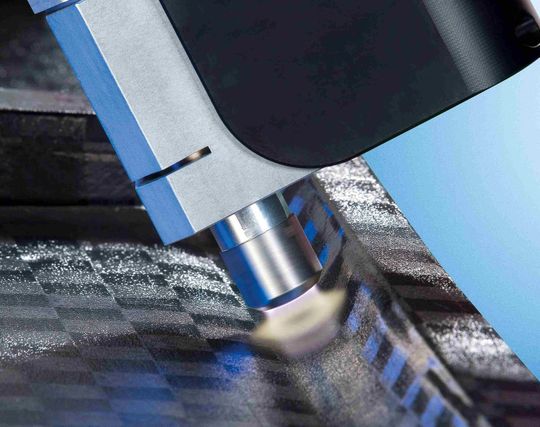
Plasmatreat's open-air plasma technology operates under atmospheric pressure and enables selective, reproducible surface cleaning and activation using only compressed air and electrical energy.
(Source: Plasmatreat)
In the aerospace and mobility industries, lightweight composite materials such as carbon-fiber-reinforced plastics (CFRP), thermoplastics, and hybrid structures are increasingly being used to reduce weight and improve efficiency and performance. However, these materials often have low surface energy, which makes it difficult to achieve reliable adhesion with adhesives, coatings, and sealants. Targeted surface pretreatment prior to further processing is therefore essential. Conventional methods such as mechanical grinding or the use of chemical primers often reach their limits when applied to large or geometrically complex components; they are difficult to control and automate, time-consuming, and subject to environmental and occupational safety regulations. Plasmatreat’s Openair Plasma technology operates under atmospheric pressure conditions and enables selective, reproducible surface cleaning and activation using only compressed air and electrical energy. This process removes organic contaminants and specifically increases surface energy without altering the fundamental material properties. A new application in the Openair range is HydroPlasma, in which distilled water is introduced into the plasma jet to effectively and reliably remove organic and inorganic residues without damaging the material surface.
Improving the Recyclability of Interior Components
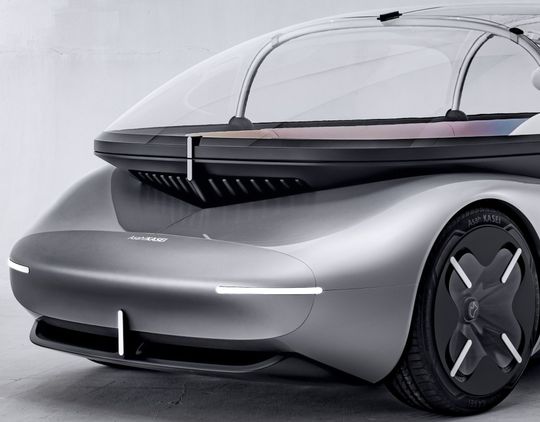
The water-based coating system makes it possible to use polycarbonate as a substitute for glass in vehicle windshields, rear windows, and side windows.
(Source: Asahi Kasei)
Traditionally, automotive interior components such as instrument panels, door trim, armrests, and center consoles are manufactured using multiple materials and separate production processes for the surface layer, foam layer, and structural backing layer. Asahi Kasei’s styrene-based thermoplastic elastomer simplifies this approach by allowing both the surface layer and the foam layer to be made from the same material family. Using the core-back injection molding process, the layers can be produced in a single process. A strong chemical bond between the layers eliminates the need for additional bonding. The result is a simplified material structure that reduces manufacturing complexity, minimizes the number of materials used, and improves the recyclability of interior components. In addition, Asahi Kasei is currently developing a novel water-based coating system that enables the use of polycarbonate as a glass substitute for vehicle windshields, rear windows, and side windows. Polycarbonate coated with this technology achieves the abrasion resistance required by ECE R43 as well as the weather resistance necessary for automotive glass. This technology thus opens up new possibilities for further reducing vehicle weight.
EPDM Compounds with a Reduced Carbon Footprint
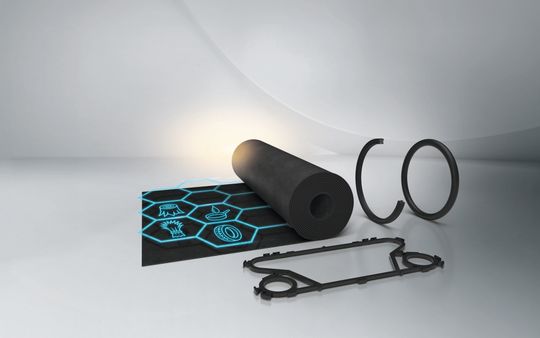
Trelleborg Sealing Solutions is launching two new EPDM compounds that, when molded into parts, have a carbon footprint (Product Carbon Footprint, PCF) that is up to 55 percent lower.
(Source: Trelleborg Sealing Solutions)
Trelleborg Sealing Solutions has added two new ethylene-propylene-diene monomer (EPDM) compounds to its portfolio; when used as molded parts, these compounds have a CO₂ footprint (Product Carbon Footprint, PCF) that is up to 55 percent lower. The new materials, available in 70 Shore A and 80 Shore A hardness grades, offer processors a more sustainable alternative without having to compromise on technical performance compared to conventional EPDM elastomers. Both are ideal for the manufacture of O-rings, seals, and custom molded parts. The materials are suitable for applications in the automotive industry, process engineering, mechanical engineering, automation, the energy sector, agriculture, and for construction and mining machinery. They provide sealing for applications in engines, doors, pumps, valves, pipe connections, household appliances, pneumatic cylinders, solar modules, ship hatches and doors, as well as a wide range of functions in heating, ventilation, air conditioning, freezing, and refrigeration technology. The new materials were developed in partnership with Arlanxeo, a raw materials supplier with a strong focus on sustainability. In compound form, E7T11 exhibits a 51 percent reduction in carbon footprint and E8T12 a 61 percent reduction compared to conventional materials.
Fire- and heat-resistant up to 760 °C
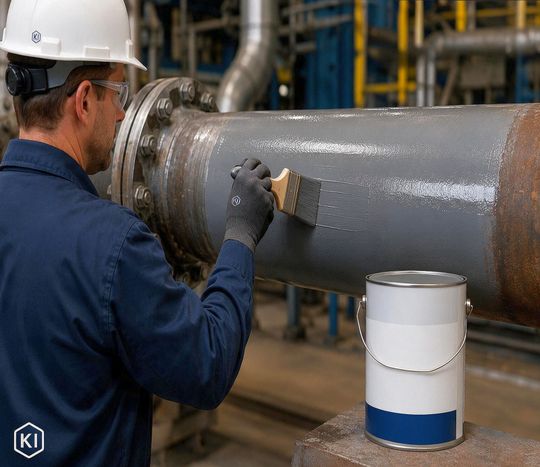
The CP4000-S2-HT silicone-glass-ceramic coating from Kager's product portfolio is fire-resistant and provides technical surfaces with long-lasting protection at temperatures up to 760 °C (1,400°F).
(Source: Kager / KI-generiert)
Where conventional silicone resin and powder coatings reach their limits as heat-protective surface barriers, the CP4000-S2-HT single-component system from the Kager portfolio still performs well. This silicone-glass-ceramic coating is fire-resistant and provides technical surfaces with long-lasting, effective protection at temperatures up to 760 °C (1,400°F). The thermal shock resistance of this coating even extends up to 981 °C ( 1,798°F.). It is therefore generally suitable for the thermal “sealing” of many surfaces, components, and joints that are exposed to intense heat and extreme temperature fluctuations during the value chain or in practical applications. Such a high-temperature coating can significantly increase the service life and availability of a surface while also substantially reducing maintenance costs. The high-temperature-resistant CP4000-S2-HT coating can be applied at normal temperatures (10 °C – 30 °C) (50°F–86°F), has a drying time of about one hour, and cures at room temperature within 24 to 48 hours. If you plan to store the base material for an extended period, you should maintain a temperature range of 4.5 °C to 30 °C (40°F to 86°F) whenever possible.
Date: 08.12.2025
Naturally, we always handle your personal data responsibly. Any personal data we receive from you is processed in accordance with applicable data protection legislation. For detailed information please see our privacy policy.
Consent to the use of data for promotional purposes
I hereby consent to Vogel Communications Group GmbH & Co. KG, Max-Planck-Str. 7-9, 97082 Würzburg including any affiliated companies according to §§ 15 et seq. AktG (hereafter: Vogel Communications Group) using my e-mail address to send editorial newsletters. A list of all affiliated companies can be found here
Newsletter content may include all products and services of any companies mentioned above, including for example specialist journals and books, events and fairs as well as event-related products and services, print and digital media offers and services such as additional (editorial) newsletters, raffles, lead campaigns, market research both online and offline, specialist webportals and e-learning offers. In case my personal telephone number has also been collected, it may be used for offers of aforementioned products, for services of the companies mentioned above, and market research purposes.
Additionally, my consent also includes the processing of my email address and telephone number for data matching for marketing purposes with select advertising partners such as LinkedIn, Google, and Meta. For this, Vogel Communications Group may transmit said data in hashed form to the advertising partners who then use said data to determine whether I am also a member of the mentioned advertising partner portals. Vogel Communications Group uses this feature for the purposes of re-targeting (up-selling, cross-selling, and customer loyalty), generating so-called look-alike audiences for acquisition of new customers, and as basis for exclusion for on-going advertising campaigns. Further information can be found in section “data matching for marketing purposes”.
In case I access protected data on Internet portals of Vogel Communications Group including any affiliated companies according to §§ 15 et seq. AktG, I need to provide further data in order to register for the access to such content. In return for this free access to editorial content, my data may be used in accordance with this consent for the purposes stated here. This does not apply to data matching for marketing purposes.
Right of revocation
I understand that I can revoke my consent at will. My revocation does not change the lawfulness of data processing that was conducted based on my consent leading up to my revocation. One option to declare my revocation is to use the contact form found at https://contact.vogel.de. In case I no longer wish to receive certain newsletters, I have subscribed to, I can also click on the unsubscribe link included at the end of a newsletter. Further information regarding my right of revocation and the implementation of it as well as the consequences of my revocation can be found in the data protection declaration, section editorial newsletter.



:quality(80)/p7i.vogel.de/wcms/8e/7e/8e7e0cda4c68699bcc48283a38739769/0133316747v1.jpeg "A little-known hidden champion! When people think of laser cutting, the first thing that comes to mind is the power of the laser beam—and it is impressive to see the sparks flying. But Air Liquide—an exhibitor at Euroblech, by the way—wants to make it clear that the process gas is also key to success. (Image:AI-generated)")
:quality(80)/p7i.vogel.de/wcms/20/fa/20fa35e0af203c3464f7e7fdbb57a685/0133281172v1.jpeg "Since 2003, Etzinger AG has been developing and manufacturing high-quality coffee grinders, pepper mills, and grinding mechanisms for professional and home use. (Image:Etzinger)")
:quality(80)/p7i.vogel.de/wcms/69/91/6991413943488b4a2f6fde9dcd88c5b0/0133256686v1.jpeg "The CMA-patented pendulum mount can compensate for radial tolerances of up to one millimeter. (Image:Schwiening)")
:quality(80)/p7i.vogel.de/wcms/0b/cd/0bcd6d502ffcd087c4fc12b7b760b3ce/0133317507v2v1.jpeg "The new Multi Center from J.G. Weisser. (Image:J.G. Weisser)")
:quality(80)/p7i.vogel.de/wcms/bd/4e/bd4ef09ab0f84932ea76ca0330ffe789/0133329802v1.jpeg "The robotics boom and its consequences: According to a study, a significant portion of value creation occurs in the electronics industry. (Image:Fraunhofer IPA)")
:quality(80)/p7i.vogel.de/wcms/35/81/35815f36be1b1c13f9abef4cea2a3e2b/0133171739v1.jpeg "Humanoid robots in industry: Despite impressive progress, many systems are still in the pilot phase. (Image:AI-generated)")
:quality(80)/p7i.vogel.de/wcms/81/dc/81dc63ed24c562521413023779495e7d/chris-kramerv1.jpeg "Chris Kramar, Director and General Manager of OEM Solutions for Germany, Austria, and Switzerland at Dell Technologies (Source: Dell Technologies)")
:quality(80)/p7i.vogel.de/wcms/bb/f5/bbf5342f532debc1bd7c09c2b9a0bf42/0133176497v1.jpeg "Over the past two years, AI has emerged as the most important growth driver in the industry. (Image: ©Gorodenkoff - stock.adobe.com)")
:quality(80)/p7i.vogel.de/wcms/e9/19/e91905d37afe605bc348a690a4fed72e/0133350592v1.jpeg "At Autodesk University, Autodesk is introducing new AI features for CAD and PLM. (Image:Autodesk)")
:quality(80)/p7i.vogel.de/wcms/98/73/98731d23cbd95ff22391993a74cfefbf/mit-bifurcatedcircuits-01-pressv1.jpeg "A sample of the variety of configurations that Bifur circuits can form. (Source: Courtesy of the researchers)")
:quality(80)/p7i.vogel.de/wcms/f4/3d/f43d1f4297d9ae0cd1b6d2adfcb5ffe1/0133276470v1.jpeg "Simulation: Electric arcs in the electrical industry, including associated field simulation. (Image:CADFEM)")
:quality(80)/p7i.vogel.de/wcms/cc/d1/ccd1607af856c9cff96c73a5ffccfcad/p90652283-highres-demonstrator-woodenv1.jpeg "The FSCM research project, which was recently completed, is delivering innovations close to production for plastics, metals, and design at BMW. (Source: BMW)")
:quality(80)/p7i.vogel.de/wcms/e3/6b/e36b7702f47642f516e0fc49b674f3cc/0132171014v1.jpeg "From a legacy structure to a competitive one: An automotive supplier transformed its global production network (stock photo). (Image: ©Kostiantyn - stock.adobe.com)")
:quality(80)/p7i.vogel.de/wcms/67/19/671987b3438916a45a20e59c277be816/0133343882v1.jpeg "Mercedes-Benz is recalling approximately 24,000 vehicles worldwide. (Image:Mercedes-Benz AG)")
:quality(80)/p7i.vogel.de/wcms/73/06/7306146c5296cdd9bd77433f736c28e9/0133344456v1.jpeg "Tesla plans to bring its electric tractor-trailer to Europe in 2027. (Image:Tesla)")
:quality(80)/p7i.vogel.de/wcms/4c/53/4c534208d09a9b1ce597938715e7fc19/0133288763v1.jpeg "Logic Folding: In its latest Kirin 9050 Pro, Huawei uses hybrid bonding to distribute the computing units across two silicon layers in order to increase the effective transistor density without resorting to finer manufacturing processes. (Image:Huawei)")
:quality(80)/p7i.vogel.de/wcms/56/d1/56d131e0b5bd05ef47411e92ad740cb4/0133351029v1.jpeg "Researchers at DTU have developed a nanolaser in a semiconductor membrane. The structure concentrates charge carriers and the light field into a small area (shaded in blue). If data is transmitted on microchips using light instead of electrical signals, transmission speeds can be increased and energy losses reduced. (Image:Yi Yu, DTU)")
:quality(80)/p7i.vogel.de/wcms/5e/55/5e55101ddc6338f755fcf3244db1367f/0133331863v1.jpeg "For data center projects, it is becoming increasingly important to also obtain the consent of the affected community. (Image:Dall-E / AI-generated)")
:quality(80)/p7i.vogel.de/wcms/8d/f9/8df95d3f58408673986b3d643e6b63ba/0133252773v1.jpeg "TXC targets high-speed optical links in AI data centers with 312.5 MHz oscillators, among other solutions. As data rates increase, requirements for jitter and frequency stability become more demanding as well. (Bild: TXC)")
:fill(fff,0)/images.vogel.de/vogelonline/companyimg/76800/76895/65.jpg "FAULHABER_120mm.jpg ()")
:fill(fff,0)/p7i.vogel.de/companies/69/88/69882c428938e/tmts2026-ticec-banner-en-2000px.png "tmts2026-ticec-banner-en-2000px (https://www.tmts.tw/en)")
:fill(fff,0)/p7i.vogel.de/companies/69/de/69de1b7403b0d/simtos-logo.jpeg "simtos-logo (SIMTOS)")
:quality(80)/p7i.vogel.de/wcms/dc/0b/dc0bb45fae3c250a7e75c1d9a1f5e041/thyssenkrupp-profile-aus-zm-beschichteten-bandstahlv1.jpeg "With ZM Ecoprotect Solar, thyssenkrupp Steel offers a variant developed for PV mounting systems. The coating is applied to the steel strip before forming, allowing profiles to be produced without the disadvantages of subsequent batch galvanizing. (Source: Thyssenkrupp Steel)")
:quality(80)/p7i.vogel.de/wcms/7d/f0/7df0df2c3fc0cd9cb7fd614412361aac/henkel-20ami-20pm-20anodis-uminium-bild-201-v1.jpeg "Henkel research in action: The development of Bonderite M-AD 2000A demonstrates how targeted additives can make anodizing processes more energy-efficient, sustainable, and economical. (Source: Henkel)")
:quality(80)/p7i.vogel.de/wcms/dc/0b/dc0bb45fae3c250a7e75c1d9a1f5e041/thyssenkrupp-profile-aus-zm-beschichteten-bandstahlv1.jpeg "With ZM Ecoprotect Solar, thyssenkrupp Steel offers a variant developed for PV mounting systems. The coating is applied to the steel strip before forming, allowing profiles to be produced without the disadvantages of subsequent batch galvanizing. (Source: Thyssenkrupp Steel)")