Physical AI is considered the next step in the evolution of industrial digitalization. However, the term often remains abstract: What technologies enable machines to perceive their environment, assess situations, and act independently?
When Machines Understand What They're Doing—The Five Technologies Behind Physical AI.
The answer lies in the interplay of several technological components. Only when sensors, AI, computing power, connectivity, and robotics work together does a data-driven system become an agent capable of taking action. NTT DATA highlights the five technologies upon which Physical AI is built.For a long time, artificial intelligence was primarily focused on analyzing existing data. Physical AI expands this approach to include direct interaction with the real world. Cameras, lidar, and other sensors capture the environment. AI systems interpret the information gathered and derive concrete actions from it.
Physical AI makes it possible to create systems that can independently handle uncertainty and variance and use that information to make the right decisions. These capabilities are particularly in demand in the manufacturing sector.
Oliver Köth, Managing Director Technology & Innovation DACH at NTT DATA
Five Key Technologies Working Together
For a long time, artificial intelligence focused primarily on analyzing existing data. Physical AI expands on this approach by enabling direct interaction with the real world. Cameras, lidar, and other sensors capture data about the environment. AI systems interpret the information gathered and use it to determine specific actions.Unlike traditional automation, it is no longer necessary to program all rules and possible scenarios in advance. Physical AI forms a closed-loop system consisting of perception, interpretation, decision-making, and action. Five technology areas are particularly important for this:
Sensor Technology and Sensor Fusion: The Foundation of Perception Physical AI begins with the precise sensing of the real world. Sensors measure, among other things, temperature, pressure, vibrations, positions, and optical properties. They convert physical states into digital signals. What matters here is not the individual sensor, but the interaction of various data sources. Sensor fusion creates a consistent overall picture that reveals complex relationships. In industrial practice, this means that machine conditions cannot be assessed based on a single measurement value alone. Instead, multiple parameters are interpreted together. This enables more reliable anomaly detection and lays the foundation for adaptive processes—such as in plant monitoring or predictive maintenance.
Edge Intelligence and Energy-Efficient Chips: Real-Time Decision-Making Physical AI often needs to process data right where it is generated. Modern sensors and embedded systems therefore increasingly have their own computing capabilities and run machine learning models directly on-site. These edge architectures reduce latency and enable responses within milliseconds. This requires powerful yet energy-efficient chips that can run complex AI models even with limited resources. This makes it possible, for example, to detect signs of wear early on or to correct quality deviations immediately during the production process. At the same time, less data needs to be transmitted to central systems. This saves bandwidth and can reduce energy consumption.
Artificial Intelligence: The Analytical Core True value is created when Physical AI transforms data into knowledge and concrete actions. Machine learning, pattern recognition, and—increasingly—generative AI are used for this purpose. Foundation models and so-called Vision-Language-Action (VLA) models open up new possibilities. Companies can build on pre-trained models and adapt them for specific use cases. This can shorten development times and accelerate the implementation of new applications. VLA models link visual information, language, and context. This enables machines, for example, to understand spoken commands, react to unexpected situations, and derive actions for robotic arms or actuators. However, traditional AI methods remain indispensable for deterministic control, regulation, and safety tasks. The greatest potential arises from combining both approaches: generative models handle perception, context understanding, and planning, while classical methods ensure precise and reliable execution.
5G, 6G, and industrial standards: the foundation for connectivity For physical-AI systems to work together reliably, data must be transmitted quickly, securely, and with low latency. Communication standards such as 5G and, in the future, 6G provide the technical foundation for this. They enable the networking of machines, sensors, and IT systems—even in dynamic production environments. Standardized protocols and data models are equally important. They unambiguously describe machine data and facilitate collaboration between different systems. Only when machines and applications speak the same “language” can data be efficiently integrated and processed further.End-to-end connectivity helps avoid isolated silos. Instead, it creates a holistic view of production processes and enables information to be used across systems.
Advanced Robotics and Adaptive Actuation: Translating Decisions into Motion Sensors and AI handle perception and decision-making. The physical execution is carried out by robotics and actuation. Modern robots are no longer designed exclusively for rigid sequences. More precise control systems, more powerful actuators, and the tight integration of AI enable them to adapt their movements to changing conditions. As a result, collaborative robots, autonomous transport systems, and adaptive grippers can operate reliably even in less structured environments. They respond to changes and immediately translate decisions into physical actions. This completes the control loop of Physical AI: the system senses its environment, interprets the data collected, makes a decision, and acts.
Date: 08.12.2025
Naturally, we always handle your personal data responsibly. Any personal data we receive from you is processed in accordance with applicable data protection legislation. For detailed information please see our privacy policy.
Consent to the use of data for promotional purposes
I hereby consent to Vogel Communications Group GmbH & Co. KG, Max-Planck-Str. 7-9, 97082 Würzburg including any affiliated companies according to §§ 15 et seq. AktG (hereafter: Vogel Communications Group) using my e-mail address to send editorial newsletters. A list of all affiliated companies can be found here
Newsletter content may include all products and services of any companies mentioned above, including for example specialist journals and books, events and fairs as well as event-related products and services, print and digital media offers and services such as additional (editorial) newsletters, raffles, lead campaigns, market research both online and offline, specialist webportals and e-learning offers. In case my personal telephone number has also been collected, it may be used for offers of aforementioned products, for services of the companies mentioned above, and market research purposes.
Additionally, my consent also includes the processing of my email address and telephone number for data matching for marketing purposes with select advertising partners such as LinkedIn, Google, and Meta. For this, Vogel Communications Group may transmit said data in hashed form to the advertising partners who then use said data to determine whether I am also a member of the mentioned advertising partner portals. Vogel Communications Group uses this feature for the purposes of re-targeting (up-selling, cross-selling, and customer loyalty), generating so-called look-alike audiences for acquisition of new customers, and as basis for exclusion for on-going advertising campaigns. Further information can be found in section “data matching for marketing purposes”.
In case I access protected data on Internet portals of Vogel Communications Group including any affiliated companies according to §§ 15 et seq. AktG, I need to provide further data in order to register for the access to such content. In return for this free access to editorial content, my data may be used in accordance with this consent for the purposes stated here. This does not apply to data matching for marketing purposes.
Right of revocation
I understand that I can revoke my consent at will. My revocation does not change the lawfulness of data processing that was conducted based on my consent leading up to my revocation. One option to declare my revocation is to use the contact form found at https://contact.vogel.de. In case I no longer wish to receive certain newsletters, I have subscribed to, I can also click on the unsubscribe link included at the end of a newsletter. Further information regarding my right of revocation and the implementation of it as well as the consequences of my revocation can be found in the data protection declaration, section editorial newsletter.



:quality(80)/p7i.vogel.de/wcms/cc/52/cc5215f3d9ba0e68096982e59228c24a/26-09-22-st-ber-ab-tiepner-bild-1v1.jpeg "Tiepner develops and designs systems for the production of credit and ID cards in the ID-1 format. Stöber supplies drive controllers, servo motors, and various gearboxes for these systems. (Source: Stöber Drive Technology)")
:quality(80)/p7i.vogel.de/wcms/7c/de/7cde60054b52df974f5251ce82c00319/0134168033v1.jpeg "That would certainly be an ideal scenario—South Korea as a good trading partner for Germany (and the EU)—and vice versa! But there are a few things that give these potential friends in this Asian country pause for thought... (Image: AI-generated)")
:quality(80)/p7i.vogel.de/wcms/26/07/2607ca9a55754c81c6d65effc806c420/0134125580v1.jpeg "The new XB series from Mazak made its European debut at Euroblech 2026. Pictured is the new Optonics XB 130-32A press brake from the series. (Image:Mazak)")
:quality(80)/p7i.vogel.de/wcms/e0/85/e085a26186d214436f5e854dcbc2b8a4/6-nicokleiner-cmykv1.jpeg "As part of his technical thesis, Nico Kleiner developed a compact laser engraving machine for Norelem to use at trade shows. (Source: Norelem)")
:quality(80)/p7i.vogel.de/wcms/5f/8c/5f8c8c18b25cb0b410b425ee8565cfef/newsimage429045v1.png "Racing with the Red Queen: Using Game Theory to Improve Software Security in the Age of AI (Source: CISPA/Chiara Schwarz)")
:quality(80)/p7i.vogel.de/wcms/3b/ea/3bea215f65935b4c429d8d1f5319bb3d/0134167887v1.jpeg "Global sales of mobile robots in intralogistics rose by 19 percent in 2025 to approximately 103,700 units. (Image:VDMA/IFR)")
:quality(80)/p7i.vogel.de/wcms/1f/7e/1f7eb8df75041d96602f297a5497d3ad/0134081637v1.jpeg "With Agile One SN, teams can develop, train, and validate humanoid robot capabilities for real-world applications, enabling them to bring their ideas from the lab to production more quickly. (Image:Agile Robots)")
:quality(80)/p7i.vogel.de/wcms/17/dd/17dd38fd7454673478427ec52780cd23/0134137180v1.jpeg "Humanoids: Between Hype and Everyday Industrial Life: Safety expert Jens Müller explains why technical maturity, safe motion sequences, and integration into existing processes are key to determining the practical utility of these robots. (Image:Jens Müller)")
:quality(80)/p7i.vogel.de/wcms/3e/1b/3e1be042a1fc59e7da9be9f6ef9400cd/bild-1v1.jpeg "In cable design, electrical, mechanical, and environmental requirements must all be taken into account. (Source: SAB Bröckskes)")
:quality(80)/p7i.vogel.de/wcms/70/ce/70cee969904bba9295b050329bae5ef5/optopatch-mosaic-2-1500x752-1v1.jpeg "High-tech patch: Bio-inspired technology simplifies measurements for cardiac diagnostics—without any electronics at all. (Source: NTNU)")
:quality(80)/p7i.vogel.de/wcms/c3/68/c368b4f6821557ec497c64bc17fe9f8d/adobestock-2051843806--kaliel-stock-adobe-com-ki-generiertv1.jpeg "To truly harness the full potential of virtual product development, teams and management must radically change their mindset. (Source: © kaliel – stock.adobe.com_AI-generated)")
:quality(80)/p7i.vogel.de/wcms/a3/c1/a3c19e028b66a6fd7c373ab94981631d/paprika-gripperv1.jpeg "For the final, additively manufactured gripper base, SoftGripping chose PA 2200, a material based on polyamide 12 (PA12). It offers balanced mechanical properties and high load-bearing capacity, making it ideal for robust gripper solutions with integrated pneumatics. (Source: SoftGripping GmbH)")
:quality(80)/p7i.vogel.de/wcms/24/56/2456f553e70bf00f88a43c6e6aa4e776/db2024fa00085-largev1.jpeg "Things continue to go poorly for German manufacturers in China. (Source: Volkswagen AG)")
:quality(80)/p7i.vogel.de/wcms/09/90/0990ce85c5d9065ea17e0368bf6ad475/0134169786v1.jpeg "Scenes like these are fueling outrage among leftists, the Greens, and within the Volkswagen Group. That’s because Audi CEO Gernot Döllner (left) spoke publicly alongside U.S. President Donald Trump. The issue concerns a planned Audi plant in the U.S. Döllner is said to have allowed himself to be used for campaign purposes... (Image:Reuters / E. Su)")
:quality(80)/p7i.vogel.de/wcms/6a/49/6a49554426ff472a0b1887a2ea21cba7/redhatv1.png "The global automaker has reduced the time required for infrastructure configurations from 60 hours to 20 minutes—30,000 employees are benefiting from the resulting increase in operational efficiency (Source: Red Hat)")
:quality(80)/p7i.vogel.de/wcms/2b/5d/2b5dcef385a5d1340f5f596520a5d855/a231598-largev1.jpeg "Audi is seeing a rapid decline in sales in China. A new leadership duo is set to turn things around. (Image:Audi AG)")
:quality(80)/p7i.vogel.de/wcms/be/16/be1630b0b876b3f8c6d21e96986d57f2/0134180147v1.jpeg "Intel has announced the acquisition of the Israeli company Classiq. The startup specializes in tools and algorithms for the practical development of scalable, efficient quantum applications. (Image:Classiq)")
:quality(80)/p7i.vogel.de/wcms/f2/c0/f2c0bfc2c3c323220c2b1154cacda57a/0134132255v1.jpeg "Established semiconductor processes: While some foundries are reducing their manufacturing capacity, others are making targeted investments in specialized technologies. For developers in industrial electronics, the automotive industry, and medical technology, the long-term availability and cost of components are crucial. (Image:Dall-E / AI-generated)")
:quality(80)/p7i.vogel.de/wcms/71/c4/71c49858dd5195cbf540c4c37debab03/0134099748v1.jpeg "The Future of Space Travel: At Pretzl Connect 2026, ESA engineer Kate Underhill explained how sensor technology, software, and AI are transforming the development of future space transportation systems. (Image:mc/VCG)")
:quality(80)/p7i.vogel.de/wcms/20/b3/20b3ea557032591a4699c28076d349e3/0134117110v1.jpeg "Thermal simulation of a 3D IC visualizes the temperature distribution within the chip structure. Siemens and Nvidia aim to automate and accelerate such electrothermal analyses using AI-powered EDA workflows. (Image: Siemens EDA)")
:fill(fff,0)/p7i.vogel.de/companies/69/88/69882c428938e/tmts2026-ticec-banner-en-2000px.png "tmts2026-ticec-banner-en-2000px (https://www.tmts.tw/en)")
:fill(fff,0)/p7i.vogel.de/companies/69/de/69de1b7403b0d/simtos-logo.jpeg "simtos-logo (SIMTOS)")
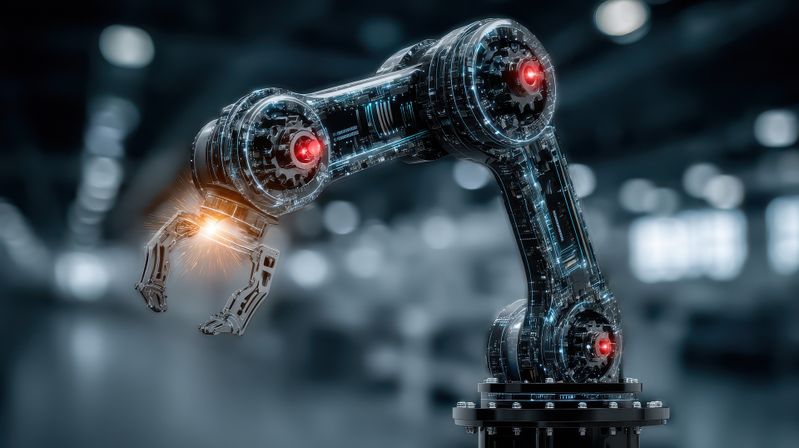
:quality(80)/p7i.vogel.de/wcms/38/79/38799bfbbccd938b64c67068cfa68780/0133329362v1.jpeg "What exactly enables machines to act on their own? (Image:Shutterstock)")
:quality(80)/p7i.vogel.de/wcms/c8/f2/c8f23e812ce87743da5435971eeee2cb/0130176428v1.jpeg "Zhaopeng Chen, CEO Agile Robots: \"Hardware forms the basis of every robot - precision, stability and agility are crucial. But without the right software, robots remain static machines.\" (Image:Agile Robots)")