Samsung has received urgently needed large orders for its 2-nanometer chips. Two Chinese manufacturers of crypto-mining equipment have committed to purchasing chips worth $480 million annually, reports the newspaper "Korea Economic Daily."
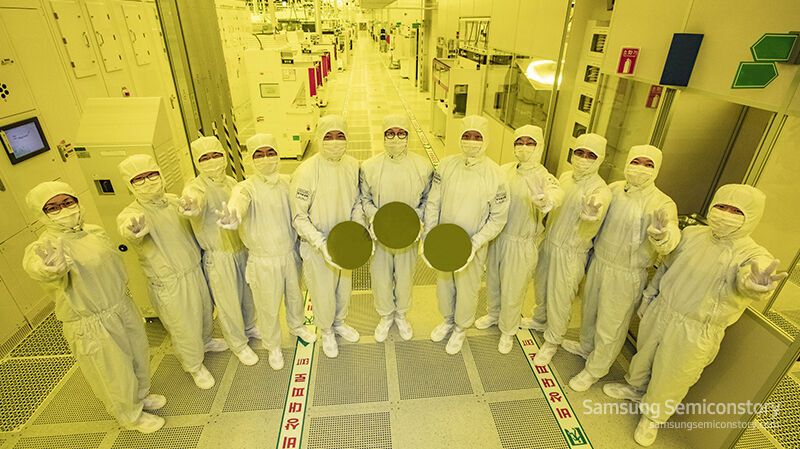
Samsung began chip production in summer 2022 using 3-nm process technology with GAA architecture.
(Image: Samsung)
So far, the technology giant Samsung lacked commitments from customers for products from its in-house 2-nm process, but apparently, that has now changed. Two interested companies have been found in China. The purchases by the new customers—MicroBT and Canaan—are described as "rain after a long drought" for Samsung's chip business, comments the technology blog ibaiwin.
The company had made a risky bet on the two-nanometer business after losing both Qualcomm and later Nvidia as customers due to technical issues with its 3-nm chips. The large orders from China offer an opportunity to scale up the production of this most advanced chip generation again.
Worldwide, only three companies are currently capable of manufacturing 2-nanometer chips: TSMC, Samsung, and Intel. Of the three, only the Taiwanese manufacturer TSMC has managed to make this business profitable. In Japan and elsewhere, there are efforts to rejoin the top tier of semiconductor manufacturing, but the investment costs and technical challenges are immense.
TSMC As Usual in the Lead
TSMC currently holds a 70.2 percent share of the global foundry business, according to second-quarter revenues. For Samsung, it's just 7.3 percent. Against the backdrop of this global race, the performance metrics for Samsung's 2-nm processes have been closely watched in the industry.
The South Korean chip manufacturer announced specific figures for these new processes for the first time in mid-November 2025. Its new 2-nm GAA chips offer up to five percent higher performance, up to eight percent better energy efficiency, and a five percent reduced footprint compared to the 3-nm GAA chips, Samsung stated.
Although this is seen by analysts as "merely a moderate upgrade," it could be crucial for Samsung's planned comeback in the chip industry. Only if the performance is right and the production yield rates improve in the long term will Samsung be able to win more international customers again.
Intel on the Hunt for Skilled Workers
Intel is also striving to build its own high-performance chips again. In addition to sufficient funding, hiring suitable "talents" is crucial. The Liberty Times in Taiwan recently reported that Wei-Jen Lo, a senior VP at TSMC, was poached by Intel and would be joining the "Team Blue" in the USA at the end of October.
TSMC dominates the global semiconductor contract manufacturing business by a wide margin. As a result, an ecosystem of research and education, suppliers of all kinds, and mass production has developed in Taiwan over several decades. Nowhere else is there such a large labor market, and nowhere else are there so many experts for all phases of chip manufacturing as in Taiwan.
Japan Under Pressure
This is a challenge that Japan, among others, is also facing. The government in Tokyo, through the Ministry of Economy, Trade and Industry (METI), has invested in Rapidus, a chip manufacturer with ambitions in the 2-nanometer segment. Reportedly, they aim to begin mass production there by 2027. However, over the past decades, as Japan gradually lost its technological leadership in semiconductor manufacturing, the corresponding talent pool has also diminished.
This is now not only a critical bottleneck for Rapidus but also for TSMC, which, under pressure from the Japanese government, has opened a factory in Kumamoto in collaboration with Sony for the production of legacy chips. Additionally, another factory for 6-nm chips is currently being built elsewhere in Japan.
That even Samsung has to be grateful to Chinese manufacturers of machines for crypto mining should be understood as a warning to techno-nationalists worldwide. It is not easy to establish a financially sustainable production of 2-nm processes "and beyond" in a short time. Even Samsung is struggling with it. (sb)
Date: 08.12.2025
Naturally, we always handle your personal data responsibly. Any personal data we receive from you is processed in accordance with applicable data protection legislation. For detailed information please see our privacy policy.
Consent to the use of data for promotional purposes
I hereby consent to Vogel Communications Group GmbH & Co. KG, Max-Planck-Str. 7-9, 97082 Würzburg including any affiliated companies according to §§ 15 et seq. AktG (hereafter: Vogel Communications Group) using my e-mail address to send editorial newsletters. A list of all affiliated companies can be found here
Newsletter content may include all products and services of any companies mentioned above, including for example specialist journals and books, events and fairs as well as event-related products and services, print and digital media offers and services such as additional (editorial) newsletters, raffles, lead campaigns, market research both online and offline, specialist webportals and e-learning offers. In case my personal telephone number has also been collected, it may be used for offers of aforementioned products, for services of the companies mentioned above, and market research purposes.
Additionally, my consent also includes the processing of my email address and telephone number for data matching for marketing purposes with select advertising partners such as LinkedIn, Google, and Meta. For this, Vogel Communications Group may transmit said data in hashed form to the advertising partners who then use said data to determine whether I am also a member of the mentioned advertising partner portals. Vogel Communications Group uses this feature for the purposes of re-targeting (up-selling, cross-selling, and customer loyalty), generating so-called look-alike audiences for acquisition of new customers, and as basis for exclusion for on-going advertising campaigns. Further information can be found in section “data matching for marketing purposes”.
In case I access protected data on Internet portals of Vogel Communications Group including any affiliated companies according to §§ 15 et seq. AktG, I need to provide further data in order to register for the access to such content. In return for this free access to editorial content, my data may be used in accordance with this consent for the purposes stated here. This does not apply to data matching for marketing purposes.
Right of revocation
I understand that I can revoke my consent at will. My revocation does not change the lawfulness of data processing that was conducted based on my consent leading up to my revocation. One option to declare my revocation is to use the contact form found at https://contact.vogel.de. In case I no longer wish to receive certain newsletters, I have subscribed to, I can also click on the unsubscribe link included at the end of a newsletter. Further information regarding my right of revocation and the implementation of it as well as the consequences of my revocation can be found in the data protection declaration, section editorial newsletter.
Future-Proof Authentication with Universal RFID Readers



:quality(80)/p7i.vogel.de/wcms/9e/23/9e23111e49d73012e9e3b7c69428ad5c/0134019347v1.jpeg "The Dominant VA45 high-helix tap from Bass, made of lead-free brass. The long chips, which result from the absence of lead, are clearly visible. (Image:Bass, Inc.)")
:quality(80)/p7i.vogel.de/wcms/1d/09/1d0999956ef87709b72ab1d0402ba207/csf-minis-gruppe-final-01-outputv1.jpeg "Since mid-2026, Harmonic Drive has been offering its CSF Mini gearheads in size 7 as well, in six variants designed for different installation scenarios. (Source: Harmonic Drive)")
:quality(80)/p7i.vogel.de/wcms/ab/08/ab08675922c3a7edea45128248b45b00/0133857009v1.jpeg "In the aerospace industry—one of the most demanding sectors of all—the Shanghai-based company TOPNC has already made a name for itself. (Image:TOPNC)")
:quality(80)/p7i.vogel.de/wcms/ff/48/ff48b1154746e79128935f28bd73ba0e/0113143253v1.jpeg "In our China Market Insider, we regularly provide you with relevant information straight from China. (Image:© Eisenhans - stock.adobe.com)")
:quality(80)/p7i.vogel.de/wcms/6e/bb/6ebb687f573be847aa611b413c6a33b1/0134094461v1.jpeg "From left: Sepp Hochreiter, founder of Nxai and AI researcher, and David Reger, founder and CEO of Neura Robotics, are excited about their collaboration on Physical AI. (Image:Neura)")
:quality(80)/p7i.vogel.de/wcms/89/01/890193a30c52ffd4811d18db82170952/0113143253v1.jpeg "In our China Market Insider, we regularly provide you with relevant information straight from China. (Image:© Eisenhans - stock.adobe.com)")
:quality(80)/p7i.vogel.de/wcms/6b/8a/6b8ac7cd85db2d1d1f6ab30957648711/schaeffler-news-taicanglighthouse6v1.jpeg "At the Lighthouse Factory, robots assemble linear and rotary actuators, among other components. (Source: Schaeffler)")
:quality(80)/p7i.vogel.de/wcms/4f/5a/4f5a2417df55dae5967e90b331e0bbc5/physical-ai-robotics-ariv1.jpeg "With new hardware and software solutions, the productive use of AI in industry is becoming increasingly prominent. (Source: Nvidia)")
:quality(80)/p7i.vogel.de/wcms/c3/68/c368b4f6821557ec497c64bc17fe9f8d/adobestock-2051843806--kaliel-stock-adobe-com-ki-generiertv1.jpeg "To truly harness the full potential of virtual product development, teams and management must radically change their mindset. (Source: © kaliel – stock.adobe.com_AI-generated)")
:quality(80)/p7i.vogel.de/wcms/a3/c1/a3c19e028b66a6fd7c373ab94981631d/paprika-gripperv1.jpeg "For the final, additively manufactured gripper base, SoftGripping chose PA 2200, a material based on polyamide 12 (PA12). It offers balanced mechanical properties and high load-bearing capacity, making it ideal for robust gripper solutions with integrated pneumatics. (Source: SoftGripping GmbH)")
:quality(80)/p7i.vogel.de/wcms/51/b8/51b8e08d2105fdd9952aff385f154192/graphic-2-adma1v1.png "The new surface hardening process enhances the performance of corrosion-resistant alloys by improving their tribological and mechanical surface properties, while preserving the properties of the base material. (Source: Bodycote)")
:quality(80)/p7i.vogel.de/wcms/96/ef/96effc239916cb7e0f396ab75627b8c0/image-space-testingv1.jpeg "Two scientists in front of a vacuum chamber used for testing: As technical instruments for spaceflight become more sensitive, the test facilities are becoming a critical system. (Source: Busch Group)")
:quality(80)/p7i.vogel.de/wcms/4c/61/4c61e3d5582715f2cadafc911480a20a/0132455124v1.jpeg "Mercedes-Benz has announced that it is moving away from its platform-based manufacturing strategy. Management expects a modular design concept to deliver greater benefits... (Image:Mercedes-Benz)")
:quality(80)/p7i.vogel.de/wcms/0d/14/0d14c9be5fc47bc256002ce3df435f21/keb-automation-drive-controller-marinev1.jpeg "Certified for ships, offshore applications, and more: the Combivert F6 Drive Controllers from KEB Automation. (Source: KEB Automation / Miss Irine)")
:quality(80)/p7i.vogel.de/wcms/ba/d3/bad3d62389a59fe3cdbac386a0dce64b/0134098250v1.jpeg "Following initial tests with its robotaxis in Europe, Pony.ai now plans to bring robot trucks to Europe as well. (Image:Pony.ai)")
:quality(80)/p7i.vogel.de/wcms/78/d1/78d124651f6149aa9f33913fc00ef98a/bertrandt-standort-tschechienv1.jpeg "Bertrandt has opened a new facility in the Czech Republic—near Škoda. (Source: Bertrandt)")
:quality(80)/p7i.vogel.de/wcms/27/47/27472d923d2d60f883a5682cb7987558/0134050215v1.jpeg "China's semiconductor industry: At the China International Industry Fair (CIIF) in Shanghai, the chip industry was given its own exhibition area for the first time in 2026. More than 300 companies showcased their technologies and solutions for industrial manufacturing at the “IC Ecosystem Show.” (Image:CIIF)")
:quality(80)/p7i.vogel.de/wcms/bc/20/bc2034a1ba033f00e539d91bcc70e403/bopla-bonext-1-rgbv1.jpeg "A translucent base allows for ambient lighting, either as a design feature or to visually indicate status. (Source: Bopla)")
:quality(80)/p7i.vogel.de/wcms/cd/23/cd239aa506b3ace30e62f44c83fa31ca/0134051508v1.jpeg "Figure 1: Schematic representation of the DAB (Dual Active Bridge) topology. (Image:Texas Instruments)")
:quality(80)/p7i.vogel.de/wcms/8b/35/8b35660420abba32fb891a4c5cc42fbd/0134018092v1.jpeg "Long-range UVC LED with lens and reflector: Close-up of a square LED with a transparent, dome-shaped lens on a dark base plate. The hermetically sealed housing ensures greater reliability and durability under demanding environmental conditions. (Image:FBH_Schurian)")
:fill(fff,0)/images.vogel.de/vogelonline/companyimg/76800/76895/65.jpg "FAULHABER_120mm.jpg ()")
:fill(fff,0)/p7i.vogel.de/companies/69/88/69882c428938e/tmts2026-ticec-banner-en-2000px.png "tmts2026-ticec-banner-en-2000px (https://www.tmts.tw/en)")
:fill(fff,0)/p7i.vogel.de/companies/69/de/69de1b7403b0d/simtos-logo.jpeg "simtos-logo (SIMTOS)")
:quality(80):fill(efefef,0)/p7i.vogel.de/wcms/67/ae/67ae0b9ac31f8/elatec-wp-universal-reader.png "Elatec WP Universal Reader")
:quality(80)/p7i.vogel.de/wcms/ff/10/ff103cc3a0e70a865e433e48c7c89d92/0131202314v1.jpeg "Revival of the partnership: Apple is apparently planning to produce future processors in Intel's US plants. (Image:Intel Corp.)")
:quality(80)/p7i.vogel.de/wcms/5b/38/5b385ec75bff6e84b70a02c0c939dd2b/0129331527v1.jpeg "The TSMC site of Japan Advanced Semiconductor Manufacturing in Kumamoto, Japan. While the second fab currently under construction was initially only intended for the production of semiconductors using the N6 process, the contract manufacturer is currently negotiating with the Japanese government to possibly upgrade the site to N3 after all. (Image:JASM)")