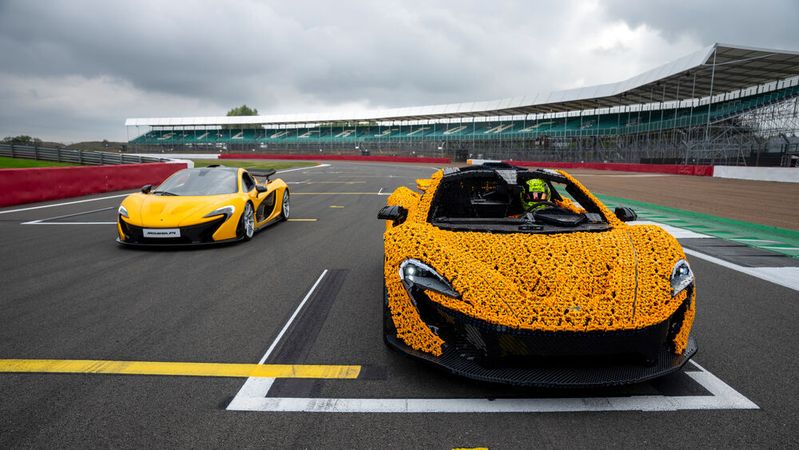
Engineers from McLaren and the creatives at LEGO have achieved something truly unique. Using hundreds of thousands of interlocking bricks and more than 700 LEGO motors, they have constructed a life-sized model of the rear-driven, mid-engine hybrid supercar, the McLaren P1. This marks the first large-scale LEGO model that can navigate curves. Formula 1 racing driver Lando Norris demonstrated this on the Silverstone track.
The real McLaren P1 and the LEGO model: In terms of dimensions, the model comes quite close to the original.
If you were a great LEGO enthusiast and had all the time and all the LEGO building elements in the world, what would you build? A giant Star Destroyer? An extensive Enterprise? Or maybe... a car, because you dreamed in your youth of cruising through brick-built cities in a car?
The plan involving the car was realized by engineers from the automaker McLaren and especially the enthusiasts at LEGO. In September 2024, they presented a life-sized model of the McLaren P1, a rear-driven mid-engine hybrid supercar that was produced between 2013 and 2015. This life-sized LEGO model has dimensions of 4,980 mm x 2,101 mm x 1,133 mm (L/W/H), primarily standing out in length compared to the original. The McLaren P1 measures 4,588 mm x 1,946 mm x 1,188 mm (L/W/H).
The special feature of this LEGO model is not only that it closely resembles the original in scale, but that it can also be driven. This was demonstrated by racing driver Lando Norris from the McLaren Formula 1 team on the legendary Silverstone Circuit—appropriately under British skies.
342,817 LEGO Technic parts in use
If you would like to purchase the vehicle, you'll certainly have to dig a bit deeper into your pockets. In addition to the estimated material costs of around 150,000 euros (approx. 166,000 USD), there's also an intangible value added. The P1 model was created, among other reasons, to promote the new 1:8 LEGO model of the P1. This set comes with a more affordable mid-three-figure price tag.
Now let's delve into the technical details of the McLaren P1 made from interlocking blocks. According to their own statements, it took 23 specialists from the fields of design, engineering, and construction at LEGO and McLaren Automotive a total of 8,344 hours to develop and build the life-sized model. They used 342,817 LEGO Technic parts, weighting about 380 kilograms. The complete model ultimately weighs 1,220 kilograms, as elements such as the tires, steering wheel, and battery are, of course, not made from the interlocking bricks that LEGO dreams are made of.
The developers faced the challenge of finding a flexible building pattern that would allow for the replication of the P1's curves, as they did not want to use carbon fiber parts. Therefore, they used 393 different types of LEGO Technic elements. Eleven of these were specifically designed for this model of the McLaren P1.
Breathtaking: The steering
The model itself wouldn't be so special and unique if it weren't the first large LEGO model that can be driven and steered around corners. Therefore, it was hardly surprising that Lando Norris was allowed to drive the vehicle around the nearly six kilometers of the Silverstone Circuit to test the cornering capabilities.
Naturally, the LEGO-P1 did not move as fast as a Formula 1 car or as fast as the real P1 with its V8 engine, which has a top speed electronically limited to 350 km/h (217 mph). The LEGO-P1 reached speeds of just under 65 km/h (40 mph) (at Silverstone. Regarding steering, Norris had no concerns, but he was more worried about the wobbling side mirrors of the model as he drove over the curbs of the racetrack.
The vehicle features an electric motor composed of LEGO Technic function batteries as well as an electric car battery. Specifically, it uses eight motor packages, each consisting of 96 LEGO Power Functions motors, meaning a total of 768 motors work to mobilize the model; this is further than any other LEGO model has ever moved. Depending on the specific motors used, the power output was likely around 3 to 3.5 kW. For comparison, the electric motor of the P1, which is used in addition to the 3.8-liter V8, alone produces 132 kW.
Date: 08.12.2025
Naturally, we always handle your personal data responsibly. Any personal data we receive from you is processed in accordance with applicable data protection legislation. For detailed information please see our privacy policy.
Consent to the use of data for promotional purposes
I hereby consent to Vogel Communications Group GmbH & Co. KG, Max-Planck-Str. 7-9, 97082 Würzburg including any affiliated companies according to §§ 15 et seq. AktG (hereafter: Vogel Communications Group) using my e-mail address to send editorial newsletters. A list of all affiliated companies can be found here
Newsletter content may include all products and services of any companies mentioned above, including for example specialist journals and books, events and fairs as well as event-related products and services, print and digital media offers and services such as additional (editorial) newsletters, raffles, lead campaigns, market research both online and offline, specialist webportals and e-learning offers. In case my personal telephone number has also been collected, it may be used for offers of aforementioned products, for services of the companies mentioned above, and market research purposes.
Additionally, my consent also includes the processing of my email address and telephone number for data matching for marketing purposes with select advertising partners such as LinkedIn, Google, and Meta. For this, Vogel Communications Group may transmit said data in hashed form to the advertising partners who then use said data to determine whether I am also a member of the mentioned advertising partner portals. Vogel Communications Group uses this feature for the purposes of re-targeting (up-selling, cross-selling, and customer loyalty), generating so-called look-alike audiences for acquisition of new customers, and as basis for exclusion for on-going advertising campaigns. Further information can be found in section “data matching for marketing purposes”.
In case I access protected data on Internet portals of Vogel Communications Group including any affiliated companies according to §§ 15 et seq. AktG, I need to provide further data in order to register for the access to such content. In return for this free access to editorial content, my data may be used in accordance with this consent for the purposes stated here. This does not apply to data matching for marketing purposes.
Right of revocation
I understand that I can revoke my consent at will. My revocation does not change the lawfulness of data processing that was conducted based on my consent leading up to my revocation. One option to declare my revocation is to use the contact form found at https://contact.vogel.de. In case I no longer wish to receive certain newsletters, I have subscribed to, I can also click on the unsubscribe link included at the end of a newsletter. Further information regarding my right of revocation and the implementation of it as well as the consequences of my revocation can be found in the data protection declaration, section editorial newsletter.
"McLaren's expertise in automotive and engineering was invaluable and helped us produce a model that is as authentic as possible to the original McLaren P1™. This allowed us to turn a dream into reality,"celebrates Lukáš Horák , Senior Project Manager of Installations at LEGO Group, following the successful completion of the project. (sb)
This article first appeared on our sister website www.ElektronikPraxis.de (German language)



:quality(80)/p7i.vogel.de/wcms/dd/92/dd928ba2e2956aa2bfff4888af8b08f8/photo--1v1.jpeg "Catalog product for extreme operating conditions: The new NRTVG guide carriage from Bosch Rexroth withstands extreme environmental conditions. (Source: Bosch Rexroth AG)")
:quality(80)/p7i.vogel.de/wcms/5a/9e/5a9e57e26964ba5c9d8719a9ee520bb3/0133310195v1.jpeg "Germany and the United Arab Emirates have signed an agreement to stand shoulder to shoulder in times of crisis. This will bring Germany many billions, to say the least.
From left: Sheikh Mohammed bin Sajed al-Nahjan and Federal Chancellor Friedrich Merz. (Image:dpa / K. Nietfeld)")
:quality(80)/p7i.vogel.de/wcms/ce/96/ce964ee3cbd875e63a809c3df1d2b01e/0133312918v1.jpeg "Do you also have a branch in China and are looking for a local partner there with whom you can work to strengthen your market position? If so, time is running out, as a survey by the German Chamber of Foreign Trade in Beijing reveals ... (Image: AI-generated)")
:quality(80)/p7i.vogel.de/wcms/a0/94/a09489b453e958dc8ffd85accab2aaf3/0130556732v1.jpeg "Mutares supported two of its portfolio companies to help them strengthen their position. It worked out perfectly. Now both have been sold. Read here to find out exactly what this is all about... (Image:Mutares)")
:quality(80)/p7i.vogel.de/wcms/81/dc/81dc63ed24c562521413023779495e7d/chris-kramerv1.jpeg "Chris Kramar, Director and General Manager of OEM Solutions for Germany, Austria, and Switzerland at Dell Technologies (Source: Dell Technologies)")
:quality(80)/p7i.vogel.de/wcms/bb/f5/bbf5342f532debc1bd7c09c2b9a0bf42/0133176497v1.jpeg "Over the past two years, AI has emerged as the most important growth driver in the industry. (Image: ©Gorodenkoff - stock.adobe.com)")
:quality(80)/p7i.vogel.de/wcms/01/61/01615a0939754c41e9d2c8971bf0b38a/web-image-kuka-kmf-1500p-300-dpi-1v1.jpeg "Thanks to its design, the KMF 1500P-CB is suitable for the stable and flexible handling of closed and open pallets. (Source: Kuka)")
:quality(80)/p7i.vogel.de/wcms/0b/ef/0bef343dfe1c7f83a1be01e7e83cc5ac/delta-fabrikv1.jpeg "Autonomous mobile manipulation robots can perform a wide range of tasks in a modern factory, from loading machines to quality control. (Image:Delta)")
:quality(80)/p7i.vogel.de/wcms/f4/3d/f43d1f4297d9ae0cd1b6d2adfcb5ffe1/0133276470v1.jpeg "Simulation: Electric arcs in the electrical industry, including associated field simulation. (Image:CADFEM)")
:quality(80)/p7i.vogel.de/wcms/1d/fb/1dfbb415cd837102a33ce21ecf052ec3/0133277411v1.jpeg "LED drivers: LED circuit boards connect the light fixture to the electronics. During design, the operating current, forward voltage, and temperature must be taken into account across the entire operating range. (Image: ©Maria - stock.adobe.com)")
:quality(80)/p7i.vogel.de/wcms/80/8a/808a0eccf49a2a4fe560bd1998506ef9/0133308770v1.jpeg "Just like that, the supports are gone! High-speed footage of the automated, ultrasound-based process for removing optimized support structures from additively manufactured metal parts. It will be presented for the first time at Formnext from November 17 to 20. (Image:Fraunhofer IAPT)")
:quality(80)/p7i.vogel.de/wcms/be/4d/be4d7294d3d171468dc0b83efa4f442c/0133268906v1.jpeg "Here, two experts from Lufthansa Technik are applying the “AeroSHARK” coating to an aircraft. Until now, Boeing has been using this coating, which mimics the skin structure of sharks. Now Airbus also wants to use it to make its aircraft more fuel-efficient. (Image:Lufthansa Technik)")
:quality(80)/p7i.vogel.de/wcms/39/86/398641ac031ac48fd402c27ffe4f0e0d/zf-screenshot-2026-09-09-131739v1.png "The decarbonization of commercial vehicles will be a key topic at IAA Transportation next week. ZF is advocating for a more technology-neutral approach. (Image:ZF)")
:quality(80)/p7i.vogel.de/wcms/94/1e/941e22de0ec2d22e9619c469ec79292b/20260731163822591v1.jpeg "The Chinese government wants its automakers to adhere to certain rules of conduct when operating abroad. (Image:Sany Truck)")
:quality(80)/p7i.vogel.de/wcms/33/f6/33f69ba076b4f655d74bd6788cf5c4a0/0133305882v1.jpeg "As they move toward production readiness, the BMW iX5 Hydrogen prototypes are undergoing an extensive testing program. (Image:BMW)")
:quality(80)/p7i.vogel.de/wcms/bb/02/bb02989aac1291557168fb36afc42343/0133288089v1.jpeg "In China, automakers will be held liable in the future if traffic rules are violated while in autonomous driving mode and, for example, an accident occurs. (Image:Created with AI)")
:quality(80)/p7i.vogel.de/wcms/6c/a6/6ca6c6410e051401d5596d5cc6dfa277/0133283570v1.jpeg "From Core to Platform: With MIPS, ARC, and RISC-V, competition is shifting from individual processor IP blocks to integrated compute platforms for specialized applications. (Image:Dall-E / AI-generated)")
:quality(80)/p7i.vogel.de/wcms/73/17/73174a2afe684fa12d7d6a57b29b20e2/0133305506v1.jpeg "AI data centers are a key driver of direct current technologies. (Image:Pixabay / Brian Penny / AI-generated)")
:quality(80)/p7i.vogel.de/wcms/08/b2/08b2ce49b6d6d11d5953064bb0a62f37/0133308791v1.jpeg "If what Anthropics is accusing its Chinese AI competitors of is true, then the industry is in for quite a shakeup! At stake is nothing less than Chinese AI systems—such as Kimi and Deepseek—that were actually trained indirectly using U.S. AI systems. (Image: AI-generated)")
:quality(80)/p7i.vogel.de/wcms/c4/b5/c4b5badd67b0037f23c1d69806a13d16/0133216860v1.jpeg "Fascinating Technology: ASML's NXE3800E EUV machine. (Image:ASML)")
:quality(80)/p7i.vogel.de/wcms/9a/c0/9ac0f82f0a198508f0b45499de5f30c1/0120933757v1.jpeg "Lando Norris, a racer for the McLaren Formula 1 team, had the opportunity to take the LEGO model of the McLaren P1 around the track at Silverstone.(Image: © Jeff Moore / McLaren / LEGO Group)")
:quality(80)/p7i.vogel.de/wcms/9d/74/9d7491c8d3fa074a3a59e296c9e8c8b8/0120933703v1.jpeg "Lando Norris, a racer for the McLaren Formula 1 team, had the opportunity to take the LEGO model of the McLaren P1 around the track at Silverstone.(Image: © Jeff Moore / McLaren / LEGO Group)")
:quality(80)/p7i.vogel.de/wcms/41/a3/41a33888003f142afd429a1b71dd8448/0120933702v1.jpeg "Lando Norris, a racer for the McLaren Formula 1 team, had the opportunity to take the LEGO model of the McLaren P1 around the track at Silverstone.(Image: © Jeff Moore / McLaren / LEGO Group)")
:quality(80)/p7i.vogel.de/wcms/65/ac/65ac22f1257a2e3fd96a944bec3a6a3e/0120933755v1.jpeg "Lando Norris, a racer for the McLaren Formula 1 team, had the opportunity to take the LEGO model of the McLaren P1 around the track at Silverstone.(Image: © Jeff Moore / McLaren / LEGO Group)")
:quality(80)/p7i.vogel.de/wcms/f9/f6/f9f602a051e77c9a3274f70fbf74033b/0132846557v1.jpeg "The concept car McLaren 6GT, with the design inspiration M6GT in the foreground. (Image:McLaren Automotive / James Lipman)")
:quality(80)/p7i.vogel.de/wcms/97/6b/976b8b47233ce9ba3ac56dca6ac6b3a9/0127259658v1.jpeg "The technologies in the Ferrari Elettrica. (Image:Ferrari)")