


:quality(80)/p7i.vogel.de/wcms/25/51/2551b61097c77bc1001804d51b3b3adb/0132795572v1.jpeg "A five-axis milling machine no longer necessarily has to be located in a production hall. If it fits through a standard door and can be operated without specialized training, numerous possibilities open up. (Image:Gemini / LBR Manufacturing / AI-generated)")
:quality(80)/p7i.vogel.de/wcms/12/cd/12cd6df99311b9b68ecf6fd67ce78027/0132684396v1.jpeg "Lower energy consumption: Switching the compressor oil in a refrigeration compressor like this paid off after just one month. (Image:Shutterstock / bit mechanic)")
:quality(80)/p7i.vogel.de/wcms/76/93/7693d898912bdec76aacaf16ac4bb559/0132746962v1.jpeg "Simple programming without special knowledge: With exclusive DMG Mori technology cycles and the gear Mill software, high-precision gear manufacturing can be achieved on standard machines like the NTX 3000 directly through intuitive, dialog-guided parameter input. (Image:DMG Mori)")
:quality(80)/p7i.vogel.de/wcms/9f/5e/9f5ebdd436f99ade82edb3b60628c9f9/0132744768v1.jpeg "During welding, molten, glowing metal particles fly around. To ensure the welder is well protected, there are several things to consider. This includes protection from head to toe, covering the body, hands (image), and even feet. Arbeitsschutz-Express provides advice here ... (Image:Nitras)")
:quality(80)/p7i.vogel.de/wcms/c7/8a/c78a9436a949192db665cbb6023ea27f/0132539338v1.jpeg "Many manufacturers meet all compliance requirements—yet remain vulnerable to cyberattacks. The problem does not lie in a lack of tools but in fragmented security strategies. (Image: ©solom - stock.adobe.com)")
:quality(80)/p7i.vogel.de/wcms/6b/70/6b70cd2fc515dee01219b578d82eb419/0132755946v1.jpeg "Artificial intelligence can help detect quality issues earlier and turn the 8D report into an efficiency booster. (Image:AI-generated)")
:quality(80)/p7i.vogel.de/wcms/d7/8b/d78ba94474aa130a97a3e5986fbb57ec/0132741806v1.jpeg "Rolling humanoid at Siemens: In practical testing, the robot moved 60 containers per hour onto the conveyor belt. (Image:Siemens)")
:quality(80)/p7i.vogel.de/wcms/11/b0/11b041587fe5783597a78530b628ed7c/0132682714v1.jpeg "Symbolic image: New US rules could make market access more difficult for foreign providers of mobile robots and connected inverters. (Image:Dall-E / AI-generated)")
:quality(80)/p7i.vogel.de/wcms/1a/59/1a59392a5924d433a9bf21e34ecad8ce/ed2456-ferry-boat-123059v1.jpeg "New project brings hydrogen to passenger ships. (Source: Meyer Werft)")
:quality(80)/p7i.vogel.de/wcms/dc/0b/dc0bb45fae3c250a7e75c1d9a1f5e041/thyssenkrupp-profile-aus-zm-beschichteten-bandstahlv1.jpeg "With ZM Ecoprotect Solar, thyssenkrupp Steel offers a variant developed for PV mounting systems. The coating is applied to the steel strip before forming, allowing profiles to be produced without the disadvantages of subsequent batch galvanizing. (Source: Thyssenkrupp Steel)")
:quality(80)/p7i.vogel.de/wcms/ca/90/ca90a13919cdade100d393bb3d2f4b3a/0132724138v1.jpeg "Improved cooling concept: Thanks to the cavity microstructure, known as vascular metamaterials, not only are volume and weight reduced, but the cooling capacity is also increased. (Image:Automoteam)")
:quality(80)/p7i.vogel.de/wcms/79/7d/797da27ccb047d5f70ba1d067db9aa81/newsimage425644v1.jpeg "Porous ceramic cubes from the 3D printer use energy-efficient evaporative cooling and noticeably reduce the temperature. (Source: Lunghammer - TU Graz)")
:quality(80)/p7i.vogel.de/wcms/ac/28/ac28570a9050963fb4cbb06c848692e7/569208-new-h-mark-symbolv1.jpeg "According to a media report, Honda is having a vehicle platform developed by the engineering service provider Tata Technologies. (Image:Honda)")
:quality(80)/p7i.vogel.de/wcms/45/22/45224d2c4ca757cdafd7037a01ed9529/image-2000-ae137bf7998e6b4aa4e525c83c24f3e0v1.jpeg "The new modular concept aims to bring road and rail traffic closer together. (Source: Pods4Rail project group, ©moodley)")
:quality(80)/p7i.vogel.de/wcms/81/76/8176b2a977e79d2f81dd6ccc90e26062/0132787041v1.jpeg "Archer plans to acquire Boeing subsidiaries Wisk, SkyGrid, and Insitu. (Image:AI-generated)")
:quality(80)/p7i.vogel.de/wcms/ab/0c/ab0c1d78287e739a0c4e5bc90927e773/0132791903v1.jpeg "The \"DCI4Charge\" project demonstrates how companies can integrate direct current networks, charging infrastructure, and electric vehicles into a unified energy system. (Image:Fraunhofer IPA | Rainer Bez)")
:quality(80)/p7i.vogel.de/wcms/9c/5a/9c5a68d580224bc84742336a0fc89d9f/0132805637v1.jpeg "GM exits the SynergyCells joint venture with Samsung SDI. However, both companies plan to jointly work on a prismatic battery cell. (Image:Samsung SDI)")
:quality(80)/p7i.vogel.de/wcms/d6/5d/d65d5db292ee5d347b3a5f0a06b721f4/0132763535v1.jpeg "For 2027, two companies are planning for the first time an optical laser communication link to be established directly between a satellite in low-Earth orbit (LEO) and a re-entering spacecraft. (Image: ATMOS Space Cargo)")
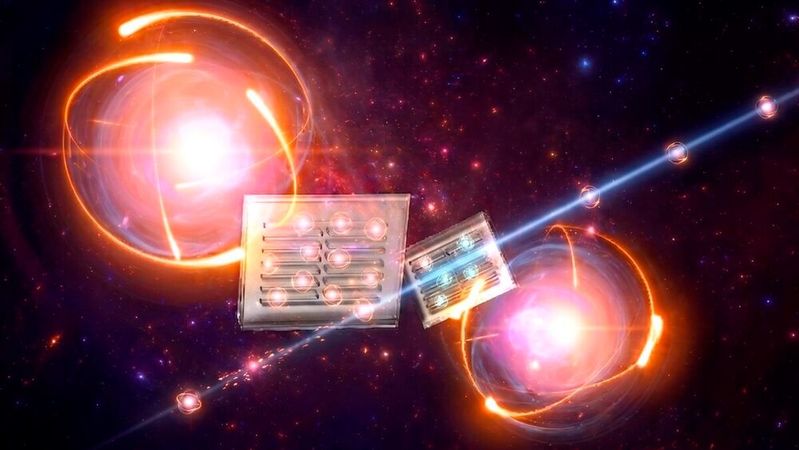
:quality(80)/p7i.vogel.de/wcms/52/7d/527dd0b214b2312f369b0ed05d6423c2/0132794981v1.jpeg "The future of sensor technology lies in atomic physics: This illustration shows a micromechanically fabricated glass vapor cell in which trapped atoms serve as a high-precision reference for measuring high-frequency electric fields. (Image:Jennifer M. McCann / Penn State)")
:quality(80)/p7i.vogel.de/wcms/1a/bf/1abf6e3b862a9ba71914b9ef7dce0ca4/0132761112v1.jpeg "Semiconductor scaling: TSMC's roadmap reveals a fundamental shift. Development is no longer solely determined by transistor density, but scaling is moving from the individual chip to the system level. (Image:TSMC)")
:fill(fff,0)/p7i.vogel.de/companies/69/de/69de1b7403b0d/simtos-logo.jpeg "simtos-logo (SIMTOS)")
Date: 08.12.2025
Naturally, we always handle your personal data responsibly. Any personal data we receive from you is processed in accordance with applicable data protection legislation. For detailed information please see our privacy policy.
Consent to the use of data for promotional purposes
I hereby consent to Vogel Communications Group GmbH & Co. KG, Max-Planck-Str. 7-9, 97082 Würzburg including any affiliated companies according to §§ 15 et seq. AktG (hereafter: Vogel Communications Group) using my e-mail address to send editorial newsletters. A list of all affiliated companies can be found here
Newsletter content may include all products and services of any companies mentioned above, including for example specialist journals and books, events and fairs as well as event-related products and services, print and digital media offers and services such as additional (editorial) newsletters, raffles, lead campaigns, market research both online and offline, specialist webportals and e-learning offers. In case my personal telephone number has also been collected, it may be used for offers of aforementioned products, for services of the companies mentioned above, and market research purposes.
Additionally, my consent also includes the processing of my email address and telephone number for data matching for marketing purposes with select advertising partners such as LinkedIn, Google, and Meta. For this, Vogel Communications Group may transmit said data in hashed form to the advertising partners who then use said data to determine whether I am also a member of the mentioned advertising partner portals. Vogel Communications Group uses this feature for the purposes of re-targeting (up-selling, cross-selling, and customer loyalty), generating so-called look-alike audiences for acquisition of new customers, and as basis for exclusion for on-going advertising campaigns. Further information can be found in section “data matching for marketing purposes”.
In case I access protected data on Internet portals of Vogel Communications Group including any affiliated companies according to §§ 15 et seq. AktG, I need to provide further data in order to register for the access to such content. In return for this free access to editorial content, my data may be used in accordance with this consent for the purposes stated here. This does not apply to data matching for marketing purposes.
Right of revocation
I understand that I can revoke my consent at will. My revocation does not change the lawfulness of data processing that was conducted based on my consent leading up to my revocation. One option to declare my revocation is to use the contact form found at https://contact.vogel.de. In case I no longer wish to receive certain newsletters, I have subscribed to, I can also click on the unsubscribe link included at the end of a newsletter. Further information regarding my right of revocation and the implementation of it as well as the consequences of my revocation can be found in the data protection declaration, section editorial newsletter.
:quality(80)/p7i.vogel.de/wcms/02/e9/02e96ae8cdd8befd5dba1ad2e07a0bf0/0128985529v1.jpeg "Researchers at TU Wien have developed electromechanical sensors that can be fully integrated into a chip. The image shows the nano-device with a planar coil. (Image:TU Vienna)")
:quality(80)/p7i.vogel.de/wcms/27/69/2769dfe9085cd4cbdb27837051f55b3b/0131782554v1.jpeg "Integrated system solution: This compact circuit board serves as a highly integrated motor controller directly in the elbow joint of humanoid robots. (Image:mc/VCG)")