Alternative Propulsion for More Sustainable Rail OperationsStadler Unveils First Narrow-Gauge Hydrogen Train
Source: Press Release
| Translated by AI
3 min Reading Time
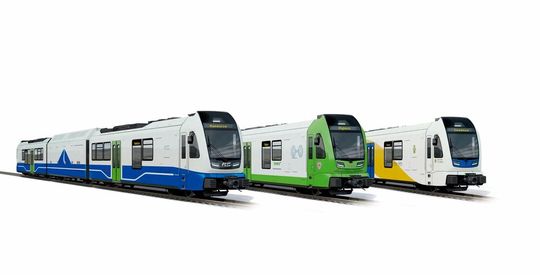
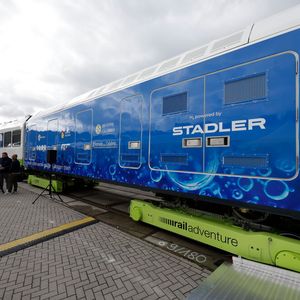
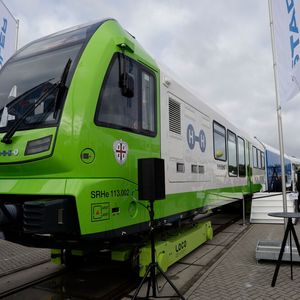
At InnoTrans 2026, Stadler, together with three southern Italian transit companies, unveiled what it claims is the world’s first narrow-gauge hydrogen train. The trains, built in Bussnang, are designed for use in Sardinia, Calabria, and Sicily. Ten trains for Sardinia are expected to reduce CO₂ emissions by up to 2,100 metric tons annually compared to the current diesel trains.
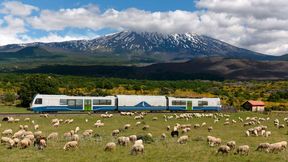
Stadler's world's first narrow-gauge hydrogen train demonstrates how sustainability, customized technology, and passenger comfort can successfully go hand in hand.
(Image: Stadler Rail AG)
Stadler is currently manufacturing 21 hydrogen trains for Sardinia’s Azienda Regionale Sarda Trasporti (ARST), Ferrovie della Calabria (FdC), and Sicily’s Ferrovia Circumetnea (FCE). The trains are being built at the company’s headquarters in Bussnang, in eastern Switzerland. The first train was manufactured for ARST. The corresponding framework agreement covers ten trains. In addition, Stadler is building nine trains for FdC and two trains for FCE. They are intended for use in regional and commuter rail service in the future.
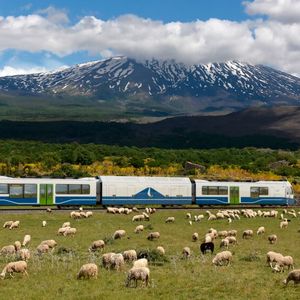
Whether it's the coastal routes of Sardinia, the tunnels of Calabria, or the steep inclines of the Etna Nature Park in Sicily: The trains are designed to meet the specific requirements of each route.
“Thanks to close collaboration with the Ministry of Transport and the transit agencies ARST, FdC, and FCE, Stadler has developed a modular solution that can be adapted to the varying requirements of Italy’s narrow-gauge rail network. All trains are based on the same technological platform and combine a compact profile, lightweight construction, and an innovative hydrogen propulsion system. This ensures high standards in terms of performance, innovation, reliability, and sustainability,” says Maurizio Oberti, Sales Manager for Italy at Stadler.
Aristide Vercillo Martino, CEO of the Calabrian railway company FdC: “The partnership between Stadler and Ferrovie della Calabria has been in place for about 20 years. It began with the first railcar developed for Italian narrow-gauge railways, which was built specifically for FdC, and has been continuously strengthened by the successful commissioning of various generations of railcars. This long-standing collaboration forms the foundation for a new generation of trains that meets both operational requirements and the expectations of passengers in Calabria. It is part of a comprehensive investment program in rail infrastructure and digital transformation that is being driven forward in collaboration with the Calabria region.”
Fuel Cells and Batteries as a Propulsion System
The narrow-gauge hydrogen trains are equipped with a propulsion system that combines hydrogen fuel cells in the middle car with batteries. The electrical energy generated from the hydrogen charges the batteries. This system enables the trains to operate on non-electrified lines.
According to Stadler, the ten hydrogen trains intended for ARST are expected to reduce CO₂ emissions by up to 2,100 metric tons annually compared to previous diesel vehicles. This is equivalent to driving around the world about 450 times.
Hydrogen from Solar Energy
The trains are fueled with hydrogen. All three transit companies rely on solar energy to produce the hydrogen they need.
“The vehicles developed with Stadler are a key component of the strategy to decarbonize the narrow-gauge network. “We are very proud to be putting the first narrow-gauge hydrogen train into service on our routes,” explains Carlo Poledrini, Executive Director of ARST. “For ARST, this is the first step on the path from being a transportation company to becoming an energy company.”
An Enhanced Travel Experience
According to the manufacturer, hydrogen trains are significantly quieter than diesel trains. Passengers also benefit from a bright interior and large panoramic windows. The low-floor entry makes it easier to get on and off the train, even for people with limited mobility.
“The trip around Mount Etna is one of Sicily’s most beautiful travel experiences. Our goal is to make every journey as pleasant as possible for our passengers. With the new hydrogen trains, we can enhance comfort while also making an important contribution to environmentally friendly mobility. “We are pleased to have Stadler as a trusted partner by our side and to make this exceptional route even more attractive for our passengers,” says Salvatore Fiore, General Manager of FCE.
Date: 08.12.2025
Naturally, we always handle your personal data responsibly. Any personal data we receive from you is processed in accordance with applicable data protection legislation. For detailed information please see our privacy policy.
Consent to the use of data for promotional purposes
I hereby consent to Vogel Communications Group GmbH & Co. KG, Max-Planck-Str. 7-9, 97082 Würzburg including any affiliated companies according to §§ 15 et seq. AktG (hereafter: Vogel Communications Group) using my e-mail address to send editorial newsletters. A list of all affiliated companies can be found here
Newsletter content may include all products and services of any companies mentioned above, including for example specialist journals and books, events and fairs as well as event-related products and services, print and digital media offers and services such as additional (editorial) newsletters, raffles, lead campaigns, market research both online and offline, specialist webportals and e-learning offers. In case my personal telephone number has also been collected, it may be used for offers of aforementioned products, for services of the companies mentioned above, and market research purposes.
Additionally, my consent also includes the processing of my email address and telephone number for data matching for marketing purposes with select advertising partners such as LinkedIn, Google, and Meta. For this, Vogel Communications Group may transmit said data in hashed form to the advertising partners who then use said data to determine whether I am also a member of the mentioned advertising partner portals. Vogel Communications Group uses this feature for the purposes of re-targeting (up-selling, cross-selling, and customer loyalty), generating so-called look-alike audiences for acquisition of new customers, and as basis for exclusion for on-going advertising campaigns. Further information can be found in section “data matching for marketing purposes”.
In case I access protected data on Internet portals of Vogel Communications Group including any affiliated companies according to §§ 15 et seq. AktG, I need to provide further data in order to register for the access to such content. In return for this free access to editorial content, my data may be used in accordance with this consent for the purposes stated here. This does not apply to data matching for marketing purposes.
Right of revocation
I understand that I can revoke my consent at will. My revocation does not change the lawfulness of data processing that was conducted based on my consent leading up to my revocation. One option to declare my revocation is to use the contact form found at https://contact.vogel.de. In case I no longer wish to receive certain newsletters, I have subscribed to, I can also click on the unsubscribe link included at the end of a newsletter. Further information regarding my right of revocation and the implementation of it as well as the consequences of my revocation can be found in the data protection declaration, section editorial newsletter.