In our “Fascination with Technology” section, we showcase impressive research and development projects for design engineers every week. Today: A robotic fish that can explore everything from shallow streams to open waters.
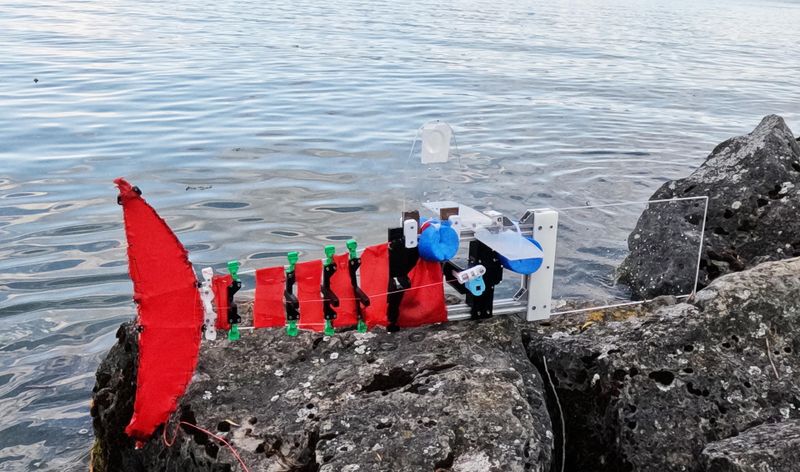
EPFL researchers have unveiled ScaFi (short for “Scalable Fish”), a robot modeled after fish such as cod and mackerel. Its size can be adjusted as needed.
Propeller-driven underwater vehicles have long assisted scientists in researching and monitoring marine environments. However, their mechanical design imposes limitations: Rotating propellers can get caught in vegetation, stir up sediment, and startle the animals they are actually meant to study. As a result, they are only partially suitable for shallow streams, densely vegetated bodies of water, or observing fish at close range.This is one of the reasons why robotics experts have been developing machines for years that move like fish—by bending their bodies instead of rotating a propeller. The challenge is that most fish-inspired robots are designed for a specific size and a specific task. Scaling them up or down therefore usually means starting from scratch.
If you want to monitor a stream and then a lake today, you basically need two different robots, each of which must be developed and tested from scratch.
Nana Obayashi
A team of engineers from EPFL and New York University (NYU) believes it has found a solution to this problem. The researchers introduced ScaFi (short for “Scalable Fish”), a robot modeled after fish such as cod and mackerel. These fish concentrate the greatest curvature of their bodies in the area near the tail. In nature, this mode of locomotion works across an unusually wide range of body sizes.“If you want to monitor a stream and then a lake today, you basically need two different robots, each of which has to be developed and tested from scratch,” says Nana Obayashi, first author of the study published in npj Robotics. “The environments we’re interested in don’t come in one size—so neither should our tools.” Obayashi is currently an assistant professor of mechanical and aerospace engineering at the NYU Center for Robotics and Embodied Intelligence. She led the project during her Ph.D. at the Computational Robot Design & Fabrication Lab, headed by Josie Hughes, in the School of Engineering at EPFL.
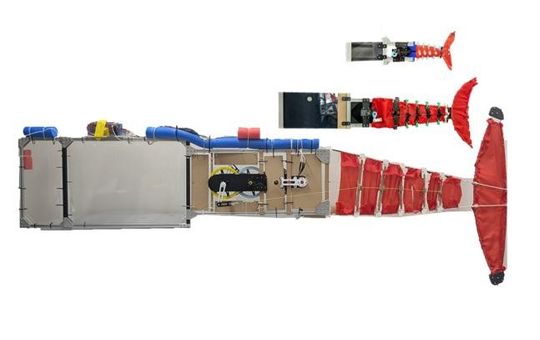
ScaFi has a rigid front section and a flexible tail made of fiberglass rods. A single motor pulls on two cables that cross near the tail end. This creates the S-shaped curvature required for the fish-like swimming motion. The diameters of the rods that make up the tail are the only components that need to be adjusted to the robot’s size. As the robot is scaled up, the rods become proportionally thicker to ensure comparable bending behavior of the tail. The underlying drive mechanism and the system of crossed cable pulls remain unchanged. This is significant because it could reduce the development effort required for fish-like robots designed for different environments. At the same time, researchers gain a platform with which they can systematically investigate how swimming performance changes with size—a question that is difficult to study systematically in both animals and custom-built robots.
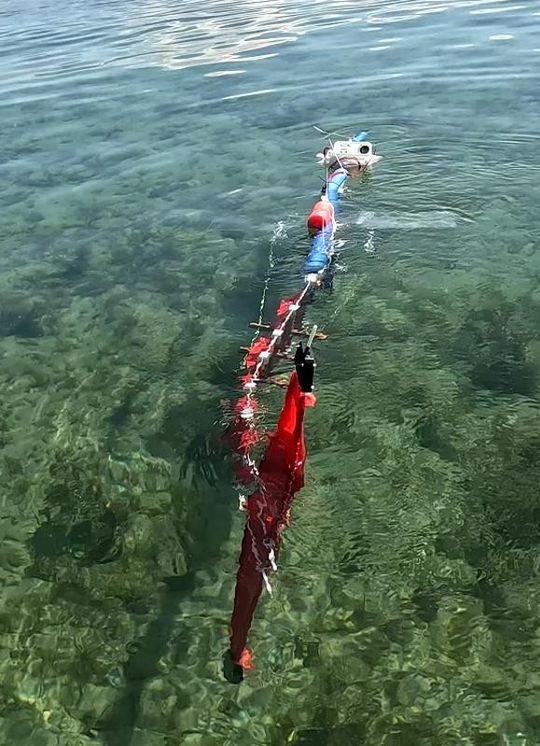
The team built three robots measuring approximately 0.6 (1.97 feet), 1.1 (3.61 feet), and 2.9 meters (9.51 feet) in length and tested how well they could swim. In collaboration with the EPFL Unsteady Flow Diagnostics Lab, led by Karen Mulleners, the researchers found that the smallest robot generated vortex patterns in the water similar to those of real fish. For all three sizes, the swimming motion closely matched that of real fish after adjusting for body size. This suggests that the scaling approach preserved the fish-like movement pattern even though the robot’s length increased nearly fivefold. The researchers also tested the robots under real-world conditions: the medium-sized robot in a Swiss stream, the largest in Lake Geneva, and the smallest in streams only 15 to 30 centimeters (5.9 to 11.8 inches) deep. During the test in the stream, the robot continued to swim even after the GPS connection failed. However, energy efficiency proved more difficult to scale. The two smaller robots achieved similar results, while the largest was consistently less efficient and required a different, more powerful motor. The authors suspect that flow resistance and inertia may be responsible for this. The exact cause, however, remains unclear. The team was thus able to scale the swimming motion itself more reliably than the energy expenditure required to generate it. A similar trade-off emerged in disturbance tests. The smallest robot was the most maneuverable but took the longest to stabilize after a course deviation. The larger robots were less maneuverable but more stable. The same approach, in which scaling is based on a central structural parameter, could also be applied to other compliant robots—including those used outside of water. Whether energy efficiency can be scaled as successfully as the swimming motion remains an open question.
Date: 08.12.2025
Naturally, we always handle your personal data responsibly. Any personal data we receive from you is processed in accordance with applicable data protection legislation. For detailed information please see our privacy policy.
Consent to the use of data for promotional purposes
I hereby consent to Vogel Communications Group GmbH & Co. KG, Max-Planck-Str. 7-9, 97082 Würzburg including any affiliated companies according to §§ 15 et seq. AktG (hereafter: Vogel Communications Group) using my e-mail address to send editorial newsletters. A list of all affiliated companies can be found here
Newsletter content may include all products and services of any companies mentioned above, including for example specialist journals and books, events and fairs as well as event-related products and services, print and digital media offers and services such as additional (editorial) newsletters, raffles, lead campaigns, market research both online and offline, specialist webportals and e-learning offers. In case my personal telephone number has also been collected, it may be used for offers of aforementioned products, for services of the companies mentioned above, and market research purposes.
Additionally, my consent also includes the processing of my email address and telephone number for data matching for marketing purposes with select advertising partners such as LinkedIn, Google, and Meta. For this, Vogel Communications Group may transmit said data in hashed form to the advertising partners who then use said data to determine whether I am also a member of the mentioned advertising partner portals. Vogel Communications Group uses this feature for the purposes of re-targeting (up-selling, cross-selling, and customer loyalty), generating so-called look-alike audiences for acquisition of new customers, and as basis for exclusion for on-going advertising campaigns. Further information can be found in section “data matching for marketing purposes”.
In case I access protected data on Internet portals of Vogel Communications Group including any affiliated companies according to §§ 15 et seq. AktG, I need to provide further data in order to register for the access to such content. In return for this free access to editorial content, my data may be used in accordance with this consent for the purposes stated here. This does not apply to data matching for marketing purposes.
Right of revocation
I understand that I can revoke my consent at will. My revocation does not change the lawfulness of data processing that was conducted based on my consent leading up to my revocation. One option to declare my revocation is to use the contact form found at https://contact.vogel.de. In case I no longer wish to receive certain newsletters, I have subscribed to, I can also click on the unsubscribe link included at the end of a newsletter. Further information regarding my right of revocation and the implementation of it as well as the consequences of my revocation can be found in the data protection declaration, section editorial newsletter.



:quality(80)/p7i.vogel.de/wcms/81/d4/81d47ab5407c961b55233009313ac9d2/0133075510v1.jpeg "Small, but designed for demanding applications: KSK demonstrates that the diameter of ball screws says nothing about their load-carrying capacity. (Image:Arkero)")
:quality(80)/p7i.vogel.de/wcms/6b/80/6b80bac3b1b33a0e3bc17849bef4ba59/0133171618v1.jpeg "With its portal solution for the MAK 4 Evolution UD swivel-bending machine, Schröder enables the fully automated production of sheet-metal enclosures. (Image:Schröder Group)")
:quality(80)/p7i.vogel.de/wcms/a0/1d/a01ddede6a787a4844122c2f42cfbce9/0133067101v1.jpeg "In solar module manufacturing, lasers are used for tasks such as patterning, drilling, and cutting delicate layers. Precise energy delivery is crucial to avoid damaging adjacent areas. (Image:Dall-E / AI-generated)")
:quality(80)/p7i.vogel.de/wcms/6c/98/6c98f4dd0780456713eee6379b3f534f/0132999605v1.jpeg "This specific project involved a similar surgical screw. (Image:KLS Martin)")
:quality(80)/p7i.vogel.de/wcms/ff/45/ff451109015c2f01b67ad3b0bad321ea/werma-success-story-skanska-1v1.webp "WeAssist combines traditional signal towers with a smart cloud solution. This allows the different colors of the signal towers to facilitate clear and intuitive communication during operations. (Source: Werma)")
:quality(80)/p7i.vogel.de/wcms/86/b1/86b14463fdbf6e77cafa6709433114bf/0132830551v1.jpeg "A look inside the automated testing lab at Amag Austria Metall AG's SmartFactory. (Image:Amag Austria Metall AG)")
:quality(80)/p7i.vogel.de/wcms/29/a8/29a8ea15ab38e4404bc1c6a3e425e454/adobestock-1550141473--leopard-stock-adobe-com-ki-generiertv1.jpeg "When Machines Understand What They're Doing—The Five Technologies Behind Physical AI. (Source: © Leopard – stock.adobe.com_AI-generated)")
:quality(80)/p7i.vogel.de/wcms/a0/0c/a00c9b7242fa38414b3281a9cd6dcc39/0133127938v1.jpeg "Demand for electronics and semiconductor products is expected to continue growing, prompting manufacturers to innovate and ramp up production while overcoming challenges. (Image:Siemens)")
:quality(80)/p7i.vogel.de/wcms/01/f1/01f16ebdc19b9cbde5bc1a7f421f9174/csm-a264340-web-1440-d0360d8de9v1.webp "At the 2026 Dutch Grand Prix in late August, two filtration systems developed by TU Berlin were used in top-level motorsports for the first time. (Source: Audi Revolut F1 Team)")
:quality(80)/p7i.vogel.de/wcms/00/c3/00c3f0f623f1b22935c99a2d364e2b6f/4082x2406v1.jpeg "EPFL researchers have unveiled ScaFi (short for “Scalable Fish”), a robot modeled after fish such as cod and mackerel. Its size can be adjusted as needed. (2026 CREATE Lab EPFL)")
:quality(80)/p7i.vogel.de/wcms/fd/76/fd76fd67142ded48cfcb2e819bea231b/0133154160v1.jpeg "The pacemaker implant is flexible and conforms to the shape of the brain. This significantly improves comfort. (Image:Fraunhofer IZM)")
:quality(80)/p7i.vogel.de/wcms/d5/49/d549f4999960da7667d46c23e68f31b9/denza-z9gt-03detail-062v1.jpeg "Some companies in China are competing to offer the shortest charging time. (Image:BYD)")
:quality(80)/p7i.vogel.de/wcms/94/d5/94d564c8630570efab7bf1afd87afb34/0133150604v1.jpeg "For years, the trend in cars was to have fewer buttons and ever-larger displays. Now, a shift is taking place in China: buttons are making a comeback. (Image:Freely licensed on Pixabay)")
:quality(80)/p7i.vogel.de/wcms/a4/b7/a4b7d453522f2cbb8e89f18b0f48a4e2/0131845932v1.jpeg "Hardly any stress! In the negotiations over VW’s drastic cost-cutting package, agreements have already been reached on several key points. VW CEO Oliver Blume calls this an encouraging sign. Read here to find out what happened on September 3... (Image:Volkswagen)")
:quality(80)/p7i.vogel.de/wcms/d2/36/d236c7089523726327e9d2d3a6c28f9b/0133152555v1.jpeg "To ensure that hydrogen, in addition to electric powertrains for trucks, becomes more widely adopted as an alternative propulsion option, several major companies are now collaborating. Here’s who they are and what exactly this is all about ... (Image:AI-generated)")
:quality(80)/p7i.vogel.de/wcms/7d/a3/7da3623df87775722e9ba4fda7e16dc7/0133164888v1.jpeg "Z.ai told ChatGPT how it would like to be portrayed. (Image:Dall-E / AI-generated)")
:quality(80)/p7i.vogel.de/wcms/88/62/886275be9b95f912061e9d7e77a3b799/0133171501v1.jpeg "Secure and reliable cloud platforms for businesses have long since become a strategic decision. (Image:Pixabay / Brian Penny / AI-generated)")
:quality(80)/p7i.vogel.de/wcms/0d/da/0dda2dc67d266b0577dd243f8e6321dd/0133153751v1.jpeg "The rising demand for AI infrastructure is having a direct impact on the supply chain and exposing bottlenecks in production. (Image:Broadcom)")
:quality(80)/p7i.vogel.de/wcms/00/71/0071675c8d6f934225a970a9731b905e/0133122313v1.jpeg "From the physical chip to a stable computing environment: The industrial viability of quantum processors is determined by circuit-level performance—not by qubit counts alone. (Image:Gemini / AI-generated)")
:fill(fff,0)/p7i.vogel.de/companies/69/88/69882c428938e/tmts2026-ticec-banner-en-2000px.png "tmts2026-ticec-banner-en-2000px (https://www.tmts.tw/en)")
:fill(fff,0)/p7i.vogel.de/companies/69/de/69de1b7403b0d/simtos-logo.jpeg "simtos-logo (SIMTOS)")
:quality(80)/p7i.vogel.de/wcms/53/6b/536b0bb25290f40453cf286dddc11ef6/3840x2160v1.jpeg "The so-called \"flapping-wing aerial-aquatic vehicle\" (FAAV) weighs less than 300 grams and is designed to help researchers study the mechanics that allow diving birds to move both in the air and in the water. (Source: Raphael Zufferey)")
:quality(80)/p7i.vogel.de/wcms/53/6b/536b0bb25290f40453cf286dddc11ef6/3840x2160v1.jpeg "The so-called \"flapping-wing aerial-aquatic vehicle\" (FAAV) weighs less than 300 grams and is designed to help researchers study the mechanics that allow diving birds to move both in the air and in the water. (Source: Raphael Zufferey)")
:quality(80)/p7i.vogel.de/wcms/5f/93/5f93e81c3f1403b7371fa628a59ec214/0128309625v1.jpeg "Robot grippers made from langoustine tails: EPFL researchers combine biological elements with synthetic components. (Image:EPFL)")