In the "GenISys" project, researchers from the University of Wuppertal, in collaboration with two industry partners, are developing generative AI models aimed at revolutionizing the construction of filling plants. The initiative focuses on making these plants smarter and more resource-efficient. The overarching goal is to enhance the adoption of artificial intelligence across key economic sectors, thereby driving innovation and efficiency.
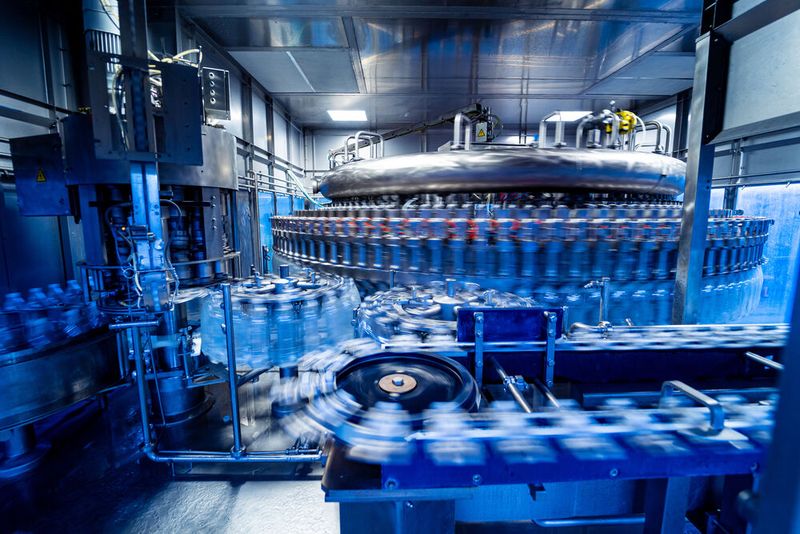
The design and construction of industrial filling plants is complex. With the help of generative AI, the configuration is expected to be more resource-saving and intelligent in the future.
(Image: romaset - stock.adobe.com)
Generative AI models are designed to generate new content from existing data. In many enterprise and user applications, the models are already integrated and demonstrate impressive capabilities, such as generating human-like texts. "However, in the industrial production area, the known potential and capability of generative AI approaches remain almost unused. This is partly because AI methods have not yet been adapted for areas of application with very specific requirements," explains Dr. Hasan Tercan, scientific director of the research area "Industrial Deep Learning" at the Chair for Technologies and Management of Digital Transformation at Bergische Universität.
Complex, costly, lengthy
Such a special area of application is the design and construction of industrial filling plants, for example for powdery and granular material like cement, which needs to be bagged in mass production. The elaborate, partly manual configuration process of these plants is characterized by laboratory tests to determine the properties of the material to be filled, as well as the development and multi-stage testing of a plant prototype. When new operational requirements and changing material properties occur, further necessary adaptation steps follow in the operation of the plant. "This labor-intensive character of the design process in conjunction with the recurring need to redefine parameters due to material changes emphasizes the need for a more innovative and adaptable approach to plant configuration," says Tercan.
Reduce test cycles
The scientist and his team are working in the now launched research project "GenISys" together with the software company Snap and the plant manufacturer Haver & Boecker to reduce the number of test cycles using digital technologies and the use of generative AI methods. In doing so, they not only want to push forward the implementation of innovative ideas and services in the industry—less production effort and less material use also protect the environment.
The significance of the innovation, according to the project partners, goes far beyond its immediate application in machinery and plant construction. Since the AI development and training process is carefully designed for adaptability and expandability, the application framework can later—for example in the form of a license model for an AI module kit—be seamlessly reused in different contexts, enabling integration into other industries.
Goal: Development of an AI-based, easy-to-use and interactive software application
The vision of the project is to develop an AI-based, easy-to-use and interactive software application for plant construction companies and plant operators. The starting point for "GenISys" is data and information about a customer order, on the basis of which the software to be developed should configure a new filling plant. The data consists of the material properties of the product to be filled—such as grain size and density - which were determined through laboratory investigations, and existing microscopic images of the product, which have so far been mainly produced for documentation and verification purposes. In addition, historical data from thousands of plant configurations and product properties are available for training the AI models integrated in the software.
To implement the software in a practical manner, the architecture of the AI models, training methods, modularization strategies for integration into existing business processes and automation strategies for their continuous optimization as well as concepts for integrating human feedback need to be adapted and partially redeveloped.
Date: 08.12.2025
Naturally, we always handle your personal data responsibly. Any personal data we receive from you is processed in accordance with applicable data protection legislation. For detailed information please see our privacy policy.
Consent to the use of data for promotional purposes
I hereby consent to Vogel Communications Group GmbH & Co. KG, Max-Planck-Str. 7-9, 97082 Würzburg including any affiliated companies according to §§ 15 et seq. AktG (hereafter: Vogel Communications Group) using my e-mail address to send editorial newsletters. A list of all affiliated companies can be found here
Newsletter content may include all products and services of any companies mentioned above, including for example specialist journals and books, events and fairs as well as event-related products and services, print and digital media offers and services such as additional (editorial) newsletters, raffles, lead campaigns, market research both online and offline, specialist webportals and e-learning offers. In case my personal telephone number has also been collected, it may be used for offers of aforementioned products, for services of the companies mentioned above, and market research purposes.
Additionally, my consent also includes the processing of my email address and telephone number for data matching for marketing purposes with select advertising partners such as LinkedIn, Google, and Meta. For this, Vogel Communications Group may transmit said data in hashed form to the advertising partners who then use said data to determine whether I am also a member of the mentioned advertising partner portals. Vogel Communications Group uses this feature for the purposes of re-targeting (up-selling, cross-selling, and customer loyalty), generating so-called look-alike audiences for acquisition of new customers, and as basis for exclusion for on-going advertising campaigns. Further information can be found in section “data matching for marketing purposes”.
In case I access protected data on Internet portals of Vogel Communications Group including any affiliated companies according to §§ 15 et seq. AktG, I need to provide further data in order to register for the access to such content. In return for this free access to editorial content, my data may be used in accordance with this consent for the purposes stated here. This does not apply to data matching for marketing purposes.
Right of revocation
I understand that I can revoke my consent at will. My revocation does not change the lawfulness of data processing that was conducted based on my consent leading up to my revocation. One option to declare my revocation is to use the contact form found at https://contact.vogel.de. In case I no longer wish to receive certain newsletters, I have subscribed to, I can also click on the unsubscribe link included at the end of a newsletter. Further information regarding my right of revocation and the implementation of it as well as the consequences of my revocation can be found in the data protection declaration, section editorial newsletter.
The project "GenISys—Intelligent system for resource-conserving plant configuration with generative AI technology" is funded as part of the innovation competition NEXT.IN.NRW by the Ministry of Economics, Industry, Climate Protection and Energy of the state of North Rhine-Westphalia and the European Union with funds from the European Regional Development Fund (ERDF program NRW 2021-2027).



:quality(80)/p7i.vogel.de/wcms/8e/7e/8e7e0cda4c68699bcc48283a38739769/0133316747v1.jpeg "A little-known hidden champion! When people think of laser cutting, the first thing that comes to mind is the power of the laser beam—and it is impressive to see the sparks flying. But Air Liquide—an exhibitor at Euroblech, by the way—wants to make it clear that the process gas is also key to success. (Image:AI-generated)")
:quality(80)/p7i.vogel.de/wcms/20/fa/20fa35e0af203c3464f7e7fdbb57a685/0133281172v1.jpeg "Since 2003, Etzinger AG has been developing and manufacturing high-quality coffee grinders, pepper mills, and grinding mechanisms for professional and home use. (Image:Etzinger)")
:quality(80)/p7i.vogel.de/wcms/69/91/6991413943488b4a2f6fde9dcd88c5b0/0133256686v1.jpeg "The CMA-patented pendulum mount can compensate for radial tolerances of up to one millimeter. (Image:Schwiening)")
:quality(80)/p7i.vogel.de/wcms/0b/cd/0bcd6d502ffcd087c4fc12b7b760b3ce/0133317507v2v1.jpeg "The new Multi Center from J.G. Weisser. (Image:J.G. Weisser)")
:quality(80)/p7i.vogel.de/wcms/bd/4e/bd4ef09ab0f84932ea76ca0330ffe789/0133329802v1.jpeg "The robotics boom and its consequences: According to a study, a significant portion of value creation occurs in the electronics industry. (Image:Fraunhofer IPA)")
:quality(80)/p7i.vogel.de/wcms/35/81/35815f36be1b1c13f9abef4cea2a3e2b/0133171739v1.jpeg "Humanoid robots in industry: Despite impressive progress, many systems are still in the pilot phase. (Image:AI-generated)")
:quality(80)/p7i.vogel.de/wcms/81/dc/81dc63ed24c562521413023779495e7d/chris-kramerv1.jpeg "Chris Kramar, Director and General Manager of OEM Solutions for Germany, Austria, and Switzerland at Dell Technologies (Source: Dell Technologies)")
:quality(80)/p7i.vogel.de/wcms/bb/f5/bbf5342f532debc1bd7c09c2b9a0bf42/0133176497v1.jpeg "Over the past two years, AI has emerged as the most important growth driver in the industry. (Image: ©Gorodenkoff - stock.adobe.com)")
:quality(80)/p7i.vogel.de/wcms/e9/19/e91905d37afe605bc348a690a4fed72e/0133350592v1.jpeg "At Autodesk University, Autodesk is introducing new AI features for CAD and PLM. (Image:Autodesk)")
:quality(80)/p7i.vogel.de/wcms/98/73/98731d23cbd95ff22391993a74cfefbf/mit-bifurcatedcircuits-01-pressv1.jpeg "A sample of the variety of configurations that Bifur circuits can form. (Source: Courtesy of the researchers)")
:quality(80)/p7i.vogel.de/wcms/f4/3d/f43d1f4297d9ae0cd1b6d2adfcb5ffe1/0133276470v1.jpeg "Simulation: Electric arcs in the electrical industry, including associated field simulation. (Image:CADFEM)")
:quality(80)/p7i.vogel.de/wcms/3e/f1/3ef196715e1b291ec7ae84f02c875c63/0133310495v1.jpeg "The Next Phase of Ethernet in Vehicles: End-to-end Ethernet integrates all high-data-rate devices into the network, including displays and central high-performance computing units. (Image:Infineon Technologies)")
:quality(80)/p7i.vogel.de/wcms/b4/b8/b4b89c48bb797df7251706d4ee096a80/0133359349v1.jpeg "To advance modern rail transportation, Knorr-Bremse and CARS have signed a memorandum of understanding regarding the China Freight Cooperation Program. Pictured here is Rail Executive Board Member Nicolas Lange at the signing ceremony in Beijing. (Image: Knorr-Bremse)")
:quality(80)/p7i.vogel.de/wcms/99/8c/998cb26cfb3110e8444a4ecbfe2dc799/0133338279v1.jpeg "Electric car manufacturer Rivian is launching its R2 SUV in the U.S. (Image:Rivian)")
:quality(80)/p7i.vogel.de/wcms/cc/d1/ccd1607af856c9cff96c73a5ffccfcad/p90652283-highres-demonstrator-woodenv1.jpeg "The FSCM research project, which was recently completed, is delivering innovations close to production for plastics, metals, and design at BMW. (Source: BMW)")
:quality(80)/p7i.vogel.de/wcms/4c/53/4c534208d09a9b1ce597938715e7fc19/0133288763v1.jpeg "Logic Folding: In its latest Kirin 9050 Pro, Huawei uses hybrid bonding to distribute the computing units across two silicon layers in order to increase the effective transistor density without resorting to finer manufacturing processes. (Image:Huawei)")
:quality(80)/p7i.vogel.de/wcms/56/d1/56d131e0b5bd05ef47411e92ad740cb4/0133351029v1.jpeg "Researchers at DTU have developed a nanolaser in a semiconductor membrane. The structure concentrates charge carriers and the light field into a small area (shaded in blue). If data is transmitted on microchips using light instead of electrical signals, transmission speeds can be increased and energy losses reduced. (Image:Yi Yu, DTU)")
:quality(80)/p7i.vogel.de/wcms/5e/55/5e55101ddc6338f755fcf3244db1367f/0133331863v1.jpeg "For data center projects, it is becoming increasingly important to also obtain the consent of the affected community. (Image:Dall-E / AI-generated)")
:quality(80)/p7i.vogel.de/wcms/8d/f9/8df95d3f58408673986b3d643e6b63ba/0133252773v1.jpeg "TXC targets high-speed optical links in AI data centers with 312.5 MHz oscillators, among other solutions. As data rates increase, requirements for jitter and frequency stability become more demanding as well. (Bild: TXC)")
:fill(fff,0)/p7i.vogel.de/companies/68/a4/68a47beec75ce/logo-cmyk-de.jpeg "logo-cmyk-de (https://www.datatec.eu/)")
:fill(fff,0)/p7i.vogel.de/companies/69/88/69882c428938e/tmts2026-ticec-banner-en-2000px.png "tmts2026-ticec-banner-en-2000px (https://www.tmts.tw/en)")
:fill(fff,0)/p7i.vogel.de/companies/69/de/69de1b7403b0d/simtos-logo.jpeg "simtos-logo (SIMTOS)")
:quality(80)/p7i.vogel.de/wcms/5c/6b/5c6ba3b01c770e0430c88a902149b004/0129558666v1.jpeg "Using quantum computing for highly complex industrial applications: this is what the Q-Genesys project is working on. (Picture: ©Kale Galaxy - stock.adobe.com)")
:quality(80)/p7i.vogel.de/wcms/56/b7/56b78fe38aee52e7604505c11876c35f/0131730705v1.jpeg "AI agents will play an increasingly important role. (Image:Sabo Mobile IT)")