ChinaMajor Fire at BYD Followed by Strict Battery Regulation
From
Henrik Bork | Translated by AI
6 min Reading Time
Time and again, videos of burning electric cars can be found on social media. Now the Chinese government wants to tackle the fires and the skepticism of potential buyers.
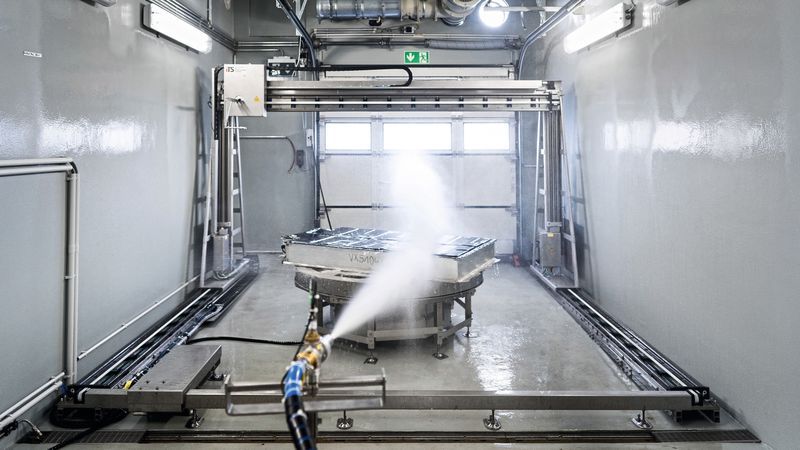
The picture shows a TÜV Rheinland test chamber. In this chamber, batteries can be loaded and overloaded in a controlled manner.
(Image: TÜV Rheinland/Oliver Tjaden)
Once again, a "BYD fire" is a major topic on social media in China. Footage of the dense smoke clouds, directly above the premises of the Chinese electric car manufacturer in Shenzhen, was spreading even while the fire department was still busy extinguishing the flames.
This time it was no small incident, but a major fire. In the early morning hours of April 14, a multi-story parking garage on the main factory premises of the Chinese auto giant went up in flames.
Only after six hours did the fire department announce that the open fire had been extinguished. However, black smoke remained visible over the industrial district of Pingshan for many hours afterward.
The Fire Comes at an Inopportune Time
Fortunately, no one was injured. BYD stated that the affected building was a "parking garage" used solely for storing test vehicles and decommissioned old vehicles. Neither production lines within the factory nor new cars were affected. At least, that’s the official statement from the company.
Preliminary investigations suggest the cause was improper work by an external construction company on the parking garage—not a defective traction battery.
However, the fire and the unwelcome attention from the Chinese public come at a very inopportune time for BYD: The world leader in electric vehicles has just launched a large charging infrastructure initiative to defend its market share against increasingly fierce domestic competition.
5,000 superfast chargers with megawatt output are already installed in 297 Chinese cities, and the number is expected to reach 20,000 by the year's end. Meanwhile, BYD has raised its export target for 2026 from 1.3 million to 1.5 million vehicles. Approximately 120,000 cars were exported in March, an increase of 65.12 percent compared to the same month last year.
Batteries Are Not the Cause
For all these ambitions, images of dense smoke clouds over the company logo are rather unfavorable. Moreover, the fire in Shenzhen was already BYD's second within five days. On April 9, there had been a fire at the Blade Battery production site FinDreams in Shengzhou, Zhejiang Province.
"These incidents highlight general challenges in safety management in the rapidly developing new energy industry," writes the Chinese energy storage specialist portal Chuneng Zhijia. The report emphasizes that "neither of the two fires involved battery self-ignition."
It is undisputed, however, that this latest fire in Shenzhen is part of a long series of major fires related to e-mobility that are unsettling car buyers in China due to their frequency.
Not Only BYD Is Affected
An electric car from BYD competitor Xiaomi caught fire in Chengdu after a high-speed collision. The driver died. Witnesses reported that the doors could not be opened and the windows could not be smashed.
An electric car from the manufacturer Li Auto caught fire in Shanghai while driving on a bumpy road. The Geely Xingyuan, China's best-selling electric model, caught fire during a drive in Suzhou and exploded several times. Geely had previously marketed its Aegis Short Blade Battery with the label "Safety Class A."
How Safe Are the Cars?
There was also a recent spectacular incident involving the transport of Chinese electric cars. A cargo ship carrying 800 electric vehicles caught fire.
Between August 2024 and June 2025 alone, there were reportedly about 300 fires involving electric cars in China, according to the portal The Economy, citing insiders. As there are no reliable statistics, especially none from the government in Beijing, the exact extent of the fire risk remains unclear.
“Thick columns of smoke drift through the night sky, rapidly spreading images captured on mobile phones. This is followed by a collective question from millions of consumers: Can the safety of the vehicles they wish to rely on still be trusted?” writes the Chinese industry portal Youjia.
Date: 08.12.2025
Naturally, we always handle your personal data responsibly. Any personal data we receive from you is processed in accordance with applicable data protection legislation. For detailed information please see our privacy policy.
Consent to the use of data for promotional purposes
I hereby consent to Vogel Communications Group GmbH & Co. KG, Max-Planck-Str. 7-9, 97082 Würzburg including any affiliated companies according to §§ 15 et seq. AktG (hereafter: Vogel Communications Group) using my e-mail address to send editorial newsletters. A list of all affiliated companies can be found here
Newsletter content may include all products and services of any companies mentioned above, including for example specialist journals and books, events and fairs as well as event-related products and services, print and digital media offers and services such as additional (editorial) newsletters, raffles, lead campaigns, market research both online and offline, specialist webportals and e-learning offers. In case my personal telephone number has also been collected, it may be used for offers of aforementioned products, for services of the companies mentioned above, and market research purposes.
Additionally, my consent also includes the processing of my email address and telephone number for data matching for marketing purposes with select advertising partners such as LinkedIn, Google, and Meta. For this, Vogel Communications Group may transmit said data in hashed form to the advertising partners who then use said data to determine whether I am also a member of the mentioned advertising partner portals. Vogel Communications Group uses this feature for the purposes of re-targeting (up-selling, cross-selling, and customer loyalty), generating so-called look-alike audiences for acquisition of new customers, and as basis for exclusion for on-going advertising campaigns. Further information can be found in section “data matching for marketing purposes”.
In case I access protected data on Internet portals of Vogel Communications Group including any affiliated companies according to §§ 15 et seq. AktG, I need to provide further data in order to register for the access to such content. In return for this free access to editorial content, my data may be used in accordance with this consent for the purposes stated here. This does not apply to data matching for marketing purposes.
Right of revocation
I understand that I can revoke my consent at will. My revocation does not change the lawfulness of data processing that was conducted based on my consent leading up to my revocation. One option to declare my revocation is to use the contact form found at https://contact.vogel.de. In case I no longer wish to receive certain newsletters, I have subscribed to, I can also click on the unsubscribe link included at the end of a newsletter. Further information regarding my right of revocation and the implementation of it as well as the consequences of my revocation can be found in the data protection declaration, section editorial newsletter.
New Safety Standard
Even as more and more car buyers consider switching from a combustion engine to an electric vehicle, every report of a fire deters potential buyers. For many customers in China, buying an electric car feels "as if they are risking their lives for a cheaper car," summarized an online portal reflecting the growing skepticism.
The Chinese government is responding to the many fires and the growing insecurity of its citizens with a new safety standard for car batteries. Starting July 1, 2026, the new mandatory standard GB 38031-2025, titled “Safety Requirements for Traction Batteries of Electric Vehicles,” will come into effect nationwide.
It was already jointly developed and published in March 2025 by the Chinese Ministry of Industry and Information Technology (MIIT), the State Administration for Market Regulation, and the National Standardization Administration. Experts comment that it is the "strictest battery safety regulation of all time."
Increasingly Strict Rules
The essence of the tightening can be summarized in four words: "No fire, no explosion." Under the previously valid version GB 38031-2020, it was sufficient if battery systems warned five minutes before thermal runaway, that feared chain reaction that can cause lithium-ion cells to ignite uncontrollably in extreme cases.
The new version, effective from the beginning of July, demands significantly more. A battery pack must not catch fire or explode even if thermal runaway has already occurred in a single cell.
Additionally, manufacturers are required to conduct a ground impact test to simulate severe underbody collisions and a short-circuit test after 300 completed fast-charging cycles, which also must not allow fire or explosions.
Safety Regulation Creates Breakthrough
"The safety standards for traction batteries of electric vehicles represent a breakthrough in safety regulation," the Chinese state broadcaster CCTV quotes Liu Hongsheng, the Director of the Standardization Division at the State Administration for Market Regulation.
"The requirement will oblige automakers to optimize battery structures and thermal management systems to improve the overall safety of new energy vehicles," said the official. The regulation will apply to new type approvals from the cut-off date of July 1. For already homologated models, a transition period is planned until July 1, 2027.
BYD Already There
Manufacturers with limited technical capacities might struggle to comply with this strict norm. The requirements are considered the world's first attempt to directly regulate reactions inside batteries. There are doubts about whether all manufacturers can truly meet these new requirements.
BYD claims that its laminated LFP modules from the Blade Battery series of lithium iron phosphate cells already meet the new requirements ahead of time. A corresponding certification from an authorized testing center is available, according to the company.
From a materials science perspective, this is plausible, writes the specialist portal Chuneng Zhijia. LFP cathodes have a thermal stability threshold of more than 500 degrees Celsius (approx. 930 °F), while ternary lithium battery systems can become unstable at around 200 degrees (approx. 390 °F).
Solid-State Batteries Are the Future
In the nail penetration test, a sort of benchmark for battery safety in China, laminated LFP batteries show no open flames or smoke when a sharp metal object pierces the cell.
For the future, the Chinese industry is setting its sights on a new type of traction battery. Solid-state batteries, which have a solid rather than liquid electrolyte, are considered less prone to catching fire, higher in energy density, and better for fast charging.
"Solid-state batteries are the answer for the future of mobility," Davis Zhang, a senior manager at specialty battery provider Suzhou Hazardtex, told the South China Morning Post (SCMP).
Not Until 2030 in the Market
Several Chinese automakers are currently preparing for mass production of solid-state batteries. "Leading companies in the next generation of batteries are likely to emerge as winners in the coming two years," the SCMP quoted an industry observer from Shanghai.
"Solid-state batteries could become the preferred choice for both manufacturers and consumers, as they improve efficiency and simultaneously boost confidence in vehicle reliability."
However, it will still be some time before solid-state batteries are ready for mass production. CATL has announced mass production of solid-state batteries for 2027. The company expects widespread market adoption only from 2030.
Are Batteries Too Expensive?
By the time they are commercially available, the price of these particularly fire-safe batteries may remain a hurdle. Current battery packs with a range of 500 kilometers cost over 20,000 yuan (approximately 2,500 euros) to manufacture, while solid-state variants could cost an estimated three times as much.
Until the new wonder batteries are mass-produced, BYD and its competitors will mainly have to hope that there aren't too many videos of devastating major fires appearing on China's social media. This isn't easy, as in China, someone always has a phone ready when there's a fire.



:quality(80)/p7i.vogel.de/wcms/17/b8/17b8af0cb725e0e1d3e8d72458bab260/siemens-meet-at-the-machinev1.jpeg "“Meet at the Machine” is Siemens’ new initiative, which aims to bring together machine builders, software, and automation technologies to accelerate innovation in the machine tool industry and help manufacturers become productive more quickly. (Source: Siemens)")
:quality(80)/p7i.vogel.de/wcms/8e/7e/8e7e0cda4c68699bcc48283a38739769/0133316747v1.jpeg "A little-known hidden champion! When people think of laser cutting, the first thing that comes to mind is the power of the laser beam—and it is impressive to see the sparks flying. But Air Liquide—an exhibitor at Euroblech, by the way—wants to make it clear that the process gas is also key to success. (Image:AI-generated)")
:quality(80)/p7i.vogel.de/wcms/20/fa/20fa35e0af203c3464f7e7fdbb57a685/0133281172v1.jpeg "Since 2003, Etzinger AG has been developing and manufacturing high-quality coffee grinders, pepper mills, and grinding mechanisms for professional and home use. (Image:Etzinger)")
:quality(80)/p7i.vogel.de/wcms/69/91/6991413943488b4a2f6fde9dcd88c5b0/0133256686v1.jpeg "The CMA-patented pendulum mount can compensate for radial tolerances of up to one millimeter. (Image:Schwiening)")
:quality(80)/p7i.vogel.de/wcms/38/79/38799bfbbccd938b64c67068cfa68780/0133329362v1.jpeg "What exactly enables machines to act on their own? (Image:Shutterstock)")
:quality(80)/p7i.vogel.de/wcms/1b/9f/1b9fc9f113fc66212e2c0e17a3edaf9f/org-blobs-user-response-file-output-f317796f-57b7-483f-9403-5d9ac8a816f5-plugin-output-call-kdigtepb7be7us8xvbota0mh-1672x940v1.png "According to Barclays data, Europe leads the global trade in actuator components. With a 34 percent share, the region ranks ahead of China, which has a 26.3 percent share. (Source: Statista | CC BY-ND 4.0, AI-generated)")
:quality(80)/p7i.vogel.de/wcms/f5/4c/f54c9fc59ccb0604ab9219188469a45f/image1v1.jpeg "Christopher Savoia, Global Head of the UR+ Ecosystem at Universal Robots, presents the new SP7 Smart Panel on a UR17g-1300 robot during the unveiling of Gen 7—UR’s 7th-generation robot platform—at IMTS in Chicago on September 14, 2026. (Image:Image: Teradyne Robotics)")
:quality(80)/p7i.vogel.de/wcms/bd/4e/bd4ef09ab0f84932ea76ca0330ffe789/0133329802v1.jpeg "The robotics boom and its consequences: According to a study, a significant portion of value creation occurs in the electronics industry. (Image:Fraunhofer IPA)")
:quality(80)/p7i.vogel.de/wcms/87/87/87870cf2b30aaef7b8a06212a4ef2c14/0133403885v1.jpeg "A digital twin and a real component demonstrate how closely simulation and manufacturing are converging. Stampack Xpress 2026.1 virtually models forming behavior and supports the validation of process and tool design. (Image:Stampack)")
:quality(80)/p7i.vogel.de/wcms/59/2a/592a7f2d0964e9e6846cae331f5daa3a/0133266065v1.jpeg "Perforated metal sheets are particularly well-suited for balcony railings, as they combine stability, privacy, and design versatility. (Image:Ripo Factory)")
:quality(80)/p7i.vogel.de/wcms/45/64/45642ff0fe0a6bec251b77739131d83b/abb-ferrari-hypersail-16-9-three-quarter-front-viewv1.jpeg "The Ferrari Hypersail is a 100-foot monohull wing-in-plane yacht powered entirely by renewable energy. (Source: ABB / Ferrari Hypersail)")
:quality(80)/p7i.vogel.de/wcms/3e/0e/3e0e3ea22e48410ceada53b02ffccb59/0133358454v1.jpeg "BYD top executive Stella Li plans to offer megawatt flash charging for commercial vehicles as well. (Image:VDA/IAA Transportation 2026)")
:quality(80)/p7i.vogel.de/wcms/e2/7d/e27de60472809cc58ac0d321066c9679/l1051833v1.jpeg "Geely has acquired a stake of just over 26 percent in Renault do Brasil. Geely models for the South American market are now also being produced at the Ayrton Senna plant in São José dos Pinhais. (Image:Renault)")
:quality(80)/p7i.vogel.de/wcms/1e/c1/1ec1495eb283200f4b7cb55de0c4dff7/20260917-110436643v1.jpeg "Ceremonial launch of Mercedes-Benz GLA production in Rastatt; among those in attendance was plant manager Marco Zwick (second from the right). (Source: Thomas Günnel – Automotive Industry)")
:quality(80)/p7i.vogel.de/wcms/76/f3/76f310eed0caebc79ff91195c29de08d/visual-siwa-treatment-optimizerv1.jpeg "A Mireo train from Siemens Mobility was used in the “Automated Train” project for a fully automated delivery and return trip on the open rail network. (Source: Siemens Mobility)")
:quality(80)/p7i.vogel.de/wcms/4c/53/4c534208d09a9b1ce597938715e7fc19/0133288763v1.jpeg "Logic Folding: In its latest Kirin 9050 Pro, Huawei uses hybrid bonding to distribute the computing units across two silicon layers in order to increase the effective transistor density without resorting to finer manufacturing processes. (Image:Huawei)")
:quality(80)/p7i.vogel.de/wcms/56/d1/56d131e0b5bd05ef47411e92ad740cb4/0133351029v1.jpeg "Researchers at DTU have developed a nanolaser in a semiconductor membrane. The structure concentrates charge carriers and the light field into a small area (shaded in blue). If data is transmitted on microchips using light instead of electrical signals, transmission speeds can be increased and energy losses reduced. (Image:Yi Yu, DTU)")
:quality(80)/p7i.vogel.de/wcms/5e/55/5e55101ddc6338f755fcf3244db1367f/0133331863v1.jpeg "For data center projects, it is becoming increasingly important to also obtain the consent of the affected community. (Image:Dall-E / AI-generated)")
:quality(80)/p7i.vogel.de/wcms/8d/f9/8df95d3f58408673986b3d643e6b63ba/0133252773v1.jpeg "TXC targets high-speed optical links in AI data centers with 312.5 MHz oscillators, among other solutions. As data rates increase, requirements for jitter and frequency stability become more demanding as well. (Bild: TXC)")
:quality(80)/p7i.vogel.de/wcms/a3/b1/a3b1fc7017077329db7f36638c443293/org-blobs-user-response-file-output-3464bb0e-cba5-499e-b2d1-f0550dad2b2c-plugin-output-call-98wgfin4vwuwdk4rk2mcggg2-1536x864v1v1.png "The safety of electric cars is currently the subject of much debate in China. (Image:Image: AI-generated)")
:quality(80)/p7i.vogel.de/wcms/9a/eb/9aebe89e1654dc14f3b44725a901b1a7/0132278483v1.jpeg "In China, since July 2026, the GB/T 43568-2026 standard defines when an energy storage device may be referred to as a solid-state battery. (Image:phonlamaiphoto - stock.adobe.com)")