If open-source models from China were to be cheaper and better than closed models, then Sam Altman and his OpenAI or Anthropic would have a problem. This is why the release of "Kimi K2 Thinking" in early November is making headlines worldwide.
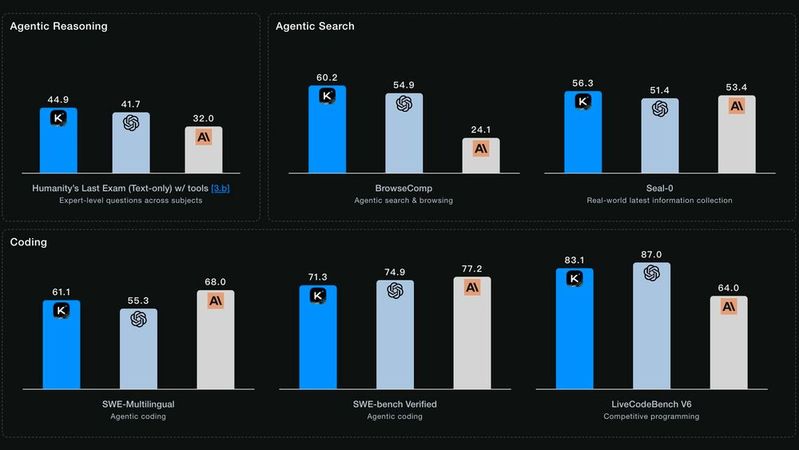
According to Moonshot AI, Kimi K2 Thinking surpasses established players like GPT-5 in the disciplines of agentic reasoning and agentic search based on benchmark tests, but still lags behind in coding capabilities.
(Image: Moonshot AI)
"Companies that do not incorporate AI or China into their strategy could face growth pressure by 2030," writes the consultancy McKinsey in a recent report. The rapid succession in which Chinese AI startups release impressive language models makes the timeframe of this forecast seem almost conservative shortly after its publication.
"A new reasoning model from a Chinese AI start-up, whose performance surpasses OpenAI's GPT-5 and Anthropic's Claude Sonnet 4.5 in several metrics, has sparked a new debate about a potential second DeepSeek moment and the future of American leadership in AI," writes the South China Morning Post in Hong Kong about the latest product from the Chinese start-up MoonShoot AI.
On the GitHub blog, MoonShoot AI claims that its new model was able to answer 44.9 percent of all questions in the benchmark test "Humanity’s Last Exam." This is better than ChatGPT-5's 41.7 percent, writes the startup, whose investors include Chinese internet and AI companies Alibaba and Tencent.
Agentic Capabilities
Experts from the American company Hugging Face, known for its open-source library "Transformers," point out in a comment that many of the SOTA results of Kimi K2 Thinking were achieved in a special "Heavy" mode. In this mode, up to eight inference runs are executed in parallel and the results are later merged. This somewhat relativizes the claims of MoonShoot AI, although this method is not uncommon in language model competitions.
In initial reviews by the trade press, the agentic capabilities of the new generative AI model from China are particularly praised. It is said to work especially well as a personal agent by combining a variety of tools when solving multi-step cognitive tasks.
"Kimi K2 Thinking can execute up to 200 to 300 consecutive tool calls without human intervention and reason coherently over hundreds of steps to solve complex problems," write its creators at MoonShoot AI on GitHub about this topic.
Benchmark King?
The new LLM from China is said to have performed better in other benchmarks than comparable US models, including "BrowseComb" for internet research and "Seal-0," which tests the factual accuracy and reasoning capabilities of search-supported large language models with its 111 questions.
In other tasks, such as software programming, Kimi K2 Thinking apparently still lags slightly behind its U.S. competitors. More important than such comparisons – and who has a slight edge or not – are likely two other aspects related to Kimi. Similar to DeepSeek, the model was reportedly trained very cost-effectively. Additionally, the model is undeniably another success for "open-source" LLMs compared to proprietary models.
"Training the new Kimi AI model cost $4.6 million, according to sources familiar with the matter," reported the American television network CNBC. Since then, the number of downloads of Kimi K2 Thinking has skyrocketed worldwide. For the first time, downloads of Chinese open-source models have now surpassed those of comparable American open-source models, writes a16z.
Forced Efficiency
The debate about Kimi K2 Thinking is very reminiscent of that about DeepSeek, whose architecture the Kimi team apparently owes a great deal to. Both Chinese models were developed under the pressure of having to work particularly efficiently with existing resources due to the American semiconductor boycotts against China.
Both models are particularly interesting to users worldwide because they may not be the absolute best in every area, but they are often "good enough." In addition, they are affordable and, due to their open-source architecture, can be integrated into existing workflows in many companies. (sb)
Date: 08.12.2025
Naturally, we always handle your personal data responsibly. Any personal data we receive from you is processed in accordance with applicable data protection legislation. For detailed information please see our privacy policy.
Consent to the use of data for promotional purposes
I hereby consent to Vogel Communications Group GmbH & Co. KG, Max-Planck-Str. 7-9, 97082 Würzburg including any affiliated companies according to §§ 15 et seq. AktG (hereafter: Vogel Communications Group) using my e-mail address to send editorial newsletters. A list of all affiliated companies can be found here
Newsletter content may include all products and services of any companies mentioned above, including for example specialist journals and books, events and fairs as well as event-related products and services, print and digital media offers and services such as additional (editorial) newsletters, raffles, lead campaigns, market research both online and offline, specialist webportals and e-learning offers. In case my personal telephone number has also been collected, it may be used for offers of aforementioned products, for services of the companies mentioned above, and market research purposes.
Additionally, my consent also includes the processing of my email address and telephone number for data matching for marketing purposes with select advertising partners such as LinkedIn, Google, and Meta. For this, Vogel Communications Group may transmit said data in hashed form to the advertising partners who then use said data to determine whether I am also a member of the mentioned advertising partner portals. Vogel Communications Group uses this feature for the purposes of re-targeting (up-selling, cross-selling, and customer loyalty), generating so-called look-alike audiences for acquisition of new customers, and as basis for exclusion for on-going advertising campaigns. Further information can be found in section “data matching for marketing purposes”.
In case I access protected data on Internet portals of Vogel Communications Group including any affiliated companies according to §§ 15 et seq. AktG, I need to provide further data in order to register for the access to such content. In return for this free access to editorial content, my data may be used in accordance with this consent for the purposes stated here. This does not apply to data matching for marketing purposes.
Right of revocation
I understand that I can revoke my consent at will. My revocation does not change the lawfulness of data processing that was conducted based on my consent leading up to my revocation. One option to declare my revocation is to use the contact form found at https://contact.vogel.de. In case I no longer wish to receive certain newsletters, I have subscribed to, I can also click on the unsubscribe link included at the end of a newsletter. Further information regarding my right of revocation and the implementation of it as well as the consequences of my revocation can be found in the data protection declaration, section editorial newsletter.



:quality(80)/p7i.vogel.de/wcms/20/fa/20fa35e0af203c3464f7e7fdbb57a685/0133281172v1.jpeg "Since 2003, Etzinger AG has been developing and manufacturing high-quality coffee grinders, pepper mills, and grinding mechanisms for professional and home use. (Image:Etzinger)")
:quality(80)/p7i.vogel.de/wcms/69/91/6991413943488b4a2f6fde9dcd88c5b0/0133256686v1.jpeg "The CMA-patented pendulum mount can compensate for radial tolerances of up to one millimeter. (Image:Schwiening)")
:quality(80)/p7i.vogel.de/wcms/0b/cd/0bcd6d502ffcd087c4fc12b7b760b3ce/0133317507v2v1.jpeg "The new Multi Center from J.G. Weisser. (Image:J.G. Weisser)")
:quality(80)/p7i.vogel.de/wcms/6a/ef/6aef8ea2d02622844db469c705a21222/0133322968v1v1.jpeg "Canada and the U.S. have been locked in a trade dispute ever since Donald Trump was re-elected as U.S. president. In the long run, however, Canada could end up being the loser. That is why the country is turning more toward its trading partner, the EU. Something very special is set to emerge... (Image:AI-generated)")
:quality(80)/p7i.vogel.de/wcms/35/81/35815f36be1b1c13f9abef4cea2a3e2b/0133171739v1.jpeg "Humanoid robots in industry: Despite impressive progress, many systems are still in the pilot phase. (Image:AI-generated)")
:quality(80)/p7i.vogel.de/wcms/81/dc/81dc63ed24c562521413023779495e7d/chris-kramerv1.jpeg "Chris Kramar, Director and General Manager of OEM Solutions for Germany, Austria, and Switzerland at Dell Technologies (Source: Dell Technologies)")
:quality(80)/p7i.vogel.de/wcms/bb/f5/bbf5342f532debc1bd7c09c2b9a0bf42/0133176497v1.jpeg "Over the past two years, AI has emerged as the most important growth driver in the industry. (Image: ©Gorodenkoff - stock.adobe.com)")
:quality(80)/p7i.vogel.de/wcms/01/61/01615a0939754c41e9d2c8971bf0b38a/web-image-kuka-kmf-1500p-300-dpi-1v1.jpeg "Thanks to its design, the KMF 1500P-CB is suitable for the stable and flexible handling of closed and open pallets. (Source: Kuka)")
:quality(80)/p7i.vogel.de/wcms/98/73/98731d23cbd95ff22391993a74cfefbf/mit-bifurcatedcircuits-01-pressv1.jpeg "A sample of the variety of configurations that Bifur circuits can form. (Source: Courtesy of the researchers)")
:quality(80)/p7i.vogel.de/wcms/f4/3d/f43d1f4297d9ae0cd1b6d2adfcb5ffe1/0133276470v1.jpeg "Simulation: Electric arcs in the electrical industry, including associated field simulation. (Image:CADFEM)")
:quality(80)/p7i.vogel.de/wcms/1d/fb/1dfbb415cd837102a33ce21ecf052ec3/0133277411v1.jpeg "LED drivers: LED circuit boards connect the light fixture to the electronics. During design, the operating current, forward voltage, and temperature must be taken into account across the entire operating range. (Image: ©Maria - stock.adobe.com)")
:quality(80)/p7i.vogel.de/wcms/80/8a/808a0eccf49a2a4fe560bd1998506ef9/0133308770v1.jpeg "Just like that, the supports are gone! High-speed footage of the automated, ultrasound-based process for removing optimized support structures from additively manufactured metal parts. It will be presented for the first time at Formnext from November 17 to 20. (Image:Fraunhofer IAPT)")
:quality(80)/p7i.vogel.de/wcms/73/06/7306146c5296cdd9bd77433f736c28e9/0133344456v1.jpeg "Tesla plans to bring its electric tractor-trailer to Europe in 2027. (Image:Tesla)")
:quality(80)/p7i.vogel.de/wcms/bf/fa/bffae31a7688e8c6721da41a7a6b502e/dsc00333-1536x864v1.jpeg "On August 10, 2026, Coolfly officially unveiled Urban, a flying vehicle designed for standing passengers. (Source: CoolFly)")
:quality(80)/p7i.vogel.de/wcms/fe/a8/fea8f62ea056f3c5334931f38cb80c76/0133324887v1v1.jpeg "It's flying off the shelves! The ID.Polo electric compact car seems to be living up to Volkswagen's expectations. After all, there are already more than 30,000 orders. The three sister models are also selling well... (Image:Volkswagen)")
:quality(80)/p7i.vogel.de/wcms/cb/00/cb0048b5a5df1a016d82aafa60aab9a9/35fa3e8bcf12df84fcc0b7ade728c03dv1.jpeg "Xiaomi has unveiled four new models. The large SUVs all have a gasoline engine to charge the battery. (Image:Xiaomi)")
:quality(80)/p7i.vogel.de/wcms/8d/f9/8df95d3f58408673986b3d643e6b63ba/0133252773v1.jpeg "TXC targets high-speed optical links in AI data centers with 312.5 MHz oscillators, among other solutions. As data rates increase, requirements for jitter and frequency stability become more demanding as well. (Bild: TXC)")
:quality(80)/p7i.vogel.de/wcms/b4/85/b48565f20a330043d0cd8c5f708f779f/0133316091v2v1.jpeg "The open Chiisai standard supports the cross-vendor development of HALs, middleware, and embedded software for small microcontrollers. (Image:Vector Informatics)")
:quality(80)/p7i.vogel.de/wcms/6c/a6/6ca6c6410e051401d5596d5cc6dfa277/0133283570v1.jpeg "From Core to Platform: With MIPS, ARC, and RISC-V, competition is shifting from individual processor IP blocks to integrated compute platforms for specialized applications. (Image:Dall-E / AI-generated)")
:quality(80)/p7i.vogel.de/wcms/73/17/73174a2afe684fa12d7d6a57b29b20e2/0133305506v1.jpeg "AI data centers are a key driver of direct current technologies. (Image:Pixabay / Brian Penny / AI-generated)")
:fill(fff,0)/images.vogel.de/vogelonline/companyimg/76800/76895/65.jpg "FAULHABER_120mm.jpg ()")
:fill(fff,0)/p7i.vogel.de/companies/69/88/69882c428938e/tmts2026-ticec-banner-en-2000px.png "tmts2026-ticec-banner-en-2000px (https://www.tmts.tw/en)")
:fill(fff,0)/p7i.vogel.de/companies/69/de/69de1b7403b0d/simtos-logo.jpeg "simtos-logo (SIMTOS)")
:quality(80)/p7i.vogel.de/wcms/70/21/7021d732ad7b441d0436592046a25432/0132610698v1.jpeg "Kimi K3 can fundamentally be self-hosted. However, due to its size, it is not a model for just any company: even in a compressed form, extensive storage and computing resources are required. (Image:Moonshot AI)")
:quality(80)/p7i.vogel.de/wcms/3c/8c/3c8cd7148e6997e144ec11ec5466d4ef/0132514800v1.jpeg "China warns of \"backdoor\" in Claude Code – Anthropic disagrees. (Image:Anthropic)")