Following the successful deployment of the humanoid robot Figure 02 at the BMW Group plant in Spartanburg, U.S., its further-developed successor, Figure 03, will now be put into operation in Spartanburg to perform complex sequencing tasks in logistics.
Humanoid robot Figure 03 in action at the BMW Group plant in Spartanburg.
(Image: BMW Group)
The BMW Group is stepping up its use of digitalization and artificial intelligence (AI) in production. With what is known as “Physical AI”—which combines digital AI with real machines and robots—intelligent systems such as humanoid robots can be integrated into real-world production processes. “The Spartanburg plant is the cradle of humanoid robotics in the BMW Group’s day-to-day operations. Having already successfully completed a pilot project with the Figure 02 in our body shop, we look forward to deploying the Figure 03 for a sequencing application in logistics,” says Ulrich Wieland, Vice President of Production Control and Logistics at BMW Manufacturing.
“Our 11-month deployment of Figure 02 has proven that humanoids are no longer just laboratory experiments—they can be a valuable part of building a flexible, reliable manufacturing workforce,” says Brett Adcock, founder and CEO of Figure AI: “We look forward to continuing our work in Spartanburg as Figure navigates the complexities of the assembly and logistics facility.”
As early as 2025, the BMW Group gained valuable experience with humanoid robotics at its Spartanburg plant. In collaboration with the technology company Figure AI, the Figure 02 robot supported the production of more than 30,000 BMW X3 vehicles over a period of ten months. In the body shop, the robot positioned sheet metal parts for the welding process—a task that demands high speeds and precision and can be physically demanding. The collaboration demonstrated that humanoid robots can safely perform precise and repeatable work steps under real production conditions.
Next Step with an Improved Robot (Figure 03)
The insights gained from this project form the basis for the next step with the successor model, Figure 03. “The robot features several new functions for expanded application possibilities. These include soft components to enhance safety, wireless charging for greater uptime, audio capabilities for speech-to-speech communication, and improved hands with tactile sensors and cameras in the palms for greater precision and dexterity,” explains Adcock.
In the new sequencing use case, delivered components first arrive unsorted in larger containers. Figure 03 picks them up and sorts them into a sequencing cart. The cart is then transported to a designated collection point for further transport. An automated guided vehicle or a smart transport robot then transports the parts to the installation site, where they are made available to assembly line workers “just in sequence.” This use case is common in logistics within automotive production and offers potential for further development and scalability.
Automation Portfolio Expanded to Include Physical AI
The use of humanoid robots is part of the BMW Group’s broader strategy to expand its automation portfolio with Physical AI. Humanoid robotics is viewed as a value-adding complement to existing automation. Its potential lies particularly in monotonous, ergonomically challenging, or safety-critical tasks. The goal is to protect employees and deploy them optimally, while at the same time further improving the workplace.
The manufacturer of Figure 03
Figure is an AI robotics company that develops autonomous, general-purpose humanoid robots. The company's goal is to bring humanoid robots with human-level intelligence to market. Figure's robots are designed to perform a wide range of tasks in both industrial and home settings. Figure is headquartered in San Jose, California.
The new project is closely linked to the digital transformation of production at the Spartanburg plant. Hall 52, where different powertrain variants of the BMW X3 and, in the future, the electrified BMW iX5 are built, has been extensively expanded and renovated. Digital applications were already used during the planning phase and are being further implemented in daily production operations as part of the BMW iFACTORY approach. Even before components arrive on the production line, virtual 3D simulations help optimize processes and ensure error-free implementation from the very beginning. The BMW Virtual Factory makes complexity manageable and supports employees by simulating human movement patterns. This refines manual processes from planning all the way to the production line. A key goal is to optimize ergonomics for employees.
Date: 08.12.2025
Naturally, we always handle your personal data responsibly. Any personal data we receive from you is processed in accordance with applicable data protection legislation. For detailed information please see our privacy policy.
Consent to the use of data for promotional purposes
I hereby consent to Vogel Communications Group GmbH & Co. KG, Max-Planck-Str. 7-9, 97082 Würzburg including any affiliated companies according to §§ 15 et seq. AktG (hereafter: Vogel Communications Group) using my e-mail address to send editorial newsletters. A list of all affiliated companies can be found here
Newsletter content may include all products and services of any companies mentioned above, including for example specialist journals and books, events and fairs as well as event-related products and services, print and digital media offers and services such as additional (editorial) newsletters, raffles, lead campaigns, market research both online and offline, specialist webportals and e-learning offers. In case my personal telephone number has also been collected, it may be used for offers of aforementioned products, for services of the companies mentioned above, and market research purposes.
Additionally, my consent also includes the processing of my email address and telephone number for data matching for marketing purposes with select advertising partners such as LinkedIn, Google, and Meta. For this, Vogel Communications Group may transmit said data in hashed form to the advertising partners who then use said data to determine whether I am also a member of the mentioned advertising partner portals. Vogel Communications Group uses this feature for the purposes of re-targeting (up-selling, cross-selling, and customer loyalty), generating so-called look-alike audiences for acquisition of new customers, and as basis for exclusion for on-going advertising campaigns. Further information can be found in section “data matching for marketing purposes”.
In case I access protected data on Internet portals of Vogel Communications Group including any affiliated companies according to §§ 15 et seq. AktG, I need to provide further data in order to register for the access to such content. In return for this free access to editorial content, my data may be used in accordance with this consent for the purposes stated here. This does not apply to data matching for marketing purposes.
Right of revocation
I understand that I can revoke my consent at will. My revocation does not change the lawfulness of data processing that was conducted based on my consent leading up to my revocation. One option to declare my revocation is to use the contact form found at https://contact.vogel.de. In case I no longer wish to receive certain newsletters, I have subscribed to, I can also click on the unsubscribe link included at the end of a newsletter. Further information regarding my right of revocation and the implementation of it as well as the consequences of my revocation can be found in the data protection declaration, section editorial newsletter.
Artificial intelligence is already being used in quality assurance as well. With AIQX (Artificial Intelligence Quality Next), the Spartanburg plant uses AI for visual and acoustic quality inspection to ensure consistent quality in a dynamic production environment. BMW has established AIQX as the standard and is exploring ways to make the system available to suppliers as well. It uses camera systems and sensors along the production line and provides immediate feedback to employees on the line via smart devices.



:quality(80)/p7i.vogel.de/wcms/43/bc/43bcc092db07947d7f240564e7d8549d/0133068647v1.jpeg "The C80 Giga inductive coupling system from SMW transmits power up to 75 W—and signals in real time at speeds of up to 1 GBit/s. (Image:SMW-Autoblok / SMW-electronics)")
:quality(80)/p7i.vogel.de/wcms/bd/b6/bdb6acbb7eafcbb21fcf66f8835ccb6d/0132925320v1.jpeg "Kyocera's MG90B Series (Image:Kyocera)")
:quality(80)/p7i.vogel.de/wcms/99/1e/991e3f401bd9a889b80c6b92506ecdf5/0132465976v1.jpeg "Above the gearbox is a stainless steel sealing flange designed to house the mechanical seal, which seals the agitator shaft. (Image:SEW)")
:quality(80)/p7i.vogel.de/wcms/90/2e/902e0c106fab72846b830855de1d4c4e/0113143253v1.jpeg "In our China Market Insider, we regularly provide you with relevant information straight from China. (Image:© Eisenhans - stock.adobe.com)")
:quality(80)/p7i.vogel.de/wcms/bc/2d/bc2d1a3291bcdf3d41ae2088fbcaccd1/0133075989v1.jpeg "Universal Robots' parent company is suing Jaka for patent infringement (Image:Universal Robots)")
:quality(80)/p7i.vogel.de/wcms/54/fa/54fa8fce526b3ab8b00500a06498c7f8/image1v1.jpeg "Humanoid robot Figure 03 in action at the BMW Group plant in Spartanburg. (Image:BMW Group)")
:quality(80)/p7i.vogel.de/wcms/95/fa/95fa92bf59ac4f0a72d6962b7c319ffb/0132527275v1.jpeg "Tom Terlouw from the Paul Scherrer Institute PSI and his team investigated around 13,000 scenarios for the climate-friendly production of ammonia, the basic component of fertilizers. (Image:Mahir Dzambegovic/Paul Scherrer Institute)")
:quality(80)/p7i.vogel.de/wcms/ea/49/ea49db542d261ce93bd6282699523c32/0131824146v1.jpeg "Ultrasonic sensors of the UB*-F42 series with IO-Link in various designs (Image:Pepperl+Fuchs)")
:quality(80)/p7i.vogel.de/wcms/24/91/24913072af80d22b62dffcec62e836de/tcartdesign-snails-757436v1.jpeg "An ordinary garden snail produces an astonishing variety of mucus types using just one molecular building block. (Source: TCartdesign)")
:quality(80)/p7i.vogel.de/wcms/aa/a5/aaa5d3c9a3e218667238db24730422dc/4--sonderteile-aus-nichtrostendem-edelstahl-verbindungstechnikv1.jpeg "In safety- and performance-critical designs, when using fasteners made of stainless steel, geometry, the manufacturing process, and operational loads—in addition to the material and corrosion resistance—play a crucial role in ensuring the safe design of the bolted joint. (Source: Güldner Screws)")
:quality(80)/p7i.vogel.de/wcms/6e/ea/6eea0f7b13ed25685b67b4741883df7a/drohnev1.jpeg "Multi-Jet Fusion is frequently used for drone components because this process offers high mechanical strength and durability while also enabling the production of complex geometries that are difficult to achieve using conventional manufacturing methods. (Source: Protolabs)")
:quality(80)/p7i.vogel.de/wcms/07/98/0798729516175be8b01888121fb1c47e/20260806-h250-c-1v1.jpeg "Regional machinery manufacturers today often find themselves between global key customers, international competition, and an internal transformation process. This can quickly lead to a critical situation, as demonstrated by the practical case of Modul MT Verzahntechnik GmbH from Chemnitz (Germany). (Image: MODUL MT)")
:quality(80)/p7i.vogel.de/wcms/f5/bc/f5bc380a5039e96c0133de620f5631f7/0133092230v1.jpeg "Chinese automaker BYD is engaging in a fiercer price war on the German market when it comes to sales of plug-in hybrids ... (Image:BYD)")
:quality(80)/p7i.vogel.de/wcms/68/e0/68e0cbb0e8bb537d593c524a81960213/0133037427v1.jpeg "In the coming years, Hyundai plans to step up its efforts, particularly with electric cars such as the Ioniq V, which was developed specifically for China. (Image:Hyundai)")
:quality(80)/p7i.vogel.de/wcms/81/31/81317bbc8be30332955ca435d55956e2/0133006538v1.jpeg "With the Nebula NEXT 01 JET Edition, Dreame presented an electrically powered hypercar with an additional rocket drive. According to Chinese media reports, the company has now largely scaled back its plans for commercial vehicle production. (Image:freely licensed)")
:quality(80)/p7i.vogel.de/wcms/e3/fb/e3fb490c8bcc4cc2e7976fe93ef3bad6/continental-zevra-tire--4v1.jpeg "The \"ZEvRA\" concept tire consists of approximately 43 percent recycled materials. (Source: Continental)")
:quality(80)/p7i.vogel.de/wcms/c5/77/c577c047d3ace675bbc29b1efa4a1050/0133057123v1.jpeg "Figure 1: Typical 2-level DC/DC topology. (Image:Renesas)")
:quality(80)/p7i.vogel.de/wcms/6c/0e/6c0eb42cb3976de378d71ae272745b61/0133056789v1.jpeg "We pay for systems that take over human labor without having yet determined how the resulting value created will be distributed in the future. (Image:freely licensed)")
:quality(80)/p7i.vogel.de/wcms/2a/2f/2a2fc1bb2a6941d1e5c795c047c969ce/0132945015v1.jpeg "Developers at the lab workplace: For WBG-based power converters and highly dynamic loads, precise efficiency and loss analysis require the time-synchronized acquisition of electrical, transient, and thermal parameters. (Image:Yokogawa)")
:quality(80)/p7i.vogel.de/wcms/61/54/6154ff60caffd4552fcdeb45e4dc72b2/0132962188v1.jpeg "Using optical coherence tomography (OCT), high-resolution cross-sectional images of the retina and cornea with a resolution of a few micrometers can be created. However, the demands on the necessary computing power of industrial PCs are high. (Image:freely licensed)")
:fill(fff,0)/p7i.vogel.de/companies/69/88/69882c428938e/tmts2026-ticec-banner-en-2000px.png "tmts2026-ticec-banner-en-2000px (https://www.tmts.tw/en)")
:fill(fff,0)/p7i.vogel.de/companies/69/de/69de1b7403b0d/simtos-logo.jpeg "simtos-logo (SIMTOS)")
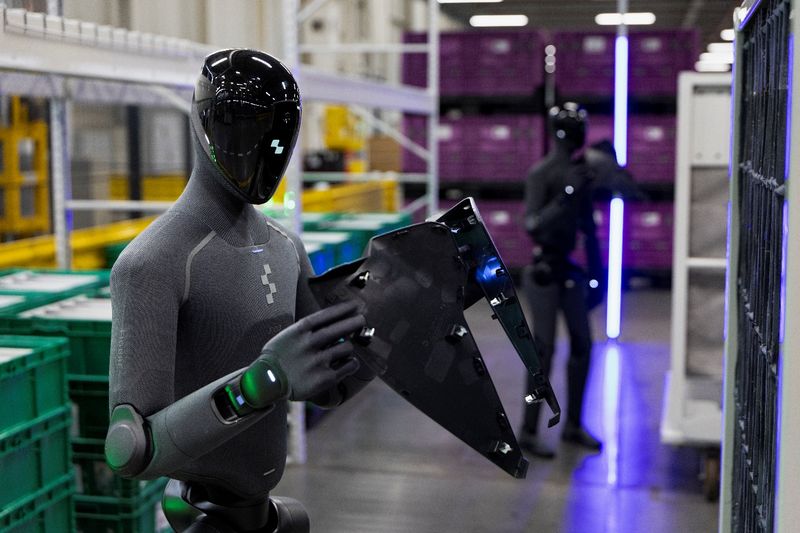
:quality(80)/p7i.vogel.de/wcms/73/7b/737bac300b859242718f2532baa15878/p90646721-highres-humanoid-robot-figurv1.jpeg "The use of humanoid robots is part of the BMW Group's broader strategy to expand its automation portfolio with Physical AI.(Source: BMW Group)")
:quality(80)/p7i.vogel.de/wcms/e2/1d/e21d3956d7409ccb458491464a18e175/p90646722-highres-humanoid-robot-figurv1.jpeg "The advantage of humanoid robotics is seen as a value-adding complement to existing automation.(Source: BMW Group)")
:quality(80)/p7i.vogel.de/wcms/8a/45/8a457beeb0fd26cf13a96830165c1aa4/p90646723-highres-humanoid-robot-figurv1.jpeg "The BMW Group's goal is to protect its employees and deploy them effectively, while at the same time continuing to improve the workplace.(Source: BMW Group)")
:quality(80)/p7i.vogel.de/wcms/24/78/247868ef81750c3b3fab9e7550a7e00e/p90646724-highres-humanoid-robot-figurv1.jpeg "Figure 03 picks up components of various sizes and places them into a sequencing cart.(Source: BMW Group)")
:quality(80)/p7i.vogel.de/wcms/5b/e5/5be54d16dd8c406b9cd9dbc892f580cb/0132041722v1.jpeg "Figure 03 in action: Thanks to tactile sensors and cameras in its hands, the robot sequences delivered components for assembly. (Image: BMW)")
:quality(80)/p7i.vogel.de/wcms/5b/e5/5be54d16dd8c406b9cd9dbc892f580cb/0132041722v1.jpeg "Figure 03 in action: Thanks to tactile sensors and cameras in its hands, the robot sequences delivered components for assembly. (Image: BMW)")
:quality(80)/p7i.vogel.de/wcms/ec/2c/ec2c4a7885839a7ba3f614736aadc76a/0131794758v1.jpeg "BMW has started the pilot use of humanoid robots at the Leipzig plant. (Image:The photo designers)")