In our "Fascination Technology" section, we present impressive research and development projects to engineers every week. Today: how a microalga can swim despite a magnetic coating.
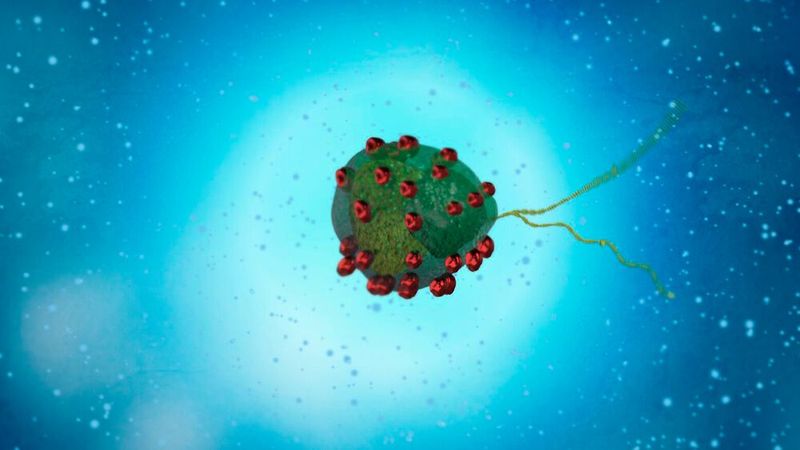
Animation of an alga coated with the natural polymer chitosan and magnetic nanoparticles.
(Image: MPI-IS / A. Posada)
In nature, single-celled microalgae are fantastic swimmers. Two antenna-like feelers at the front perform a swimming motion that propels the cell forward. Scientists at the Max Planck Institute for Intelligent Systems have coated a single-celled green microalga with magnetic material. This miniature robot was put to the test: Would the microalga with its magnetic coating be able to swim through tight spaces—and as if that wasn't challenge enough—through a viscous liquid, as found in the human body? Would the tiny robot be able to find its way through these difficult conditions?
Biohybrid microswimmers reach 115 micrometers per second
The scientists found that their biohybrid microswimmers were hardly affected by the coating. Thanks to the breaststroke-like movement of the small feelers at the front, the coated algae darted forward at an almost unchanged swimming speed: they reached 115 micrometers per second—about 12 body lengths per second. For comparison, Olympic champion Michael Phelps reached a speed of 1.4 body lengths per second at his best. However, the alga is just a single cell without legs and feet.
Birgül Akolpoglu and Saadet Fatma Baltaci, who jointly led the research work, investigated several years ago how bacteria-based microswimmers can be magnetically controlled in liquids to eventually use them as a means of transporting drugs. Now they have turned their attention to microalgae. The goal of the two researchers was to functionalize the surface of the single-celled organisms with a magnetic material so that the cells can be directed in any desired direction—and thus turn the microalga into a microrobot.
Algae coated with magnetic nanoparticles
The coating of the cells took only a few minutes and almost always worked: nine out of ten algae could be successfully coated with magnetic nanoparticles by the women. They initially tested their biohybrid robot in a liquid as thin as water. With the help of external magnetic fields, they could steer the robots in any desired direction. Then the researchers guided their robots along tiny 3D-printed tubes—a highly confined environment only up to three times the width of the microalgae. To see if control worked there as well, the team set up two different systems: one with magnetic coils and one with permanent magnets around the microscope. They generated a uniform magnetic field and repeatedly changed its direction.
Magnetic control helped the microswimmers to align with the direction of the field. They showed real potential for navigating tight spaces—as if they were equipped with a sort of tiny GPS!
Birgül Akolpoglu
"We found that the algae navigated the 3D-printed microchannels in three ways: reverse movement, crossing, and magnetic crossing. Without magnetic control, the algae often got stuck and moved back to the start. However, with magnetic control, they moved more smoothly and circumvented obstacles," says the co-first author of the publication, Birgül Akolpoglu. "The magnetic control helped the microswimmers align with the direction of the field. They showed real potential for navigation in tight spaces—as if they were equipped with a kind of tiny GPS!"
Viscosity affects the swimming ability of the microalgae
In the next step, the team increased the viscosity of the liquid and sent their microrobots through the narrow channels again. "We wanted to test how our swimmers behave in an environment that resembles mucus. We found that viscosity affects the swimming ability of the microalgae. Higher viscosity slows them down and changes the way they move. When we applied the magnetic field, the swimmers swung back and forth—they moved forward in a zigzag pattern. This shows how fine-tuning viscosity and magnetic alignment can optimize the navigation of microrobots in complex environments," adds Baltaci.
"Our vision is to deploy the microrobots in complex and small environments that are highly confined, such as those found in our tissue. Our results open doors for applications like targeted drug delivery and offer a biocompatible solution for medical treatments with exciting potential for future innovations in biomedicine and beyond," the team concludes.
Date: 08.12.2025
Naturally, we always handle your personal data responsibly. Any personal data we receive from you is processed in accordance with applicable data protection legislation. For detailed information please see our privacy policy.
Consent to the use of data for promotional purposes
I hereby consent to Vogel Communications Group GmbH & Co. KG, Max-Planck-Str. 7-9, 97082 Würzburg including any affiliated companies according to §§ 15 et seq. AktG (hereafter: Vogel Communications Group) using my e-mail address to send editorial newsletters. A list of all affiliated companies can be found here
Newsletter content may include all products and services of any companies mentioned above, including for example specialist journals and books, events and fairs as well as event-related products and services, print and digital media offers and services such as additional (editorial) newsletters, raffles, lead campaigns, market research both online and offline, specialist webportals and e-learning offers. In case my personal telephone number has also been collected, it may be used for offers of aforementioned products, for services of the companies mentioned above, and market research purposes.
Additionally, my consent also includes the processing of my email address and telephone number for data matching for marketing purposes with select advertising partners such as LinkedIn, Google, and Meta. For this, Vogel Communications Group may transmit said data in hashed form to the advertising partners who then use said data to determine whether I am also a member of the mentioned advertising partner portals. Vogel Communications Group uses this feature for the purposes of re-targeting (up-selling, cross-selling, and customer loyalty), generating so-called look-alike audiences for acquisition of new customers, and as basis for exclusion for on-going advertising campaigns. Further information can be found in section “data matching for marketing purposes”.
In case I access protected data on Internet portals of Vogel Communications Group including any affiliated companies according to §§ 15 et seq. AktG, I need to provide further data in order to register for the access to such content. In return for this free access to editorial content, my data may be used in accordance with this consent for the purposes stated here. This does not apply to data matching for marketing purposes.
Right of revocation
I understand that I can revoke my consent at will. My revocation does not change the lawfulness of data processing that was conducted based on my consent leading up to my revocation. One option to declare my revocation is to use the contact form found at https://contact.vogel.de. In case I no longer wish to receive certain newsletters, I have subscribed to, I can also click on the unsubscribe link included at the end of a newsletter. Further information regarding my right of revocation and the implementation of it as well as the consequences of my revocation can be found in the data protection declaration, section editorial newsletter.



:quality(80)/p7i.vogel.de/wcms/81/d4/81d47ab5407c961b55233009313ac9d2/0133075510v1.jpeg "Small, but designed for demanding applications: KSK demonstrates that the diameter of ball screws says nothing about their load-carrying capacity. (Image:Arkero)")
:quality(80)/p7i.vogel.de/wcms/6b/80/6b80bac3b1b33a0e3bc17849bef4ba59/0133171618v1.jpeg "With its portal solution for the MAK 4 Evolution UD swivel-bending machine, Schröder enables the fully automated production of sheet-metal enclosures. (Image:Schröder Group)")
:quality(80)/p7i.vogel.de/wcms/a0/1d/a01ddede6a787a4844122c2f42cfbce9/0133067101v1.jpeg "In solar module manufacturing, lasers are used for tasks such as patterning, drilling, and cutting delicate layers. Precise energy delivery is crucial to avoid damaging adjacent areas. (Image:Dall-E / AI-generated)")
:quality(80)/p7i.vogel.de/wcms/6c/98/6c98f4dd0780456713eee6379b3f534f/0132999605v1.jpeg "This specific project involved a similar surgical screw. (Image:KLS Martin)")
:quality(80)/p7i.vogel.de/wcms/ff/45/ff451109015c2f01b67ad3b0bad321ea/werma-success-story-skanska-1v1.webp "WeAssist combines traditional signal towers with a smart cloud solution. This allows the different colors of the signal towers to facilitate clear and intuitive communication during operations. (Source: Werma)")
:quality(80)/p7i.vogel.de/wcms/86/b1/86b14463fdbf6e77cafa6709433114bf/0132830551v1.jpeg "A look inside the automated testing lab at Amag Austria Metall AG's SmartFactory. (Image:Amag Austria Metall AG)")
:quality(80)/p7i.vogel.de/wcms/29/a8/29a8ea15ab38e4404bc1c6a3e425e454/adobestock-1550141473--leopard-stock-adobe-com-ki-generiertv1.jpeg "When Machines Understand What They're Doing—The Five Technologies Behind Physical AI. (Source: © Leopard – stock.adobe.com_AI-generated)")
:quality(80)/p7i.vogel.de/wcms/a0/0c/a00c9b7242fa38414b3281a9cd6dcc39/0133127938v1.jpeg "Demand for electronics and semiconductor products is expected to continue growing, prompting manufacturers to innovate and ramp up production while overcoming challenges. (Image:Siemens)")
:quality(80)/p7i.vogel.de/wcms/45/20/45208dbb0868aa49d32ded081173ebdb/siemens-sarla-aviation-01v1.jpeg "To ensure that data does not remain isolated in individual departments or systems, three companies are leveraging the Digital Thread with Siemens solutions. (Source: Sarla Aviation)")
:quality(80)/p7i.vogel.de/wcms/92/e9/92e9f029ef416e02b6f0b772b39c30df/limbitless-stratasys-zacharyv1.jpeg "The renewed focus of the expanded partnership between Stratasys and Limbitless is on sustainability, education, and improved access to 3D-printed prosthetics. (Source: Stratasys)")
:quality(80)/p7i.vogel.de/wcms/01/f1/01f16ebdc19b9cbde5bc1a7f421f9174/csm-a264340-web-1440-d0360d8de9v1.webp "At the 2026 Dutch Grand Prix in late August, two filtration systems developed by TU Berlin were used in top-level motorsports for the first time. (Source: Audi Revolut F1 Team)")
:quality(80)/p7i.vogel.de/wcms/00/c3/00c3f0f623f1b22935c99a2d364e2b6f/4082x2406v1.jpeg "EPFL researchers have unveiled ScaFi (short for “Scalable Fish”), a robot modeled after fish such as cod and mackerel. Its size can be adjusted as needed. (2026 CREATE Lab EPFL)")
:quality(80)/p7i.vogel.de/wcms/f3/d5/f3d5d5a330ab5425c90e6a37d23627ba/jag-f-type-heritage60edition-21my-091220-09v1.jpeg "Jaguar Land Rover is cutting 4,000 jobs. (Source: Jaguar Land Rover)")
:quality(80)/p7i.vogel.de/wcms/9e/6e/9e6eadbb44711dca055482f29b651ca9/0133192930v1.jpeg "At Automechanika, Stellantis' SUSTAINera business unit is introducing a remanufactured NOx sensor. (Image:Stellantis)")
:quality(80)/p7i.vogel.de/wcms/8d/f0/8df02ef9301116199dd602a1b3ffa976/0133198864v1.jpeg "Open System Protocol: The concept of a vehicle interior with distributed, dynamic RGB lighting. (Image:AMS Osram)")
:quality(80)/p7i.vogel.de/wcms/3a/52/3a524cf069c88cbd661c88d4a49f864f/db2022fa00082-largev1.jpeg "How much longer will VW models continue to be built in Emden? (Source: Volkswagen AG)")
:quality(80)/p7i.vogel.de/wcms/a4/4e/a44e89f5d47d037ca5d0c870b8dabc65/0133203720v1.jpeg "Transparent DC charging connector from Lapp featuring the vSECC.InPlug communication controller board from Vector (Image:Vector Informatics)")
:quality(80)/p7i.vogel.de/wcms/56/51/5651e7ef1aca62353ddff5727f6d40a3/0133183641v1.jpeg "Edge AI Security: The more autonomously AI systems operate at the network edge, the more important it becomes to have a consistent chain of trust—from secure boot to a protected model. (Image:NXP)")
:quality(80)/p7i.vogel.de/wcms/22/32/223265897c761a5ec2207a53151d2a36/adobestock-2168933153--zmaj88-stock-adobe-com-ki-generiertv1.jpeg "The 800-VDC power distribution system has established itself as a practical way to efficiently supply power to racks, even at the megawatt level. (Source: © zmaj88 – stock.adobe.com / AI-generated)")
:quality(80)/p7i.vogel.de/wcms/7d/a3/7da3623df87775722e9ba4fda7e16dc7/0133164888v1.jpeg "Z.ai told ChatGPT how it would like to be portrayed. (Image:Dall-E / AI-generated)")
:fill(fff,0)/p7i.vogel.de/companies/69/88/69882c428938e/tmts2026-ticec-banner-en-2000px.png "tmts2026-ticec-banner-en-2000px (https://www.tmts.tw/en)")
:fill(fff,0)/p7i.vogel.de/companies/69/de/69de1b7403b0d/simtos-logo.jpeg "simtos-logo (SIMTOS)")
:quality(80):fill(efefef,0)/p7i.vogel.de/wcms/67/ad/67adf4a647532/elatec-wp-machine-authentication.png "Elatec WP Machine Authentication")
:quality(80)/p7i.vogel.de/wcms/4c/c0/4cc018af5ef2a8f944a5d027fec68d69/0127944991v1.jpeg "Microrobot for the bloodstream: only one millimeter (0.04 inches) in size (Image:Luca Donati / ETH Zurich)")
:quality(80)/p7i.vogel.de/wcms/8d/24/8d24f9d5df2b6958b142559871f71368/0132044695v1.jpeg "Robotic systems that execute the surgeon's motion commands with high precision, in real time, and with millimeter accuracy while filtering out even the finest tremors are already successfully in use in clinics. Now, the combination of this technology with data glasses promises another innovation boost. (Image: University Hospital Leipzig I Lilly Schmidt)")