Bio-Inspired SensorElectric Eel Sensors for Robotic Arms
By
Henrik Bork* | Translated by AI
5 min Reading Time
Inspired by the electric eel, a research team has built a sensor that detects metals, plastics, glass, and wood by measuring changes in an electric field. It is currently being tested for noncontact material inspection, gesture control of robotic arms, and the inspection of coatings.
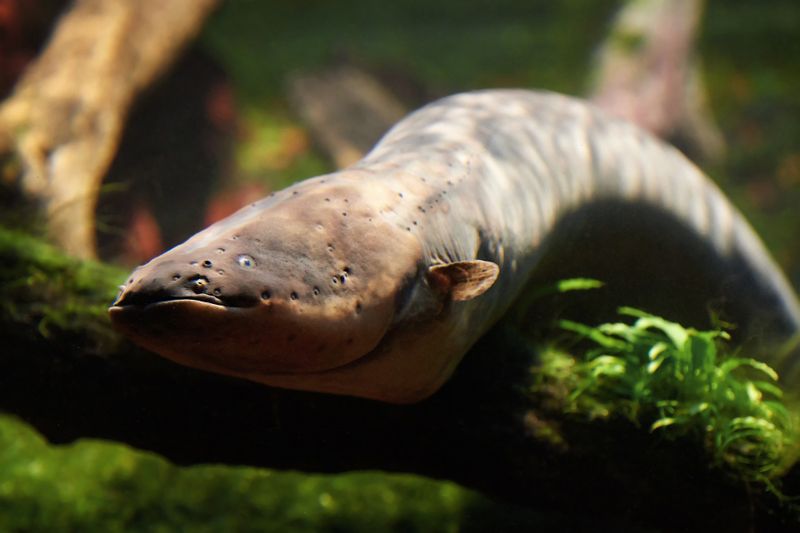
Electric eels have three electric organs that allow them to deliver electric shocks with voltages of up to 860 volts (illustration).
(Source: dennisjacobsen - stock.adobe.com)
Electric eels hunt in the murky waters of the Amazon. Their eyes are of little use there. So they generate an electric field around their bodies to track down their prey. Researchers in China have now developed a sensor that works on exactly this principle. The researchers hope that robots will be able to use it in the future to detect objects without touching them.
The Sensor Measures without Contact and in the Dark
The team at Xidian University in Xi'an described this “bio-inspired electrostatic field sensor” in early July in the journal *Advanced Materials*. According to the paper, it operates without actively transmitting signals and without mechanical contact. It is also independent of lighting conditions, the paper states. The invention could be useful in a variety of scenarios in the future, wrote the Chinese science newspaper Keji Ribao. These include, among other things, contactless material identification on production lines, touchless control of robots via hand gestures, and non-destructive testing of coatings.
How the Sensor Inspired by the Electric Eel Works
“We are not fully replicating the electric eel’s biological system. Instead, we are borrowing its basic principle of generating an electric field, detecting disturbances, and deriving information from them,” the newspaper quotes team leader Zhang Weiqiang of the School of Aerospace Engineering at Xidian University as saying.
At the heart of the sensor is a fluoropolymer electret, which the researchers charged using a method called corona polarization. An electret can permanently store an electric charge, much like a permanent magnet stores a magnetic field. The science journal compares it to a tiny “electrostatic battery.”
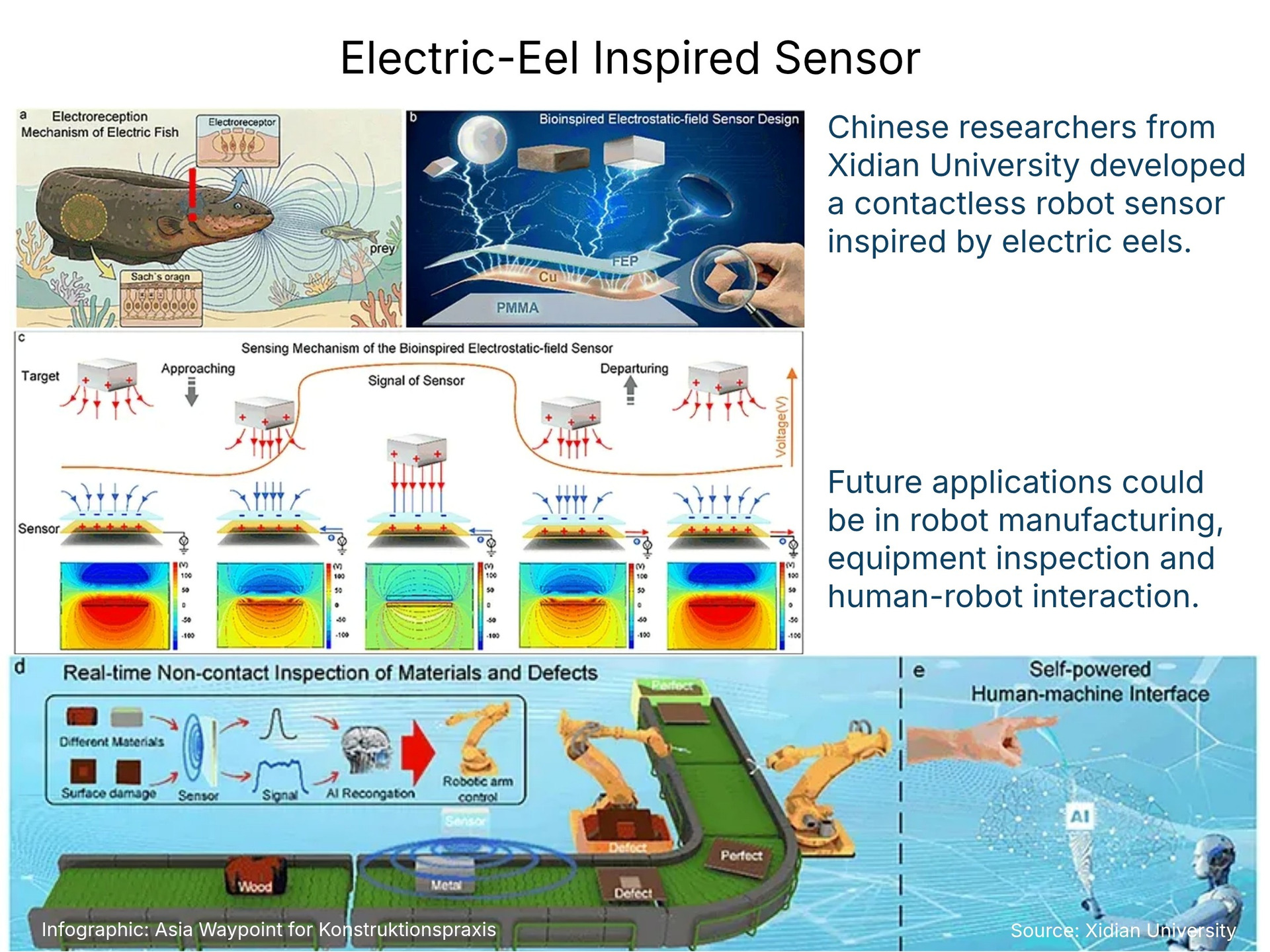
A research group at Xidian University in Chain developed the contactless sensor, modeled after the Sachsian organ found in electric eels.
(Infographic:Asia Waypoint for Engineering Practice, Source: Xidian University)
“Once charged, it can retain its electrical charge for a long time and form a relatively stable quasi-static electric field around the sensor. You can think of it as an invisible spiderweb of electric fields surrounding the sensor,” Zhang explained to a reporter from the newspaper.
“When an object approaches, the sensor detects changes in the field, and from these changes it can determine the object’s electrical conductivity, dielectric properties, and geometric shape,” the South China Morning Post in Hong Kong quoted the scientist as saying.
Whether it’s metal, plastic, glass, or a human hand, every object alters the local distribution of the field in its own way. It’s like a stone falling into water and creating its own unique ripples. This creates a measurable potential signal at the sensor’s grounded reference electrode.
“A 50-micrometer change in position can produce a voltage change of about one volt,” Zhang said. That is roughly half the diameter of a human hair. According to the paper published in *Advanced Materials*, the sensor’s signal remains stable even after 10,000 measurement cycles.
The Sensor Detects Metals, Polymers, Wood, and Glass
“Different materials interfere with the electric field in different ways, just as every person has a unique fingerprint,” said the team leader. Inductive sensors respond primarily to metal. Optical methods depend on the surface’s reflective properties. The novel eel-inspired sensor, on the other hand, responds to metals, polymers, glass, and wood. In automated sorting of recycled materials or on a production line, a machine could use it to determine the material of an object without the need for physical contact. The sensor can distinguish between two parts that are identical in color and appearance, provided they are made of different materials.
Experiments: Controlling a Robotic Arm Using Gestures
Another property of the sensor is of interest for controlling robots in hazardous environments. When a hand moves within the sensor’s field of view, each gesture follows a different trajectory. It also leaves behind its own unique disturbance wave. The team collected these signals, trained a neural network on them, and experimented with controlling a robotic arm. In the lab, at least, the closed loop consisting of gesture input, signal recognition, and execution worked. However, they also noted that there is still a long way to go before a practical application is possible.
Potential Applications for Gesture Control
In the future, however, many exciting applications are conceivable. “An operator doesn’t have to wear any equipment. All they have to do is perform simple swiping, tapping, or grasping gestures in front of the sensor, and the robotic arm will carry out the corresponding action with precision,” said Zhang. A worker could thus instruct a robotic arm to grasp and move an object with a simple hand gesture in the air. Such technology would be valuable in medical isolation areas, in hazardous work environments, or in assistive devices for people with disabilities, writes the Keji Ribao.
Test Coatings
In the manufacturing industry, the electric eel sensors could also be particularly useful in any application where surfaces need to be inspected as gently as possible. “Coating defects alter the local dielectric properties and leave a characteristic signal signature in the electric field. The sensor can detect these changes with a high degree of sensitivity,” Zhang was quoted as saying.
Small bubbles, scratches, or variations in thickness in coatings reduce a product’s performance, and currently, transparent layers and curved surfaces pose challenges for optical inspection. The team from western China tested its sensor on glass with a conductive coating, on composites made of stainless steel and polyimide, and on UV-cured PMMA coatings. The researchers reported that defects of varying severity produced distinguishable signals.
Sensor Applications in Space Exploration
Such sensors could even be used in space exploration one day, for example, to monitor equipment outside spacecraft. After all, they are “energy-efficient, contactless, and light-independent proximity sensors,” Zhang told the South China Morning Post.
Date: 08.12.2025
Naturally, we always handle your personal data responsibly. Any personal data we receive from you is processed in accordance with applicable data protection legislation. For detailed information please see our privacy policy.
Consent to the use of data for promotional purposes
I hereby consent to Vogel Communications Group GmbH & Co. KG, Max-Planck-Str. 7-9, 97082 Würzburg including any affiliated companies according to §§ 15 et seq. AktG (hereafter: Vogel Communications Group) using my e-mail address to send editorial newsletters. A list of all affiliated companies can be found here
Newsletter content may include all products and services of any companies mentioned above, including for example specialist journals and books, events and fairs as well as event-related products and services, print and digital media offers and services such as additional (editorial) newsletters, raffles, lead campaigns, market research both online and offline, specialist webportals and e-learning offers. In case my personal telephone number has also been collected, it may be used for offers of aforementioned products, for services of the companies mentioned above, and market research purposes.
Additionally, my consent also includes the processing of my email address and telephone number for data matching for marketing purposes with select advertising partners such as LinkedIn, Google, and Meta. For this, Vogel Communications Group may transmit said data in hashed form to the advertising partners who then use said data to determine whether I am also a member of the mentioned advertising partner portals. Vogel Communications Group uses this feature for the purposes of re-targeting (up-selling, cross-selling, and customer loyalty), generating so-called look-alike audiences for acquisition of new customers, and as basis for exclusion for on-going advertising campaigns. Further information can be found in section “data matching for marketing purposes”.
In case I access protected data on Internet portals of Vogel Communications Group including any affiliated companies according to §§ 15 et seq. AktG, I need to provide further data in order to register for the access to such content. In return for this free access to editorial content, my data may be used in accordance with this consent for the purposes stated here. This does not apply to data matching for marketing purposes.
Right of revocation
I understand that I can revoke my consent at will. My revocation does not change the lawfulness of data processing that was conducted based on my consent leading up to my revocation. One option to declare my revocation is to use the contact form found at https://contact.vogel.de. In case I no longer wish to receive certain newsletters, I have subscribed to, I can also click on the unsubscribe link included at the end of a newsletter. Further information regarding my right of revocation and the implementation of it as well as the consequences of my revocation can be found in the data protection declaration, section editorial newsletter.
In future experiments, the team plans to evaluate the signal's robustness, the stability of the entire sensor, and its reliability under challenging conditions such as a vacuum, temperature fluctuations, or complex electromagnetic fields.
* Henrik Bork, a longtime China correspondent for the *Süddeutsche Zeitung* and the *Frankfurter Rundschau*, is Managing Director at Asia Waypoint, a consulting firm specializing in China and based in Beijing. “China Market Insider” is a joint project of the Vogel Communications Group, based in Würzburg, and Jigong Vogel Media Advertising in Beijing.



:quality(80)/p7i.vogel.de/wcms/43/bc/43bcc092db07947d7f240564e7d8549d/0133068647v1.jpeg "The C80 Giga inductive coupling system from SMW transmits power up to 75 W—and signals in real time at speeds of up to 1 GBit/s. (Image:SMW-Autoblok / SMW-electronics)")
:quality(80)/p7i.vogel.de/wcms/bd/b6/bdb6acbb7eafcbb21fcf66f8835ccb6d/0132925320v1.jpeg "Kyocera's MG90B Series (Image:Kyocera)")
:quality(80)/p7i.vogel.de/wcms/99/1e/991e3f401bd9a889b80c6b92506ecdf5/0132465976v1.jpeg "Above the gearbox is a stainless steel sealing flange designed to house the mechanical seal, which seals the agitator shaft. (Image:SEW)")
:quality(80)/p7i.vogel.de/wcms/90/2e/902e0c106fab72846b830855de1d4c4e/0113143253v1.jpeg "In our China Market Insider, we regularly provide you with relevant information straight from China. (Image:© Eisenhans - stock.adobe.com)")
:quality(80)/p7i.vogel.de/wcms/bc/2d/bc2d1a3291bcdf3d41ae2088fbcaccd1/0133075989v1.jpeg "Universal Robots' parent company is suing Jaka for patent infringement (Image:Universal Robots)")
:quality(80)/p7i.vogel.de/wcms/54/fa/54fa8fce526b3ab8b00500a06498c7f8/image1v1.jpeg "Humanoid robot Figure 03 in action at the BMW Group plant in Spartanburg. (Image:BMW Group)")
:quality(80)/p7i.vogel.de/wcms/a2/11/a211bcc07ec547e0fa37965a078802a3/newsimage426357v1.jpeg "As part of the “AgriLoop” project, researchers at the University of Bonn are developing a system designed to control greenhouse robots using natural language and to map plant populations in three dimensions. (Source: University of Bonn)")
:quality(80)/p7i.vogel.de/wcms/95/fa/95fa92bf59ac4f0a72d6962b7c319ffb/0132527275v1.jpeg "Tom Terlouw from the Paul Scherrer Institute PSI and his team investigated around 13,000 scenarios for the climate-friendly production of ammonia, the basic component of fertilizers. (Image:Mahir Dzambegovic/Paul Scherrer Institute)")
:quality(80)/p7i.vogel.de/wcms/24/91/24913072af80d22b62dffcec62e836de/tcartdesign-snails-757436v1.jpeg "An ordinary garden snail produces an astonishing variety of mucus types using just one molecular building block. (Source: TCartdesign)")
:quality(80)/p7i.vogel.de/wcms/aa/a5/aaa5d3c9a3e218667238db24730422dc/4--sonderteile-aus-nichtrostendem-edelstahl-verbindungstechnikv1.jpeg "In safety- and performance-critical designs, when using fasteners made of stainless steel, geometry, the manufacturing process, and operational loads—in addition to the material and corrosion resistance—play a crucial role in ensuring the safe design of the bolted joint. (Source: Güldner Screws)")
:quality(80)/p7i.vogel.de/wcms/6e/ea/6eea0f7b13ed25685b67b4741883df7a/drohnev1.jpeg "Multi-Jet Fusion is frequently used for drone components because this process offers high mechanical strength and durability while also enabling the production of complex geometries that are difficult to achieve using conventional manufacturing methods. (Source: Protolabs)")
:quality(80)/p7i.vogel.de/wcms/aa/96/aa96adace3d0396e169f3da7f7c9b85e/adobestock-107687632--dennisjacobsen-stock-adobe-comv1.jpeg "Electric eels have three electric organs that allow them to deliver electric shocks with voltages of up to 860 volts (illustration). (Source: dennisjacobsen - stock.adobe.com)")
:quality(80)/p7i.vogel.de/wcms/f5/bc/f5bc380a5039e96c0133de620f5631f7/0133092230v1.jpeg "Chinese automaker BYD is engaging in a fiercer price war on the German market when it comes to sales of plug-in hybrids ... (Image:BYD)")
:quality(80)/p7i.vogel.de/wcms/68/e0/68e0cbb0e8bb537d593c524a81960213/0133037427v1.jpeg "In the coming years, Hyundai plans to step up its efforts, particularly with electric cars such as the Ioniq V, which was developed specifically for China. (Image:Hyundai)")
:quality(80)/p7i.vogel.de/wcms/81/31/81317bbc8be30332955ca435d55956e2/0133006538v1.jpeg "With the Nebula NEXT 01 JET Edition, Dreame presented an electrically powered hypercar with an additional rocket drive. According to Chinese media reports, the company has now largely scaled back its plans for commercial vehicle production. (Image:freely licensed)")
:quality(80)/p7i.vogel.de/wcms/e3/fb/e3fb490c8bcc4cc2e7976fe93ef3bad6/continental-zevra-tire--4v1.jpeg "The \"ZEvRA\" concept tire consists of approximately 43 percent recycled materials. (Source: Continental)")
:quality(80)/p7i.vogel.de/wcms/c5/77/c577c047d3ace675bbc29b1efa4a1050/0133057123v1.jpeg "Figure 1: Typical 2-level DC/DC topology. (Image:Renesas)")
:quality(80)/p7i.vogel.de/wcms/6c/0e/6c0eb42cb3976de378d71ae272745b61/0133056789v1.jpeg "We pay for systems that take over human labor without having yet determined how the resulting value created will be distributed in the future. (Image:freely licensed)")
:quality(80)/p7i.vogel.de/wcms/2a/2f/2a2fc1bb2a6941d1e5c795c047c969ce/0132945015v1.jpeg "Developers at the lab workplace: For WBG-based power converters and highly dynamic loads, precise efficiency and loss analysis require the time-synchronized acquisition of electrical, transient, and thermal parameters. (Image:Yokogawa)")
:quality(80)/p7i.vogel.de/wcms/61/54/6154ff60caffd4552fcdeb45e4dc72b2/0132962188v1.jpeg "Using optical coherence tomography (OCT), high-resolution cross-sectional images of the retina and cornea with a resolution of a few micrometers can be created. However, the demands on the necessary computing power of industrial PCs are high. (Image:freely licensed)")
:quality(80)/p7i.vogel.de/wcms/bc/a6/bca6ad4daac3cfa1cdffa04c725d791b/0131558106v1.jpeg "Electronic skin for industry: Sensors integrated into gloves capture the wearer's finger movements and transmit them in real-time to a robotic gripper. (Image:mc/VCG)")
:quality(80)/p7i.vogel.de/wcms/8b/2a/8b2aa1706944495814db6ec30efd5cb2/0129190693v1.jpeg "With sensors for thickness, position, temperature and 3D geometry, Micro-Epsilon enables precise automation. (Picture:Micro-Epsilon)")