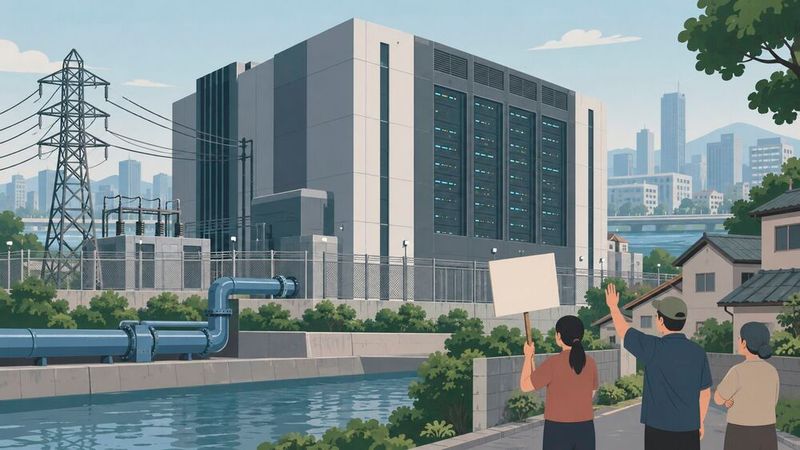
In Asia, local resistance is mounting against the construction of new AI data centers. In countries such as Australia, India, South Korea, Malaysia, and Thailand, residents are protesting the construction of server farms in their neighborhoods. Some projects have already been halted.
For data center projects, it is becoming increasingly important to also obtain the consent of the affected community.
(Image: Dall-E / AI-generated)
In addition to electricity, land, water supply, and grid connections, the approval of local residents is now increasingly becoming a scarce resource for data center operators and hyperscalers such as Amazon, Microsoft, and Google.
In Moss Vale, a small town between Sydney and Canberra, opposition to the construction of a data center began in a WhatsApp group of parents.
The operator of the local data center is already planning to build a second facility, which will be powered by three of its own gas-fired power plants and will operate independently of the existing power grid. The largest of the three power plants, with a capacity of 673 megawatts, would be the most powerful in New South Wales, according to the Japanese business newspaper Nikkei Asia.
“It wasn’t until we realized the full extent of the problem that we all mobilized,” Heather Champion, a city council member and organizer of the “Stop the Gas Plant” campaign, told the newspaper. The central government in Canberra now plans to pass legislation requiring data centers to finance their own power supply.
Protests in India as Well
In Visakhapatnam, South India—known as Vizag for short—there are also citizen protests. There, Google is building a data center with a capacity of one gigawatt in partnership with the Adani Group. It is the largest investment of its kind that Google has announced outside the U.S. to date. According to media reports, environmental permits were granted suspiciously quickly—sometimes within just a few days.
“Our biggest concern is the speed of the approval process,” Deeksha Vanguru, an organizer of a local citizens’ movement opposing the data center, told Nikkei Asia. Concerns here also revolve around the water supply. Data centers require intensive cooling. The city needs 480 million liters of water daily, but currently receives only 410 million.
In Seoul, 22 of 25 district mayors called in August for a separate construction review for data centers in residential areas, according to the Korea JoongAng Daily. “We firmly oppose the construction of data centers that threaten health and property rights!” read a banner hung by protesters in Yeongdeungpo District. Last year, 17 out of 33 approved projects in South Korea were delayed due to protests by local residents, according to statistics from the real estate consulting firm Savills.
In Malaysia, on August 20, 2026, a developer withdrew its building permit application for a data center in Kota Damansara near Kuala Lumpur. An online petition opposing the project had gathered more than 6,000 signatures within a week. Residents feared noise and water shortages. In September 2026, Thailand halted the construction of 49 data centers, according to the Bloomberg news agency. This is a kind of moratorium by the government, which now plans to issue new regulations within a month. In Bangkok, a data center had previously been approved next to a hospital by classifying it as a warehouse, thereby circumventing certain requirements.
Aiming for a Moratorium
Some citizens in Asia feel inspired by similar protests in Europe and the U.S. In July, New York State imposed a one-year moratorium on new hyperscale data centers. Such restrictions are already in place in Europe and Singapore, James Murphy of DC Byte, a London-based market research firm specializing in data centers, told Nikkei Asia. In the first quarter of 2026, local opposition in the U.S. blocked or delayed at least 75 projects worth about 110 billion euros, according to the research group Data Center Watch.
In many places, electricity consumption is the top concern. AI models require a great deal of energy. Local residents therefore fear rising electricity prices. Where operators are planning to build their own gas-fired power plants, there is also concern about new air pollution from exhaust emissions. At other locations, the main concern is water consumption. Data centers also require large amounts of water for cooling, which is problematic in water-scarce regions such as Vizag. Sometimes, general uncertainty about the impact of AI on jobs and society is enough to spark protests, Bloomberg reports.
Date: 08.12.2025
Naturally, we always handle your personal data responsibly. Any personal data we receive from you is processed in accordance with applicable data protection legislation. For detailed information please see our privacy policy.
Consent to the use of data for promotional purposes
I hereby consent to Vogel Communications Group GmbH & Co. KG, Max-Planck-Str. 7-9, 97082 Würzburg including any affiliated companies according to §§ 15 et seq. AktG (hereafter: Vogel Communications Group) using my e-mail address to send editorial newsletters. A list of all affiliated companies can be found here
Newsletter content may include all products and services of any companies mentioned above, including for example specialist journals and books, events and fairs as well as event-related products and services, print and digital media offers and services such as additional (editorial) newsletters, raffles, lead campaigns, market research both online and offline, specialist webportals and e-learning offers. In case my personal telephone number has also been collected, it may be used for offers of aforementioned products, for services of the companies mentioned above, and market research purposes.
Additionally, my consent also includes the processing of my email address and telephone number for data matching for marketing purposes with select advertising partners such as LinkedIn, Google, and Meta. For this, Vogel Communications Group may transmit said data in hashed form to the advertising partners who then use said data to determine whether I am also a member of the mentioned advertising partner portals. Vogel Communications Group uses this feature for the purposes of re-targeting (up-selling, cross-selling, and customer loyalty), generating so-called look-alike audiences for acquisition of new customers, and as basis for exclusion for on-going advertising campaigns. Further information can be found in section “data matching for marketing purposes”.
In case I access protected data on Internet portals of Vogel Communications Group including any affiliated companies according to §§ 15 et seq. AktG, I need to provide further data in order to register for the access to such content. In return for this free access to editorial content, my data may be used in accordance with this consent for the purposes stated here. This does not apply to data matching for marketing purposes.
Right of revocation
I understand that I can revoke my consent at will. My revocation does not change the lawfulness of data processing that was conducted based on my consent leading up to my revocation. One option to declare my revocation is to use the contact form found at https://contact.vogel.de. In case I no longer wish to receive certain newsletters, I have subscribed to, I can also click on the unsubscribe link included at the end of a newsletter. Further information regarding my right of revocation and the implementation of it as well as the consequences of my revocation can be found in the data protection declaration, section editorial newsletter.
Nevertheless, the boom in the construction of new data centers shows no signs of slowing down for the time being. Demand remains “red-hot in virtually every market in the region,” Nikkei Asia quotes James Murphy as saying. Consulting firm McKinsey estimates that data center capacity in the Asia-Pacific region could triple by 2030. Thailand approved 88 projects worth approximately 23 billion euros in the first half of the year, before protests broke out recently. PricewaterhouseCoopers estimates that around 27 trillion euros (31.05 trillion US dollars) will be invested in data centers worldwide by 2050.
Local Events
"It is still just 'isolated, local opposition,'" Adib Zalkapli of the risk consulting firm "Viewfinder Global Affairs" told Nikkei Asia. However, as attention grows, "greater public scrutiny is to be expected." Many governments are responding with new regulations without completely halting the construction of data centers. “Today’s decision does not mean that Thailand is closing the door on investment in data centers,” Thailand’s Finance Minister Ekniti Nitithanprapas said, according to Bloomberg. “We want clear and uniform standards so that the industry can grow sustainably.”
Among data center developers, the numerous protests are gradually prompting a shift in thinking. While public protests were long viewed as a minor hurdle during the construction phase, dialogue with local residents is now becoming an integral part of project development in many places. The term “social license to operate” is gaining importance. Sustainability and engagement with local residents are increasingly determining access to the market.
Robin Khuda, CEO of the Australian provider AirTrunk, sees public opposition as one of the biggest hurdles to expanding AI infrastructure. However, he says this opposition can often be effectively mitigated through dialogue with residents. “Problems arise when developers fail to engage with the community,” said Murphy of DC Byte. The conflicting interests between residents and data center operators present a dilemma. Artificial intelligence presents a major opportunity for economic growth and new prosperity, even in the affected communities. At the same time, there is a complex mix of legitimate objections and special interests. While some want to make extensive use of AI, they do not want to see an unsightly data center on their own doorstep.
Without data centers, there would be no artificial intelligence and no productivity gains—which Asia’s economies are counting on. Governments in the region must therefore balance the concerns of individual citizen groups against the benefits for the population as a whole. In China, where data centers are being expanded at record speed, there are hardly any public protests. Yet Beijing faces the same dilemma as other Asian governments: the energy and water consumption required for AI must be met without creating shortages elsewhere.
What is Sustainable, and What isn't?
China's data economy has grown by 15.7 percent to 6.78 trillion yuan (about 870 billion euros / 1.0005 trillion US dollars) in the space of a year, according to official statistics. According to various forecasts, the electricity demand of data centers could more than double—or even triple—by 2030, reaching up to 600 terawatt-hours.
That would amount to more than Germany’s total electricity consumption today (about 500 terawatt-hours)—just for data centers alone. Beijing must balance this demand with various objectives, including its national energy security, a reliable supply for Chinese factories, and its stated climate goal of peaking carbon dioxide emissions by 2030. China is therefore placing a strong emphasis on green electricity as it expands its AI data centers. The expansion of renewable energy is an integral part of the Beijing central government’s AI strategy. In Ningxia, China’s first AI data center—powered by local green electricity—went into operation in May 2025, the South China Morning Post reported.
A cloud facility in Zhongwei is powered directly by a solar farm with a capacity of 500 megawatts. An additional 1.5 gigawatts of wind power is expected to be added by the end of this year. Beijing is making the use of renewable energy a requirement for the approval of new data centers. In eight data center clusters in China, which are governed by the central government’s “Dong Shu Xi Suan” (Data from the East, Computing in the West) strategy, at least 80 percent of the electricity must come from clean sources. At the end of June this year, the National Development and Reform Commission (NDRC) and the National Energy Administration (NEA) officially included the direct connection of data centers to wind and solar farms in their energy plan through 2030, according to the official Xinhua News Agency.
AI from the Desert
However, data centers in the desert—or in very remote regions in general—are not always a suitable solution. “Data must be close to users to reduce transmission delays,” Lee Seung-won of ET Solutions told the Korea JoongAng Daily. Even a delay of one-tenth of a second could cause a self-driving car to travel about three meters further. Beijing is therefore currently assessing which computing workloads are less time-sensitive and can be relocated to remote sites, and which cannot.
The reverse approach is also being actively tested, in which green electricity flows to computers in the coastal provinces. China is currently rapidly expanding its extensive network of ultra-high-voltage power lines to transport wind and solar power from the desert regions in the west of the country to the densely populated and heavily industrialized coastal provinces. In addition, an underwater data center was put into operation a few months ago off the coast of Shanghai; it is cooled by seawater and powered by green electricity from a nearby offshore wind farm.
The integration of artificial intelligence into industry across Asia is one of the greatest upheavals since the First Industrial Revolution. Data centers consume vast amounts of electricity, water, and land. At the same time, AI promises unprecedented productivity gains for these countries’ economies and further advances, such as better and more accessible healthcare. The countries that best resolve this contradiction will be particularly competitive in the long term. Asia’s democracies are grappling with this issue in city councils, through petitions, and in oversight commissions. China is attempting to address it through its five-year plans. Actively and effectively managing this conflict between the advantages and disadvantages of artificial intelligence has become one of the most important skills in modern statecraft.



:quality(80)/p7i.vogel.de/wcms/8e/7e/8e7e0cda4c68699bcc48283a38739769/0133316747v1.jpeg "A little-known hidden champion! When people think of laser cutting, the first thing that comes to mind is the power of the laser beam—and it is impressive to see the sparks flying. But Air Liquide—an exhibitor at Euroblech, by the way—wants to make it clear that the process gas is also key to success. (Image:AI-generated)")
:quality(80)/p7i.vogel.de/wcms/20/fa/20fa35e0af203c3464f7e7fdbb57a685/0133281172v1.jpeg "Since 2003, Etzinger AG has been developing and manufacturing high-quality coffee grinders, pepper mills, and grinding mechanisms for professional and home use. (Image:Etzinger)")
:quality(80)/p7i.vogel.de/wcms/69/91/6991413943488b4a2f6fde9dcd88c5b0/0133256686v1.jpeg "The CMA-patented pendulum mount can compensate for radial tolerances of up to one millimeter. (Image:Schwiening)")
:quality(80)/p7i.vogel.de/wcms/0b/cd/0bcd6d502ffcd087c4fc12b7b760b3ce/0133317507v2v1.jpeg "The new Multi Center from J.G. Weisser. (Image:J.G. Weisser)")
:quality(80)/p7i.vogel.de/wcms/bd/4e/bd4ef09ab0f84932ea76ca0330ffe789/0133329802v1.jpeg "The robotics boom and its consequences: According to a study, a significant portion of value creation occurs in the electronics industry. (Image:Fraunhofer IPA)")
:quality(80)/p7i.vogel.de/wcms/35/81/35815f36be1b1c13f9abef4cea2a3e2b/0133171739v1.jpeg "Humanoid robots in industry: Despite impressive progress, many systems are still in the pilot phase. (Image:AI-generated)")
:quality(80)/p7i.vogel.de/wcms/81/dc/81dc63ed24c562521413023779495e7d/chris-kramerv1.jpeg "Chris Kramar, Director and General Manager of OEM Solutions for Germany, Austria, and Switzerland at Dell Technologies (Source: Dell Technologies)")
:quality(80)/p7i.vogel.de/wcms/bb/f5/bbf5342f532debc1bd7c09c2b9a0bf42/0133176497v1.jpeg "Over the past two years, AI has emerged as the most important growth driver in the industry. (Image: ©Gorodenkoff - stock.adobe.com)")
:quality(80)/p7i.vogel.de/wcms/e9/19/e91905d37afe605bc348a690a4fed72e/0133350592v1.jpeg "At Autodesk University, Autodesk is introducing new AI features for CAD and PLM. (Image:Autodesk)")
:quality(80)/p7i.vogel.de/wcms/98/73/98731d23cbd95ff22391993a74cfefbf/mit-bifurcatedcircuits-01-pressv1.jpeg "A sample of the variety of configurations that Bifur circuits can form. (Source: Courtesy of the researchers)")
:quality(80)/p7i.vogel.de/wcms/f4/3d/f43d1f4297d9ae0cd1b6d2adfcb5ffe1/0133276470v1.jpeg "Simulation: Electric arcs in the electrical industry, including associated field simulation. (Image:CADFEM)")
:quality(80)/p7i.vogel.de/wcms/1d/fb/1dfbb415cd837102a33ce21ecf052ec3/0133277411v1.jpeg "LED drivers: LED circuit boards connect the light fixture to the electronics. During design, the operating current, forward voltage, and temperature must be taken into account across the entire operating range. (Image: ©Maria - stock.adobe.com)")
:quality(80)/p7i.vogel.de/wcms/e3/6b/e36b7702f47642f516e0fc49b674f3cc/0132171014v1.jpeg "From a legacy structure to a competitive one: An automotive supplier transformed its global production network (stock photo). (Image: ©Kostiantyn - stock.adobe.com)")
:quality(80)/p7i.vogel.de/wcms/67/19/671987b3438916a45a20e59c277be816/0133343882v1.jpeg "Mercedes-Benz is recalling approximately 24,000 vehicles worldwide. (Image:Mercedes-Benz AG)")
:quality(80)/p7i.vogel.de/wcms/73/06/7306146c5296cdd9bd77433f736c28e9/0133344456v1.jpeg "Tesla plans to bring its electric tractor-trailer to Europe in 2027. (Image:Tesla)")
:quality(80)/p7i.vogel.de/wcms/bf/fa/bffae31a7688e8c6721da41a7a6b502e/dsc00333-1536x864v1.jpeg "On August 10, 2026, Coolfly officially unveiled Urban, a flying vehicle designed for standing passengers. (Source: CoolFly)")
:quality(80)/p7i.vogel.de/wcms/4c/53/4c534208d09a9b1ce597938715e7fc19/0133288763v1.jpeg "Logic Folding: In its latest Kirin 9050 Pro, Huawei uses hybrid bonding to distribute the computing units across two silicon layers in order to increase the effective transistor density without resorting to finer manufacturing processes. (Image:Huawei)")
:quality(80)/p7i.vogel.de/wcms/56/d1/56d131e0b5bd05ef47411e92ad740cb4/0133351029v1.jpeg "Researchers at DTU have developed a nanolaser in a semiconductor membrane. The structure concentrates charge carriers and the light field into a small area (shaded in blue). If data is transmitted on microchips using light instead of electrical signals, transmission speeds can be increased and energy losses reduced. (Image:Yi Yu, DTU)")
:quality(80)/p7i.vogel.de/wcms/5e/55/5e55101ddc6338f755fcf3244db1367f/0133331863v1.jpeg "For data center projects, it is becoming increasingly important to also obtain the consent of the affected community. (Image:Dall-E / AI-generated)")
:quality(80)/p7i.vogel.de/wcms/8d/f9/8df95d3f58408673986b3d643e6b63ba/0133252773v1.jpeg "TXC targets high-speed optical links in AI data centers with 312.5 MHz oscillators, among other solutions. As data rates increase, requirements for jitter and frequency stability become more demanding as well. (Bild: TXC)")
:fill(fff,0)/p7i.vogel.de/companies/69/88/69882c428938e/tmts2026-ticec-banner-en-2000px.png "tmts2026-ticec-banner-en-2000px (https://www.tmts.tw/en)")
:quality(80)/p7i.vogel.de/wcms/c4/9f/c49f5b8173f678f7ef071355b1fbbd7c/yamu-jay-ai-generated-9088888v1.jpeg "As part of a strategic partnership, Siemens and Reinhausen are advancing the future of energy supply solutions for AI data centers. (Symbol image) (Source: pixabay / AI-generated)")
:quality(80)/p7i.vogel.de/wcms/35/e2/35e29bb4a9f8326c2c1fb2d772547828/adobestock-2094390289--c2-a9-20moneymoney-20-e2-80-93-20stock-adobe-com-ki-generiertv1.jpeg "A central question in the concept of the underwater data center was how to cool the server cabinets in sealed chambers on the seabed. (Symbol image) (Source: © moneymoney – stock.adobe.com / AI-generated)")
:quality(80)/p7i.vogel.de/wcms/90/2e/902e0c106fab72846b830855de1d4c4e/0113143253v1.jpeg "In our China Market Insider, we regularly provide you with relevant information straight from China. (Image:© Eisenhans - stock.adobe.com)")