The electronics specialist Megatron is expanding its range of CAN-bus-enabled components with the Space Mouse Module. The 3D joystick enables intuitive control of complex movements in industrial environments.
The Space Mouse Module has more degrees of freedom than any other finger joystick on the market.
(Image: Megatron Elektronik GmbH & Co. KG)
The CAN (Controller Area Network) bus system is frequently used in the industry as it offers a range of advantages. The serial interface not only provides high data transmission security but is also resistant to magnetic interference. Since many electronic components can be directly connected via the CAN bus, designers also require significantly fewer cables for their application.
This is precisely what engineers at an automotive supplier and IT experts aimed to achieve in 1981 with the development of the CAN bus system: they were looking for a solution to simplify the networking of control units in cars and save installation space. Over the past 40 years, the interface has spread throughout the entire industry: mechatronic components with CAN bus are now found in many areas of automation technology, plant engineering, and mobile machinery.
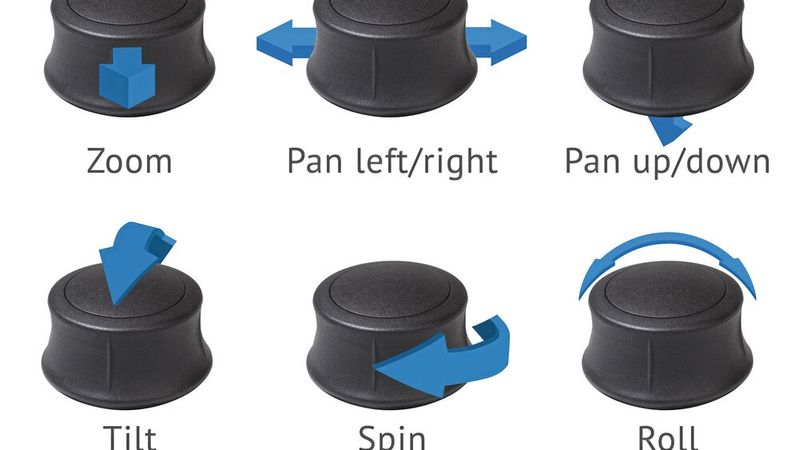
This also applies to the products of Megatron: more and more encoders and joysticks from the electronics specialist feature a CANopen or CAN J1939 interface. A particular example is the Space Mouse Module: this 3D joystick was specifically developed for human-machine interaction in industrial environments. The Space Mouse Module differs significantly from conventional joysticks as it features an ergonomically optimized control knob with six degrees of freedom. With this innovative design, the operator can intuitively control even complex movements with just one hand. Previously, two separate control units were required for this, which not only needed more installation space but also limited the operator's flexibility.
Input Device with Special Capabilities
Similar to the CAN bus system, the Space Mouse Module also has an interesting backstory. In the 1970s, researchers at the German Aerospace Center (DLR) were searching for a suitable solution for controlling a robotic arm in Cartesian space. A six-axis force-torque sensor integrated into a sphere proved to be ideal for this task. The basic principle of today's 3D joystick was born.
It soon became apparent that the potential application range of 3D joysticks could be much larger. The reason was simple: for a long time, the selection of input devices was very limited. While simple joysticks can control quite complex sequences of movements, they cannot handle three translations and three rotations in space simultaneously. Touchscreens can start predefined sequences or enter short commands, but they cannot control complex movements because of the lack of haptic feedback. And trackballs have only two degrees of freedom. The Space Mouse Module combines the properties of all these input devices.
Industry is a Large Target Group
The success story of the module began in 1993—the same year a 3D joystick was first used to control a robotic arm in space. Within a few years, the Space Mouse Module became the standard control element for CAD programs and spread across the globe. To tap into new target groups, a cooperation partner with extensive experience in automation technology and medical technology was eventually sought.
The choice fell on Megatron Elektronik GmbH & Co. KG, as the company has been supplying industry with precise encoders and joysticks for more than 60 years. A special feature is the individual service: if needed, the mechatronics specialists customize almost any product in terms of function, design, as well as mechanical and electrical interfaces, starting from small quantities.
Wide Range of Applications
The Space Mouse Module complements Megatron's product range perfectly. The core of the 3D joystick is an optoelectronic sensor that operates contactlessly and thus wears out free. Unlike other sensor types, this technology is relatively insensitive to electromagnetic interference fields, making it suitable for a wide range of applications. The Space Mouse Module is also characterized by optimized spring strength, a durable surface material (ABS), as well as improved sealing and a dead zone. This ensures that the joystick operates reliably and precisely even under the harshest environmental conditions. Another advantage of the module is its compact design, which allows for easy integration into control panels, armrests, or desk enclosures. Besides the CANopen, a USB interface and a serial interface (UART) ensure easy connection to the application.
Date: 08.12.2025
Naturally, we always handle your personal data responsibly. Any personal data we receive from you is processed in accordance with applicable data protection legislation. For detailed information please see our privacy policy.
Consent to the use of data for promotional purposes
I hereby consent to Vogel Communications Group GmbH & Co. KG, Max-Planck-Str. 7-9, 97082 Würzburg including any affiliated companies according to §§ 15 et seq. AktG (hereafter: Vogel Communications Group) using my e-mail address to send editorial newsletters. A list of all affiliated companies can be found here
Newsletter content may include all products and services of any companies mentioned above, including for example specialist journals and books, events and fairs as well as event-related products and services, print and digital media offers and services such as additional (editorial) newsletters, raffles, lead campaigns, market research both online and offline, specialist webportals and e-learning offers. In case my personal telephone number has also been collected, it may be used for offers of aforementioned products, for services of the companies mentioned above, and market research purposes.
Additionally, my consent also includes the processing of my email address and telephone number for data matching for marketing purposes with select advertising partners such as LinkedIn, Google, and Meta. For this, Vogel Communications Group may transmit said data in hashed form to the advertising partners who then use said data to determine whether I am also a member of the mentioned advertising partner portals. Vogel Communications Group uses this feature for the purposes of re-targeting (up-selling, cross-selling, and customer loyalty), generating so-called look-alike audiences for acquisition of new customers, and as basis for exclusion for on-going advertising campaigns. Further information can be found in section “data matching for marketing purposes”.
In case I access protected data on Internet portals of Vogel Communications Group including any affiliated companies according to §§ 15 et seq. AktG, I need to provide further data in order to register for the access to such content. In return for this free access to editorial content, my data may be used in accordance with this consent for the purposes stated here. This does not apply to data matching for marketing purposes.
Right of revocation
I understand that I can revoke my consent at will. My revocation does not change the lawfulness of data processing that was conducted based on my consent leading up to my revocation. One option to declare my revocation is to use the contact form found at https://contact.vogel.de. In case I no longer wish to receive certain newsletters, I have subscribed to, I can also click on the unsubscribe link included at the end of a newsletter. Further information regarding my right of revocation and the implementation of it as well as the consequences of my revocation can be found in the data protection declaration, section editorial newsletter.
The application areas of the Space Mouse Module include, among many others, sewer inspection devices, gyroscopically stabilized drones, turning centers, or instruments in assisted surgery. The high sensitivity of the 3D joystick pays off here: It responds even to the smallest movements of the finger or wrist, enabling highly precise operations.
Teach Robots Easily
The Space Mouse Module also provides valuable services in human-robot collaboration. Since automated processes can be taught intuitively and without programming knowledge, the 3D joystick is an ideal alternative for companies looking to further automate their production due to a shortage of skilled workers. With the Space Mouse Module, robots can not only be easily taught but also manually and precisely guided. This function is particularly helpful in the manufacturing and assembly of bulky or heavy components—such as the assembly of car roofs and doors. Another application area for the Space Mouse Module is the control of visualizations and simulations, which are used, for example, in medical and dental technology or in machining centers in manufacturing.
In addition to the 3D joystick, Megatron offers a variety of other CAN-bus-enabled products. These include the Heavy-Duty Finger Joystick 844 (CANopen/CAN J1939) with an installation depth of <0.79 inches, as well as the robust FHB58 encoder for applications in the food and pharmaceutical industries. The Finger Joystick TRY100 also features CANopen and CAN J1939 and is used by medical technology manufacturers, for example, for controlling patient tables in eye surgery.
Future-Proof Authentication with Universal RFID Readers



:quality(80)/p7i.vogel.de/wcms/80/c6/80c6ed88edcd6debc35fcb4715bc25ab/0130871864v1.jpeg "Tech billionaire Elon Musk can be happy, as Tesla's turnover and profits rose significantly in the first quarter compared to the same period last year. And as far as car manufacturing is concerned, it's just a side show for Musk anyway ... (Image:Tesla)")
:quality(80)/p7i.vogel.de/wcms/87/b4/87b4eee1466def5499e8147f19744016/0130876930v1.jpeg "The market for cobots is set to grow rapidly over the next few years. ABB is taking advantage of this prospect and is launching the ultra-fast-acting cobot family called Powa ... (Image:ABB)")
:quality(80)/p7i.vogel.de/wcms/c3/8a/c38a10479e5bc6748f5be24a5fb46890/0130879174v1.jpeg "According to Savills' calculations, Europe's growing market for data centers will increase demand for logistics space by a whopping 8.5 million square feet. (Picture: ©DKPhoto - stock.adobe.com)")
:quality(80)/p7i.vogel.de/wcms/5f/9d/5f9dd59b9f2df54d5c3974ad15fc2276/0130879366v1.jpeg "With a new combination of beam shaping technology, a new generation of fiber lasers and a new cutting nozzle, Trumpf is offering the opportunity to become more efficient in the laser cutting of hot-formed parts. The centerpiece here is the new X-Blast 2.0 cutting nozzle. (Image:Trump)")
:quality(80)/p7i.vogel.de/wcms/1f/46/1f46342b2f0dd64f7e8a1d1c6190948c/0130857572v1.jpeg "Hexagon, the Swiss expert for humanoid robot systems, such as the Aeon here, has know-how that Schaeffler now also wants to use as part of a cooperation. Read here what this is all about ... (Image:Hexagon Robotics)")
:quality(80)/p7i.vogel.de/wcms/78/4e/784e2e52da701049408ebf90a497198f/0130734639v1.jpeg "The combination of smart sensors and intuitive software such as the Baumer Sensor Suite makes it extremely easy for users to use IO-Link. (Image:Baumer)")
:quality(80)/p7i.vogel.de/wcms/c4/64/c464ffc097633e91ae6803d0065daa9f/0130862904v1.jpeg "At Hannover Messe 2026 (Germany), Dassault Systèmes and Omron will demonstrate how the use of mobile robots, advanced modeling and simulation, real-time data integration and integrated cybersecurity can create production systems that can be virtually designed, tested and optimized before they are physically implemented. (Image:M. Zwettler/VCG)")
:quality(80)/p7i.vogel.de/wcms/cb/78/cb78643ed2a4bbfe7792178a4873c57d/0130773901v1.jpeg "The \"Robot Transfer Units\" from Rollon prove to be particularly advantageous when moving and positioning large robots that carry loads weighing up to 1000 kg. (Image:Rollon)")
:quality(80)/p7i.vogel.de/wcms/42/f0/42f05894fe2f2c56ed34ab84fa3e7e4f/pm1826-1-3500x1968v1v1.jpeg "With the material Iglidur A351, Igus has developed a new bisphenol-free and FDA-compliant material that is approved for contact with food and is particularly resistant to cleaning chemicals and high temperatures of up to 356°F. (Image:Igus)")
:quality(80)/p7i.vogel.de/wcms/64/f6/64f6843ae30267c5c3f8e930d9b4d28a/iap-teaser-gross-1000px-x-800px-1000x563v1v1.jpeg "The newly developed biomimetic tissue substitute opens up new approaches for high-performance implants - demonstrated here on a printed pericardium. (Image:Fraunhofer IAP)")
:quality(80)/p7i.vogel.de/wcms/fd/25/fd2542c4abb445427a3044120703e917/0130799156v1.jpeg "Supply chains: Not only external, but also internal company weaknesses have a negative impact on the ability to deliver. (Image:freely licensed)")
:quality(80)/p7i.vogel.de/wcms/ab/a3/aba3362936ca55fa62cf6c213e11f773/newsimage420756-1440x810v1v1.jpeg "Thanks to its property profile, the bio-based foam made from polybutylene succinate can replace conventional polyethylene (PE) foams in important areas of application—for example in packaging, protection and transportation solutions as well as in construction applications. (Image:Fraunhofer ICT)")
:quality(80)/p7i.vogel.de/wcms/5a/d9/5ad9590b9d98884be04826d509f119ef/0130768129v1.jpeg "In Linares, Spain, Desay SV Automotive completed the shell construction of its new plant in September 2025. (Image:Desay SV)")
:quality(80)/p7i.vogel.de/wcms/07/58/0758a559ab5e3e9079ad1390803ff57d/0130860779v1.jpeg "A controlled adhesive bond that can be released if necessary allows corrections to be made during production and repairs to be carried out over the entire product life cycle. (Image:Aumovio)")
:quality(80)/p7i.vogel.de/wcms/a2/ce/a2ce08dd268dc526811457491342052e/0130819693v1.jpeg "Yanmar America, manufacturer of agricultural equipment, energy systems and industrial engines, relies on deep reinforcement learning to optimize its exhaust aftertreatment technology. (Image:Yanmar America)")
:quality(80)/p7i.vogel.de/wcms/fa/69/fa6977c7b45a843f0b067180338c34b1/0130823301v1.jpeg "The new fuel cell system from Cellcentric delivers up to 503 horsepower. (Image:Cellcentric)")
:quality(80)/p7i.vogel.de/wcms/d7/dc/d7dcb6a8e3fbefbf1db738f128108aa6/0130804280v1.jpeg "Zone trigger: When conventional edge or pattern triggers reach their limits, the time has come for the zone trigger. By simply drawing zones on the oscilloscope display, rare anomalies can be isolated with pinpoint accuracy. (Picture:Rohde & Schwarz)")
:quality(80)/p7i.vogel.de/wcms/61/c0/61c0e8c23e03b0d01e318e421a35b49f/0130823277v1.jpeg "The Beforce platform from Imec. (Image:Imec)")
:quality(80)/p7i.vogel.de/wcms/be/9c/be9c5c6f17c390340f37eb54cafa985a/0130861266v1.jpeg "Render of the planned advanced packaging plant in Cheongju, South Korea. (Image:SK Hynix)")
:quality(80)/p7i.vogel.de/wcms/d9/ed/d9ed948b0430f6da5f7f0dd46cbd905c/0130824631v1.jpeg "Keysight and Sateliot win competition for 6G innovations from the European Space Agency and the GSMA Foundry. (Image:Keysight)")
:fill(fff,0)/images.vogel.de/vogelonline/companyimg/76800/76895/65.jpg "FAULHABER_120mm.jpg ()")
:fill(fff,0)/p7i.vogel.de/companies/69/de/69de1b7403b0d/simtos-logo.jpeg "simtos-logo (SIMTOS)")
:quality(80)/p7i.vogel.de/wcms/54/99/5499a6315015316f5b8f38eed2b434c9/0123046076v1.jpeg "Sewer inspection systems can be controlled with high precision using the SpaceMouse® Module.(Image: Kummert GmbH)")
:quality(80)/p7i.vogel.de/wcms/3d/9f/3d9f44e2c11a94231a870e36ef17d3da/0123046078v1.jpeg "The Space Mouse Module from Megatron is suitable for the intuitive control of complex movements in space.(Image: Megatron Elektronik GmbH & Co. KG)")
:quality(80)/p7i.vogel.de/wcms/bf/97/bf976414bb81d7daf8237ffeb8b90b6e/0124284781v1.jpeg "The Space Mouse Module has more degrees of freedom than any other finger joystick on the market.(Image: Megatron Elektronik GmbH & Co. KG)")
:quality(80)/p7i.vogel.de/wcms/45/7b/457bb899cc2baa2e9280df66ac5cf05c/0123046091v1.jpeg "Also used for controlling patient tables in eye surgery: The TRY 100 finger joysticks from Megatron.(Image: Megatron Elektronik GmbH & Co. KG)")
:quality(80):fill(efefef,0)/p7i.vogel.de/wcms/67/ae/67ae0b9ac31f8/elatec-wp-universal-reader.png "Elatec WP Universal Reader")
:quality(80)/p7i.vogel.de/wcms/62/93/62934fd6900b930a0db9493be3d931ba/0127310246v1.jpeg "Servomotors without housings can be used very efficiently in confined spaces. (Image:TQ-Robotics)")
:quality(80)/p7i.vogel.de/wcms/86/d3/86d3e80177392a7d11f68a6ed8bb0aa8/0127182524v1.jpeg "The Atro modular industrial robot system enables robot solutions to be implemented that are precisely tailored to the application and seamlessly integrated into TwinCAT. (Image:Beckhoff Automation GmbH & Co. KG)")