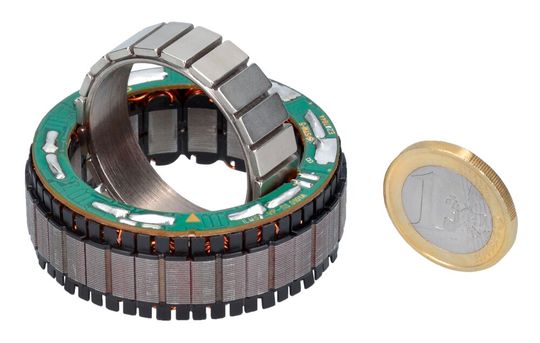
Frameless servomotors offer decisive advantages over standard servomotors with housings: they enable more space-saving integration, reduce the overall weight and eliminate superfluous components such as additional housings and mounting structures. Sophisticated system integration results in an efficient, lightweight and powerful drive solution.
Servomotors without housings can be used very efficiently in confined spaces.
(Image: TQ-Robotics)
However, in order to optimize the design of the motor, control system and mechanical components, it is important to clearly define key parameters as early as the planning phase. The desired application ultimately determines the choice of components and their composition. This article shows how these key parameters can be used to select the right drive components, ensure efficient system integration and make the application powerful, reliable and economical.
Key questions before selecting the drive components are:
Gallery
What power must the drive provide? (torque, speed)
Which input variables are available? (operating voltage, current, control interfaces)
What other requirements must be met? (weight, size, inertia)
What are the requirements of the application? (accuracy, speed, safety, braking)
The actual operating conditions of the application result in a load profile that the drive must fulfill. It describes how the torque and speed change over time, which peak loads occur and which thermal requirements need to be taken into account.
1. Servo Motor
Choosing the right servomotor is crucial for the development of sophisticated drive systems. This is the case when the drive plays a central role in the application and it is essential for the function of the product that it is particularly powerful, but at the same time compact, light and efficient. A number of key technical criteria must be clarified when selecting a motor. Lie power defines how much energy the motor converts per unit of time. This is measured in watts. The power requirement varies depending on the application: a small gripper arm requires significantly less power than an autonomous vehicle drive system.
The torque indicates the force that the motor exerts on a rotary movement; it is measured in Newton meters. The torque is the decisive factor for applications in which loads have to be moved or held, for example in humanoid robot joints.
Size and weight should not be neglected when selecting the right motor. The motor must be integrated into the overall design to save space. Especially in mobile robots and drones, weight is crucial for efficiency.
During use, heat is generated that must be dissipated; this is ensured by thermal management. How efficiently the motor dissipates heat is crucial for continuous loads and high power requirements. Thanks to their high copper fill factor, TQ motors minimize electrical resistance and reduce ohmic losses to a minimum—for maximum efficiency and lower heat generation.
Dynamics and speed, in other words high rotational speeds and acceleration, are essential for fast movements—especially when these have to be able to change abruptly. They are therefore crucial for applications that require maximum precision and responsiveness.
Ultimately, of course, the cost-benefit ratio also determines the choice of motor. In addition to performance, production costs, service life and maintenance costs also play a decisive role. Frameless servomotors offer clear advantages here: By dispensing with additional components in the system, they require less maintenance and are more robust and cost-efficient in the long term than conventional servo motors.
Motor selection is not an isolated step—it must fit harmoniously with the housing, electronics, controller and application. Especially in robotics, a precisely coordinated drive solution is crucial to optimize energy efficiency, performance and service life.
2. Sensors
Various sensors are required for reliable and efficient control of drive units. These include temperature sensors for monitoring the motor temperature. They monitor the winding temperature to ensure that the motor operates within the optimum load range at all times. Additional sensors in the system enable a more precise analysis of the load limits and can be used to dynamically adjust the motor control.
Hall sensors determine the rotor position based on the magnetic field and are essential for the commutation of servomotors, i.e. for switching the current flow in the windings to ensure constant torque and continuous rotation. Without Hall sensors, sensorless techniques such as electromotive force (EMF) feedback are required, but these are less accurate at low speeds.
Date: 08.12.2025
Naturally, we always handle your personal data responsibly. Any personal data we receive from you is processed in accordance with applicable data protection legislation. For detailed information please see our privacy policy.
Consent to the use of data for promotional purposes
I hereby consent to Vogel Communications Group GmbH & Co. KG, Max-Planck-Str. 7-9, 97082 Würzburg including any affiliated companies according to §§ 15 et seq. AktG (hereafter: Vogel Communications Group) using my e-mail address to send editorial newsletters. A list of all affiliated companies can be found here
Newsletter content may include all products and services of any companies mentioned above, including for example specialist journals and books, events and fairs as well as event-related products and services, print and digital media offers and services such as additional (editorial) newsletters, raffles, lead campaigns, market research both online and offline, specialist webportals and e-learning offers. In case my personal telephone number has also been collected, it may be used for offers of aforementioned products, for services of the companies mentioned above, and market research purposes.
Additionally, my consent also includes the processing of my email address and telephone number for data matching for marketing purposes with select advertising partners such as LinkedIn, Google, and Meta. For this, Vogel Communications Group may transmit said data in hashed form to the advertising partners who then use said data to determine whether I am also a member of the mentioned advertising partner portals. Vogel Communications Group uses this feature for the purposes of re-targeting (up-selling, cross-selling, and customer loyalty), generating so-called look-alike audiences for acquisition of new customers, and as basis for exclusion for on-going advertising campaigns. Further information can be found in section “data matching for marketing purposes”.
In case I access protected data on Internet portals of Vogel Communications Group including any affiliated companies according to §§ 15 et seq. AktG, I need to provide further data in order to register for the access to such content. In return for this free access to editorial content, my data may be used in accordance with this consent for the purposes stated here. This does not apply to data matching for marketing purposes.
Right of revocation
I understand that I can revoke my consent at will. My revocation does not change the lawfulness of data processing that was conducted based on my consent leading up to my revocation. One option to declare my revocation is to use the contact form found at https://contact.vogel.de. In case I no longer wish to receive certain newsletters, I have subscribed to, I can also click on the unsubscribe link included at the end of a newsletter. Further information regarding my right of revocation and the implementation of it as well as the consequences of my revocation can be found in the data protection declaration, section editorial newsletter.
Finally, the position, speed and direction of rotation of a rotating or linear movement are measured and converted into an electrical signal using an incremental or absolute encoder. Incremental encoders measure position changes of the motor in small steps or increments. As soon as a movement occurs, they generate pulse signals that are counted to determine the movement or speed. This has the disadvantage that the absolute motor position is not known after the first switch-on. Therefore, a reference run is necessary to determine the starting position.
An absolute encoder, on the other hand, records the exact position at all times, even after a power failure. Each position is defined by a unique code pattern, for example a binary or gray code. This means that no reference run is required, as the current position is available immediately after switching on.
Depending on the requirements, one or two encoders are usually used per axis. In standard applications, an encoder is attached directly to the motor, for example on the rotor. It measures the position of the motor, which is sufficient for many applications such as simple industrial robots.
In the extended application, an encoder is installed on the motor to control the drive movement. An additional encoder on the joint is responsible for more precise position feedback directly on the mechanical axis. This design is often found in high-precision robots, such as cobots or in medical technology. In highly developed robots, such as in humanoid robotics or space travel, encoders and torque sensors are combined to enable precise and force-adaptive control. One example of this is the complete drive for robotic solutions from Sensodrive.
3. Gearbox
When it comes to the composition of the drive system, there is one key question: Does my application need a gearbox? This decision depends on several factors:
Torque requirement: Is the torque generated directly by the motor sufficient or is a gear ratio required?
Dynamics: Should the axis react quickly and perform precise movements?
Precision: How precise must the positioning be?
Space requirement: Is there enough installation space available to install a larger gearbox or a more powerful motor?
Weight: Is a lightweight drive crucial, e.g. for mobile robot systems?
Direct drives and gearbox solutions each have their justification. Direct drives do not require gears and transmit power directly. They are ideal when maximum precision, minimum friction and maximum dynamics are required. They are particularly useful whenever the required torque can be achieved directly and no additional play is required.
An intermediate form is the quasi-direct drive, which develops more power with a minimal gear ratio. A slightly reduced gearbox bridges smaller differences in speed or torque without significantly impairing dynamics and precision. One example is the TQ-HPR50 e-bike drive, which works with a low gear ratio when the motor needs a little more torque.
For applications that require high torque at low speeds, a high gear ratio makes sense. The focus here is on power transmission; dynamics and efficiency must be optimally coordinated.
4. Motor Controller
The motor controller controls the voltage, current, speed and direction of rotation of a servomotor. The choice of controller is crucial for the performance and precision of a robot system—especially in humanoid robotics or highly dynamic applications. Various criteria are also decisive for the selection of the motor controller. First of all, the performance requirements, i.e. the maximum controllable voltage and current, must match the motor
Motor controllers offer various control options that must be suitable for the respective application. For example, speed control that generates a precise speed is ideal for driving conveyor belts. A robot axis, on the other hand, requires precise movements, which is where position control comes into play. Torque control enables sensitive force control and is used in cobots or grippers, for example.
Interfaces connect the motor controller to the environment, for example CAN bus, Ethercat or RS485 for communication or interfaces to incremental or absolute encoders. Finally, external sensors, such as torque sensors, can be integrated.
Important prerequisites for smooth movements are the real-time capability and reaction time of the controller. These are particularly important for humanoid robots.
The functional safety of motor controllers defines various safety functions that ensure the safe operation of machines and systems, for example:
STO (Safe Torque Off): This function interrupts the power supply to the motor, preventing it from generating torque. It prevents the motor from starting up unexpectedly.
SS1 (Safe Stop 1): The drive is brought to a controlled standstill before the STO function is activated. This corresponds to stop category 1 and ensures that the motor comes to a controlled stop before the torque is switched off.
SP (Safe Position): Provides safe position data of the drive via a safe bus, which can be used by a safety controller, for example to monitor end positions or activate position-dependent safety functions.
Finally, motor controllers can be programmed and adapted. This allows individual control algorithms to be integrated. An important criterion here is compatibility with the flexible open source framework Robot Operating System (ROS) for the development of robot software.
5. Integration of the Overall System
Choosing the right components is not enough—the motor, sensors, gearbox and controller must work together optimally. Efficient integration is crucial for the performance, reliability and service life of the entire system. Here too, a large number of parameters must be taken into account for optimum design:
Mechanical & electrical integration
Mechanical fit:The motor-gearbox unit must fit into the overall structure of the system in the best possible way.
Alignment & assembly: Precise connection of motor, gearbox and sensors ensures efficient power transmission and minimizes vibrations and noise.
Electrical connection: The motor controller must be compatible with the power supply as well as the encoders, sensors and safety functions. A continuous power and signal connection is crucial for multi-axis applications—a large hollow shaft in the motor makes clean cable routing and integration much easier.
Software and control
Communication & interfaces: CAN, EtherCAT, RS485 for seamless integration.
Signal transmission & feedback: Encoders and torque sensors ensure precise control and monitoring.
Real-time capability: Especially in humanoid robotics, low latencies are crucial for smooth movements.
Heat dissipation:Heat sink, fan or housing design to prevent overheating.
Even heat distribution:Protection of sensitive components through targeted dissipation.
Material selection and insulation:Reduction of thermal loads for maximum service life.
Synchronization and system tuning
Perfect coordination of motor, gearbox and sensors to avoid torsional vibrations and uneven movements.
Feedback loop:Sensors and motors communicate continuously to ensure maximum efficiency and precision.
Finished Joints And Highly Integrated Axles
In addition to customized system integrations, the market offers ready-made joints from suppliers such as Sensodrive, Synapticon, Sumitomo or Robotis. Application-specific actuators are also available, for example from Servoneering.
For specific applications, on the other hand, it often makes sense to develop highly integrated axes individually. The motor, gearbox, encoder and sensors are then tailored precisely to the requirements in order to ensure maximum performance and precision. This requires close cooperation between the manufacturer and customer and is particularly common in industrial robotics, medical technology, automation and vehicle technology, where standard solutions are often not sufficient.
Increasingly, highly integrated axes are also being developed as directly usable standard products that can be integrated into various systems for different applications in the industry without complex adaptations. These offer a high level of compatibility, making them ideal for companies that require fast and cost-effective solutions.
Highly integrated stand-alone axes can be brought to market faster and deployed quickly without long development times. No expensive adaptations are necessary because a wide range of variants are available for different applications. In terms of performance and efficiency, they are very often comparable with customized solutions.
Successful Integration Through Clear Requirements
Optimum system integration not only requires mechanical accuracy of fit, reliable electrical connection, efficient thermal management and precise synchronization of all components—it starts with a clear definition of the requirements.
The key to success: performance, size, costs and the importance of the drive unit for the overall application must be precisely analyzed as early as the planning phase. Particularly in areas such as robotics, measurement technology or for positioning systems, where the drive performs a core function, the right selection and integration are crucial for the efficiency and performance of the end product.



:quality(80)/p7i.vogel.de/wcms/d1/ef/d1ef6b6f7d4543f7999980bacccaf22b/0133499261v1.jpeg "As the growing imbalance in trade relations with China continues to widen, the EU Chamber of Commerce foresees a day when trade with China will have to be seriously reevaluated ... (Image: AI-generated)")
:quality(80)/p7i.vogel.de/wcms/fe/1f/fe1fa5ee713f94deaba963dc24c3abc5/0133299273v1.jpeg "The Flexistar enables highly flexible production of laser-welded tubes thanks to its tool-free clamping system. (Image:Because Technology, LLC)")
:quality(80)/p7i.vogel.de/wcms/1b/5a/1b5ac72f83db4dbee3ff91e51bc398f4/0133496095v1.jpeg "BASF announces that it will take the next step toward producing the polyurethane precursor MDI in India ... (Image:BASF)")
:quality(80)/p7i.vogel.de/wcms/3f/cf/3fcfa390902944ffcf24e7fe973cc3ee/0133486258v1.jpeg "Do you need to create secure connections on structures using blind rivets, but space is tight? Then you should take a closer look at the Universalgrip from Gesipa ... (Image: Gesipa)")
:quality(80)/p7i.vogel.de/wcms/60/ef/60ef4f07e4829b2c2929befc0f353c58/0133511729v1.jpeg "Humanoid robots can match human performance in certain tasks. (Image:Gemini / AI-generated)")
:quality(80)/p7i.vogel.de/wcms/2e/99/2e99726b522e4b35b690e25eb6a42643/0133463991v1.jpeg "Robotics: In AMR applications, connection technology must reliably transmit power, signals, and data despite vibration and shock loads—in very confined spaces and in a way that allows for regular maintenance. (Image:Hyperever)")
:quality(80)/p7i.vogel.de/wcms/d0/18/d01801e3d5dbd7bc9d0b4f60408b630c/0133468429v1.jpeg "Quality requirements for film packaging are on the rise. At the same time, many companies are turning to recyclable film materials, which, however, have their own challenges. Fraunhofer researchers have therefore developed a fast system that detects problems in real time. (Image:Fraunhofer IKTS)")
:quality(80)/p7i.vogel.de/wcms/b1/06/b106cf44923ce39565c3264982fd20eb/0133414574v1.jpeg "Robots Build Robots: At the new Ubtech factory, automated systems even handle parts of the material supply and logistics for the production of humanoid robots. (Image:Ubtech)")
:quality(80)/p7i.vogel.de/wcms/c0/52/c052f405eb55fc3d08c4837e77206fc0/adobestock-2021845957--aucartstudio-stock-adobe-com-ki-generiertv1.jpeg "An innovation from China to combat extreme summer heat: A novel coating lowers temperatures. (Source: © AucArtStudio – stock.adobe.com_AI-generated)")
:quality(80)/p7i.vogel.de/wcms/66/a7/66a7b78159caeacce57136529688799f/0133503398v1.jpeg "Sunlight Makes Stone! These stone blocks weren't made the traditional way. Instead, they were additively manufactured from sand using a laser. In the future, however, the laser is set to be replaced by concentrated sunlight—if the startup Addisol is successful... (Image:Addisol / F. Fiedler)")
:quality(80)/p7i.vogel.de/wcms/72/b9/72b995c2c8d812c5e2115cbef31e035a/0133462727v1.jpeg "Eggl manufactures center hoods that are precisely tailored to each cooking island—whether standard size or custom shape. They are made entirely of stainless steel and are individually customized in terms of size and filter arrangement. (Image:SPI)")
:quality(80)/p7i.vogel.de/wcms/13/5d/135dfae6229ceaf5c55467a43e8f7257/adobestock-1879961393--ardi-stock-adobe-com-ki-generiertv1.jpeg "Annoying chatterboxes or awkward silences in response to questions—a moderator should specifically prepare for difficult situations in order to navigate them effectively. (Image:ardi - stock.adobe.com_AI-generated)")
:quality(80)/p7i.vogel.de/wcms/aa/a2/aaa2c6dd2daa24b485cddbf9297590c0/0133467318v1.jpeg "Battery Monitoring: Battery monitoring using electrochemical impedance spectroscopy offers several advantages. (Image:TI)")
:quality(80)/p7i.vogel.de/wcms/39/b2/39b21bf03be1683831862239a369987c/0133469638v1.jpeg "Data from autonomous vehicles and robots operating autonomously is in high demand, and Ruqi wants to capitalize on this. (Image:Ruqi Mobility)")
:quality(80)/p7i.vogel.de/wcms/8a/bb/8abbb6217220595edc1549ac9b84f307/0133429906v1.jpeg "The IAA in Hanover showcased the ambitions of Chinese commercial vehicle manufacturers in Europe. (Image:Wehner - VCG)")
:quality(80)/p7i.vogel.de/wcms/0c/53/0c5313ef91c14b6df0d0996efc33c8ad/jpg03568-bearbeitetv1.jpeg "The category winners of the 2027 German Car of the Year award. (Source: GCOTY)")
:quality(80)/p7i.vogel.de/wcms/f3/d8/f3d870d8f31a5a5110449c929ea3e641/0133470449v1.jpeg "The new Nexora sensor family from Teledyne e2v: These CMOS image sensors combine BSI technology with a global shutter and are available in 12- and 16-megapixel versions. (Image:Teledyne)")
:quality(80)/p7i.vogel.de/wcms/11/2e/112eabc5fb41e1a401f0e93e9326ef51/0133489329v1.jpeg "A sandbox limits the actions an AI agent can take, but it is not an impenetrable barrier. Only multiple independent layers of protection prevent an escape from immediately granting access to production systems. (Image:freely licensed)")
:quality(80)/p7i.vogel.de/wcms/18/ba/18bae45f9e6f7cacc203d56f3bc26e3c/0133455937v1.jpeg "Google did not make the incidents public until after receiving an inquiry from the “Wall Street Journal.” (Image:Google)")
:quality(80)/p7i.vogel.de/wcms/65/58/655895abe42a598e146fe47baf7c54db/0133441212v1.jpeg "Wukong, a 72-qubit quantum processor manufactured by Origin Quantum. (Image:Origin Quantum)")
:fill(fff,0)/images.vogel.de/vogelonline/companyimg/76800/76895/65.jpg "FAULHABER_120mm.jpg ()")
:quality(80)/p7i.vogel.de/wcms/68/cb/68cb09d45f6e8a21bc46241dede543ea/0127310244v1.jpeg "The TQ-HPR50 e-bike drive works with a lower gear ratio and therefore offers slightly more torque.(Image: TQ-Robotics)")
:quality(80)/p7i.vogel.de/wcms/de/64/de6458915e7b4f10a6fac122f82edad7/0127310250v1.jpeg "Complete, highly integrated axes and robot arms simplify the design and shorten the time to market.(Image: TQ-Robotics)")
:quality(80)/p7i.vogel.de/wcms/5e/f0/5ef0dfcdf1f93b0c8b11e2d214e20934/0127310252v1.jpeg "Integrated sensors provide information on the current status of the engine.(Image: TQ-Robotics)")
:quality(80):fill(efefef,0)/p7i.vogel.de/wcms/67/ad/67adf92d254d2/elatec-wp-smart-factory.png "Elatec WP Smart Factory")
:quality(80)/p7i.vogel.de/wcms/17/40/1740ea2e261b768a3cafcf7805adccfb/adobestock-789872912--c2-a9-20littlewolf1989-20-e2-80-93-20stock-adobe-comv1.jpeg "The tractor gearbox was removed for maintenance purposes. (Stock image) (Source: littlewolf1989 – stock.adobe.com)")
:quality(80)/p7i.vogel.de/wcms/e9/e0/e9e0535ee2cbe132750fba13607eba18/0130896173v1.jpeg "Escon 2 is used wherever maximum dynamics and precision are required - for example in laboratory automation systems. (Image:DavidBGray/maxon)")