The memory crisis has long since spread to DRAM and NAND flash as well. As prices rise and availability falls, SK Hynix is warning of shortages through 2030. What does this mean for industrial electronics and embedded systems?
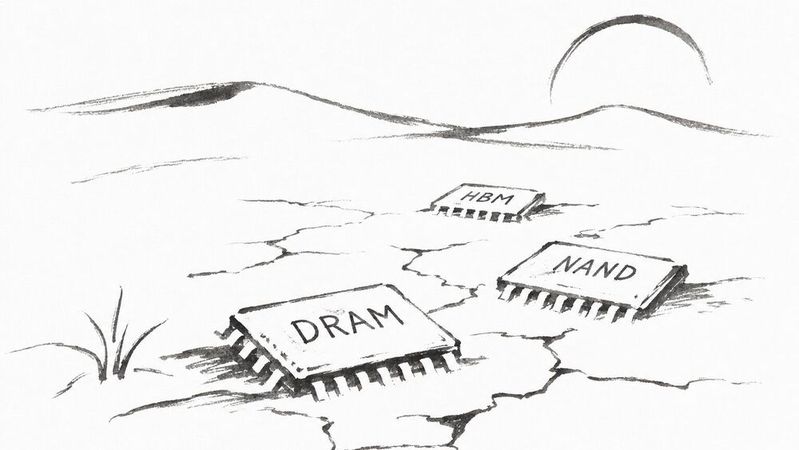
Memory chips are in short supply: Persistently high demand and limited manufacturing capacity are driving up prices for DRAM, NAND flash, and HBM. It could be years before the memory market eases up.
(Image: Dall-E / AI-generated)
The memory crisis is likely to continue to affect the electronics industry for years to come. South Korean semiconductor manufacturer SK Hynix expects, as part of its Q3 2026 quarterly results, the company anticipates that global demand for memory chips could exceed available supply through 2030. The company cites growing memory demand driven by AI applications, technological challenges in modern manufacturing processes, and the long lead times involved in expanding production capacity as reasons for this outlook.
The published financial results illustrate just how much memory manufacturers are currently benefiting from market trends: SK Hynix’s revenue alone rose 328 percent year-over-year to 104.6 trillion South Korean won. Operating profit reached 83.3 trillion won, corresponding to an operating margin of approximately 80 percent.
More than Half of the Capacity is already under Contract
The trend in supply agreements is particularly revealing. SK Hynix has now signed long-term contracts with 14 major customers, including leading cloud providers. The agreed-upon volumes account for more than 50 percent of the total planned production capacity for 2027 and 2028. This means that a significant portion of future production is already contractually committed. According to the company, the agreements also include mechanisms that allow prices to be adjusted within specified limits in line with market developments.
SK Hynix plans to expand its capacity: The new M15X manufacturing facility is expected to reach its maximum capacity by 2026, enabling, in particular, the production of HBM4. In the fourth quarter, this generation of memory is expected to surpass the previous HBM3E generation for the first time in terms of both sales volume and revenue. The company plans significantly higher investments for 2027. The first phase of expansion at the new production complex in Yongin is also expected to contribute to this. However, it takes several years for new manufacturing facilities to provide significant additional capacity.
HBM Exacerbates Capacity Pressure in the DRAM Market
The global shortage of memory chips affects conventional DRAM as well as NAND flash and High Bandwidth Memory (HBM). Demand from AI data centers, in particular, is exacerbating the situation: memory manufacturers are increasingly focusing their production on HBM and high-margin server products, resulting in a shortage of capacity for other memory segments. Moreover, the production of HBM requires a higher wafer yield than conventional DRAM for comparable memory capacity. Additional production capacity therefore does not necessarily lead to a correspondingly higher amount of available memory.
According to an assessment by the market research firm Trendforce, contract prices for conventional DRAM will rise by another 10 to 15 percent in the fourth quarter of 2026 compared to the previous quarter. For NAND flash, analysts forecast price increases of between 15 and 20 percent.
The supply of DDR4 memory is becoming particularly critical. Major manufacturers are scaling back production on older process nodes and focusing on newer memory technologies. At the same time, DDR4 components are still needed in numerous existing systems. Trendforce therefore expects the DRAM supply to remain tight through 2027. In contrast, the situation for NAND flash could ease in the second half of 2027 due to additional manufacturing capacity. The various memory markets are thus not necessarily evolving in the same way.
For Industrial Electronics, the Crisis Will Become a Long-Term Problem
For manufacturers of industrial electronics, high memory prices and supply chain issues have long been a daily reality. For certain memory products, prices have multiplied within just a few months; Spectra, a manufacturer of industrial PCs, reported in late October 2026 on supply bottlenecks for motherboards as well as new price pressures for memory and graphics cards. SK Hynix’s forecast therefore raises a new question: How should manufacturers of industrial PCs, embedded systems, and other long-lasting electronic products secure their memory supply if a fundamental easing of market conditions might not occur for years to come?
A study published in October by Memphis Electronic and EETech. Of the 105 developers surveyed in Europe and North America, 36 percent stated that they had redesigned products due to memory availability issues. Twenty-four percent delayed product launches, and 46 percent reported additional development costs. While the results are not representative due to the limited sample size, they do show that memory procurement has long since become a development issue, going beyond mere purchasing.
Date: 08.12.2025
Naturally, we always handle your personal data responsibly. Any personal data we receive from you is processed in accordance with applicable data protection legislation. For detailed information please see our privacy policy.
Consent to the use of data for promotional purposes
I hereby consent to Vogel Communications Group GmbH & Co. KG, Max-Planck-Str. 7-9, 97082 Würzburg including any affiliated companies according to §§ 15 et seq. AktG (hereafter: Vogel Communications Group) using my e-mail address to send editorial newsletters. A list of all affiliated companies can be found here
Newsletter content may include all products and services of any companies mentioned above, including for example specialist journals and books, events and fairs as well as event-related products and services, print and digital media offers and services such as additional (editorial) newsletters, raffles, lead campaigns, market research both online and offline, specialist webportals and e-learning offers. In case my personal telephone number has also been collected, it may be used for offers of aforementioned products, for services of the companies mentioned above, and market research purposes.
Additionally, my consent also includes the processing of my email address and telephone number for data matching for marketing purposes with select advertising partners such as LinkedIn, Google, and Meta. For this, Vogel Communications Group may transmit said data in hashed form to the advertising partners who then use said data to determine whether I am also a member of the mentioned advertising partner portals. Vogel Communications Group uses this feature for the purposes of re-targeting (up-selling, cross-selling, and customer loyalty), generating so-called look-alike audiences for acquisition of new customers, and as basis for exclusion for on-going advertising campaigns. Further information can be found in section “data matching for marketing purposes”.
In case I access protected data on Internet portals of Vogel Communications Group including any affiliated companies according to §§ 15 et seq. AktG, I need to provide further data in order to register for the access to such content. In return for this free access to editorial content, my data may be used in accordance with this consent for the purposes stated here. This does not apply to data matching for marketing purposes.
Right of revocation
I understand that I can revoke my consent at will. My revocation does not change the lawfulness of data processing that was conducted based on my consent leading up to my revocation. One option to declare my revocation is to use the contact form found at https://contact.vogel.de. In case I no longer wish to receive certain newsletters, I have subscribed to, I can also click on the unsubscribe link included at the end of a newsletter. Further information regarding my right of revocation and the implementation of it as well as the consequences of my revocation can be found in the data protection declaration, section editorial newsletter.