After switching to the ExBurrDrill from deburring specialist Kempf, Tries GmbH & Co. KG was not only able to improve the quality of the drill holes, but also increase the tool life by a factor of 10.
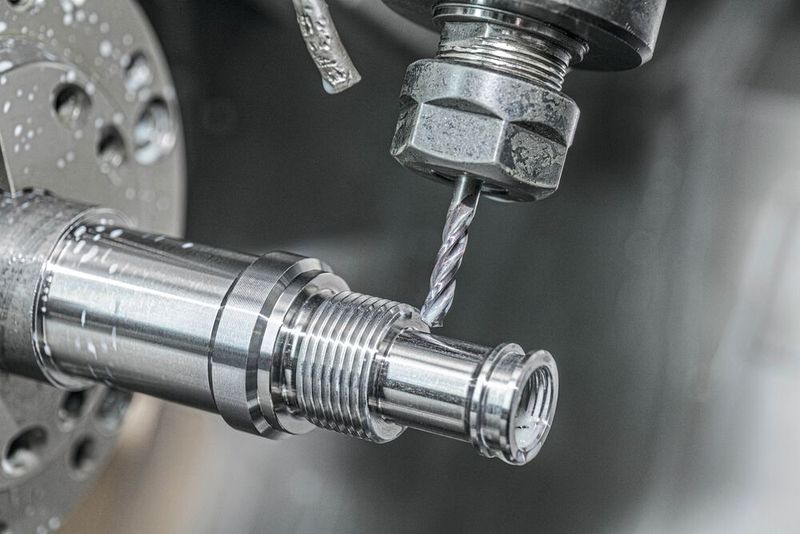
The hydraulic housing made of steel, clamped in the CNC machine. The ExBurrDrill with TiAlN coating (diameter 5 mm, Z=3) drills the four holes in the component within a few seconds, without having to deburr them afterwards. The workpiece comes directly from the machine finished and burr-free.
(Image: Kempf GmbH)
Quality was already the top priority when Manfred Tries' engineering office was founded in 1964, so it wasn't long before the company set up and incorporated its own production facility for the development and design of hydraulic components. In 1978, today's Tries GmbH & Co. KG, which now employs almost 180 people and is internationally renowned for its hydraulic control blocks, valves and cylinders, among other things. Today, as then, the focus is on the development and construction of individual special solutions, which take place in close cooperation with the customer. Depending on the component and requirements, this results in production volumes at Tries ranging from a few individual items to several tens of thousands per year, which are mainly used in special vehicles, wheeled excavators and cranes from various large and well-known manufacturers.
A Lot of Effort for a Standard Component
During the production of a turned part with cross bores for hydraulic blocks, which measures only around 120 mm (~4.8 inches) in length and is already a standard product at Tries with a quantity of around 25,000 parts per year, the supposedly "simple" drilling application turned out to be a real sticking point in the entire machining process.
The drills used sometimes produced such high burrs at the bore exit on the inside of the component that it was necessary to have the parts thermally deburred by hand in the first step and again by an external service provider in a second step. Added to this was the relatively short service life of the drills used and the resulting lack of or unpredictable process reliability, as the burr formation had to be checked repeatedly and the drills had to be replaced after different periods of use (usually around 2,000 drill holes). Overall, the production process was not satisfactory for the head of the series production department, Robert König, which is why a new and better solution was sought.
A Small Drill Makes a Big Difference
After several trials with various drill bits from well-known manufacturers, none of which were able to achieve a satisfactory result in terms of the burr height at the hole exit, Tries finally became aware of the ExBurrDrill from Kempf. The burr-minimizing drill, a development from the deburring specialist, also promises that no drill caps will stick to the component thanks to its special geometry. With the support of Kempf sales representative Thomas Welte, the drill was tested at Tries without further ado.
Although Tries' expectations were not too high due to the many preliminary tests and satisfactory performance would have been achieved if external thermal deburring could be dispensed with, the performance of the ExBurrDrill was all the more surprising. Run in on several machines, the burr build-up at the bore exit was not visible or barely measurable, even after many thousands of bores had been produced. In continuous operation since then, the performance has been so good that, in principle, there is no longer any need for checks, but the drill is changed as a precaution after approx. 20,000 parts in order to prevent any burr formation.
Performance Enhancement and Production Optimization
Since using the Kempf ExBurrDrill, the bore exits no longer need to be reworked. The constant inspection work and machine downtimes associated with tool changes are also a thing of the past.
Following the first successful use of the ExBurrDrill, we are now also using the drill for other components in a total of three different diameters. The drill has to drill up to eight holes per component and even with these applications we no longer have any problems with burrs.
Robert König, Head of Series Production at Tries GmbH & Co. KG
Developed for Minimum Burr at Maximum Feed Rate
The Kempf ExBurrDrill impresses with further advantages that can optimize machining in many areas compared to the use of standard drills. In order to be able to exploit the full range of advantages, the special drill from Kempf is not offered as an off-the-shelf tool, but is manufactured individually for the corresponding customer application in the diameter range 0.8 mm to 20 mm. The tool geometry of the ExBurrDrill is parameterized, taking into account the engagement conditions at the bore exit and the material of the component. Individual tool production also makes it possible to combine several process steps in one drilling operation. By using a step drill, for example, both the downstream deburring process and a countersinking or boring process can be omitted. This reduces tool change times and main times on the machine.
Date: 08.12.2025
Naturally, we always handle your personal data responsibly. Any personal data we receive from you is processed in accordance with applicable data protection legislation. For detailed information please see our privacy policy.
Consent to the use of data for promotional purposes
I hereby consent to Vogel Communications Group GmbH & Co. KG, Max-Planck-Str. 7-9, 97082 Würzburg including any affiliated companies according to §§ 15 et seq. AktG (hereafter: Vogel Communications Group) using my e-mail address to send editorial newsletters. A list of all affiliated companies can be found here
Newsletter content may include all products and services of any companies mentioned above, including for example specialist journals and books, events and fairs as well as event-related products and services, print and digital media offers and services such as additional (editorial) newsletters, raffles, lead campaigns, market research both online and offline, specialist webportals and e-learning offers. In case my personal telephone number has also been collected, it may be used for offers of aforementioned products, for services of the companies mentioned above, and market research purposes.
Additionally, my consent also includes the processing of my email address and telephone number for data matching for marketing purposes with select advertising partners such as LinkedIn, Google, and Meta. For this, Vogel Communications Group may transmit said data in hashed form to the advertising partners who then use said data to determine whether I am also a member of the mentioned advertising partner portals. Vogel Communications Group uses this feature for the purposes of re-targeting (up-selling, cross-selling, and customer loyalty), generating so-called look-alike audiences for acquisition of new customers, and as basis for exclusion for on-going advertising campaigns. Further information can be found in section “data matching for marketing purposes”.
In case I access protected data on Internet portals of Vogel Communications Group including any affiliated companies according to §§ 15 et seq. AktG, I need to provide further data in order to register for the access to such content. In return for this free access to editorial content, my data may be used in accordance with this consent for the purposes stated here. This does not apply to data matching for marketing purposes.
Right of revocation
I understand that I can revoke my consent at will. My revocation does not change the lawfulness of data processing that was conducted based on my consent leading up to my revocation. One option to declare my revocation is to use the contact form found at https://contact.vogel.de. In case I no longer wish to receive certain newsletters, I have subscribed to, I can also click on the unsubscribe link included at the end of a newsletter. Further information regarding my right of revocation and the implementation of it as well as the consequences of my revocation can be found in the data protection declaration, section editorial newsletter.
In principle, the ExBurrDrill was designed to drill with minimal burrs, ideally at higher feed rates than standard drills, without leaving behind any drill caps, which always pose a risk to subsequent tools. The special cutting edge of the ExBurrDrill eliminates this risk. If an edge break is required on the workpiece, the subsequent deburring tool is significantly relieved by the low residual burr. If the bore is ECM deburred, this also runs with significantly fewer faults, as the residual burr is considerably smaller.



:quality(80)/p7i.vogel.de/wcms/62/14/6214b7c2c247ff6610c33ec375ff629a/0132992790v1.jpeg "Oliver Sax is a member of the board of Ceratizit and responsible for the areas of machining and rods. He heads the specialist for machining tools and carbide solutions, which is part of the Plansee Group. Sax is responsible for the strategic direction of the global market leader, focusing particularly on the expansion of the circular economy and technological independence in the supply of the critical raw material tungsten. The company boasts over 100 years of expertise in material development. (Image:Ceratizit Deutschland GmbH)")
:quality(80)/p7i.vogel.de/wcms/35/ca/35cac9f68609eccae3173dad1863df49/0132991739v1.jpeg "Carbide prices are skyrocketing, as Vomat observes. This makes these materials strategic resources that should be kept in the most closed material cycle possible. Vomat fine filtration technology can help with this ... (Image:Vomat)")
:quality(80)/p7i.vogel.de/wcms/cf/fc/cffc25779317b5b1e42cba9cfcd52bbc/0132927530v1.jpeg "The analysts were wrong again, as Japan was able to increase its export volume far more than predicted. Here are some numbers and facts about Nippon's economic situation... (Image:AI-generated)")
:quality(80)/p7i.vogel.de/wcms/6f/12/6f122ac26fd08f621f7b14f421fc435c/0132930817v1.jpeg "The Federal Statistical Office has taken a closer look at the first half of 2026 in terms of trade. Among other findings, it revealed that China is once again Germany's top trading partner... (Image:AI-generated)")
:quality(80)/p7i.vogel.de/wcms/95/fa/95fa92bf59ac4f0a72d6962b7c319ffb/0132527275v1.jpeg "Tom Terlouw from the Paul Scherrer Institute PSI and his team investigated around 13,000 scenarios for the climate-friendly production of ammonia, the basic component of fertilizers. (Image:Mahir Dzambegovic/Paul Scherrer Institute)")
:quality(80)/p7i.vogel.de/wcms/ea/49/ea49db542d261ce93bd6282699523c32/0131824146v1.jpeg "Ultrasonic sensors of the UB*-F42 series with IO-Link in various designs (Image:Pepperl+Fuchs)")
:quality(80)/p7i.vogel.de/wcms/e5/a7/e5a74207af0c3ad3948ff7c4019101bc/lapp-sps25-impr2-067v1.jpeg "Building on the insights from Etherline Guard for data cables, Lapp is developing a system that will, for the first time, record the wear of power-carrying cables during operation. (Source: Lapp)")
:quality(80)/p7i.vogel.de/wcms/37/96/37968ffa64fab850183b13fe38f7d304/0132983547v1.jpeg "They orchestrated the purchase of Adlatus by Neura (from left to right): Adlatus CEO Stefan Erhardt, Neura Robotics CEO David Reger, and Andreas Lindemann, Managing Director of Neura Mobile Robots GmbH. (Image: Neura Robotics)")
:quality(80)/p7i.vogel.de/wcms/07/98/0798729516175be8b01888121fb1c47e/20260806-h250-c-1v1.jpeg "Regional machinery manufacturers today often find themselves between global key customers, international competition, and an internal transformation process. This can quickly lead to a critical situation, as demonstrated by the practical case of Modul MT Verzahntechnik GmbH from Chemnitz (Germany). (Image: MODUL MT)")
:quality(80)/p7i.vogel.de/wcms/cb/0b/cb0b1aae460fa33151607c1171ee2576/mit-st-tzstruktur1v1.jpeg "The new process allows the same support structures to be reused over multiple printing operations. (Source: MIT)")
:quality(80)/p7i.vogel.de/wcms/95/7b/957b5deb968697d4fc72dbc82799b13e/0132976937v1.jpeg "In the telescopic PV pool cover from Skyvolution, energy chains from Igus safely guide the solar cables through the moving roof elements, even in the tightest installation spaces. (Image:Igus)")
:quality(80)/p7i.vogel.de/wcms/7d/17/7d174cbff42173176bae8b12dcec0c18/0132966756v1.jpeg "Thermal management: Custom and mechanically perfectly adapted heat sink solutions for the application provide users with efficient thermal management for many applications. (Image:© Fischer Elektronik)")
:quality(80)/p7i.vogel.de/wcms/81/31/81317bbc8be30332955ca435d55956e2/0133006538v1.jpeg "With the Nebula NEXT 01 JET Edition, Dreame presented an electrically powered hypercar with an additional rocket drive. According to Chinese media reports, the company has now largely scaled back its plans for commercial vehicle production. (Image:freely licensed)")
:quality(80)/p7i.vogel.de/wcms/e3/fb/e3fb490c8bcc4cc2e7976fe93ef3bad6/continental-zevra-tire--4v1.jpeg "The \"ZEvRA\" concept tire consists of approximately 43 percent recycled materials. (Source: Continental)")
:quality(80)/p7i.vogel.de/wcms/77/e0/77e08f061ae9c307f0e3450eda337427/0132990135v1.jpeg "Charging infrastructure in focus: Hubject and Localiser have entered into a cooperation. (Image:Hubject)")
:quality(80)/p7i.vogel.de/wcms/f7/9e/f79eb21ac246cb5ae9f4413400c8f8f7/0129006331v1.jpeg "The range of electric cars has grown significantly compared to 2024. At the same time, prices have dropped sharply. (Image:Hyundai)")
:quality(80)/p7i.vogel.de/wcms/2a/2f/2a2fc1bb2a6941d1e5c795c047c969ce/0132945015v1.jpeg "Developers at the lab workplace: For WBG-based power converters and highly dynamic loads, precise efficiency and loss analysis require the time-synchronized acquisition of electrical, transient, and thermal parameters. (Image:Yokogawa)")
:quality(80)/p7i.vogel.de/wcms/61/54/6154ff60caffd4552fcdeb45e4dc72b2/0132962188v1.jpeg "Using optical coherence tomography (OCT), high-resolution cross-sectional images of the retina and cornea with a resolution of a few micrometers can be created. However, the demands on the necessary computing power of industrial PCs are high. (Image:freely licensed)")
:quality(80)/p7i.vogel.de/wcms/d6/61/d661801f679db7b71de6cbf76c38de64/0132929603v1.jpeg "Thermal management in the data center: Air cooling is no longer sufficient for AI applications, but liquid cooling is not universally applicable. (Image:Dall-E / AI-generated)")
:quality(80)/p7i.vogel.de/wcms/dc/17/dc178c6f831bb1d99ecca0a342f6bcee/0132945424v1.jpeg "The BrainBoard 1500 brings the AI accelerator AKD1500 to a development board. (Image:Brainchip)")
:fill(fff,0)/p7i.vogel.de/companies/69/88/69882c428938e/tmts2026-ticec-banner-en-2000px.png "tmts2026-ticec-banner-en-2000px (https://www.tmts.tw/en)")
:fill(fff,0)/p7i.vogel.de/companies/69/de/69de1b7403b0d/simtos-logo.jpeg "simtos-logo (SIMTOS)")
:quality(80)/p7i.vogel.de/wcms/a5/a7/a5a7db4b8ff2f25b96454edc9ab9ff7c/0124421902v1.jpeg "The component on the right and the cut-open version for examination on the left. The complete bore and the two cut-open bores on the left and right (in the left component) are clearly visible. The bore diameter is 5 mm, the inner diameter of the main bore at this point is 14 mm. The hole exit on the inside of the workpiece shown in the close-up (Fig. 3) was produced after approximately 4,000 drillings with the ExBurrDrill. There is no visible burr.(Image: Kempf GmbH)")
:quality(80)/p7i.vogel.de/wcms/03/8e/038ea5d945287e4e2c839758b734e197/0124422085v1.jpeg "The hole exit on the inside of the workpiece shown in the close-up was created after around 4,000 holes were drilled with the ExBurrDrill. No visible burr can be seen.(Image: Kempf GmbH)")
:quality(80)/p7i.vogel.de/wcms/60/88/608815d5d6f3810f2ab7d6b95d39a699/0124422342v1.jpeg "The ExBurrDrill with a total of three different diameter variants is used for these components. The fourth diameter variant with 3 mm is currently still in the testing phase.(Image: Kempf GmbH)")
:quality(80)/p7i.vogel.de/wcms/e5/13/e513c1915e3274581e84976ad14d60f9/0124422089v1.jpeg "Left: Thomas Welte, Technical Field Service at deburring specialist Kempf GmbH and right: Robert König, Head of Series Production at Tries GmbH & Co. KG. in front of the machine, which produces around 25,000 workpieces a year with the ExBurrDrill.(Image: Kempf GmbH)")
:quality(80)/p7i.vogel.de/wcms/a7/17/a717ab2c04cbd5a936e25d990fe66b9b/0125791006v1.jpeg "The doubling of cutting edges, the use of PcBN high-performance cutting materials, and the robust clamping system result in a significant productivity increase in valve seat machining. (Image:Mapal)")
:quality(80)/p7i.vogel.de/wcms/0b/1b/0b1b1bafe0e6a1059f5595f5d6f11339/geyser-2934-detail-15112787-bearbeitet-komprv1.jpeg "Robot-assisted high-pressure water jet deburring for targeted deburring and cleaning of complex components with holes, channels and functional areas. (Source: BvL)")